

Why Asset-Based Equipment Financing Could Be Your Business’s Game-Changer
Asset based equipment financing is a secured lending solution that uses your existing or new equipment as collateral to open up working capital for your business. Instead of relying solely on cash flow or credit scores, lenders focus on the value of your machinery, vehicles, or other business assets to determine loan amounts.
Quick Answer for Asset Based Equipment Financing:
- What it is: Loans secured by equipment value, not just credit scores
- Advance rates: 70-100% of equipment’s appraised value
- Speed: 24 hours to 4 weeks depending on lender type
- Credit requirements: As low as 550 FICO score accepted
- Loan amounts: $50,000 to $25+ million available
- Best for: Businesses with valuable equipment but limited cash flow
Think of it this way: your equipment becomes your bank account. That $500,000 construction excavator sitting in your yard? It could open up $350,000-$500,000 in immediate capital without selling the machine or disrupting operations.
The beauty lies in the simplicity. As one manufacturer told their lender: “Unlike some lenders who focus on FICO scores, we look at your business as a whole.” This approach opens doors for businesses that traditional banks might reject due to seasonal cash flows, recent credit challenges, or rapid growth phases.
Why This Matters Now
Small businesses face a critical challenge: they need equipment to grow, but equipment costs drain cash reserves. Asset based equipment financing solves this puzzle by turning your existing machinery into a funding source while keeping operations running smoothly.
I’m Vincent Cerniglia, and through my work at Noreast Capital Corporation, I’ve helped hundreds of businesses open up millions in capital through asset based equipment financing solutions. Our direct lending approach has made us a leader in changing equipment into immediate working capital for businesses nationwide.
Understanding Asset-Based Equipment Financing
Asset based equipment financing works like turning your equipment into a cash machine – without actually selling it. Think of it as borrowing against the value of your business assets, similar to how a homeowner might take out a home equity loan.
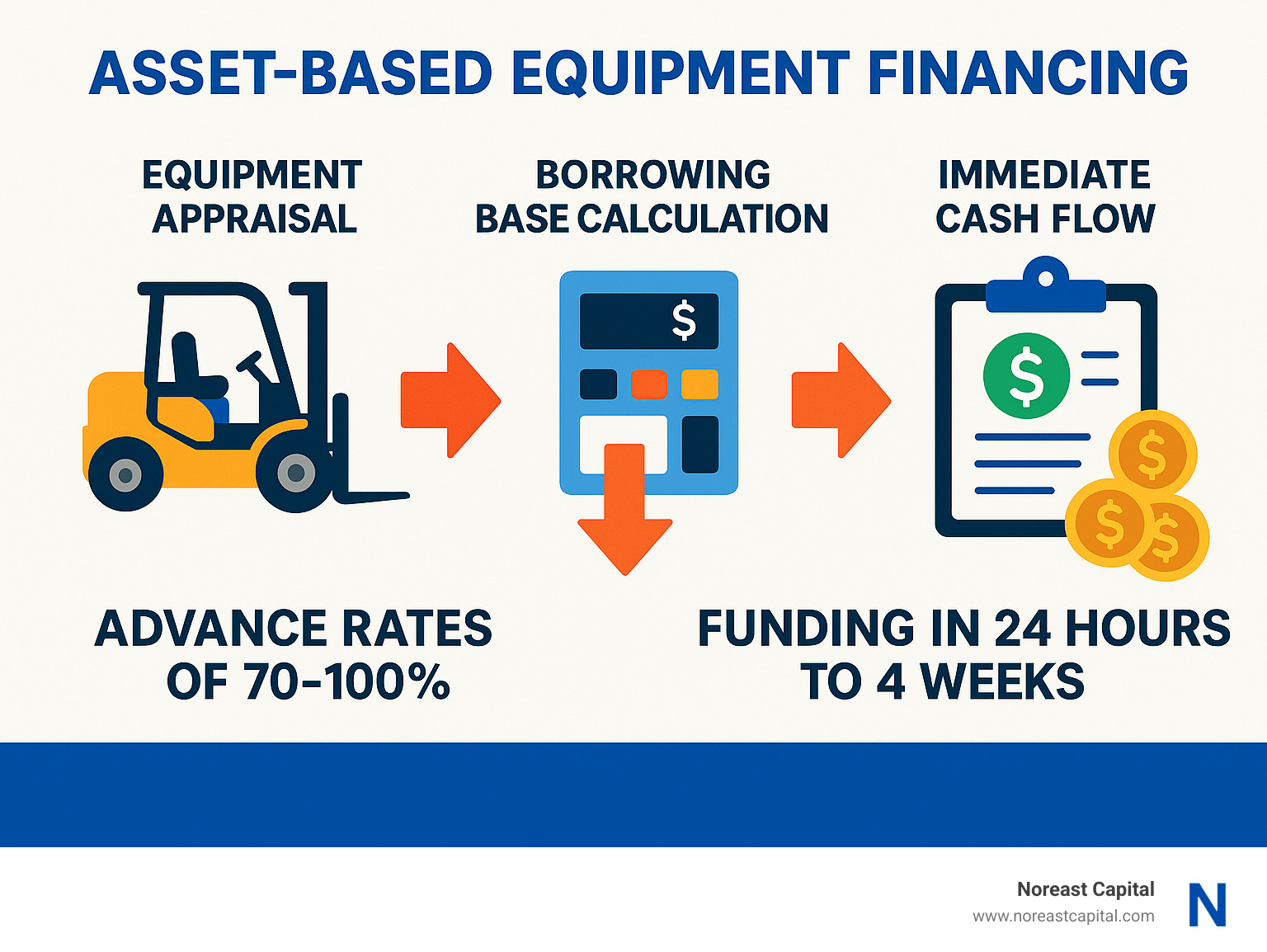
The magic happens through something called a “borrowing base.” This is simply the maximum amount you can borrow based on what your equipment is actually worth. Lenders look at your machinery, vehicles, and other business assets, then offer you advance rates typically ranging from 70% to 100% of the equipment’s appraised value.
Here’s what makes this approach so different from traditional business loans: your equipment’s value matters more than your monthly cash flow statements. Had a rough quarter? No problem. Seasonal business that’s slow right now? We get it. Your equipment still has value, and that value can open up the capital you need.
According to scientific research on small-business lending, asset-based lending has become increasingly important for businesses that don’t fit the traditional lending box. It’s particularly helpful when you need money fast or when your cash flow doesn’t tell the whole story of your business’s strength.

What Is Asset Based Equipment Financing?
Asset based equipment financing is secured credit that uses your business equipment as collateral. Instead of crossing your fingers and hoping your credit score impresses the bank, you’re showing them something real – the valuable machinery that keeps your business running.
The beauty of this approach is its simplicity. Your equipment has value whether you bought it yesterday or five years ago. That construction crane, medical imaging equipment, or fleet of delivery trucks represents real dollars that can be converted into working capital.
This isn’t about giving up your equipment – you keep using everything just like before. The equipment simply serves as security for the loan, kind of like how your car secures an auto loan. You can choose between a term loan for a specific amount or a lease arrangement, depending on what makes the most sense for your business.
This financing method works especially well for businesses with substantial equipment investments but unpredictable cash flows. Construction companies dealing with seasonal work, manufacturers with long production cycles, or transportation businesses managing fuel cost swings often find this approach much more practical than traditional lending.
How It Works: From Appraisal to Funding
The asset based equipment financing process is surprisingly straightforward once you understand the steps. We’ve streamlined it to get you from application to funding as quickly as possible.
The Field Exam
First, we send a qualified appraiser to your location for what’s called a field exam. This isn’t some intimidating audit – it’s simply a professional taking inventory of your equipment. They’ll document the make, model, year, and condition of each piece, plus take photos and note any maintenance history you can provide.
Professional Appraisal Process
The appraiser determines several different values for your equipment. The liquidation value (what it would sell for quickly) usually matters most to lenders, but they also look at fair market value and orderly liquidation value. These different metrics help establish exactly how much your equipment could secure.
Creating Your Borrowing Base Certificate
Once we have the appraisal, we calculate your borrowing base – essentially your equipment’s lending power. Most lenders offer advance rates of 80-90% for machinery and equipment based on orderly liquidation value, 70-85% for vehicles, and 50-70% for highly specialized equipment that might be harder to resell.
Funding Timeline
Here’s where asset-based lending really shines. Since we’re secured by tangible collateral, we can move fast. Non-bank lenders like Noreast Capital can often fund within 24-48 hours once documentation is complete. Traditional banks typically take 2-4 weeks, while complex transactions might need 3-6 weeks.
The entire process usually takes 10 days to 3 weeks from start to finish, depending on how complex your equipment portfolio is and how quickly you can gather the required documentation.
Collateral, Eligibility & Terms
When it comes to asset based equipment financing, the variety of assets lenders accept might surprise you. While many business owners think only about their biggest machines, modern asset-based lenders look at your entire equipment portfolio as potential collateral.
The beauty of this approach is that your business likely has more borrowing power than you realize. That fleet of delivery trucks, your office computers, even specialized software licenses – they all have value that can be converted into working capital.
Types of Assets Accepted as Collateral
Construction and heavy equipment typically get the royal treatment from lenders. Your excavators, bulldozers, cranes, and earth-moving machinery usually qualify for 75-85% advance rates. Why? These machines hold their value well and there’s always a strong market for quality construction equipment.
Transportation assets like semi-trucks, trailers, and delivery vehicles are also favorites among lenders, often receiving 70-80% advance rates. Fleet vehicles with good maintenance records and reasonable mileage get even better treatment. One trucking company owner told us, “I never realized my fleet was basically a rolling bank account.”
Manufacturing equipment presents interesting opportunities. CNC machines, production lines, and packaging equipment can qualify for solid rates, though specialized equipment might see 50-70% advance rates due to smaller buyer markets. The more common your equipment type, the better your advance rate typically becomes.
Medical and healthcare equipment has become increasingly attractive to lenders. Diagnostic equipment, surgical devices, and medical technology often qualify for competitive rates, especially newer equipment with strong manufacturer support.
Even technology and software can work as collateral now. Computer equipment, servers, and licensed software qualify, though advance rates vary based on how quickly technology becomes outdated.
Sale-leaseback arrangements offer perhaps the most attractive option: you can sell equipment you own outright to a lender and immediately lease it back, getting 80-100% of the equipment’s value in cash while keeping it for daily operations.
More info about Equipment Collateral Loans
Typical Advance Rates, LTV & Pricing
Understanding advance rates helps you estimate your borrowing power before you even apply. The loan-to-value (LTV) ratios vary significantly depending on who you work with and what equipment you’re using as collateral.
Bank equipment loans typically offer 50-80% LTV ratios with more conservative pricing. Non-bank asset-based lenders often provide 70-100% LTV ratios, while specialized equipment lenders sometimes go up to 100% for select equipment categories.
Interest rates follow a similar pattern. Bank equipment loans usually range from 6-17% APR, while alternative asset-based lenders typically charge 12-40% APR. The higher rates from alternative lenders often come with faster approval times and more flexible requirements.
Term lengths give you flexibility to match payments with your cash flow. Short-term financing runs 12-36 months for quick needs, standard equipment loans span 24-72 months, and heavy equipment financing can extend up to 7 years for substantial assets.
Here’s something many business owners miss: longer terms often mean lower APRs, but this varies based on your equipment type and the lender’s risk assessment.
Beyond interest rates, factor in origination fees (typically 1-5% of the loan amount), appraisal costs ($2,000-$10,000 for complex equipment portfolios), and ongoing monitoring fees for revolving facilities.
Eligibility Requirements & Underwriting Checklist
The good news about asset based equipment financing is that eligibility requirements are much more forgiving than traditional business loans. Lenders care more about what you own than your credit history or cash flow patterns.
Credit score requirements start surprisingly low. Alternative lenders accept FICO scores as low as 550, while traditional banks typically require 650+. Even recent bankruptcies might be acceptable if you have strong collateral backing the loan.
Revenue thresholds are also reasonable. Most lenders want to see minimum annual revenue of $150,000-$500,000 depending on the lender type. Your business needs at least 1 year of operating history, though seasonal businesses get evaluated on annual performance rather than monthly ups and downs.
The documentation process is straightforward but thorough. You’ll need your last 2-3 years of business tax returns, 3-6 months of bank statements, and current accounts receivable aging if applicable. Don’t forget equipment lists with serial numbers and acquisition dates, plus personal financial statements for guarantors.
Ongoing reporting keeps lenders comfortable and your credit line available. Expect to provide monthly borrowing base certificates, annual equipment appraisal updates, quarterly or annual financial statements, and insurance documentation to maintain lien positions.
The key advantage here is simple: asset-based lenders focus heavily on your collateral value rather than traditional cash flow metrics. This makes approval possible even with challenging credit histories or irregular revenue patterns that might stop traditional lenders in their tracks.
Asset-Based Equipment Financing vs. Other Funding Options
When you’re looking for business capital, you’ve got choices. Asset based equipment financing stands out from the crowd because it focuses on what you own rather than just your credit score or monthly revenue. Let’s break down how it compares to other funding options so you can make the best choice for your business.
The big difference comes down to what lenders care about most. Traditional lenders want to see consistent cash flow and perfect credit scores. Asset-based lenders? They’re more interested in the value of your equipment and how easily it could be sold if needed.
More info about Equipment Leasing vs. Financing
Asset-Based Equipment Financing vs. Cash-Flow Loans
Here’s where asset based equipment financing really shines compared to traditional cash-flow loans. With asset-based lending, you get a covenant-light structure – that’s fancy talk for “fewer rules about how you run your business.” Traditional loans often come with restrictions on everything from how much you can pay yourself to whether you can take on additional debt.
The approval process moves much faster too. While cash-flow lenders spend weeks analyzing your financial projections and historical performance, asset-based lenders focus on one key question: “What’s this equipment worth?” This means you can often get approved in days rather than weeks.
Higher loan amounts become possible because lenders base decisions on asset value rather than debt-service coverage ratios. If you own a $500,000 piece of equipment, you might qualify for $350,000-$400,000 in financing, regardless of whether your monthly cash flow would traditionally support that payment.
Cash-flow loans do have their place though. If you have stable, predictable revenue and excellent credit, you’ll typically pay 2-5% less in interest than with asset-based alternatives. These loans work great for established businesses with strong banking relationships and minimal equipment collateral.
When should you choose asset-based financing? If your revenue is seasonal, you’re growing rapidly, you’ve had recent credit challenges, or you own substantial equipment relative to your revenue, asset-based lending often makes more sense.
Asset-Based Equipment Financing vs. Equipment Leasing
The financing versus leasing decision affects more than just your monthly payment – it shapes your entire relationship with the equipment.
When you finance equipment, you own it immediately. Every payment builds equity, and you can take advantage of Section 179 deductions that let you expense the entire purchase price in the first year (subject to annual limits). Plus, you might qualify for bonus depreciation that gives you additional first-year tax benefits.
Leasing takes a different approach. You get lower monthly payments because you’re not paying down the full purchase price, just the depreciation during your lease term. Lease payments are fully deductible as operating expenses, but you don’t get the ownership benefits.
At the end of a financed equipment loan, you own the equipment outright with no additional payments. With a lease, you’ll typically face a choice: buy the equipment for its residual value, return it, or start a new lease.
Choose financing when the equipment has a long useful life, you want the tax advantages of ownership, or you plan to use the equipment for many years. Choose leasing when technology changes rapidly (like computer equipment), you prefer keeping the asset off your balance sheet, or you want to avoid the risk of equipment becoming obsolete.
When to Choose a Sale-Leaseback
Sometimes the best funding solution involves equipment you already own. A sale-leaseback transaction lets you convert your equipment equity into immediate cash while keeping the equipment in your business.
Here’s how it works: You sell your existing equipment to a lender, then immediately lease it back. You get 80-100% of the equipment’s value in cash while continuing to use it exactly as before. There’s no operational disruption – your team keeps working with the same equipment they know.
This approach offers immediate liquidity when you need capital fast. Maybe you’re acquiring another business, managing seasonal cash flow challenges, or recapitalizing your debt structure. Sale-leasebacks often move faster than traditional refinancing options.
The trade-off is straightforward: you give up ownership in exchange for immediate cash and predictable monthly lease payments. Depending on how the lease is structured, it might also improve your financial ratios by moving the asset off your balance sheet.
Sale-leasebacks work best for debt recapitalization needs, acquisition financing, seasonal cash flow management, or when you want to optimize your equipment portfolio without disrupting operations.
More info about Equipment Sale Leaseback

Application Process & Growth Use Cases
Getting started with asset based equipment financing doesn’t have to feel overwhelming. Most lenders have simplified their processes dramatically, understanding that business opportunities don’t wait around for lengthy approval cycles.
Think of it like getting a mortgage, but faster and with your equipment doing the talking instead of just your credit score. The key is preparation – having your documentation ready can turn a month-long process into a week-long sprint.
More info about Business Equipment Loan Rates
Step-by-Step Application & Approval
Getting started is surprisingly straightforward. Most lenders begin with a simple online pre-qualification that takes about 15 minutes. You’ll share basic business information, list your equipment with rough values, and upload recent bank statements. Within 24-48 hours, you’ll know if you’re in the ballpark and what terms might look like.
The formal application phase digs deeper but stays focused. You’ll provide complete financial statements, detailed equipment schedules with serial numbers, and personal guarantor information. This isn’t busy work – lenders need this information to structure the best possible terms for your situation.
Here’s where things get interesting: the collateral evaluation. A professional appraiser visits your location to inspect your equipment firsthand. They’re not just checking if it runs – they’re evaluating condition, market demand, and what it would actually sell for in different scenarios. This typically takes 5-10 days but determines your borrowing capacity.
The underwriting and documentation phase brings everything together. Legal documents get prepared, insurance requirements are verified, and final terms are negotiated. Most lenders are flexible here – if something doesn’t work for your business, speak up.
Closing and funding happens fast once everything’s approved. Documents get signed, liens get filed, and funds hit your account. For simple transactions with established lenders, this can happen in 24-48 hours. More complex deals might take 2-4 weeks total, but that’s still faster than most traditional bank loans.
Strategic Uses & Industry Examples
Asset based equipment financing isn’t just about buying new equipment – it’s about open uping the value you’ve already built.
One manufacturing client used their $2.8 million CNC equipment portfolio to secure a $2.1 million revolving credit facility. Instead of buying more machines, they funded raw materials for a major automotive contract. Their equipment became their bank account, providing working capital exactly when they needed it.
Fleet-based businesses love this approach. A regional logistics company leveraged their truck fleet to fund both new vehicle purchases and expansion into adjacent markets. The beauty? They could draw funds as opportunities arose rather than guessing their needs upfront.
Acquisition financing gets creative with equipment collateral. Companies often use the target business’s equipment as collateral for the purchase itself, creating a self-funding acquisition structure that traditional lenders struggle to match.
Turnaround situations benefit enormously from equipment-based financing. When cash flow gets tight, your equipment value doesn’t disappear overnight. This provides breathing room for restructuring without selling assets you need to operate.
Seasonal businesses use equipment collateral to fund inventory builds. Construction companies finance equipment for project-specific needs. Healthcare practices upgrade medical equipment while preserving cash for operations. The applications are as varied as the businesses themselves.
Reporting, Covenants & Tax Considerations
The ongoing relationship with asset-based lenders is refreshingly straightforward. Monthly borrowing base certificates sound intimidating but are usually simple forms confirming your equipment location, condition, and insurance status. Think of it as a monthly check-in rather than an audit.
Annual appraisal updates keep your borrowing capacity current as equipment values change. This works both ways – if your equipment appreciates or you add valuable assets, your borrowing capacity can increase.
Financial reporting requirements are typically lighter than traditional loans. Quarterly or annual financial statements, tax returns when completed, and notification of significant changes. Asset-based lenders focus more on collateral protection than micromanaging your operations.
Covenant structures reflect this collateral-focused approach. You’ll maintain minimum liquidity (often $50,000-$250,000), keep comprehensive insurance with the lender as loss payee, and maintain your equipment in reasonable condition. That’s usually it – no complex financial ratios or operational restrictions.
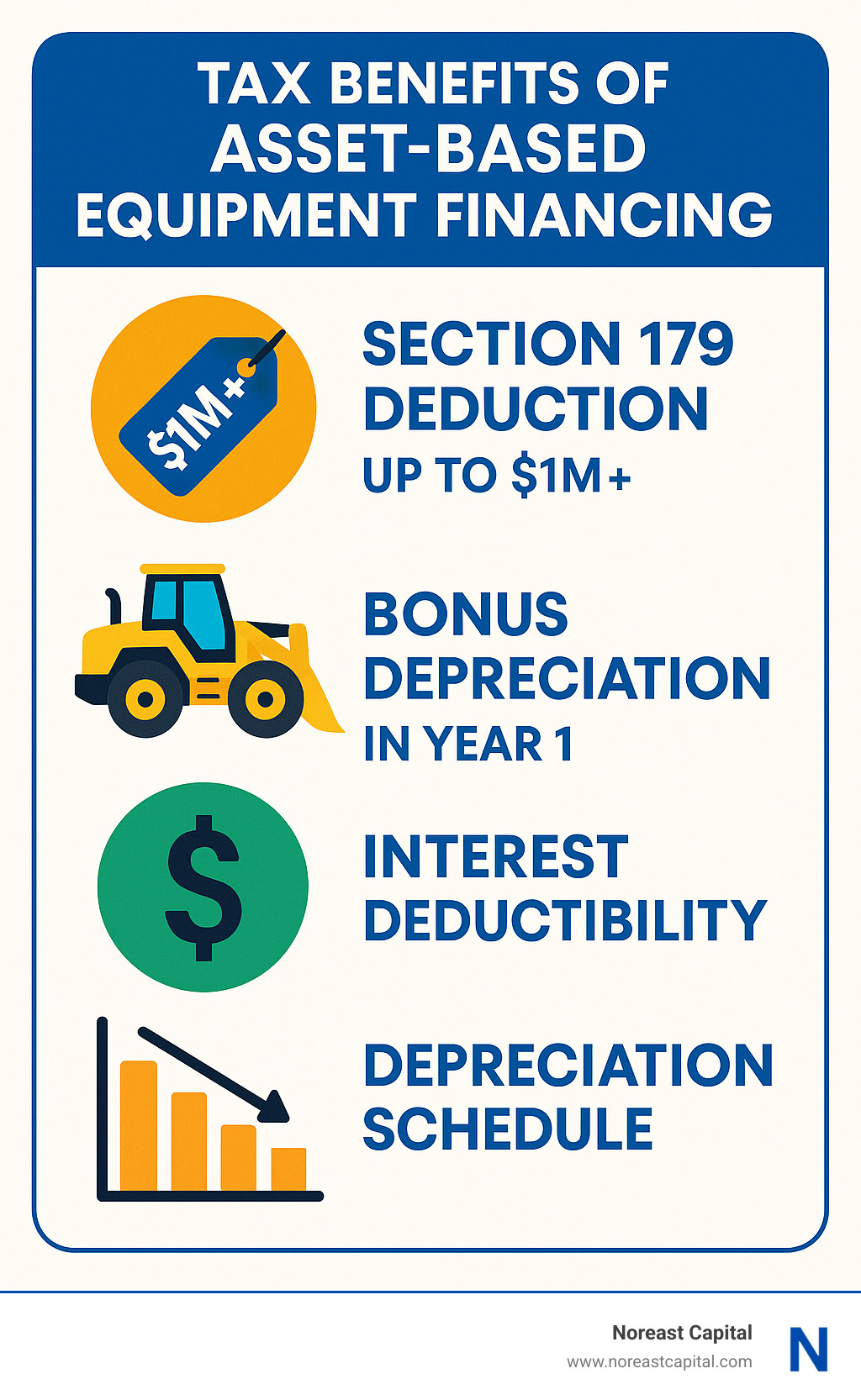
Tax benefits make equipment financing even more attractive. Section 179 deductions allow immediate expensing of equipment purchases up to over $1 million annually. Bonus depreciation can accelerate these benefits further. Interest payments are fully deductible as business expenses, reducing your effective financing cost.
Equipment depreciation follows normal tax schedules whether you finance or pay cash, so financing doesn’t hurt your tax position. In fact, the combination of immediate Section 179 benefits plus interest deductibility often makes financing more tax-efficient than cash purchases.
The bottom line? Asset based equipment financing provides both immediate capital access and ongoing tax advantages, making it a powerful tool for businesses with substantial equipment investments.
Frequently Asked Questions about Asset-Based Equipment Financing
Let’s address the most common questions we hear from business owners considering asset based equipment financing. These answers come from real conversations I’ve had with clients over the years, and they might help clear up some confusion you’re facing.
How fast can I get funded?
The short answer? It depends on who you’re working with and how prepared you are.
Non-bank lenders like us can often get you funded in 24 hours for straightforward equipment deals. We focus on what really matters – your equipment’s value – rather than getting bogged down in endless paperwork. When a construction company needs quick funding for a project that starts Monday, speed makes the difference between winning and losing the contract.
Traditional banks typically need 2-4 weeks to work through their approval process. They’re not necessarily slower because they want to be – they just have more committees, compliance requirements, and layers of approval. The trade-off is often lower interest rates if you qualify and can wait.
Complex transactions with multiple locations or equipment portfolios over $1 million might take 3-6 weeks regardless of the lender. These deals require extensive appraisals and legal documentation that simply takes time to complete properly.
Here’s the real secret to faster funding: preparation beats everything else. Have your financial documents ready, create detailed equipment lists with serial numbers, and know exactly how you’ll use the money. I’ve seen well-prepared applications get approved the same day, while incomplete ones drag on for weeks.
What happens if equipment value drops?
This is probably the question that keeps business owners up at night, and I understand why. Equipment values do fluctuate, but experienced lenders plan for this reality.
Most lenders use conservative valuations from the start. Instead of lending against optimistic fair market values, we typically use Orderly Liquidation Values – essentially what the equipment would sell for in a reasonable timeframe. This builds in a cushion against normal depreciation and market swings.
If values drop significantly, a few things might happen. Lenders may request a margin call – asking for additional collateral or partial loan repayment to maintain proper coverage ratios. It sounds scary, but it’s actually designed to protect both parties.
Annual appraisal updates might reduce your borrowing capacity if equipment has depreciated faster than expected. But here’s what many people don’t realize – most facilities allow you to substitute collateral. Bought new equipment? Great, add it to the borrowing base. Sold old machinery? We can adjust accordingly.
The best protection is simple: maintain your equipment properly and plan for normal depreciation. Equipment that’s well-maintained in a stable market rarely causes surprises that can’t be managed.
Can startups qualify?
Absolutely, though it’s not always straightforward. I’ve helped plenty of new businesses get the equipment financing they needed to grow.
Business age matters less when you have strong collateral. Most traditional lenders want 1-2 years of operating history, but asset-based lenders often care more about the equipment’s value and your ability to use it profitably.
Personal guarantees can open doors that business credit alone can’t. If you have strong personal credit and net worth, many lenders will work with startups, especially when substantial equipment secures the loan. I’ve seen brand-new companies get approved based on the founder’s track record and the quality of their equipment.
Industry experience counts for a lot. A startup led by someone with 20 years in construction will get different consideration than someone completely new to the business. Lenders want to know you understand how to make money with the equipment you’re financing.
Alternative lenders offer more flexibility for newer businesses. We’ve approved startups with credit scores as low as 550 when the equipment and business plan made sense. Sale-leaseback transactions can be particularly attractive for startups that already own equipment but need working capital.
The key is finding lenders who specialize in asset based equipment financing and understand that equipment value often tells a better story than limited operating history.
Conclusion
Your business equipment doesn’t have to just sit there earning dust. Asset based equipment financing transforms those machines, vehicles, and tools into a powerful source of working capital – all while keeping your operations running smoothly.
Think about it this way: that excavator in your yard, those delivery trucks in your fleet, or that manufacturing equipment on your factory floor represents real money. With the right financing partner, you can access 70-100% of that equipment’s value without selling a single asset or disrupting your daily operations.
The game-changing advantages we’ve covered include lightning-fast approval processes that focus on what you own rather than getting bogged down in complex financial projections. You get covenant-light structures that don’t tie your hands with operational restrictions. Plus, you can use the funds for whatever your business needs – whether that’s new equipment, seasonal inventory, or just keeping cash flow steady during busy periods.
The beauty of asset based equipment financing lies in its flexibility. Your construction company might use it to bridge seasonal gaps. Your manufacturing business could fund a major expansion. Your transportation company might leverage it for fleet upgrades without depleting cash reserves.
At Noreast Capital, we’ve seen how the right financing structure can change everything for a business. Our direct lending approach means we can move quickly when opportunities arise. Whether you’re in Annapolis, Baltimore, Washington DC, or anywhere else, we understand that timing matters when you’re trying to grow.
Here’s what really matters: Your equipment represents more than just tools for getting work done. It’s your pathway to financial flexibility and growth opportunities. In today’s economic climate, lenders increasingly recognize that tangible assets provide real security – something you can see, touch, and value accurately.
The smart business owners we work with understand this concept. They don’t let valuable equipment sit idle when it could be working double duty – supporting operations while also providing access to capital for strategic moves.
Your next growth phase might be closer than you think. That equipment you’re looking at right now? It could be the key to open uping the working capital you need to take your business to the next level.