

Benefits of leasing equipment for your business are substantial and often overlooked. As a business owner, you are constantly seeking ways to maintain cash flow, access the latest technology, and avoid the pitfalls of equipment obsolescence. Here’s a quick list of the advantages you can expect:
- Conserve Cash Flow: Lease instead of spend big and keep your finances healthy.
- Access to Latest Technology: Stay competitive without the hefty price tag.
- Flexibility and Scalability: Your lease adapts to your business needs.
- Tax Benefits: Enjoy possible tax deductions on your leased equipment.
- Streamlined Administration: Experience a hassle-free leasing process.
In a dynamic business landscape, equipment leasing can be a game-changer. This strategic financial tool not only supports growth but also empowers companies to remain on the cutting edge of their industries. Consider leasing as a powerful lever for business success, optimizing your resources efficiently.
My name is Vincent Cerniglia and at Noreast Capital Corporation, I’ve witnessed the transformative benefits of leasing equipment for your business. As a leader in equipment financing, we ensure customized, competitive leasing solutions that cater to firms of all sizes—from budding enterprises to Fortune 500 giants. Dive into equipment leasing and see how it aligns with your business goals.

Benefits of Leasing Equipment for Your Business
Leasing equipment offers several benefits for your business that can improve financial health and operational flexibility. Let’s explore how it can impact cash flow, provide tax benefits, and offer flexibility.
Improved Cash Flow
Leasing helps improve your business’s cash flow by spreading out the costs over time. Unlike purchasing, which often requires a large upfront payment, leasing allows you to pay in smaller, predictable installments. This means you can conserve your capital for other essential expenses like marketing or expansion.
By maintaining a steady cash flow, your business can remain financially stable even when unexpected expenses arise. This financial cushion can be crucial, especially in uncertain economic times.
Tax Benefits
Leasing equipment can offer significant tax advantages. Lease payments are typically considered a business expense, which means they are tax-deductible. This can lower your taxable income and reduce the amount of tax you owe at the end of the year.
Moreover, under the latest accounting standards, leases can also be listed as a liability on your balance sheet, similar to owned assets. This can positively impact your financial ratios and make your business more attractive to investors.
Flexibility
One of the standout benefits of leasing is its flexibility. Leasing allows you to upgrade or replace equipment as your business needs change. This adaptability is especially important in industries where technology evolves rapidly.
With leasing, you are not tied down to outdated equipment. Instead, you can easily access cutting-edge technology, keeping your business competitive and efficient. This flexibility also extends to lease terms, allowing you to choose agreements that align with your business cycle and growth plans.
In summary, leasing equipment is more than just a financing option—it’s a strategic decision. By improving cash flow, offering tax advantages, and providing flexibility, leasing can propel your business forward, ensuring you remain agile and competitive in a market.
Conserve Cash Flow
Managing cash flow is crucial for any business, especially small ones. Leasing equipment can be a game-changer in this regard. Instead of making a hefty upfront payment, leasing spreads the cost into manageable monthly installments. This approach helps maintain your cash reserves, allowing you to invest in other essential areas like hiring staff or expanding your market reach.
Spread Payments
When you lease equipment, you pay over time rather than all at once. This setup provides a predictable expense, making it easier to budget and plan. Imagine needing new office computers. Instead of a large initial outlay, you can lease them, keeping your capital free for other needs.
Avoid Upfront Costs
Leasing eliminates the need for a significant upfront investment. This is particularly beneficial if you’re a startup or a business looking to scale quickly without depleting your cash reserves. By avoiding large initial expenses, you can direct funds towards growth opportunities such as marketing or product development.
Financial Stability
Leasing contributes to financial stability by maintaining a healthy cash flow. This stability is vital for handling unexpected expenses, like sudden repairs or market shifts. With a steady cash flow, your business can steer these challenges without financial strain.
In conclusion, leasing not only conserves cash but also improves your business’s financial resilience. By spreading payments, avoiding upfront costs, and ensuring financial stability, leasing provides a solid foundation for growth and success.
Hedge Against Equipment Obsolescence
In today’s world, technology evolves rapidly. For businesses, keeping up with these changes is crucial. One way to stay ahead is through leasing equipment, which offers a smart solution to combat obsolescence.
Technology Upgrades
Leasing allows you to access the latest technology without the burden of ownership. Imagine your business relies on high-tech machinery. Owning means you’re stuck with it until you can afford to replace it. But with leasing, you can upgrade to newer models as your lease term ends. This ensures you always have cutting-edge equipment at your disposal.
Competitive Edge
Staying competitive means having the best tools for the job. Leasing provides the flexibility to switch to new equipment as industry standards change. For example, if you’re in a tech-driven field, using outdated equipment could put you at a disadvantage. Leasing helps you maintain a competitive edge by ensuring your tools are always up-to-date.
“Leasing enables businesses to adapt quickly and efficiently to industry trends, keeping them at the forefront of their markets.”
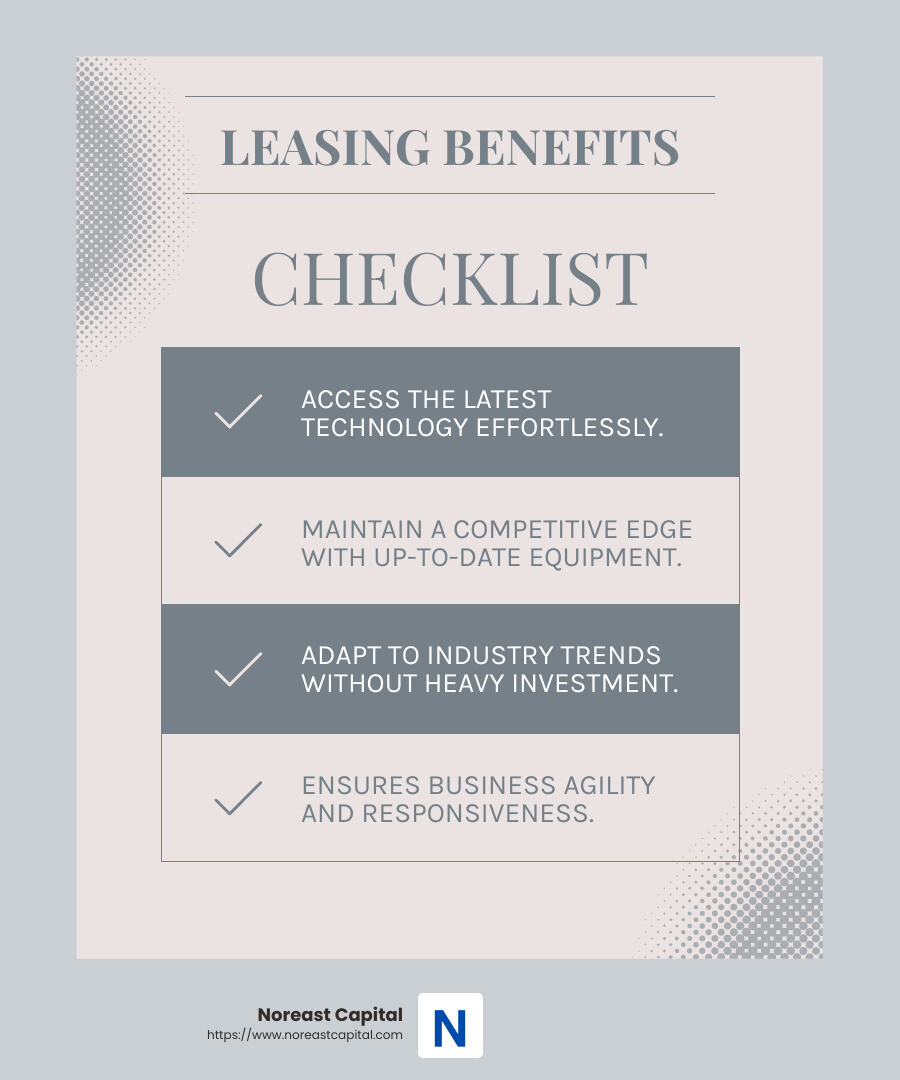
Industry Trends
Industries evolve, and so do their equipment needs. Leasing allows you to align with these trends without heavy investment. Whether it’s eco-friendly machinery or software with improved capabilities, leasing provides the flexibility to adapt to market demands. This adaptability is vital for businesses aiming to lead rather than follow.
In summary, leasing is a strategic approach to avoid the pitfalls of equipment obsolescence. By enabling technology upgrades, maintaining a competitive edge, and adapting to industry trends, leasing ensures your business remains agile and forward-thinking.
Strategic Flexibility and Scalability
In the ever-changing business landscape, leasing equipment offers best strategic flexibility and scalability. This approach allows businesses to adapt swiftly to market demands and improve operational agility.
Adaptability
Leasing provides the adaptability your business needs to stay ahead. Imagine your company is experiencing rapid growth or a shift in market trends. Buying equipment ties you down, but leasing lets you adjust quickly. Need more machinery during peak seasons? Lease it. Need less during slow times? Return it. This flexibility ensures you’re never overextended.
Market Demands
Market demands can be unpredictable. Leasing equips your business with the tools required to meet these demands without the burden of ownership. For instance, if a new technology emerges that could boost your efficiency, leasing allows you to integrate it into your operations immediately. This responsiveness is crucial in industries where staying current is essential for success.
Operational Agility
Operational agility is about making quick decisions and implementing them with ease. Leasing supports this by eliminating long-term commitments. With leases often ranging between 12 to 36 months, you can reassess your equipment needs at the end of each term. If your business strategy changes, you can pivot without the hassle of selling outdated assets.
“Leasing empowers businesses to be nimble and responsive, ensuring they can seize opportunities as they arise.”
Furthermore, leasing simplifies the process of scaling operations. Whether you’re expanding to new locations or ramping up production, leasing provides the resources you need without a massive upfront investment. This scalability is key for businesses looking to grow efficiently and sustainably.
In conclusion, leasing is not just about accessing equipment; it’s about creating a business model that thrives on adaptability, meets market demands, and improves operational agility.
Tax and Accounting Advantages
When considering the benefits of leasing equipment for your business, tax and accounting advantages stand out prominently. Leasing provides several financial perks that can significantly impact your bottom line.
Deductible Expenses
One of the primary tax benefits of leasing equipment is that lease payments are generally treated as tax-deductible operating expenses. This means you can deduct these payments from your taxable income, which reduces your overall tax liability. For many businesses, this is a straightforward way to decrease taxable income and improve cash flow.
Financial Ratios
Leasing can also improve your financial ratios. Since leased equipment does not appear as a capital asset on your balance sheet, it keeps your liabilities lower. This can improve key financial ratios, such as the debt-to-equity ratio, making your business more attractive to investors and lenders. Better financial ratios can lead to more favorable borrowing terms and increased investment opportunities.
Tax Strategy
Strategically, leasing allows businesses to plan their tax obligations more effectively. By treating lease payments as operating expenses, you can align your tax strategy with your business goals. This approach provides more control over how and when you incur expenses, allowing for better financial planning and forecasting.
“Leasing not only supports daily operations but also serves as a strategic tool in long-term tax planning.”
Leasing offers a dual advantage: it supports operational needs while optimizing tax strategy. This can be a game-changer for businesses aiming to maintain financial stability and pursue growth opportunities.
With these tax and accounting advantages, leasing becomes more than just an equipment solution—it becomes a vital part of a strategic financial plan.
Access to Newer Technology
Staying ahead in today’s world means keeping up with the latest technology. Leasing equipment for your business is a smart way to ensure you have access to the newest tools without breaking the bank.
Innovation and Modern Equipment
When you lease, you can regularly upgrade to the latest models. This is crucial for businesses that rely on cutting-edge technology. Imagine a small medical practice that leases advanced diagnostic devices. With each lease renewal, they can switch to the latest equipment, ensuring they provide top-notch service to their patients.
This approach not only keeps your business competitive but also boosts your reputation as a leader in innovation.
Technological Advancement
Leasing allows businesses to adapt quickly to technological advancements. For example, a manufacturing firm can lease the latest software for inventory tracking and production planning. This means they can operate more efficiently and respond to market changes swiftly.
“Leasing gives us the flexibility to upgrade our technology without the huge upfront costs,” says a business owner from Annapolis, MD.
This flexibility is vital for businesses that need to pivot quickly in response to industry trends or customer demands.
Competitive Edge
Having access to modern equipment gives your business a competitive edge. For instance, a restaurant that leases the latest kitchen appliances can serve customers faster and more efficiently than competitors still using outdated equipment.
In the business world, speed and efficiency often make the difference between success and failure.
With leasing, you don’t just keep up with the competition—you set the pace. By embracing this strategy, your business can thrive in an changing technological landscape.
Simplify Administration
Leasing equipment for your business not only provides access to the latest technology but also simplifies the administrative process. Let’s explore how easy application, seamless approval, and efficient management make leasing a hassle-free experience.
Easy Application
The process of applying for an equipment lease is designed to be straightforward. Noreast Capital makes it simple by requiring minimal documentation, especially for smaller leases. For amounts under $50,000, the application is often just a one-page form. This means less paperwork and more time for you to focus on your business.
Seamless Approval
Once you’ve submitted your application, the approval process is quick and efficient. Depending on the size of your lease, you might receive an answer within a few hours to a few business days. This speed is especially beneficial for businesses that need equipment fast to meet operational demands.
“Our application was approved in just a day, and we had the equipment delivered by the end of the week,” shares a business owner from Baltimore, MD.
This kind of responsiveness can be crucial when you’re looking to seize new business opportunities or manage unexpected challenges.
Efficient Management
Managing leased equipment is simpler than owning it. With leasing, maintenance and repairs are often the responsibility of the lessor, reducing the burden on your administrative team. Additionally, lease terms can be custom to match your business’s operational needs, allowing for easy adjustments as your business grows.
This streamlined management approach means less time spent on logistics and more time dedicated to core business activities.
In summary, leasing not only keeps your business equipped with the latest technology but also makes the entire process easy and efficient. With a simplified administrative burden, you can focus on what truly matters—growing your business.
Frequently Asked Questions about Equipment Leasing
What are the tax benefits of leasing equipment?
Leasing equipment offers significant tax advantages for businesses. The monthly lease payments are often considered deductible operating expenses, which can lower your taxable income. This deduction can result in substantial tax savings, making leasing an attractive option for businesses looking to optimize their tax strategy.
Additionally, leasing agreements can help manage your balance sheet. Since lease payments are treated as operating expenses, they don’t count as liabilities. This can improve your financial ratios, making your business more appealing to potential investors or lenders.
How does leasing improve cash flow?
Leasing is a smart financial strategy for conserving cash flow. Instead of a large upfront expense required for purchasing equipment, leasing allows you to spread costs over time. This means you make smaller, predictable payments each month, which can be easier to manage within your budget.
By avoiding large expenses upfront, your business retains more cash on hand. This financial flexibility ensures you have funds available for other critical investments or unexpected costs. With better cash flow management, your business can maintain financial stability and be prepared for future growth opportunities.
Why choose leasing over buying?
Leasing offers several compelling reasons over buying equipment outright. One of the primary benefits is flexibility. Leasing contracts can be custom to suit your business needs, allowing you to upgrade to newer models or different equipment as technology advances or your business evolves.
Moreover, leasing provides obsolescence protection. In industries where technology changes rapidly, owning equipment can lead to obsolescence, leaving you with outdated tools. Leasing ensures you always have access to the latest technology without the burden of disposing of old equipment.
In summary, leasing equipment is not just about acquiring tools—it’s a strategic decision that supports financial health, operational flexibility, and technological advancement.
Conclusion
In the world of business, making strategic decisions is crucial for success. Choosing to lease equipment with Noreast Capital is one such decision that can propel your business forward. By opting for leasing, you’re not just acquiring equipment but setting the stage for sustained growth and adaptability.
Leasing allows you to conserve cash flow, which is vital for maintaining financial stability and seizing new opportunities. You avoid hefty upfront costs and benefit from predictable monthly payments, giving you the financial flexibility to invest in other areas of your business.
Moreover, leasing provides access to the latest technology, keeping your business at the forefront of innovation. With Noreast Capital, you have the freedom to upgrade your equipment as needed, ensuring you remain competitive without the risk of obsolescence.
Our commitment to simplifying the leasing process means you can focus on what truly matters—growing your business. From easy applications to seamless approvals, we make equipment leasing an efficient and hassle-free experience.
Partnering with Noreast Capital is more than a financial decision; it’s a strategic move towards long-term business success. By leveraging the benefits of leasing equipment for your business, you position yourself to adapt, innovate, and thrive in an ever-changing market.
Ready to explore how equipment leasing can benefit your business? Find more with Noreast Capital. Let us help you open up your business’s full potential.