

Why Upfront Payment Clarity Matters for Your Business
A business equipment finance calculator is an online tool that estimates your monthly payments for equipment loans or leases by inputting the equipment cost, interest rate, loan term, and down payment. Here’s what you need to know:
Key Inputs Required:
– Equipment purchase price or invoice amount
– Down payment percentage (typically 0-30%)
– Financing term (usually 2-10 years)
– Interest rate or lease factor rate
– Residual value (for leases)
What You’ll Get:
– Monthly payment estimate
– Total interest cost
– APR comparison between loan and lease options
– Payment schedule breakdown
Making smart equipment decisions starts with knowing your numbers before you commit. Whether you’re eyeing a new delivery truck, manufacturing equipment, or office technology, understanding your monthly obligations protects your cash flow and prevents budget surprises.
The math behind equipment financing can feel overwhelming. Interest rates range from 4% to 45% depending on your credit and business profile. Lease payments use different calculations than loans. Factor rates, residual values, and APR comparisons add layers of complexity that most business owners don’t have time to decode.
But here’s the thing: getting clear payment estimates upfront helps you budget accurately, compare offers effectively, and negotiate better terms with confidence.
I’m Vincent Cerniglia, and I’ve helped thousands of businesses steer equipment financing decisions through our direct lending platform at Noreast Capital Corporation. Having worked extensively with business equipment finance calculators and financing solutions ranging from small startups to Fortune 500 companies, I’ll walk you through exactly how to use these tools to make informed equipment decisions.

What Is a Business Equipment Finance Calculator?
Picture this: you’re shopping for a new piece of equipment, and the salesperson starts throwing around monthly payment numbers. But are those numbers real? Can you actually afford them? That’s where a business equipment finance calculator comes in handy.
A business equipment finance calculator is essentially your financial crystal ball. It’s an online tool that takes the guesswork out of equipment financing by showing you what your monthly payments might look like before you sign anything. Think of it as test-driving the financial side of your equipment purchase.
The calculator works pretty simply. You plug in your equipment cost, how much you want to put down, how long you want to finance it, and what interest rate you might qualify for. Then it crunches the numbers and spits out your estimated monthly payment, total interest cost, and sometimes even a full payment schedule.
The beauty is in the planning. Instead of walking into a financing deal blind, you can budget accurately and compare different scenarios from the comfort of your office. Want to see how much you’d save with a bigger down payment? Just change the number and watch the magic happen.
Benefits of a Business Equipment Finance Calculator
The biggest win? You save tons of time. Remember the old days of calling lender after lender for quotes? Those days are gone. Now you can test dozens of scenarios in the time it used to take to make one phone call.
The accuracy is pretty impressive too. Modern calculators use real market data and current lending standards. While they’re still estimates, they’re typically spot-on within 5-10% of what qualified borrowers actually get quoted. That’s close enough to make real business decisions.
But here’s my favorite part: scenario testing becomes a breeze. Smart business owners run multiple “what-if” situations. What happens if you finance for three years instead of five? How much does that extra equipment add-on really cost per month? The calculator lets you explore all these options without any pressure or commitment.
Common Mistakes with a Business Equipment Finance Calculator
Here’s where things get tricky. Many people use unrealistic interest rates. Those “starting at 4.99%” rates you see online? They’re usually for borrowers with perfect credit and established businesses. Most equipment loans actually run between 7% and 20%, so be honest about where your credit stands.
Don’t forget about fees – this trips up almost everyone. The calculator might show a clean $500 monthly payment, but real financing includes origination fees, documentation charges, and sometimes monthly administrative costs. These can add 1-6% to your total loan amount.
For lease calculations, skipping the residual value is a costly mistake. This is what the equipment will be worth when your lease ends, and it has a huge impact on your monthly payment. If you leave this blank or guess wrong, your actual payment could be way off. Most equipment holds about 10-30% of its original value after a typical lease term.
The good news? Once you know these pitfalls, calculators become incredibly powerful tools for making smart equipment decisions.
Step-by-Step: Using the Calculator Like a Pro

Getting accurate results from a business equipment finance calculator is like baking a cake – the quality of your ingredients determines your final outcome. Let me walk you through the process that consistently gives our clients the most reliable payment estimates.
Gathering the Right Numbers First
Before you even open a calculator, you need three essential pieces of information. First, get your equipment invoice or quote. Real equipment costs beat guesswork every time. If you’re still shopping around, manufacturer MSRP works as a starting point, but actual purchase prices often come in lower after negotiations.
Next, you’ll want to know your credit range honestly. Your credit score isn’t just a number – it’s the key that open ups your interest rate. Business credit scores above 680 typically qualify for prime rates between 7-12%. If you’re sitting between 600-679, expect rates around 12-20%. Below 600? You’re looking at 20%+ rates, but don’t panic. Equipment loans are often easier to qualify for because the equipment itself serves as collateral.
Finally, have your business revenue ready. Most lenders will finance 80-100% of equipment value, but your annual revenue determines how much monthly payment you can handle. Here’s a helpful guideline: your monthly equipment payments shouldn’t exceed 10-15% of your monthly gross revenue.
Interpreting the Results Screen
When you hit that calculate button, you’ll see several numbers staring back at you. The monthly payment is your main budgeting number – this typically covers principal and interest only. You might have separate insurance, maintenance, or property tax obligations on top of this.
The total interest shows exactly how much extra you’ll pay beyond the equipment cost. For example, financing $50,000 worth of equipment at 10% over 5 years means you’ll pay roughly $13,500 in interest. That number helps you understand the true cost of financing versus paying cash.
Some calculators also show an amortization summary – a fancy term for how much of each payment tackles principal versus interest. Early payments are mostly interest, while later payments chip away at more principal. This breakdown helps if you’re planning to pay off the loan early.
Fine-Tuning Scenarios With a Business Equipment Finance Calculator
Here’s where the real magic happens. Smart business owners run sensitivity analysis – testing how small changes affect their bottom line. Moving from a 5-year term to 4 years might only bump your monthly payment by $100, but could save you thousands in total interest.
If you expect strong cash flow down the road, explore early payoff scenarios. See how extra principal payments affect your total cost. Most equipment loans allow prepayment without penalties, so this flexibility can save you serious money.
Don’t overlook balloon payment options either. Some calculators let you test large final payments, which reduce your monthly costs but require planning for that bigger payment at the end.
More info about Equipment Finance Calculator
Loan vs. Lease: How Do Payments Differ?

Here’s something that trips up many business owners: equipment loans and leases calculate payments completely differently. When you’re using a business equipment finance calculator, understanding these differences helps you make smarter choices for your cash flow.
Equipment loans work like buying a car – you’re borrowing money to purchase equipment outright. From day one, you own that forklift, printing press, or delivery truck. You can paint it purple, modify it however you want, and every payment builds equity in an asset you own.
Equipment leases are more like a long-term rental agreement. The leasing company owns the equipment while you use it. At the end of your lease term, you typically have options to buy it, return it, or lease something newer.
The payment difference can be eye-opening. Lease payments are often 10-30% lower than loan payments for the same equipment. But here’s the catch – lower monthly payments don’t always mean lower total costs.
| Factor | Equipment Loan | Equipment Lease |
|---|---|---|
| Ownership | Immediate | At lease end (with purchase option) |
| Monthly Payment | Typically higher | Often 10-30% lower |
| Total Cost | Principal + interest | All payments + purchase option |
| Tax Treatment | Depreciation deductions | Payments often fully deductible |
| Customization | Unlimited | Requires lessor approval |
Calculating Equipment Loan Payments
Equipment loan calculations follow the same math as any installment loan. Your business equipment finance calculator takes three main numbers and runs them through a standard formula.
The principal amount is your equipment cost minus whatever down payment you make. The interest rate gets divided by 12 to create your monthly rate. The term length tells the calculator how many monthly payments to spread everything across.
Let’s say you’re financing $100,000 worth of equipment at 8% interest over 5 years. Your monthly payment would be about $2,028. Over the full term, you’d pay $121,660 total – that’s $21,660 in interest.
But here’s where equipment loans get interesting: Section 179 tax benefits can dramatically improve your real cost. You might be able to deduct the entire equipment purchase in the first year, up to $1,160,000 for 2023. That tax savings can make the higher monthly payments much more attractive.
Scientific research on Section 179 deduction
Calculating Lease Payments & Rate Factors
Lease calculations use completely different math that can seem confusing at first. Instead of simple interest rates, leases use something called a money factor – think of it as an interest rate’s quirky cousin.
The money factor looks like a tiny decimal (something like 0.003), but you can convert it to a familiar APR by multiplying by 2,400. So that 0.003 money factor equals about 7.2% APR.
Residual value is the other big piece. This is what the leasing company thinks your equipment will be worth when your lease ends. Higher residual values mean lower monthly payments because you’re only “using up” part of the equipment’s value.
Here’s how it works with that same $100,000 equipment: if the residual value is $30,000 after 5 years with a 0.003 money factor, your monthly payment drops to around $1,467. That’s $561 less per month than the loan payment.
The trade-off? You don’t own anything at the end unless you exercise a purchase option, which typically costs that residual value amount.
More info about Equipment Leasing Calculator
Five Key Factors That Change Your Monthly Payment
Think of your monthly payment like a recipe – change any ingredient, and you change the final result. Understanding these five key factors helps you tweak your financing to fit your budget perfectly.
Interest rates pack the biggest punch. A seemingly small 2% difference on a $100,000 five-year loan changes your monthly payment by about $190. That’s over $2,200 per year! This is why shopping around matters so much. We see rate spreads of 5-8% between lenders for the same borrower.
Term length works like a see-saw – longer terms bring down monthly payments but push up total costs. Stretching from five years to seven years might cut your monthly payment by 25%, but you’ll pay roughly 30% more in total interest. It’s the classic trade-off between cash flow today and total cost tomorrow.
Down payments give you immediate relief. Every dollar you put down reduces your financed amount dollar-for-dollar. A 20% down payment on $100,000 equipment drops your monthly payment by roughly $400. Plus, larger down payments often open up better interest rates.
Residual values (for leases) act like a crystal ball prediction. Set a higher residual value, and your monthly payments drop significantly. But remember – you’ll pay more if you decide to buy the equipment at lease end. Conservative residuals protect you from nasty surprises.
Fees and add-ons are the sneaky budget busters. Origination fees, extended warranties, and insurance can quietly add 5-15% to your total cost. When you’re using a business equipment finance calculator, don’t forget to include these extras for realistic payment estimates.
Comparing Offers From Different Lenders
Here’s where many business owners trip up: they focus only on the interest rate and miss the bigger picture.
APR tells the real story because it includes fees along with the interest rate. A loan at 8% with 3% origination fees often costs more than a 9% loan with no fees. Always compare APRs, not just rates.
Hidden costs love to hide in the fine print. Documentation fees, early termination charges, and end-of-lease fees can add thousands to your total cost. Ask every lender for a complete fee breakdown before you decide.
Sometimes the total package matters more than the lowest rate. Faster approval times, better customer service, or more flexible terms might justify paying slightly more. We’ve seen businesses choose lenders based on their ability to close quickly when time-sensitive opportunities arise.
Qualifying Amounts & Typical Terms
Most equipment lenders finance 80-100% of your equipment’s value. Higher loan-to-value ratios mean you keep more cash in your business, but you’ll typically pay slightly higher rates for the privilege.
Equipment financing terms usually run 2-10 years, with most deals falling in the sweet spot of 3-7 years. Newer equipment often qualifies for longer terms since it holds its value better.
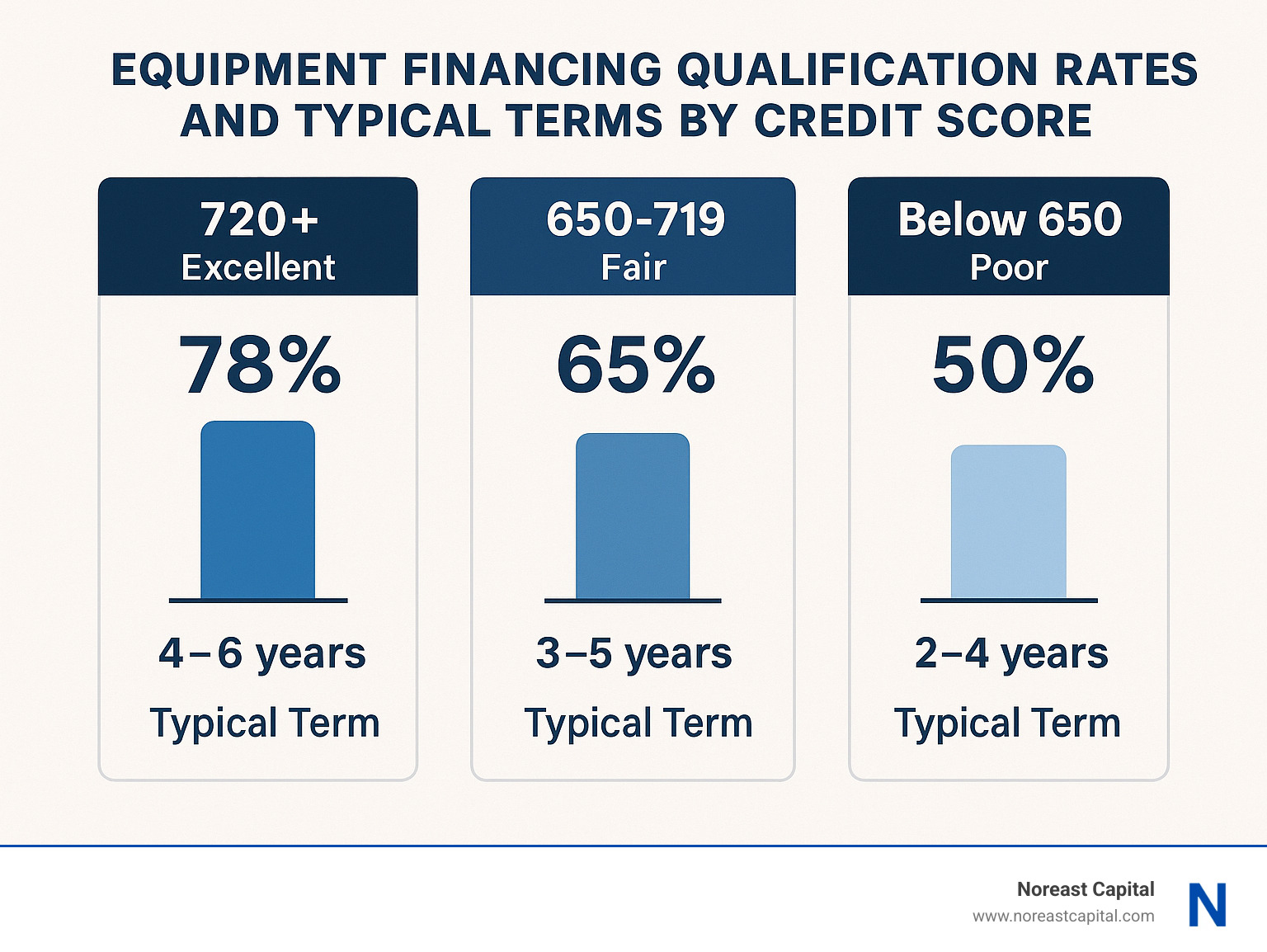
Your credit score determines which door you walk through. Prime borrowers with 720+ credit scores get the red-carpet treatment with the best rates and terms. Near-prime borrowers (650-719) see modest rate bumps but still access competitive financing. Even subprime borrowers (below 650) can often qualify because the equipment itself serves as collateral – though they’ll pay higher rates for the risk.
The beauty of equipment financing? It’s often easier to qualify for than unsecured business loans because lenders can repossess the equipment if things go sideways.
Frequently Asked Questions About Business Equipment Finance Calculators
Let’s tackle the most common questions we hear about using a business equipment finance calculator and what comes next in your financing journey.
How much can I qualify to borrow?
The short answer? Most lenders will finance 80% to 100% of your equipment’s value. But your actual qualification amount depends on your business’s financial health and cash flow capacity.
Here’s how lenders typically evaluate your borrowing power: They want your monthly equipment payments to stay under 10-15% of your monthly gross revenue. So if your business brings in $50,000 per month, you’d likely qualify for payments between $5,000 and $7,500 monthly.
Debt service coverage is another key factor. Lenders analyze whether your cash flow can comfortably handle new payments on top of existing debts. Most want to see a 1.25x coverage ratio – meaning your available cash flow should be at least 25% higher than all your debt payments combined.
The good news? Equipment serves as collateral, which makes approval easier than unsecured business loans. Even if your credit isn’t perfect, the equipment’s value backing the loan often helps you qualify when other financing might not work.
Are there tax advantages to leasing or financing?
Both options offer tax benefits, but they work differently depending on your business situation.
When you purchase equipment, Section 179 deductions let you write off the full equipment cost in the year you buy it – up to $1,160,000 in 2023. This immediate deduction can dramatically reduce your tax bill and improve your effective financing cost. Bonus depreciation may provide additional first-year benefits.
With equipment leases, your monthly payments are typically 100% tax-deductible as regular business expenses. This provides immediate cash flow relief, though you don’t build equity or qualify for depreciation deductions since you don’t own the equipment.
The bottom line? Purchases often provide better long-term tax benefits while leases offer superior short-term cash flow. Your accountant can help you determine which approach works best for your specific tax situation and business goals.
What steps come after the calculator?
Once your business equipment finance calculator gives you confidence in the numbers, here’s your roadmap to actual financing:
Documentation gathering comes first. You’ll need recent business financial statements, tax returns, bank statements, and equipment quotes or invoices. Having these ready speeds up the entire process.
Submit applications to 2-3 lenders to compare real offers against your calculator estimates. Most lenders provide pre-qualification within 24-48 hours, so you’ll know quickly where you stand.
Review terms carefully when offers arrive. Compare APR, fees, prepayment options, and any equipment restrictions. The lowest rate isn’t always the best deal if it comes with expensive fees or restrictive terms.
Plan your funding timeline – most equipment financing closes within 1-2 weeks of approval. Coordinate with your equipment vendor to ensure smooth delivery timing and avoid storage fees or delays.
The calculator gets you started, but real financing brings your equipment plans to life. At Noreast Capital, we’ve streamlined this process to help businesses move from calculation to equipment delivery as smoothly as possible.
Conclusion
Making smart equipment financing decisions doesn’t have to feel like solving a complex math puzzle. A business equipment finance calculator gives you the power to see exactly what you’re getting into before you sign anything.
Think of it this way: you wouldn’t buy a house without knowing the monthly mortgage payment, right? The same logic applies to that new delivery truck, manufacturing equipment, or office technology your business needs.
The calculator is your starting point, not your finish line. It shows you realistic payment ranges, helps you compare loan versus lease options, and lets you test different scenarios without any pressure. Want to see how a bigger down payment affects your monthly costs? Curious about stretching the term to lower payments? The calculator gives you answers in seconds.
Here’s what really matters: accurate inputs lead to accurate results. Use your real credit score, factor in all fees, and don’t forget about residual values for leases. These details make the difference between helpful estimates and wishful thinking.
At Noreast Capital, we’ve watched thousands of business owners use these tools to make confident financing decisions. The ones who succeed share a common approach – they do their homework with calculators first, then work with experienced lenders to turn estimates into actual solutions.
Your next step is simple. Run your numbers through a calculator to understand your options. Then reach out to financing professionals who can provide real quotes based on your specific situation. The goal isn’t just getting equipment – it’s getting equipment in a way that supports your business growth and protects your cash flow.
More info about lease payment calculation
Ready to move forward? Start with our equipment finance calculator to explore your scenarios. When you’re ready for actual quotes and personalized guidance, our team is here to help you find financing solutions that make sense for your business. After all, the right equipment financing should feel like a stepping stone to growth, not a financial burden.