

Business Line of Credit: 7 Powerful Benefits in 2025
Why Cash Flow Gaps Keep Business Owners Up at Night
A business line of credit is a revolving credit facility that lets you borrow funds up to a preset limit, pay interest only on what you use, and access funds repeatedly as you repay the balance – like a credit card for your business.
Quick Answer for Business Line of Credit:
- What it is: Revolving credit up to a set limit (typically $10,000-$1,000,000)
- How it works: Draw funds when needed, pay interest only on borrowed amount
- Best for: Cash flow gaps, seasonal expenses, emergency funding
- Typical rates: Prime + 1.5% to 5% (secured) or 10-99% APR (unsecured)
- Requirements: 6+ months in business, $36,000+ annual revenue, 580+ credit score
Payday is coming up, but your biggest client hasn’t paid their invoice yet – will you be able to make payroll next week? This scenario hits close to home for many small business owners who face the constant challenge of uneven cash flow.
Unlike a traditional loan that gives you a lump sum upfront, a business line of credit works more like a financial safety net. You only draw what you need, when you need it. Interest accrues only on the funds you actually use – not on your entire credit limit.
Say you get approved for a $50,000 line of credit but only need $15,000 to cover a temporary cash shortfall. You’ll pay interest on just the $15,000, and as you repay that amount, your available credit replenishes for future use.
I’m Vincent Cerniglia, and through my work at Noreast Capital Corporation, I’ve helped countless businesses steer equipment financing and understand how a business line of credit can complement their funding strategy.
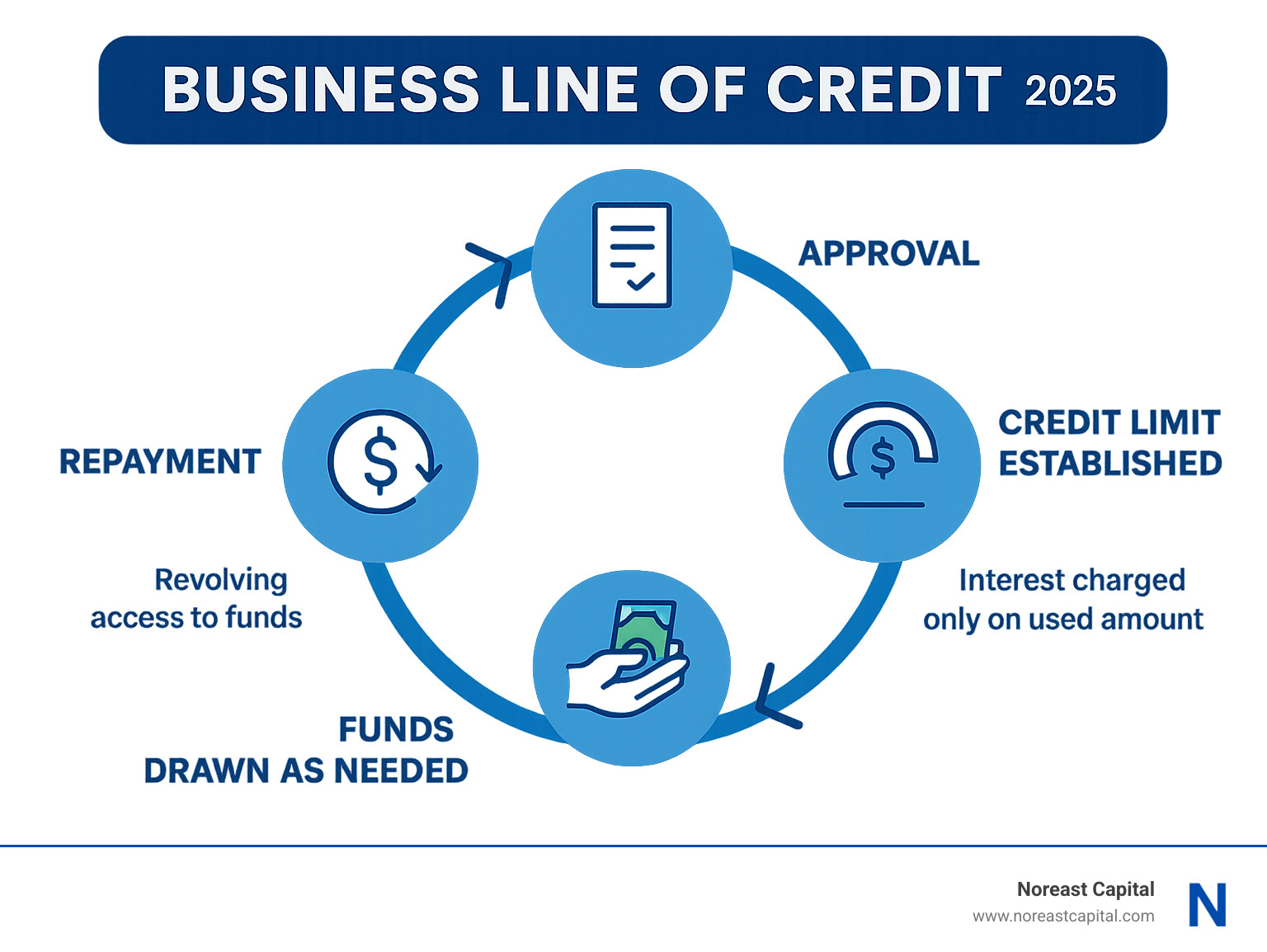
What Is a Business Line of Credit?
A business line of credit is a revolving credit account that gives your company access to funds up to a preset limit. Unlike a traditional loan that hands you a big check upfront and starts charging interest immediately, a line of credit just sits there quietly until you need it.
Here’s what makes it special: you only pay interest on the money you actually use. Got approved for $100,000 but only need $20,000 for seasonal inventory? You’ll only pay interest on that $20,000. The remaining $80,000 stays available as your financial safety net, costing you nothing.
The revolving nature means as you pay back what you’ve borrowed, that money becomes available to borrow again – no reapplication needed. Credit limits can range from $10,000 for newer businesses to well over $1 million for established companies.
How a Business Line of Credit Works
The draw, repay, redraw cycle is beautifully simple. You get approved for your credit limit, then access funds through online banking transfers, checks, wire transfers, or sometimes a dedicated business card.
Interest is calculated daily on only your outstanding balance. Borrow $15,000 on Monday, pay back $5,000 on Friday, and you’re only paying interest on $10,000 going forward.
Most lenders require only minimum monthly payments (often just the interest), but you can pay down principal whenever cash flow allows. Every dollar you repay immediately becomes available to borrow again.
Keeping your utilization ratio below 30% helps your credit score and often gets you better rates. Most business lines of credit come with variable interest rates tied to the prime rate.
Secured vs. Unsecured Business Line of Credit
Secured lines of credit require collateral – business equipment, real estate, inventory, or personal guarantees. The benefits are lower interest rates (often Prime + 1.5% to 3%), higher credit limits (sometimes up to $2 million), and generally more favorable terms.
Unsecured lines of credit don’t require collateral, but lenders charge higher interest rates (Prime + 3% to 10% or more) and offer lower credit limits (typically $50,000 to $250,000).
Even “unsecured” lines often require personal guarantees from owners with significant stakes in the business. The rate spread between secured and unsecured can be substantial – sometimes 2-5 percentage points difference.
Business Line of Credit Costs, Rates & Fees
Most lenders price their lines of credit as a spread over the prime rate. With prime rate trends around 8-9%, a typical Prime + 2% line of credit would cost roughly 10-11% annually on whatever you borrow.
The math gets interesting because you’re only paying interest on what you actually use. Borrow $20,000 from your $100,000 credit line, and you’re only paying interest on that $20,000.

Typical Interest Rates in Canada & the U.S.
In Canada, big banks like RBC and TD typically offer rates starting at Prime + 1.5% to 5%. Credit unions often price at Prime + 2% to 6%, while alternative lenders might charge 15% to 35% APR.
U.S. businesses see similar patterns. Traditional banks offer prime borrowers rates around Prime + 1.75% to 8%, while online lenders span 10% to 99% APR. SBA-backed lines through CAPLines programs might offer Prime + 2% to 6%.
Your personal and business credit scores carry the most weight in rate determination, followed by time in business, annual revenue, cash flow patterns, industry, and collateral. Secured lines backed by business equipment loan rates typically earn you a 1-3 percentage point discount.
Fee Checklist & Hidden Charges
The origination fee hits you upfront – usually 0.5% to 3% of your total credit limit. Annual or renewal fees of $50 to $500 keep the line active each year, while monthly maintenance fees of $25 to $125 tick away whether you use the line or not.
Some lenders charge a draw fee of $10 to $50 every time you access funds. Others hit you with an inactivity fee if you don’t use your line for several months.
Watch out for rate adjustment fees, documentation fees for changes, and wire transfer fees. Always ask for a complete fee schedule upfront and run the numbers based on how you plan to use the credit line.
Qualifying for and Applying to a Business Line of Credit
Most lenders want to see that you’ve been in business for at least 6 months to 2 years. Your annual revenue threshold typically starts around $36,000, though many lenders prefer $100,000 or more yearly.
Your credit score plays a huge role in both approval and pricing. While some alternative lenders work with scores as low as 580, you’ll get much better rates with 650 or higher.
Traditional banks often want 2+ years in business, six-figure revenues, and strong credit scores, but offer the best rates. Alternative lenders are more flexible with newer businesses and lower credit scores, but charge higher rates.
The SBA CAPLines program provides 85% loan guarantees for better rates. In Canada, the Small Business Financing Program offers similar support. If your business needs equipment alongside working capital, explore Equipment Finance for Startups.
Required Documents & Information
Lenders want financial statements – profit and loss statements, balance sheets, and cash flow statements. You’ll need tax returns for both your business and yourself – typically 2-3 years worth.
Bank statements from the last 3-6 months give lenders insight into your cash flow patterns. Have your Employer Identification Number (EIN) and basic business registration documents ready. If you have existing business debt, prepare a debt schedule.
Application Timeline & Funding Speed
Online lenders offer 15-30 minute applications, decisions within 48 hours, and funding within 1-3 business days.
Traditional banks require 1-2 hours for applications, decisions take 1-3 weeks, followed by 2-5 business days for funding.
Government-backed programs take 2-4 hours to complete applications, with decision timelines of 2-6 weeks.
If you already bank somewhere with a good relationship, many institutions offer instant online approvals for existing customers.

Managing Your Business Line of Credit Like a Pro
The real magic happens in how you manage your credit line day-to-day. Create a 13-week rolling forecast showing when cash will be tight and when it’ll flow freely. This helps you draw funds strategically and repay them quickly.
Think of your business line of credit as a financial safety net, not a permanent solution. The most effective users draw funds strategically and repay them quickly.
Consider setting up automatic sweeps between your operating account and credit line if available. When your checking account has extra cash, it automatically pays down your balance. When you need funds, they’re instantly available.
Common Uses & Best Timing
Seasonal businesses are natural fits – retailers building inventory before holidays or landscapers maintaining crews through winter.
Cash flow bridging might be the most common use. Your biggest client pays net-60 terms, but suppliers want payment in 30 days. A credit line smooths out these timing mismatches.
Opportunity purchases represent another sweet spot. When suppliers offer discounts for paying upfront and your credit line costs less than the discount percentage, the math works in your favor.
Emergency situations happen to every business. Having an established credit line means handling these professionally instead of scrambling for expensive emergency funding.
The golden rule: Apply when you don’t desperately need the money. Lenders respond with better rates when your business is performing well.
Pros, Cons & Risk Mitigation
The flexibility of a business line of credit is genuinely game-changing. Credit building happens naturally when you use your line responsibly, opening doors to better rates and higher limits.
But variable rates mean costs can jump when the Federal Reserve raises rates. The temptation factor is real – easy access can lead to lazy financial management.
Personal guarantees put your personal assets on the line, even with “unsecured” lines.
Smart risk management starts with setting internal limits below your actual credit limit. Monitor your utilization ratio below 30% to maintain strong credit scores. Track prime rate trends and budget for potential increases.
For equipment-heavy businesses, pairing your line of credit with Commercial Equipment Finance solutions can optimize your capital structure.
Comparing a Business Line of Credit to Other Financing Options

Term loans work best when you know exactly what you need the money for – like purchasing equipment or expanding facilities. You’ll often get lower interest rates, but you start paying interest on the full amount immediately. Predictable monthly payments make budgeting easier, but there’s no flexibility if needs change.
Business credit cards offer convenience and rewards but come with higher interest rates and lower credit limits – often maxing out around $50,000 to $100,000.
The real advantage of a business line of credit becomes clear with unpredictable cash flow. You pay interest only on what you actually use, when you use it.
When to Choose a Business Line of Credit Over a Loan or Card
A business line of credit shines when financing needs don’t follow predictable patterns. Seasonal fluctuations – like landscaping companies needing spring equipment cash but generating summer revenue – benefit from borrowing when needed and repaying when money flows.
The revolving benefit is huge for regular working capital needs. Wholesalers can draw funds for inventory purchases, pay them back as products sell, then draw again for the next cycle.
Cost-conscious business owners often prefer lines over credit cards because interest rates are typically 5-15 percentage points lower. For a $25,000 balance, that could save $1,250 to $3,750 annually.
Online & Government Programs vs Traditional Banks
Traditional banks offer the lowest rates – often Prime + 1.5% to 3% for secured lines – but approval can take weeks.
Online lenders have flipped the script on speed. What used to take weeks now happens in hours, with approval and funding within 48 hours. The trade-off is higher rates – often 15% to 35% APR.
Government-backed programs like SBA CAPLines offer middle ground with 85% guarantees reducing lender risk, translating to lower rates – typically Prime + 2% to 6%.
For businesses in equipment-heavy industries, consider how different financing options work together. A business line of credit handles short-term cash flow while specialized equipment loans tackle longer-term asset purchases.
Frequently Asked Questions about Business Lines of Credit
What credit score do I need?
Traditional banks typically want personal FICO scores of 650 or higher. Online lenders have opened doors for scores as low as 500 to 580, though you’ll pay higher rates.
Don’t forget business credit scores. Experian Intelliscore and D&B Paydex both use 1-100 scales, with scores above 75 considered strong. Your credit score gets you in the door and determines your rates and terms.
How much can I borrow?
Most lenders use annual revenue as a starting point:
Smaller businesses with under $500,000 in annual revenue usually qualify for $10,000 to $100,000 credit lines. Medium-sized businesses in the $500,000 to $2 million range often see $50,000 to $500,000. Larger businesses with over $2 million in revenue can access $250,000 to $1 million or more.
Secured lines typically offer higher limits because collateral reduces lender risk. Some lenders go up to $1 million unsecured for exceptionally qualified borrowers, though $250,000 is more realistic.
How does it affect my business credit?
Responsible use builds business credit beautifully. On-time payments create positive payment history, the biggest factor in credit scoring. You’re establishing valuable credit relationships and demonstrating creditworthiness.
Keep usage below 30% of your credit limit when possible. Late payments are credit killers, getting reported to business credit bureaus and damaging your rating for years.
Use your business line of credit responsibly, and it becomes a powerful tool for building credit that opens doors to better financing options.

Conclusion
A business line of credit serves as a financial bridge between your business’s cash flow realities and its operational needs. When managed properly, it provides the flexibility to seize opportunities, weather unexpected challenges, and maintain smooth operations without the burden of paying interest on unused funds.
The key takeaways for business owners considering this financing option:
- Apply early: Secure your credit line when your business is financially strong, not when you’re desperate for funds
- Understand the true costs: Look beyond interest rates to evaluate fees and total borrowing costs
- Use strategically: Draw only what you need and repay quickly to minimize costs
- Monitor your credit: Responsible use builds business credit, while poor management can damage it
- Consider alternatives: Ensure a line of credit fits your specific needs better than term loans or other financing options
At Noreast Capital, we understand that every business has unique financing needs. While we specialize in equipment financing solutions that help businesses acquire the tools they need to grow, we recognize that a comprehensive financial strategy often includes multiple funding sources working together.
Whether you’re considering a business line of credit for working capital or exploring equipment financing options, the key is matching the right financial tool to your specific business needs. A line of credit excels at managing cash flow fluctuations and providing financial flexibility, while equipment financing can help you acquire productive assets that drive business growth.
Ready to explore your financing options? Our team at Noreast Capital is here to help you steer the equipment financing landscape and find solutions that support your business goals. Contact us today for easy equipment financing that complements your overall financial strategy.