

When it comes to buying vs leasing equipment, understanding the fundamentals can make a significant impact on your business’s financial health:
- Buying Equipment:
- You own the equipment.
- Higher upfront costs.
- Long-term asset value.
Responsibility for maintenance and repairs.
Leasing Equipment:
- Lower upfront costs.
- No ownership (renting instead).
- Flexibility to upgrade.
- Maintenance may be included.
In the competitive world of business, the question of whether to own or lease equipment is crucial. Having the right equipment can mean the difference between thriving and surviving. But, with a myriad of choices available, deciding between buying and leasing can be daunting.
My name is Vincent Cerniglia from Noreast Capital. With a background in equipment financing and leasing solutions across numerous industries, I am well-versed in helping businesses steer the complex landscape of buying vs leasing equipment to make informed decisions.

Quick look at buying vs leasing equipment:
– advantages of leasing
– difference between financed and leased
– what is the difference between lease and finance
Understanding Equipment Leasing
When you’re running a business, managing your cash flow is critical. That’s where equipment leasing can offer a significant advantage. Instead of a hefty upfront payment, leasing spreads the cost over time. This preserves your cash for other essential expenses, like payroll or unexpected repairs.
Flexibility is another key benefit of leasing. Technology evolves rapidly, and leasing allows you to stay current without being stuck with outdated equipment. When your lease ends, you can upgrade to the latest models, ensuring your business stays competitive.

Leasing also brings tax benefits. Lease payments are often fully deductible as a business expense, which can lower your taxable income. This is different from buying, where you might only get deductions through depreciation over several years.
Obsolescence is less of a worry with leasing. If your industry relies on cutting-edge technology, leasing can prevent you from being stuck with obsolete tools. You can return or upgrade equipment at the end of the lease, keeping your business on the cutting edge.
Maintenance can be a significant cost when owning equipment. Many lease agreements include maintenance services, reducing the burden on your internal team. This means fewer unexpected repair bills and less downtime, allowing you to focus on what you do best.
In short, equipment leasing offers a blend of financial flexibility, tax advantages, and reduced risk of obsolescence. Whether you’re a small startup or an established business, leasing can be a strategic choice to keep your operations smooth and your finances healthy.
Next, we’ll dig into the benefits of buying equipment and how it compares to leasing in the long run.
The Case for Buying Equipment
When considering buying vs leasing equipment, ownership is a major factor. Purchasing equipment means you own it outright. This can be especially beneficial for items with a long useful life, like office furniture or industrial machinery. Unlike leased equipment, you can customize owned equipment to fit your specific needs without any restrictions.
Tax deductions are another important advantage. When you buy equipment, you may qualify for the Section 179 tax deduction. This allows you to deduct the full cost of qualifying equipment in the first year. As of 2024, you can deduct up to $1.22 million, making it a significant tax-saving opportunity for many businesses.
Owning equipment also provides long-term value. While leasing might seem cheaper initially, buying can be more cost-effective over time. Once the equipment is paid off, you no longer have monthly payments, which can lead to substantial savings. Moreover, you can resell the equipment if it’s still in good condition, recouping some of your investment.
However, it’s important to consider depreciation. Equipment loses value over time, especially technology that becomes outdated quickly. This means that by the time you’ve paid off your equipment, it might be worth much less than you paid. But for industries where technology doesn’t change rapidly, the depreciation might be less of a concern.
In summary, buying equipment can offer significant benefits, particularly in terms of ownership, tax savings, and long-term cost-effectiveness. However, it’s crucial to weigh these benefits against the initial costs and potential depreciation to decide if purchasing is the right choice for your business.
Next, we’ll explore the key considerations when deciding between buying and leasing equipment.
Buying vs Leasing Equipment: Key Considerations
When deciding between buying vs leasing equipment, several key factors come into play. Understanding these can help you make the best decision for your business.
Initial Costs
Buying equipment often involves higher initial costs. You might need a significant down payment or have to pay the full price upfront. This can strain your cash flow, especially if you’re a small business. In contrast, leasing typically requires lower upfront payments, which can be more manageable for businesses with limited capital.
Asset Ownership
Ownership is a significant factor. When you buy equipment, you own it outright, giving you complete control over its use. This can be advantageous if the equipment has a long lifespan or if you want to customize it. Leasing, however, means you don’t own the equipment, and at the end of the lease, you might have to return it unless you have a purchase option.
Upgrade Flexibility
Upgrade flexibility is another important consideration. Leasing allows you to upgrade to the latest technology at the end of the lease term. This is particularly beneficial for industries where technology rapidly evolves, ensuring you always have access to the newest innovations. Buying, on the other hand, can leave you with outdated equipment unless you invest in upgrades.
Financial Health
Your business’s financial health plays a crucial role in this decision. Leasing can preserve your cash flow by spreading payments over time, which might be beneficial if you need to allocate resources elsewhere. However, buying can be more cost-effective in the long run, as you eventually eliminate monthly payments once the equipment is paid off.
In summary, the decision between buying and leasing should be guided by your business’s financial situation, the nature of the equipment, and your long-term goals. Balancing these considerations will help you choose the best path forward for your business needs.
Pros and Cons of Leasing Equipment
Leasing equipment can be a smart choice for many businesses, especially those that want to preserve cash flow and stay flexible. However, it’s not without its drawbacks. Let’s break down the pros and cons of leasing equipment.
Pros of Leasing Equipment
Lower Upfront Costs
One of the biggest advantages of leasing is the lower initial financial burden. Unlike buying, which may require a large down payment or full purchase price upfront, leasing typically involves lower monthly payments. This can be a lifesaver for businesses that need to conserve cash for other expenses or investments.
Flexibility and Upgrades
Leasing often provides the option to upgrade to newer technology at the end of the lease term. This is particularly useful in industries where technology changes rapidly, as it allows businesses to keep up with the latest advancements without the hassle of selling old equipment.
Tax Benefits
Lease payments can often be deducted as a business expense, which could reduce your taxable income. This can make leasing a more attractive option from a tax perspective compared to buying, where only depreciation might be deductible.
Cons of Leasing Equipment
No Ownership
A major downside of leasing is that you don’t own the equipment. This means you cannot count it as a business asset, which might be a disadvantage if you need collateral for a loan. At the end of the lease, you might also face additional costs if you decide to purchase the equipment.
Potentially Higher Overall Costs
While leasing can be cheaper initially, it may end up costing more over the long term. Monthly payments add up, and you might end up paying more than the equipment’s purchase price by the end of the lease term.
Contractual Obligations
Leases come with agreements that might include restrictions on equipment usage. Breaking a lease early can result in penalties, and there may be fees for exceeding usage limits or not maintaining the equipment to specified standards. It’s important to understand these obligations before signing a lease agreement.
In conclusion, leasing equipment offers benefits like lower upfront costs and flexibility, but it also has downsides, such as no ownership and potential higher costs. Assessing these factors will help you determine if leasing aligns with your business strategy.
Pros and Cons of Buying Equipment
When it comes to acquiring equipment, buying offers its own set of advantages and challenges. Let’s explore the pros and cons of purchasing equipment for your business.
Ownership Benefits
Ownership is the most significant advantage of buying equipment. When you purchase, you gain a tangible asset for your business. This asset can be used as collateral if you need to secure a loan in the future. Moreover, owning equipment means you have full control over its use without any restrictions often found in lease agreements. You can modify, sell, or continue using the equipment as long as it remains functional.
High Initial Costs
However, buying equipment typically involves high initial costs. This can be a substantial financial burden, especially for small businesses. You might need to make a large down payment or pay the full purchase price upfront. If financing the purchase, interest rates can add to the total cost. It’s important to assess whether your business can handle these upfront expenses without disrupting cash flow.
Maintenance Responsibility
As the owner, you are responsible for all maintenance and repair costs. Unlike leasing, where maintenance might be covered by the leasing company, buying means these costs fall on your shoulders. Regular maintenance is crucial to keep the equipment in good working condition, which can also extend its useful life.
Depreciation
Another consideration is depreciation. Equipment can lose value over time due to wear and tear or technological advancements. This depreciation can impact the resale value if you decide to sell the equipment later. However, depreciation can also offer tax benefits. You might be eligible for deductions, such as the Section 179 tax deduction, which allows you to deduct a portion of the equipment’s cost in the first year.
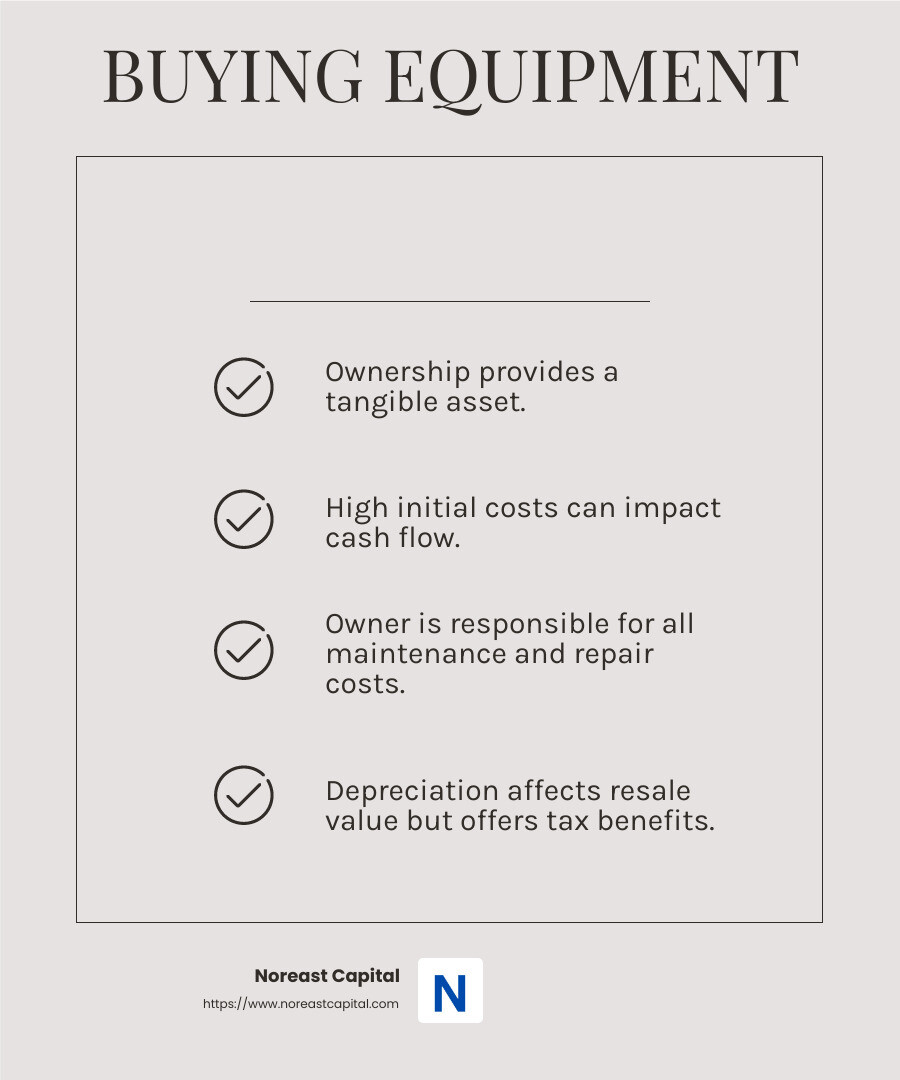
In summary, buying equipment provides the benefit of ownership and potential tax deductions. However, it also comes with high initial costs, maintenance responsibilities, and the impact of depreciation. Carefully weighing these factors will help you decide if purchasing equipment is the right choice for your business.
Frequently Asked Questions about Buying vs Leasing Equipment
Is it better to buy or lease equipment for tax purposes?
When considering buying vs leasing equipment for tax purposes, both options offer unique benefits. Buying equipment allows you to take advantage of the Section 179 tax deduction. This deduction lets you deduct the full purchase price of qualifying equipment in the year you buy it, up to $1.22 million as of 2024. Additionally, you can use bonus depreciation to further reduce taxable income.
On the other hand, leasing equipment can also provide tax advantages. Lease payments are generally deductible as a business expense, reducing your taxable income. However, if the IRS recharacterizes the lease as a purchase, you might lose this benefit. It’s crucial to consult with a tax advisor to determine which option maximizes your tax benefits.
Why do companies prefer leasing over purchasing equipment?
Many companies choose to lease equipment to improve cash flow and avoid obsolescence. Leasing typically requires lower monthly payments compared to buying, helping businesses conserve cash for other needs. This can be especially beneficial for small businesses or startups with limited capital.
Leasing also allows businesses to access the latest technology without a large upfront investment. As equipment becomes obsolete, companies can easily upgrade to newer models at the end of the lease term. This flexibility ensures businesses stay competitive without the burden of outdated equipment.
What are the disadvantages of leasing equipment?
While leasing offers several benefits, there are also potential downsides. One major disadvantage is the accumulated cost over time. Although leasing might seem cheaper initially, the total cost of leasing can exceed the purchase price if the lease term is long.
Additionally, lease terms can be restrictive. You may face limitations on how you use the equipment, and early termination fees can be costly if your business needs change. Interest rates on leases might also be higher than traditional loans, increasing the overall expense.
Finally, at the end of the lease, you don’t own the equipment. This means you won’t have an asset to sell or use as collateral, which could be a drawback if you need to secure future financing.
Conclusion
Deciding whether to buy or lease equipment is a crucial decision that can significantly impact your business’s financial health and operational efficiency. Both options have their merits, and the right choice largely depends on your specific business needs and circumstances.
Buying equipment might be the best route if you prioritize ownership and long-term cost savings. With ownership, you gain an asset that can be sold or used as collateral in the future. It also allows you to take advantage of tax benefits like the Section 179 deduction and depreciation. However, buying requires a significant upfront investment and comes with the risk of equipment obsolescence.
On the flip side, leasing equipment offers flexibility and preserves cash flow, which can be particularly advantageous for businesses in fast-evolving industries. Leasing allows you to access the latest technology without a hefty initial cost and includes maintenance services in many cases. This option, however, might lead to higher overall costs over time, and you won’t own the equipment at the end of the lease.
At Noreast Capital, we understand the complexities involved in this decision. Our mission is to provide you with custom equipment financing solutions that align with your business goals. Whether you choose to lease or buy, we’re here to support you with flexible terms and competitive rates.
To explore how our equipment leasing services can meet your unique needs, visit our Equipment Leasing page. Let us help you make the best financial decision for your business, ensuring you have the right tools to thrive and grow.