

Understanding Lease Residual Value: What’s Left at the End
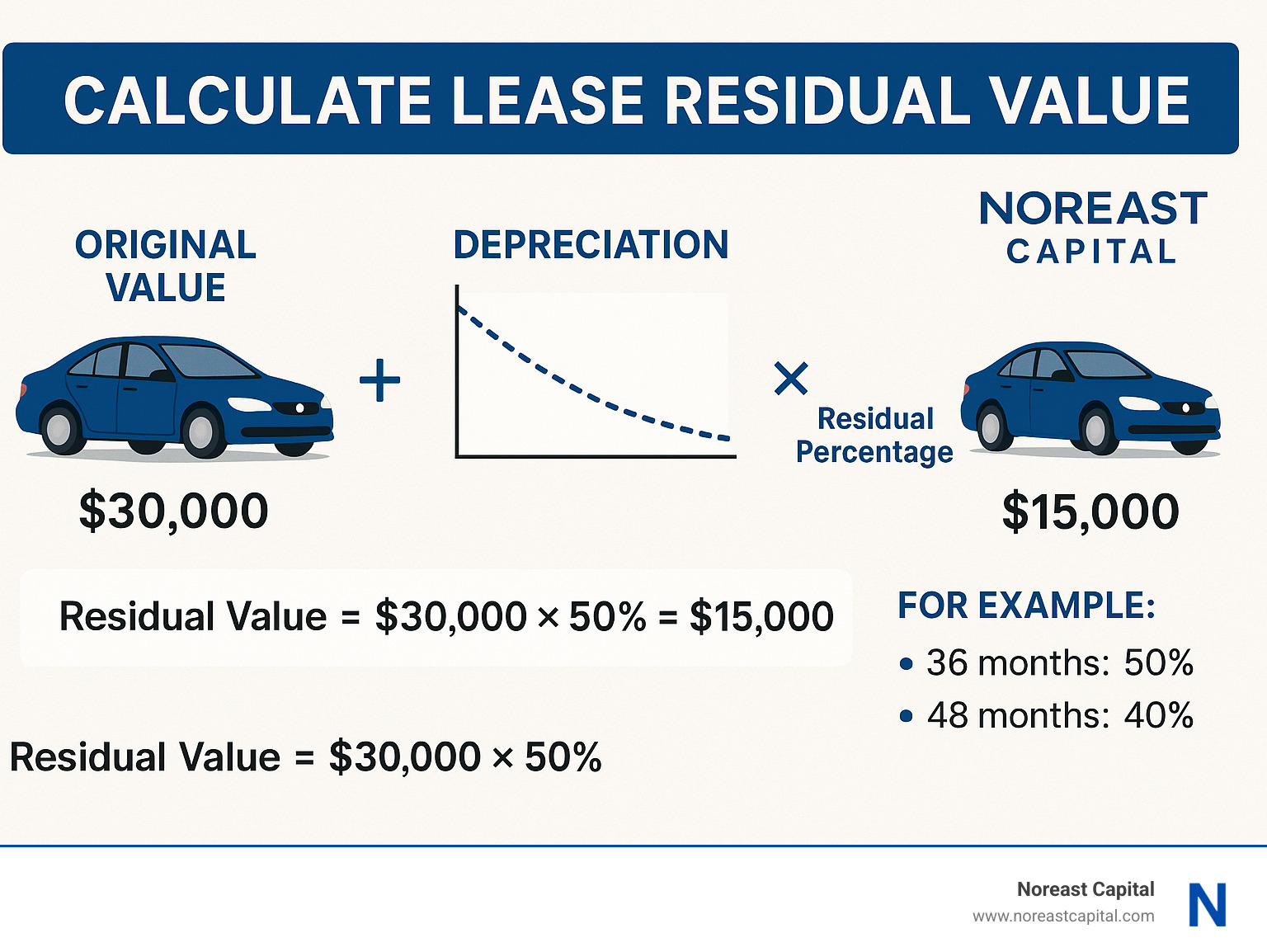
To calculate lease residual value, multiply the original MSRP by the residual percentage. For example:
| Step | Formula | Example |
|---|---|---|
| 1. Find MSRP | Check vehicle window sticker or contract | $30,000 |
| 2. Identify residual percentage | Typically 45-60% for 36-month lease | 50% |
| 3. Calculate | MSRP × Residual Percentage | $30,000 × 50% = $15,000 |
When you sign a lease agreement, understanding the calculate lease residual value process is crucial for making informed financial decisions. Residual value represents what your leased asset—whether it’s a vehicle, equipment, or machinery—is expected to be worth at the end of your lease term. This figure directly impacts your monthly payments and potential buyout options when the lease ends.
Think of residual value as the portion of your asset’s worth that you’re not paying for during the lease. The higher the residual value, the lower your monthly payments will be, since you’re only financing the depreciation (the difference between the original value and what’s left behind).
For businesses looking to preserve cash flow while accessing necessary equipment, knowing how to evaluate residual values can lead to significant savings over time. A vehicle or piece of equipment with strong residual value often represents a better leasing value, especially if you plan to upgrade at lease-end rather than purchase.
I’m Vincent Cerniglia from Noreast Capital, where I’ve helped countless businesses optimize their equipment financing by accurately calculating lease residual values to match their operational needs and cash flow requirements.
Lease Residual Value 101: What It Is & Why It Matters

When you lease equipment for your business, there’s a critical number that shapes your entire agreement – the residual value. But what exactly is it? Simply put, lease residual value is what your leased asset is expected to be worth when your lease ends. It’s like the “leftover value” after you’ve put that truck, copier, or manufacturing equipment to work for a few years.
Think of it this way: when you drive a new car off the lot, it immediately loses value. The same happens with business equipment. The residual value represents what’s still “left in the tank” after you’ve finished using it during your lease term.
At Noreast Capital, we carefully determine this figure at the beginning of every lease by analyzing the equipment type, expected wear and tear, technological obsolescence, and market conditions. This isn’t just some arbitrary number – it’s the cornerstone of your entire lease structure.
Why does residual value matter so much? For starters, it directly impacts your wallet. Calculate lease residual value correctly, and you’ll see how it:
Shapes your monthly payments – You’re essentially paying for the difference between the initial value and the residual value (plus interest and fees). Higher residual values mean lower monthly payments because you’re financing less depreciation.
Sets your buyout price – Thinking about keeping the equipment when your lease ends? The residual value typically determines what you’ll pay to make it yours permanently.
Reveals your true leasing costs – Understanding residual value helps you compare different lease options accurately, beyond just looking at monthly payments.
For our Maryland and DC area clients, we’ve found that equipment with strong residual values often provides the most favorable leasing terms. A piece of equipment with a higher upfront cost but excellent value retention might actually cost less per month than cheaper alternatives that depreciate rapidly.
It’s worth noting that residual value isn’t the same as market value. The residual is predetermined at lease signing, while market value fluctuates based on actual market conditions. This distinction becomes crucial when your lease ends and you’re weighing your options.
For most business equipment, residual values typically range between 45% and 60% of the original value for a 36-month lease. However, this varies widely – construction equipment often holds value differently than medical devices or IT infrastructure.
Understanding how to calculate lease residual value gives you powerful insight into making leasing decisions that align perfectly with your business goals, whether you’re in Annapolis, Baltimore, or anywhere else we serve in the region.
How to Calculate Lease Residual Value: Step-by-Step Formula

Let’s explain the math behind lease residuals – I promise it’s simpler than you might think! The basic formula boils down to:
Residual Value = Original Value (MSRP) × Residual Percentage
If you’d like a concise primer on how different industries view this concept, take a look at this Wikipedia overview of residual value.
While the equation itself isn’t complicated, getting the right numbers and applying them correctly makes all the difference. Let me walk you through the process in everyday language.
Gather Your Numbers Before You Calculate Lease Residual Value
Before crunching any numbers, you’ll need to collect a few key pieces of information:
First, you’ll need the Manufacturer’s Suggested Retail Price (MSRP) – that’s the window sticker price for vehicles or the manufacturer’s list price for equipment before any discounts. Always use the MSRP, not your negotiated price, since leasing companies almost always base residuals on the original sticker price.
Next, you’ll need the residual percentage from your leasing company. This percentage varies based on several factors: how long you’ll lease the equipment, what type of asset it is, how much you’ll use it, and current market conditions. This number is crucial – it directly determines how much value your equipment is expected to retain.
The lease term also plays a significant role – typically 24, 36, 48, or 60 months. Generally speaking, the longer your lease, the lower the residual percentage will be.
Don’t forget about usage limitations – for vehicles, this means mileage caps (usually between 10,000-15,000 miles annually), and for equipment, it might be operating hours or production volume.
Here in the Baltimore area, we at Noreast Capital can help you obtain these figures for whatever equipment you’re considering. For a quick reference, here’s how residual percentages typically vary for well-maintained business equipment:
| Lease Term | Typical Residual Range |
|---|---|
| 24 months | 60-70% |
| 36 months | 50-60% |
| 48 months | 40-50% |
| 60 months | 30-40% |
Apply the Formula to Calculate Lease Residual Value
Once you’ve gathered your information, applying the formula is straightforward:
Take your equipment’s MSRP and multiply it by the residual percentage (converted to decimal form). The result gives you your expected residual value.
Let me show you with a real-world example: Imagine you’re looking at a piece of manufacturing equipment with a $50,000 MSRP. For a 36-month lease, the residual percentage is 55%.
Doing the math: $50,000 × 0.55 = $27,500
This means after your three-year lease, the equipment is expected to be worth $27,500. Your lease payments essentially cover the $22,500 in depreciation (plus interest and fees) over those 36 months.
Sometimes you’ll need to factor in additional considerations like disposal costs for removing equipment at lease-end, potential reconditioning expenses to restore equipment to acceptable condition, or specialized equipment factors for items with unique depreciation patterns.
Verify and Adjust When You Calculate Lease Residual Value
After you’ve done your calculation, it’s smart to double-check your results:
Compare your figure against industry guides – resources like Automotive Lease Guide (ALG) or Black Book for vehicles, or industry association publications for equipment often provide benchmark residual values.
Always review your lease contract carefully to ensure the stated residual value matches your calculation.
Consider broader market factors too – economic conditions, technological advances, and regulatory changes can all impact residual values beyond standard depreciation curves.
Here at Noreast Capital, we help Washington DC area businesses verify these calculations to ensure they’re getting fair lease terms with accurate residual values for their specific equipment needs. We’ve seen how getting this right can make a significant difference in a company’s bottom line.
More info about Lease Formula Calculator
What Drives Residual Value Up or Down?

Ever wonder why some equipment holds its value better than others? Understanding what influences residual value can save your business thousands over a lease’s lifetime. Let’s explore the factors that push residual values up or down – and how you can use this knowledge to your advantage.
Mileage & Wear: Silent Residual Killers
The way you use your equipment directly impacts what it’s worth at lease-end. Think of usage as a quiet thief that slowly steals value when you’re not looking.
For vehicles, mileage limits are the most obvious factor. Exceed your annual cap of 10,000-15,000 miles, and you’re looking at penalties of 5-20 cents per mile. These aren’t arbitrary fees – they directly reflect the additional depreciation from heavier use.
Equipment operates on a similar principle, but with operating hours instead of miles. That construction loader with 2,000 hours will be worth significantly less than one with 1,000 hours, even if they’re the same age.
Maintenance records are your best defense against unnecessary depreciation. I’ve seen businesses in Annapolis save thousands simply by keeping detailed service logs. When you can prove your equipment has been properly maintained, you’re protecting its residual value.
Don’t underestimate the impact of condition upon return either. A quick professional detailing or reconditioning before turning in your leased equipment can make a substantial difference. It’s like selling a house – first impressions matter!
More info about How to Calculate Leasing Installment
Lease Term & Depreciation: Choosing the Sweet Spot
The length of your lease plays a huge role in determining residual value. It’s all about finding that balance between monthly payments and total cost.
Shorter terms mean higher residuals – a 24-month lease typically preserves 60-70% of value for well-maintained equipment, while a 48-month lease might only retain 40-50%. This isn’t just arbitrary math; it reflects how equipment actually loses value in the real world.
The depreciation curve isn’t a straight line downward. Most assets lose value quickly in the beginning, then the decline slows over time. This is why doubling your lease term doesn’t cut the residual value in half.
For Baltimore businesses, I often recommend analyzing your equipment replacement cycles when choosing lease terms. If you typically replace technology every three years anyway, a 36-month lease with a higher residual value often makes more financial sense than a 60-month term.
Be aware of whether you’re signing an open-end or closed-end lease. With closed-end leases (common for vehicles), the leasing company takes the residual value risk. With open-end leases (more common for specialized business equipment), you might bear some or all of that risk if the equipment is worth less than expected at lease-end.
Market Swings and Vehicle Class Differences
External factors can dramatically impact what your leased equipment is worth when the lease ends.
Asset class differences are substantial – standard construction equipment typically holds value better than rapidly-evolving technology. Similarly, premium vehicles generally depreciate more slowly than economy models. When calculating lease residual value, these class differences can create variations of 10-15% in residual percentages.
Supply and demand shifts can create interesting situations. During the recent equipment shortages, many lessees found their leased assets were worth more at lease-end than the predetermined residual value – creating potential equity positions.
Economic cycles affect all equipment values. During downturns, used equipment values typically fall, while they rise during growth periods. Smart businesses time their leases with these cycles when possible.
Technological changes can make equipment obsolete faster than expected. Equipment facing rapid innovation typically has lower residual values to compensate for this risk. I’ve seen this especially with medical equipment and certain manufacturing technologies.
Regulatory impacts work both ways. New efficiency standards might make older equipment less valuable – or more valuable if grandfathering provisions apply. At Noreast Capital, we help Washington DC businesses steer these complex factors to secure equipment leases with favorable residual values.
Residual value isn’t just some abstract number in your lease agreement. It’s a powerful financial lever that directly impacts your monthly payments and end-of-lease options. Understanding what drives it up or down puts you in control of your equipment financing strategy.
Scientific research on vehicle depreciation
Turning Residual Value Into Savings: Payments, Buyouts, and Negotiation

Now that you understand residual value, let’s talk about something more exciting – how to use this knowledge to put real money back in your business’s pocket. After all, these numbers aren’t just theoretical; they translate directly into dollars saved or spent.
Lower Payments Through High Residuals
Have you ever wondered why some leases seem so much more affordable than others? The secret often lies in the residual value. The relationship works like a seesaw: when residual values go up, your monthly payments come down.
Your monthly lease payment is like a sandwich with three layers:
First, there’s the depreciation fee – essentially what the asset loses in value during your lease, spread across all your payments. Second comes the finance charge, which is basically interest on the lease amount. And finally, there are taxes and fees that get sprinkled on top.
Here’s where residual value makes all the difference. Let’s say you’re leasing a $40,000 piece of equipment over 36 months. If it has a 50% residual value ($20,000), your monthly depreciation would be about $555. But bump that residual to 60% ($24,000), and suddenly you’re paying only $444 in monthly depreciation – saving you over $110 every single month!
For a small business in Baltimore or Annapolis, that’s $4,000 back in your pocket over the lease term – just from a 10% difference in residual value. That could be a part-time employee, a marketing campaign, or simply better cash flow when you need it most.
How to Calculate a Lease Payment
Spotting Lease Equity & Buyout Opportunities
Sometimes the market throws you a pleasant surprise – your leased equipment might actually be worth more at the end of the lease than what the contract says it’s worth. This creates what we call “lease equity” – essentially a hidden pot of gold at the end of your lease rainbow.
I had a client in Washington DC who leased construction equipment right before a major supply shortage hit. When his lease ended, similar used equipment was selling for $5,000 more than his buyout price. That’s $5,000 in equity he hadn’t planned on!
To spot these opportunities, keep an eye on market values as you approach lease-end. If similar assets are selling for more than your residual value, you’ve got options. You might buy out the lease and keep using the equipment at below-market cost. Or you could purchase it and resell it for a profit. Some clients even leverage this equity as a trade-in value toward their next lease.
There can be tax advantages too, though I always recommend chatting with your tax advisor about your specific situation. The right move depends on your business needs and market conditions.
At Noreast Capital, we’ve helped countless Maryland businesses analyze whether a buyout makes financial sense. Sometimes the answer surprises even seasoned business owners!
Tools to Run the Numbers Fast
Nobody has time for complex calculations on napkins anymore. Thankfully, there are tools that make number-crunching painless:
Online lease calculators let you play with different scenarios to see how residual values affect your payments. Our clients love seeing how even small changes can significantly impact their bottom line.
Amortization schedule calculators show exactly how each payment gets applied throughout your lease term – no more mystery about where your money goes each month. It’s like having X-ray vision into your lease agreement.
Industry guides provide benchmark residual values so you can tell if you’re getting a fair deal. And for those who want to dive deeper, lease analysis software can compare multiple options side by side.
We provide our clients access to these tools, but more importantly, we help interpret what the numbers actually mean for your business. A calculator can tell you the what, but we help with the “so what” and “now what” that follows.
Lease Amortization Schedule Calculator
More info about Lease Buyout Calculator
The best part about understanding how to calculate lease residual value isn’t just the knowledge itself – it’s the confidence to make decisions that align with your business goals. Whether you’re looking to minimize monthly payments, capitalize on buyout opportunities, or simply understand where your money is going, residual value knowledge puts you in the driver’s seat.
Frequently Asked Questions About Lease Residual Value
What is the difference between residual value and market value?
When you’re diving into equipment leasing, these two terms often cause confusion. Residual value is like a prediction frozen in time – it’s the amount established at the beginning of your lease that estimates what your equipment will be worth when your lease ends. This number is set in stone in your contract and doesn’t change regardless of what happens in the real world.
Market value, on the other hand, breathes and changes with the economy. It’s simply what someone would actually pay for your equipment on the open market at any given moment. Think of market value as the “real-time price tag” that fluctuates based on supply, demand, and even how well you’ve maintained your equipment.
The key differences are pretty straightforward: residual value stays fixed while market value dances with the market; residual value is a contractual figure while market value is determined by actual buyers; and perhaps most importantly for your monthly budget, residual value directly affects your lease payments while market value doesn’t.
When you reach the end of your lease and find the market value exceeds your residual value, you’ve hit a sweet spot called “lease equity” – essentially meaning your leased equipment is worth more than what you’d pay to buy it. It’s like finding money in the pocket of a jacket you haven’t worn in months!
Can I negotiate the residual value in my lease?
I wish I could tell you that residual values are wide open for negotiation, but the truth is they’re typically not directly negotiable. Leasing companies set these values based on sophisticated projections, historical data, and their own risk calculations. It’s a bit like trying to negotiate the weather forecast – the numbers are based on data, not opinions.
That said, there are several clever ways to influence what effectively becomes your residual value:
First, shop around! Different leasing companies may use different projections for identical equipment. At Noreast Capital, we pride ourselves on offering competitive residual values that reflect our deep understanding of equipment markets.
Consider adjusting your lease terms. Shorter leases generally come with higher residual percentages because equipment depreciates less over shorter periods.
You can also focus on negotiating the initial equipment cost (capitalized cost). While the residual percentage might be fixed, lowering your starting point reduces the total depreciation you’ll finance.
Lastly, be strategic about equipment selection. Some brands and models naturally hold their value better than others – just like some cars depreciate less than others. Our team can help identify equipment options with historically strong value retention.
How do excess miles affect my car’s residual value?
Miles on a vehicle are like hours on equipment – they directly impact value by showing how much life has been used up. Calculate lease residual value carefully when considering mileage because excess usage substantially reduces what your vehicle will be worth at lease-end.
Most vehicle leases include a mileage allowance (typically 10,000-15,000 miles annually), and going over these limits triggers penalties that aren’t arbitrary – they’re designed to compensate the leasing company for the reduced value caused by your extra driving.
For example, if your lease allows 12,000 miles annually but you drive 17,000 miles each year, you’ll exceed your three-year lease by 15,000 miles. At a typical penalty of $0.20 per mile, that’s an extra $3,000 due at lease-end. That might seem steep, but it reflects the genuine decrease in the vehicle’s value due to those additional miles.
For businesses that know they’ll put heavy mileage on vehicles, we often recommend negotiating higher mileage allowances upfront. Yes, this increases your monthly payment, but it’s usually more cost-effective than paying excess mileage fees later. Alternatively, consider a shorter lease term to reduce the risk of accumulating excess mileage, or ask about specialized high-mileage leases designed for businesses with above-average usage needs.
At Noreast Capital, we help businesses throughout Maryland and the DC area structure equipment leases with appropriate usage allowances to avoid those painful end-of-lease surprises. We believe the best lease is one that aligns with how you’ll actually use the equipment – not one that leaves you with unexpected charges down the road.
Conclusion

When it comes down to it, knowing how to calculate lease residual value isn’t just number-crunching—it’s about putting money back in your business’s pocket. I’ve seen countless Maryland and DC area businesses transform their equipment strategies once they truly understand this concept.
Think of residual value as your financial compass when navigating lease options. It guides you toward equipment that holds its value well, helps you spot those golden buyout opportunities, and ensures your monthly payments align with your actual business needs. The simple formula—multiplying original value by the residual percentage—open ups powerful financial planning possibilities.
For most businesses I work with in Baltimore and Annapolis, equipment with strong residual values (typically 45-60% for a 36-month lease) creates breathing room in their monthly cash flow. This extra liquidity often becomes the difference between comfortable growth and constant financial pressure.
What I find most rewarding is helping business owners connect these calculations to real-world decisions. Should you lease that manufacturing equipment for 36 or 48 months? Is that construction machinery worth buying out at lease-end? The answers lie in understanding the residual value journey from day one to lease-end.
At Noreast Capital, we don’t just run the numbers—we translate them into practical strategies custom to your business reality. We understand the unique equipment needs of Washington DC area businesses and how to structure leases that preserve your working capital while giving you access to the tools you need.
The strongest leasing decisions align with your usage patterns, growth plans, and financial objectives. Whether you’re managing a fleet of vehicles or equipping a new production line, mastering residual value calculations gives you the upper hand in negotiations and long-term planning.
Ready to put this knowledge to work for your business? Our lease calculators can help you visualize different scenarios, or you can reach out directly to discuss your specific equipment needs. Let’s make sure your next lease works as hard for your business as you do.