

Explaining Monthly Lease Payments
To calculate monthly lease payment, use this simple formula:
| Step | Calculation |
|---|---|
| 1. Find depreciation fee | (Capitalized cost – Residual value) ÷ Lease term in months |
| 2. Calculate finance fee | (Capitalized cost + Residual value) × Money factor |
| 3. Add taxes | (Depreciation fee + Finance fee) × Tax rate |
| 4. Total monthly payment | Depreciation fee + Finance fee + Taxes |
Leasing a vehicle or equipment can be a smart financial move for businesses and individuals who want lower monthly payments and flexibility. Unlike purchasing, where you pay for the entire asset, when you calculate monthly lease payment you’re only paying for the portion of the asset you use – the depreciation during your lease term, plus interest and taxes.
Think of leasing as paying for the value you actually use rather than the entire purchase price. This is why lease payments are typically 30% to 60% lower than loan payments on the same item.
The math behind lease payments might seem complex at first glance, but breaking it down into simple components makes it much easier to understand and calculate.
I’m Vincent Cerniglia from Noreast Capital, where I’ve helped countless businesses calculate monthly lease payment options for equipment financing that maintain healthy cash flow while accessing the tools they need to grow. My experience spans working with businesses of all sizes, from small startups to Fortune 500 companies seeking the most advantageous lease structures for their equipment needs.

Must-know calculate monthly lease payment terms:
– business equipment finance calculator
– calculate lease residual value
Why Lease? Understanding the Basics
Leasing lets you use new equipment or vehicles while paying only for the portion you actually consume the expected depreciation instead of the full purchase price. That single difference is why lease payments often run 3060% lower than comparable loan payments.
When you lease through Noreast Capital, we retain ownership while you enjoy the benefits of use. At the end of the term you can return, renew, or buy the assetwhatever fits your business plan.
For a broader look at how leasing works, see Wikipedias overview.

Lease vs. Rental (Quick View)
- Rentals are typically days or weeks; leases usually last 2448 months.
- With most leases you maintain the asset; with rentals the provider does.
- Leases include usage caps (miles, hours) that keep residual values predictable.
- At lease end you may buy, renew, or walk awayflexibility a rental doesnt offer.
Buying vs. Leasing: Snapshot
| Factor | Leasing | Buying |
|---|---|---|
| Upfront cost | Low minimal down | High down payment + financing |
| Monthly cost | 3060% less | Higher |
| Equity gained | None | Builds equity |
| Obsolescence risk | Low easy upgrade | High you own it |
| Tax treatment | Payments may be deductible | Depreciation + interest |
Leasing shines when equipment ages quickly, needs regular upgrades, or ties up too much capital to purchase outright. Thats why many of our clients in Annapolis, Baltimore, and Washington DC rely on Noreast Capital to keep cash flowing while still getting the tools they need.
How to Calculate Monthly Lease Payment Like a Pro
Now let’s break down exactly how to calculate monthly lease payment amounts. Understanding each component gives you the knowledge to negotiate better terms and verify dealer calculations.

Think of your monthly lease payment as a pie with four slices. Each slice represents a different cost: the depreciation fee (how much value the asset loses while you’re using it), the finance fee (what you pay for borrowing), sales tax (your contribution to local government), and any administrative fees rolled into your monthly payment.
Let’s walk through how to calculate each piece so you can understand exactly what you’re paying for:
Step 1: Nail Down the Numbers
Before you can calculate monthly lease payment amounts, you need to gather some key figures. Think of this as collecting ingredients before cooking a meal.
First, you’ll need the MSRP – that’s the sticker price you see on the window. But don’t worry, you won’t be paying based on this number if you’re savvy. Instead, focus on the negotiated price (also called the capitalized cost or “cap cost”). This is the actual price you’ve worked out with the dealer – and yes, you should negotiate this just as aggressively as you would for a purchase!
Any down payment, trade-in credit, or manufacturer rebates you apply will reduce this amount, giving you what’s called the adjusted capitalized cost – the final amount being financed.
You’ll also need to know the residual value – what the equipment is expected to be worth when your lease ends. For a typical 36-month equipment lease, this usually ranges from 45% to 60% of MSRP, depending on what you’re leasing.
Don’t forget about your lease term (how many months you’ll be leasing), the money factor (think of this as the lease’s interest rate), and your local sales tax rate.
With these numbers in your toolkit, you’re ready to start calculating.
Step 2: Crunch Depreciation & Rent Charges
Now for the math that makes up the bulk of your payment. Don’t worry – it’s simpler than it looks!
Your depreciation fee is essentially paying for the value the equipment loses while you’re using it. To calculate monthly lease payment depreciation, just take your adjusted capitalized cost, subtract the residual value, and divide by the number of months in your lease.
For example, if you’re leasing a $40,000 piece of equipment that will be worth $24,000 after 36 months, your calculation would be:
($40,000 – $24,000) ÷ 36 = $444.44 per month
Next comes the rent charge or finance fee. This is basically the interest you’re paying to borrow the equipment. You calculate it by adding the adjusted capitalized cost to the residual value, then multiplying by the money factor.
Using the same example with a money factor of 0.00125:
($40,000 + $24,000) × 0.00125 = $80 per month
These two figures form the backbone of your monthly payment. For more detailed calculations, check out our Lease Formula Calculator.
Step 3: Add Taxes, Fees & Due-at-Signing
The final step to calculate monthly lease payment is adding taxes and fees – the cherry on top (though perhaps not as sweet).
Sales tax varies by location and can be calculated in different ways. Most commonly, you’ll pay tax on your monthly payment (depreciation fee + rent charge). Using a 6% tax rate in our example:
($444.44 + $80) × 0.06 = $31.47 per month
Some states might tax the entire lease value upfront or treat leases like purchases for tax purposes. This is where having a local expert like Noreast Capital can be invaluable for businesses in Maryland and DC.
Your payment might also include an acquisition fee (for setting up the lease), document fees, and registration fees spread across your lease term.
Add everything together and you get your total monthly payment:
$444.44 + $80 + $31.47 + any monthly fees = $555.91 plus fees
Separately, you’ll need to prepare for what’s due when you sign: your first month’s payment, any down payment, security deposit, acquisition fee (if not rolled into the monthly payment), and registration, title, and documentation fees.
At Noreast Capital, we help businesses structure their equipment leases to balance upfront costs with monthly payments, creating a solution that keeps your cash flow healthy while getting you the equipment you need. Our How to Calculate a Lease Payment guide provides even more detailed information if you want to dive deeper.
Beyond the Basics: Factors That Move Your Payment
Ever notice how two people leasing the same equipment end up with different payments? A handful of variables make the numbers swing when you calculate monthly lease payment amounts:
Credit Score Impact
Your credit profile (or your companys) drives the money factor. Excellent credit open ups the lowest rates, while scores below the high600s see higher finance charges.
Mileage or Usage Allowance
For vehicles, standard leases include about 12,000 miles per year. Choosing fewer miles trims your payment; selecting more raises it. Similar hour limits apply to machinery.
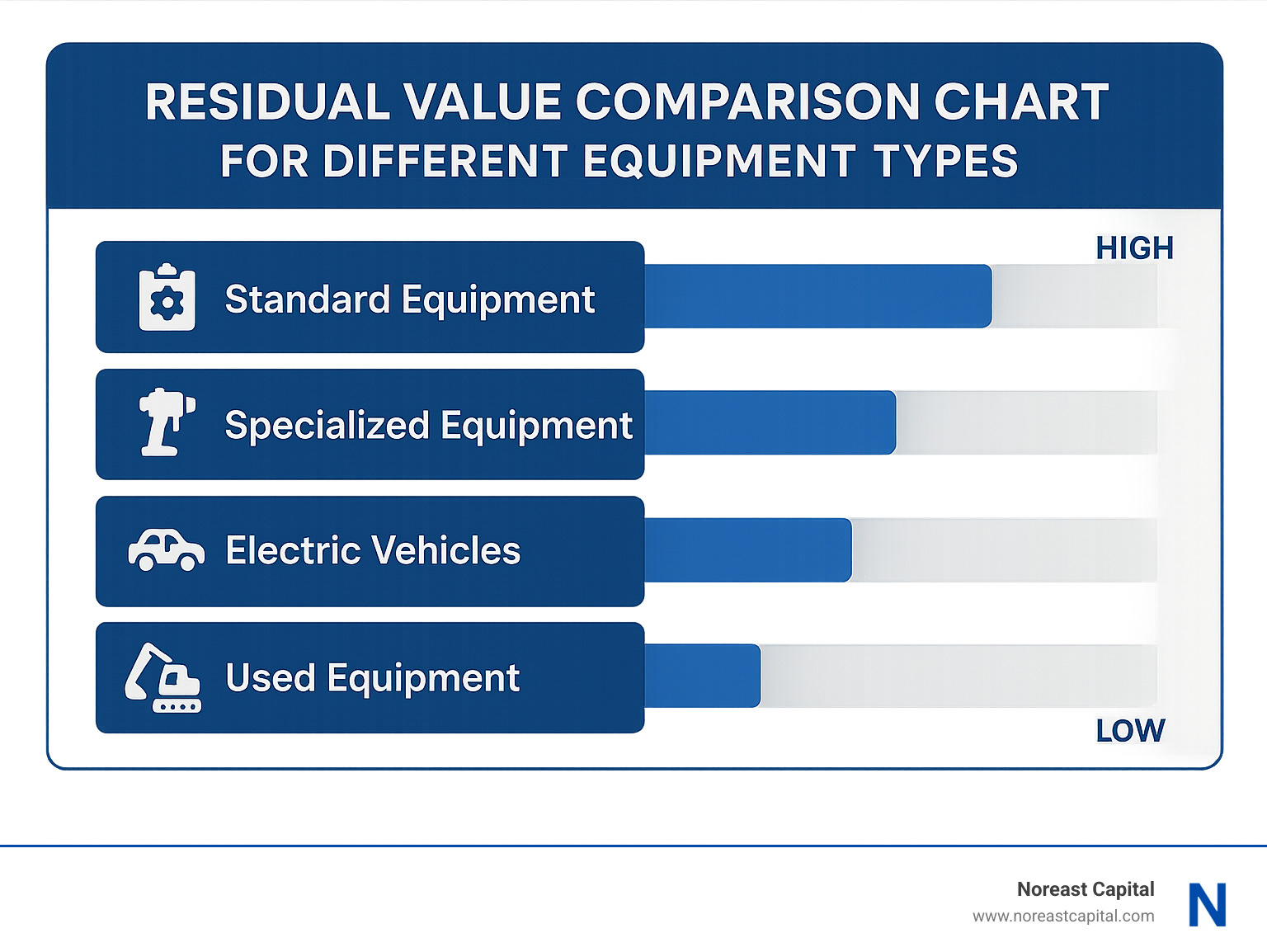
Equipment Type and Residual Values
Assets that hold valuestandard construction gear, certain electric vehiclesget higher residuals and lower payments. Specialized or quickly outdated items usually carry lower residuals.
Money Factor APR Conversion
Multiply the money factor by 2,400 to see the equivalent APR. Example: 0.00125 7 2,400 = 3% APR. Knowing this lets you compare lease offers to traditional loans.
Down Payment: Pros & Cons
Putting cash down lowers the amount financed, but it doesnt build equity and isnt refundable if the asset is lost. Most Noreast Capital clients keep down payments small and reserve cash for operations.
End-of-Lease Options & Costs
At terms end you can buy the asset at its residual value, extend the lease, or return it. Factor in possible disposition, excess mileage, or wear-and-tear charges when budgeting.

Negotiation, Comparison & Mistake-Proofing
Armed with knowledge about how to calculate monthly lease payment figures, you’re ready to negotiate and compare offers like a pro.

The 1% Rule for Quick Evaluation
Here’s a handy shortcut I share with my clients: a competitive lease payment should hover around 1% of the equipment’s MSRP. If someone offers you a $50,000 piece of equipment with monthly payments of $500 or less, you’re likely looking at a solid deal.
This isn’t perfect—especially for specialized equipment—but it gives you a quick gut-check before diving into detailed calculations. Think of it as your first line of defense against overpriced offers.
Negotiation Strategy
When I sit down with business owners in Maryland and DC, I always emphasize that negotiating a lease isn’t that different from haggling at a car dealership. Start by negotiating the capitalized cost first—this single number has the biggest impact on what you’ll pay each month.
Don’t be shy about asking directly for the money factor and residual value. Some dealers dance around these figures, but they’re essential for verifying that your calculate monthly lease payment math checks out. I’ve seen clients save thousands simply by questioning these numbers.
Take a hard look at any fees that seem excessive. That $895 acquisition fee? Often negotiable. The $500 document fee? Sometimes completely unnecessary. Even disposition fees can be reduced or waived if you’re a repeat customer or planning to lease again.
Remember to look beyond the glossy brochure for manufacturer incentives or special lease programs. These can dramatically lower your costs, especially for vehicles and standard equipment types. And always, always consider the total cost of the lease—down payment, all monthly payments, and end-of-lease costs combined—not just the monthly figure.
Using a Lease Calculator to Compare Offers
Think of a lease calculator as your trusted financial advisor that never sleeps. When comparing different offers, make sure you’re inputting identical parameters across the board—same term length, same mileage/usage, same down payment. Otherwise, you’re comparing apples to oranges.
I often recommend playing with different term lengths to see how they affect both your payment and total cost. Sometimes extending from 36 to 48 months drops your payment significantly, but actually increases your overall cost. Similarly, adjusting your down payment might reveal your sweet spot between manageable upfront costs and comfortable monthly payments.
For businesses considering equipment leases, our Equipment Leasing Calculator at Noreast Capital lets you test different scenarios without the pressure of a salesperson standing over your shoulder. Many of my Baltimore clients tell me they’ve used it to verify dealer calculations—sometimes catching “errors” that would have cost them thousands.
Common Errors When You Calculate Monthly Lease Payment
After years in this business, I’ve seen smart people make the same mistakes when trying to calculate monthly lease payment figures. Sales tax is probably the biggest culprit—different states treat lease taxes completely differently, and forgetting to account for your local rules can throw your calculations way off.
Another common pitfall? Using the sticker price (MSRP) instead of your negotiated capitalized cost. Your payment should always be based on the price you’ve actually agreed to pay.
Watch out for money factor markups too. Some dealers quietly add 0.0001 or 0.0002 to the money factor—doesn’t sound like much until you realize it can add hundreds or even thousands over the lease term. Know what rates you qualify for based on your credit score before walking in.
Being realistic about your usage needs is crucial, especially for vehicles. That 10,000-mile annual limit might look attractive for its lower payment, but if you actually drive 15,000 miles a year, you’ll pay dearly for those extra miles at lease-end.
I’ve also seen too many clients focus exclusively on monthly payment, only to find they’ve signed up for excessive fees or a longer term that costs more overall. The monthly payment matters, but it’s just one piece of the puzzle.
And don’t forget about gap insurance—this covers the difference between what you owe and what insurance pays if the equipment is totaled. Without it, you could be on the hook for thousands in the event of a major accident or loss.
By avoiding these common mistakes, you’ll be well-positioned to secure a lease that truly works for your business needs and budget—not just one that looks good on paper.
Frequently Asked Questions about Lease Math
What Is Residual Value and Why Does It Matter?
Think of residual value as your equipment’s future value – what it’ll be worth when your lease ends. This number is absolutely crucial when you calculate monthly lease payment amounts because it determines how much depreciation you’re actually paying for.
It’s pretty simple: higher residual values mean lower monthly payments. Let me show you why. If you’re leasing a $30,000 piece of equipment with a 50% residual after 36 months, you’re essentially paying for $15,000 in depreciation. But if that same equipment has a 60% residual ($18,000), you’re only paying for $12,000 in depreciation – that’s a significant difference in your monthly payment!
Leasing companies don’t just pull these numbers out of thin air. They carefully determine residual values based on historical data, market predictions, equipment durability, how quickly the technology becomes outdated, and typical usage patterns. For most standard equipment on a 36-month lease, you’ll typically see residual values between 45% and 60% of the original price.
How Do I Convert a Money Factor to APR?
Money factors can feel like a foreign language if you’re new to leasing. Fortunately, there’s a simple translation:
APR = Money Factor × 2,400
This conversion matters because while a money factor of 0.00208 might not mean much to you at first glance, knowing it equals 5% APR suddenly makes it clear whether you’re getting a good deal or not.
The reverse is just as handy if a dealer talks in terms of APR but you need the money factor:
Money Factor = APR ÷ 2,400
Always double-check that the money factor matches what someone with your credit should receive. The difference between 0.00125 (3% APR) and 0.00208 (5% APR) might seem tiny, but it can add up to hundreds or even thousands over your lease term.
Will a Bigger Down Payment Always Lower My Costs?
While putting more money down will certainly reduce your monthly payment, it’s not always the smartest financial move when leasing. Here’s the honest truth about down payments on leases:
First, unlike with loans, your down payment doesn’t build any equity – it simply reduces the amount you’re financing. If your equipment gets stolen or totaled early in the lease, that down payment is typically gone for good. Your gap insurance will cover the difference between what you owe and what insurance pays, but usually not your down payment.
Then there’s opportunity cost to consider. That $5,000 you put down might serve your business better invested elsewhere, especially if it could generate returns higher than your lease’s implicit interest rate.
For most of our clients in Baltimore, Annapolis, and DC, we recommend making just enough of a down payment to achieve your target monthly payment – no more. Keep your capital working for your business instead of tying it up in a lease where you won’t build equity.
At Noreast Capital, we’ve helped countless businesses structure leases with minimal down payments while still maintaining manageable monthly costs. The goal isn’t just a low monthly payment – it’s optimizing your overall financial position.
Conclusion
Let’s face it – leases can be complicated. But now that you understand how to calculate monthly lease payment figures, you’re in the driver’s seat. No more wondering if that dealer quote is fair or scratching your head at mysterious fees. You’ve got this!
At Noreast Capital, we love seeing that moment when everything clicks for our clients in Annapolis, Baltimore, Washington DC, and beyond. There’s something empowering about understanding exactly what you’re paying for and why. It transforms the leasing process from intimidating to straightforward.
I’ve worked with countless business owners who came to us feeling overwhelmed by leasing options. After walking through the calculations together – breaking down the depreciation, finance charges, and taxes – they leave with the confidence to make decisions that truly benefit their business.
Remember your new leasing toolkit:
First, always negotiate that capitalized cost like your business depends on it (because it kind of does!). A lower starting point cascades into savings throughout your entire lease.
Second, don’t be shy about asking for the money factor and residual value. You deserve transparency, and now you know exactly what these numbers mean for your bottom line.
Third, look beyond the monthly payment. That attractive low number might hide a longer term or excessive fees that cost more in the long run.
Fourth, choose lease terms that match how you’ll actually use the equipment. Be realistic about mileage, wear and tear, and how long you’ll need it.
Finally, consider how the lease fits into your broader business strategy. The right lease structure preserves capital for other opportunities while giving you access to the tools you need to grow.
Whether you’re leasing your first piece of equipment or your fiftieth, these principles remain your north star for navigating equipment financing decisions.
Ready to put your new knowledge into practice? Contact our team for a friendly, no-pressure consultation. We’re here to help you find equipment financing solutions that feel as good as they look on paper – ones that support your business growth without unnecessary complexity or hidden costs.
After all, equipment financing should help your business move forward, not hold you back with confusing terms and surprise costs. Let’s make your next lease your best one yet.