

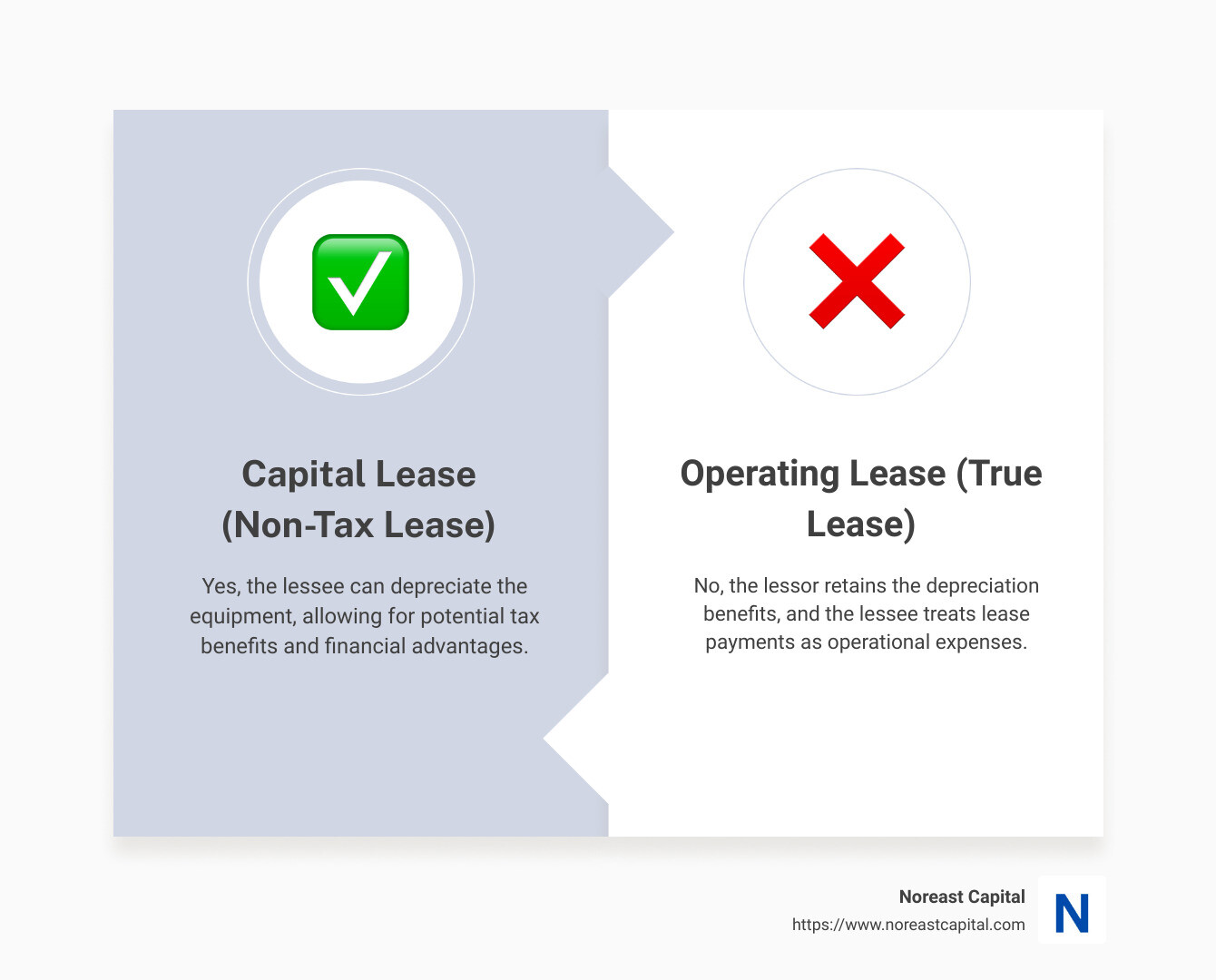
Can leased equipment be depreciated? The short answer is:
- Capital Lease (Non-Tax Lease): Yes, the lessee can depreciate the equipment.
- Operating Lease (True Lease): No, the lessor holds depreciation benefits.
When it comes to acquiring equipment for your business, leasing can be a smart financial move. It allows you to use essential tools without the significant upfront cost of purchasing them outright.
However, understanding how depreciation works in the context of leasing is critical. This knowledge can open up valuable tax benefits for your business. This introductory guide will explore the basics of equipment leasing and its impact on depreciation, helping you to make informed decisions.
My name is Vincent Cerniglia. With years of experience in the equipment financing and leasing industry, I specialize in helping businesses steer the complexities of leasing equipment, including understanding whether leased equipment can be depreciated.
Understanding Equipment Leasing
Operating Lease vs. Capital Lease
When it comes to equipment leasing, understanding the difference between an operating lease and a capital lease is crucial. Both types have unique impacts on your balance sheet and offer different tax benefits.
Operating Lease: Think of this as a rental agreement. The leased equipment is not listed as an asset on your balance sheet. Instead, the lease payments are recorded as operating expenses. This approach can help improve financial ratios, like return on assets, and often doesn’t require board approval. For example, a tech startup may opt for an operating lease to keep its balance sheet clean and maintain flexibility.
Capital Lease: This is more like a purchase agreement. The equipment is listed as an asset, and the lease payments are recorded as liabilities. This type of lease allows you to claim depreciation and interest expense deductions, which can be beneficial for tax purposes. A manufacturing company with stable cash flow might prefer a capital lease to eventually own the equipment and benefit from the depreciation deductions.
True Lease vs. Non-Tax Lease
The IRS categorizes leases into two main types: True Lease and Non-Tax Lease. Understanding these categories can help you maximize your tax benefits.
True Lease: Also known as a tax lease, in this arrangement, the lessor (the entity receiving the lease payments) retains ownership of the equipment and claims the tax benefits, including depreciation. The lessee (the entity using the equipment) can deduct the lease payments as operating expenses. This type of lease is advantageous for businesses looking to keep equipment off their balance sheets.
Non-Tax Lease: In this setup, the lessee (the entity using the equipment) receives the tax benefits of ownership, including claiming depreciation and interest expense deductions. This type of lease can be particularly attractive for businesses looking to leverage Section 179 deductions.
IRS Rules: The IRS has specific guidelines for determining whether a lease qualifies as a True Lease or a Non-Tax Lease. For instance, a lease is not considered a True Lease if the lessee has the option to purchase the equipment at a bargain price, among other criteria.
Tax Deductions: Choosing the right type of lease can open up significant tax benefits. For example, a Non-Tax Lease allows you to claim depreciation, which can reduce your taxable income. On the other hand, a True Lease lets you deduct lease payments, which can also lower your tax bill.
Understanding these different lease types and their implications can help you make the best financial decisions for your business.

In the next section, we’ll dig deeper into whether leased equipment can be depreciated and how to steer the IRS guidelines to maximize your tax benefits.
Can Leased Equipment Be Depreciated?
Depreciation for Capital Leases
When it comes to capital leases, the answer to “can leased equipment be depreciated” is yes. A capital lease is treated like a purchase for accounting purposes. This means the lessee (you) can claim depreciation on the leased equipment.
Depreciation Rules: Under a capital lease, the equipment is recorded as an asset on your balance sheet. This allows you to depreciate the asset over its useful life. Depreciation expense helps spread out the cost of the equipment, matching it with the revenue it generates.
Useful Life: The useful life is the period over which the equipment is expected to be economically useful. For instance, if you lease a piece of machinery with a useful life of 10 years, you can depreciate its cost over that period.
The IRS has specific guidelines for capital leases. One key rule is that the lease must meet certain criteria, such as having a bargain purchase option or transferring ownership at the end of the lease term. If these conditions are met, you can depreciate the leased equipment.
Depreciation for Operating Leases
Now, let’s talk about operating leases. The rules are different here. For an operating lease, the equipment cannot be depreciated by the lessee. Instead, the lessor (the owner) is responsible for depreciation.
Right of Use Asset: Under an operating lease, you record a “right of use” asset and a lease liability on your balance sheet. This asset represents your right to use the equipment over the lease term. However, this right of use asset is not depreciated in the traditional sense.
Amortization: Instead of depreciation, you amortize the right of use asset. Amortization is similar to depreciation but is used for intangible assets. The amortization expense reflects the cost of using the leased equipment over the lease term.
The IRS has specific guidelines for operating leases as well. If the lease does not meet the criteria for a capital lease, it is classified as an operating lease, and you cannot claim depreciation.
Understanding these differences is crucial for making informed financial decisions. Capital leases allow for depreciation, providing tax benefits, while operating leases involve amortization of the right of use asset.
In the next section, we’ll explore the tax implications of leasing equipment, including Section 179 and conditional sales contracts.
Tax Implications of Leasing Equipment
Section 179 and Leased Equipment
Section 179 is a powerful tax provision that can significantly impact your business’s finances. It allows businesses to deduct the full purchase price of qualifying equipment purchased or financed during the tax year. But can leased equipment be depreciated under Section 179? The answer depends on the type of lease.
For a capital lease (also known as a non-tax lease), the lessee can take advantage of Section 179. This means you can write off the entire cost of the equipment in the year it’s put into use. For example, if your restaurant leases a $10,000 oven under a capital lease, you can deduct the full $10,000 from your taxable income, potentially saving thousands in taxes. This is a substantial benefit for small businesses looking to minimize their tax burden.
However, it’s important to note that operating leases (or true leases) do not qualify for Section 179 deductions. In an operating lease, the equipment is not considered owned by the lessee, so you cannot claim depreciation. Instead, lease payments are treated as rental expenses, which can be deducted as operating expenses on your income statement.
Conditional Sales Contracts
A conditional sales contract is another term you might encounter when leasing equipment. Under such a contract, the lessee is treated as the owner of the equipment for tax purposes, even though they do not have full ownership until all payments are made.
The IRS has specific guidelines to determine if an agreement is a conditional sales contract. Key indicators include:
- The agreement designates part of each payment towards an equity interest.
- You gain title to the property after paying a stated amount.
- The amount paid for a short-term use is a significant portion of the purchase price.
- You have the option to buy the property at a nominal price compared to its value.
If your lease meets any of these conditions, it may be classified as a conditional sales contract. This classification allows you to claim depreciation deductions, similar to owning the equipment outright. For example, if Penny’s Cake Company leases a $35,000 mixer with an option to buy it for $2,000 at the end of the lease, the IRS may classify this as a conditional sales contract, allowing Penny’s to depreciate the mixer over its useful life.
Understanding these tax implications helps you make informed decisions about leasing equipment. Whether leveraging Section 179 for immediate deductions or navigating conditional sales contracts for depreciation benefits, knowing the rules can save your business money and improve financial planning.
In the next section, we’ll address frequently asked questions about depreciating leased equipment.
Frequently Asked Questions about Depreciating Leased Equipment
Can you take depreciation on leased equipment?
Yes, but it depends on the type of lease. If you have a capital lease (also known as a finance lease), you can depreciate the leased equipment. In a capital lease, the lessee essentially has the benefits and risks of ownership, even though the lessor technically owns the equipment. This means you can spread the cost of the asset over its useful life.
In contrast, with an operating lease, the equipment remains the property of the lessor, and you cannot depreciate it. Instead, you can only deduct the lease payments as an operating expense.
Is depreciation on leased assets allowable?
Depreciation on leased assets is allowable for capital leases but not for operating leases.
In a capital lease, the equipment is treated as if you own it. Consequently, you can depreciate the asset, reflecting its wear and tear over time. This depreciation is recorded on your balance sheet and can reduce your taxable income.
For example, if you lease a piece of machinery for five years under a capital lease, you can depreciate the cost of that machinery over those five years, matching the expense with the revenue it helps generate.
However, for an operating lease, the lessor retains ownership of the asset. You can only deduct the lease payments as an expense, not depreciate the asset itself.
Is leased equipment an asset or expense?
Leased equipment can be both an asset and an expense, depending on the type of lease.
Capital Lease: The equipment is considered an asset on your balance sheet. You recognize both the asset and a corresponding liability for the lease payments. Over time, you depreciate the asset and record interest expenses on the liability.
Operating Lease: The equipment is considered an expense. Lease payments are recorded as an operating expense on your income statement. The equipment does not appear as an asset on your balance sheet.
For instance, if your business leases a delivery truck:
- Under a capital lease, the truck is listed as an asset, and you depreciate it over its useful life.
- Under an operating lease, you simply record the lease payments as an expense, with no impact on your balance sheet.
Understanding these distinctions helps you manage your financial statements and tax obligations more effectively.
In the next section, we’ll dive deeper into the tax implications of leasing equipment, including how Section 179 can offer significant tax benefits.
Conclusion
At Noreast Capital, we understand that navigating the complexities of equipment leasing can be challenging. But with the right knowledge and guidance, it becomes a strategic advantage for your business.
Equipment Leasing Benefits
Leasing equipment offers numerous benefits:
- Preserve Cash Flow: Leasing requires less upfront cash, allowing you to use your capital for other business needs.
- Flexibility: Leases often come with options to return, extend, or purchase the equipment, providing flexibility to adapt to changing needs.
- Tax Advantages: With options like Section 179, leasing can offer significant tax deductions, reducing your overall tax burden.
- Avoid Obsolescence: Leasing allows you to upgrade to the latest technology without the long-term commitment of ownership.
Financial Flexibility
Leasing equipment also improves your financial flexibility. By keeping leased assets off your balance sheet through operating leases, you can maintain a stronger financial position. This can be crucial for securing additional financing or meeting financial covenants.
Additionally, leasing can simplify your budgeting process. Fixed monthly payments make it easier to plan and manage your expenses, ensuring you can focus on growing your business without financial surprises.
Ready to explore how leasing can benefit your business? Visit our Office Equipment Financing page to learn more and get started today.