

Why Commercial Equipment Finance is Essential for Growing Businesses
Commercial equipment finance allows businesses to acquire necessary machinery, vehicles, and technology without the burden of large upfront payments or immediate depreciation hits to their balance sheets.
Quick Answer for Commercial Equipment Finance:
– Equipment Loans: Borrow money to purchase equipment (you own it)
– Equipment Leasing: Rent equipment with options to buy later
– Financing Range: $500,000 to $20 million typically
– Terms: Up to 12 years for equipment loans, up to 5 years for leases
– Approval Time: Few business days for under $1M, up to 2 weeks for larger amounts
– Down Payment: Often 0% to 100% financing available
Whether you’re a pizza restaurant owner looking to finance a new oven that could increase production by 20% or a manufacturer needing a $350,000 automated packaging line, equipment financing preserves your working capital while giving you access to the tools that drive growth.
Equipment loans can finance up to 125% of equipment costs (including installation and training), with amortization periods extending up to 12 years. For transactions under $1 million, approvals often come within just a few business days.
Most successful businesses use equipment financing because it makes financial sense. Instead of tying up $100,000 in cash for machinery, you can spread that cost over time while using the equipment to generate revenue immediately.
I’m Vincent Cerniglia, and through my work at Noreast Capital Corporation, I’ve helped businesses ranging from small startups to Fortune 500 companies steer the commercial equipment finance landscape as a direct lender providing nationwide solutions.
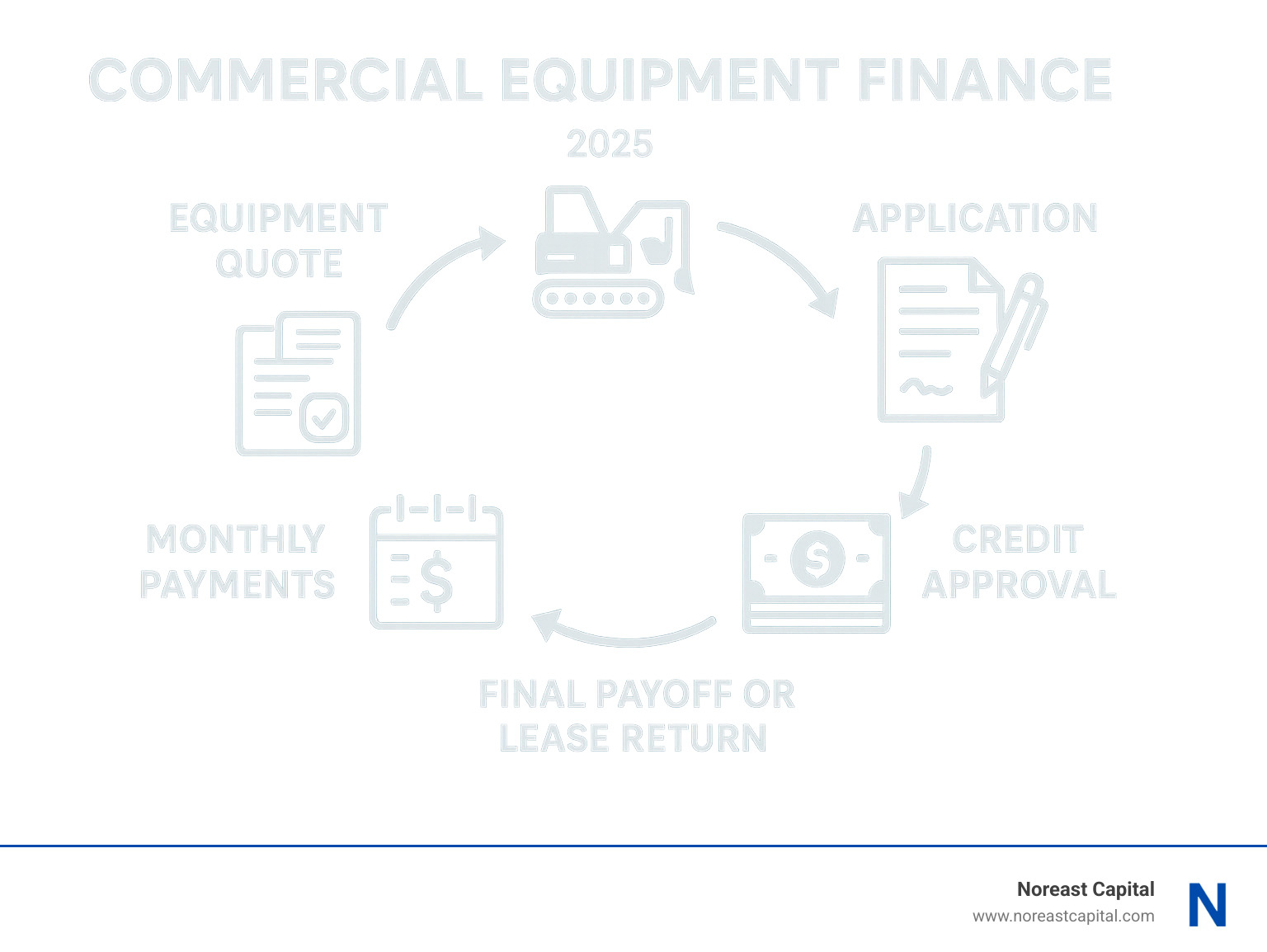
Must-know commercial equipment finance terms:
– asset based equipment financing
– equipment financing online
– laundromat equipment financing
Commercial Equipment Finance Fundamentals
Commercial equipment finance is a smart way to get the tools your business needs without emptying your bank account. You use the equipment itself as collateral, which makes lenders more comfortable and gives you better terms than unsecured loans.
This approach is flexible – we regularly help businesses finance 100% of their equipment costs, including installation fees, training costs, delivery charges, and sales tax. Some deals cover up to 125% of the equipment value to handle all soft costs.
You’ve got equipment loans where you own the asset from day one, or operating leases that keep things off your balance sheet. Capital leases give you lease flexibility with ownership benefits. Many manufacturers offer vendor financing programs, and sale-leaseback arrangements can open up cash from existing assets.
We can structure payments around your cash flow patterns. Agricultural businesses might skip winter months, while construction companies can align payments with busy building seasons.
How Commercial Equipment Finance Works
Commercial equipment finance operates on a simple principle: productive equipment pays for itself. Unlike traditional bank loans focused on credit scores, we focus on the asset’s value and your business’s ability to handle payments.
The equipment serves as security. If something goes wrong, we can recover our investment by reselling the asset. This protection lets us offer better rates and longer terms than unsecured financing.
Most healthy businesses can support a debt-to-equity ratio between 2 and 3, varying by industry. Amortization periods can stretch up to 12 years for equipment loans – much longer than typical working capital loans.
Types of Equipment Eligible for Commercial Equipment Finance
Manufacturing machinery forms the backbone of many deals – CNC machines, packaging lines, specialized production equipment. These assets hold value well and generate measurable returns.
Medical devices represent another huge category, from MRI machines to dental chairs and diagnostic equipment. Healthcare providers depend on equipment financing to keep up with technology.
Construction fleets are natural fits – excavators, bulldozers, cranes, specialized vehicles. The seasonal nature makes lease structures particularly attractive.
IT hardware and technology equipment become outdated quickly, but shorter lease terms and upgrade options solve this problem. Many companies use 3-year lease cycles to stay current.
Renewable energy equipment has exploded in popularity – solar panels, wind turbines, energy storage systems often qualify for specialized financing programs with tax benefits.
Almost any productive business asset can potentially be financed. If it helps your business make money, there’s probably a financing structure for it.
More info about Business Equipment Leasing
Financing Structures & Key Terms

Commercial equipment finance offers multiple structures to match your business needs.
Equipment loans are straightforward – you borrow money, buy equipment, and own it from day one. Monthly payments include principal and interest, and you own a valuable asset when finished.
Operating leases work like long-term rentals. You use the equipment, make payments, and typically return it at lease end. Payments are usually fully tax-deductible and don’t show as debt on your balance sheet.
Capital leases provide ownership benefits during the lease term, usually with a $1 purchase option at the end.
Sale-leaseback arrangements open up cash from equipment you already own. You sell us the equipment, then immediately lease it back, converting assets into working capital.
TRAC leases are designed for vehicles and mobile equipment, with lower payments through shared residual value risk.
| Feature | Equipment Loans | Equipment Leases |
|---|---|---|
| Ownership | Immediate | At lease end (if purchased) |
| Balance Sheet | Asset and liability recorded | Operating lease stays off-balance |
| Tax Benefits | Depreciation deductions | Full payment deductibility |
| Flexibility | Limited | High (upgrade/return options) |
| Total Cost | Generally lower | Higher due to lessor profit |
| End-of-Term | You own the asset | Return, purchase, or renew |
Loans vs Leases: The Big Differences
The loan versus lease decision comes down to: Do you want to own it? How important is cash flow flexibility? What makes sense tax-wise?
With equipment loans, you build equity from day one and can claim depreciation deductions, including Section 179 expensing up to current limits. You control everything about the asset.
Equipment leases offer flexibility and cash flow management. Operating leases can stay off your balance sheet under ASC 842 accounting standards, keeping debt ratios favorable. Lease payments are typically fully deductible as business expenses.
Residual value risk can work for or against you. With leases, you pay for depreciation during your use period. If equipment is worth more than expected at lease end, the lessor keeps the upside. If technology makes it obsolete, you walk away.
More info about Equipment Financing vs Leasing
Alternative Commercial Equipment Finance Options
Vendor financing programs come directly from manufacturers wanting to make products more affordable. Synthetic leases offer off-balance-sheet treatment while keeping tax benefits of ownership for larger companies.
Sale-leaseback arrangements help clients free up working capital tied up in owned equipment. Leveraging existing equipment as collateral for new financing works when you need cash but don’t necessarily need new equipment.
Scientific research on Section 179 deductions
From Application to Approval

The equipment financing application process has evolved significantly, with most transactions starting online. For express leases under $250,000, we often provide approvals within hours using streamlined documentation.
Credit analysis focuses on three areas: borrower creditworthiness, equipment value and marketability, and transaction structure. We examine debt-to-equity ratios, cash flow coverage, payment history, and industry experience.
Documentation requirements scale with transaction size. Smaller deals under $100,000 might require only basic financial information and equipment quotes. Larger transactions demand comprehensive financials, tax returns, business plans, and detailed equipment specifications.
Timeline expectations: Express leases for standard equipment with strong credit can close in 24-48 hours. Complex transactions over $1 million typically require 1-2 weeks.
Common approval delays include incomplete applications, outdated financials, unrealistic equipment valuations, and inadequate cash flow projections.
Required Documents & Evaluation Criteria
A complete commercial equipment finance application includes two years of business financials, personal financial statements for guarantors, tax returns, and detailed equipment quotes.
Cash flow projections showing how equipment will generate sufficient revenue to support payments are crucial. We want realistic assumptions about increased productivity, cost savings, or revenue generation.
Business plans should explain how equipment fits operations and growth strategy. For newer businesses, personal guarantees from owners with strong credit often bridge gaps in business credit history.
Equipment quotes should be detailed and current, ideally from multiple vendors. We conduct lien searches to ensure clear title and verify condition for used assets.
The Approval Process & Typical Terms
Interest rates generally range from 6% to 15% depending on credit quality, equipment type, and market conditions. New equipment typically gets better rates than used equipment.
Term lengths should align with equipment’s useful life. Manufacturing equipment might support 7-10 year terms, while technology equipment rarely justifies terms beyond 3-5 years due to obsolescence risk.
Fixed rates provide payment certainty and budget predictability. Variable rates might start lower but create uncertainty. Most clients prefer fixed rates for equipment financing.
Skip payment options accommodate seasonal businesses. Construction companies might skip winter payments, while agricultural operations might defer during off-seasons.
More info about How Equipment Leasing Works
Strategic Benefits, Tax Implications & Risks
Commercial equipment finance isn’t just about acquiring machinery – it’s a strategic decision that transforms your business’s financial health and growth trajectory.
The most obvious benefit is cash preservation. Instead of writing a $150,000 check for new equipment, you keep that money working in your business for inventory, marketing, or new opportunities.
Equipment financing creates a hedge against inflation. When you lock in fixed payments today, you pay tomorrow’s bills with today’s dollars. As inflation pushes up prices and wages, your equipment payments stay the same while revenue grows.
Upgrade flexibility in lease structures can be a game-changer for technology-dependent businesses. Companies save thousands by upgrading equipment mid-lease rather than being stuck with outdated systems.
Section 179 deductions let you expense up to $1.16 million in equipment purchases immediately, providing massive tax breaks in the purchase year. Bonus depreciation can let you deduct more than you actually spent – but only if you own the equipment.
Leasing offers fully deductible payments. Every monthly lease payment reduces taxable income immediately. For high-tax-bracket businesses, this immediate write-off can be more valuable than spreading depreciation over years.

Risks include equipment obsolescence – making payments on machines replaced by more efficient technology. Repossession can happen if payments fall behind, potentially shutting down operations.
The total cost of financing always exceeds paying cash upfront through interest and fees. But if equipment generates returns exceeding financing costs, you’re making money by financing rather than buying.
How Equipment Financing Boosts Cash Flow & Growth
Commercial equipment finance transforms major expenses into manageable monthly payments. Instead of depleting your account with a $300,000 purchase, you might pay $4,500 monthly while equipment starts generating revenue immediately.
Working capital preservation creates opportunities you might otherwise miss. That preserved $300,000 stays available for inventory, marketing, hiring, or unexpected opportunities.
The pay-as-you-earn structure makes perfect sense – new equipment produces value immediately while you spread costs over time. Equipment essentially pays for itself while building your business.
ROI scenarios often favor financing when equipment generates returns exceeding financing costs. If your new line increases production 40% while carrying 8% financing costs, you create positive arbitrage.
Potential Downsides and How to Mitigate Them
Over-leveraging is the biggest trap. Too much equipment debt squeezes cash flow and limits response to opportunities. Keep debt service coverage ratios above 1.25 for healthy cushions.
Mismatched terms create problems when financing periods outlast equipment’s useful life. Always align financing terms with realistic equipment lifecycles.
Hidden fees turn good deals into expensive mistakes. Documentation fees, prepayment penalties, and surprise end-of-lease charges add up quickly. Demand transparent pricing with detailed cost breakdowns upfront.
End-of-lease surprises involve excess wear charges or unrealistic return conditions. Understand exactly what condition equipment needs to be in when returned.
Maintenance obligations vary significantly between structures. Operating leases might require specific maintenance standards, while loans give complete control. Factor these requirements into decisions.
Choosing the Right Offer & Provider

Choosing the right commercial equipment finance provider feels overwhelming when you’re staring at multiple quotes with different rates, terms, and structures. The good news? Once you know what to look for, the decision becomes much clearer.
The equipment financing world has several distinct players, each with their own strengths. Traditional banks offer the lowest rates but move slowly and stick to rigid credit boxes. They’re perfect if you have stellar credit and time to spare, but they’ll often pass on newer businesses or unique equipment deals.
Alternative lenders fill the gaps banks leave behind. They make faster decisions and work with businesses that don’t fit traditional molds. The trade-off? You’ll typically pay higher rates for that flexibility and speed.
Specialized equipment finance companies like Noreast Capital bring deep industry knowledge to the table. We understand how different equipment types hold their value, which industries have seasonal cash flows, and how to structure deals that actually make sense for your business.
Manufacturer captive finance companies can offer attractive promotional rates, especially during slow sales periods. Just remember that their primary goal is selling equipment, not necessarily getting you the best financing terms.
The digital revolution has transformed equipment financing applications and approvals. AI-powered underwriting now handles many routine decisions, while green financing programs offer special incentives for environmentally friendly equipment. But complex deals still benefit from working with experienced professionals who understand the nuances.
Comparing Quotes Like a Pro
Smart business owners don’t just compare monthly payments – they dig deeper into the real costs and terms. The APR (Annual Percentage Rate) gives you the truest comparison because it rolls interest rates, fees, and charges into one number. A quote with a lower monthly payment might actually cost more if the APR is higher.
Total cost of ownership tells the complete story. Add up all payments, fees, maintenance requirements, and end-of-lease costs. That lease with the attractive monthly payment might include expensive wear-and-tear charges that blow up your budget later.
Prepayment penalties can trap you in expensive financing if your business takes off faster than expected. Some lenders charge hefty fees if you want to pay off early or refinance. Others give you complete flexibility. Guess which option serves your interests better?
Residual value assumptions in lease deals deserve special attention. Conservative estimates mean higher monthly payments but less risk at lease end. Aggressive residuals create lower payments but potential surprises when the lease expires.
Don’t overlook customer service quality. Equipment financing relationships can last a decade. You’ll need responsive support for payment adjustments, insurance questions, and end-of-term decisions. A lender who’s impossible to reach when you need help isn’t worth saving a few dollars.
Industry-Specific Commercial Equipment Finance Programs
Different industries have unique equipment needs, and smart lenders design programs around these realities. Medical equipment financing understands that imaging equipment depreciates differently than surgical devices, and that healthcare practices have specific cash flow patterns tied to insurance reimbursements.
Transportation financing uses specialized TRAC lease structures that account for mileage, maintenance schedules, and the unique residual value challenges of vehicles and mobile equipment. These programs recognize that a delivery truck’s value depends heavily on how it’s used and maintained.
Construction equipment financing accommodates the feast-or-famine nature of the construction business. Yellow iron financing often includes seasonal payment options, recognizing that cash flows differently in winter than during busy building season.
IT equipment financing tackles the technology obsolescence challenge head-on with shorter terms, upgrade options, and refresh programs. These structures help businesses stay current without getting stuck with outdated equipment that hurts competitiveness.
Renewable energy financing combines equipment financing with tax credits, performance guarantees, and power purchase agreements. These complex deals require lenders who understand both equipment values and energy markets.
The key is finding a lender who truly understands your industry’s unique challenges and opportunities. Generic financing might work, but specialized programs often provide better terms and more flexible structures that align with how your business actually operates.
Frequently Asked Questions about Commercial Equipment Finance
These are the three questions I hear most often from business owners exploring commercial equipment finance options. Let me give you straight answers based on real market conditions.
What interest rates and terms should I expect today?
Right now, commercial equipment finance rates typically fall between 6% and 15%, but your actual rate depends on several key factors. If you have strong credit and you’re financing new equipment, you’ll likely see rates in that sweet spot of 6-8%.
Higher-risk situations – maybe you’re a newer business or financing used equipment – might push you toward the 12-15% range. It’s not personal, it’s just how lenders price risk.
Term lengths should match your equipment’s useful life. Technology equipment usually gets 3-5 year terms because it becomes outdated quickly. Vehicles typically work well with 5-7 year terms. Heavy manufacturing equipment can support 7-12 year terms since these machines often run for decades.
Here’s the thing about longer terms – yes, your monthly payments drop, but you’ll pay more total interest. I always recommend matching your financing term to how long you realistically expect to use the equipment. Nobody wants to make payments on obsolete machinery.
Market conditions matter too. When interest rates rise across the economy, equipment financing costs go up as well. But competitive markets sometimes create opportunities for promotional rates or reduced fees.
Can I use existing equipment as collateral for new financing?
Absolutely, and this is actually a smart strategy that many business owners overlook. Your existing equipment can work for you in several ways.
Sale-leaseback arrangements are probably the most popular option. We buy your equipment from you, then immediately lease it back. You get cash in your pocket while keeping the equipment you need to run your business. It’s like refinancing your house, but for equipment.
You can also use owned equipment as collateral for equipment-secured loans when you need general business financing. This approach often gets you better rates than unsecured loans because we have solid collateral backing the deal.
Cross-collateralization is another option where your existing equipment helps secure financing for new equipment purchases. The additional collateral can improve your terms and rates.
The key is having equipment with real value that we can easily resell if needed. We’ll typically want professional appraisals for high-value assets and we’ll run lien searches to make sure you actually own the equipment free and clear.
How fast can I get funding for equipment under $250,000?
For deals under $250,000, our express lease programs can get you funded in 24-48 hours if everything aligns perfectly. I’m talking complete application, current financials, clear equipment specs, and solid credit.
The speed really comes down to preparation. Have your documentation ready before you apply – recent financial statements, detailed equipment quotes, and basic business information. When everything’s complete upfront, we can move fast.
Same-day funding happens, especially for simple transactions with standard equipment and strong credit profiles. But honestly, most express deals close within 2-3 business days once we account for documentation review and funding logistics.
As you get closer to that $250,000 mark or if you’re financing complex specialty equipment, expect 3-5 business days even with our express programs. The larger exposure requires more thorough underwriting, but we’re still much faster than traditional bank processes.
The bottom line – if you need equipment quickly and you’re prepared with complete documentation, we can usually make it happen within a week. That’s fast enough for most business opportunities.
Conclusion
Finding the right commercial equipment finance solution can transform how your business grows and operates. The flexibility to choose between equipment loans, operating leases, or creative structures like sale-leasebacks means you can match the financing to your exact needs rather than settling for a one-size-fits-all approach.
The industry keeps getting better for business owners. Technology has streamlined applications that used to take weeks into processes that can close in days. Green financing incentives are making environmentally friendly equipment more affordable. Industry-specific programs understand the unique challenges of your business better than ever before.
But here’s what really matters: don’t get caught up in just comparing monthly payments. The total cost of ownership tells the real story. Factor in tax benefits, what happens at the end of the term, who handles maintenance, and how the equipment fits your long-term plans. A slightly higher payment might save you thousands in the long run.
We’ve seen too many businesses make decisions based on the wrong criteria. The cheapest option isn’t always the best option. The fastest approval might come with strings attached. The vendor financing might seem convenient but lack the flexibility you’ll need down the road.
At Noreast Capital, we believe in making the complex simple. Our clients appreciate straight talk about costs, realistic timelines, and financing structures that actually make sense for their operations. We’ve been doing this long enough to know that every business has unique needs, and cookie-cutter solutions rarely work.
The truth is, commercial equipment finance should feel like a strategic advantage, not a necessary evil. When you preserve working capital for operations, match payments to revenue cycles, and structure terms that align with equipment lifecycles, financing becomes a growth tool rather than just a way to acquire assets.
More info about commercial equipment finance solutions
Your business deserves financing that works as hard as you do. Whether you’re looking to expand, upgrade, or simply preserve cash flow, the right equipment financing partner makes all the difference in turning your equipment needs into competitive advantages.