

Commercial equipment financing calculator: Smart 2025
Why Using a Commercial Equipment Financing Calculator is Essential for Business Success
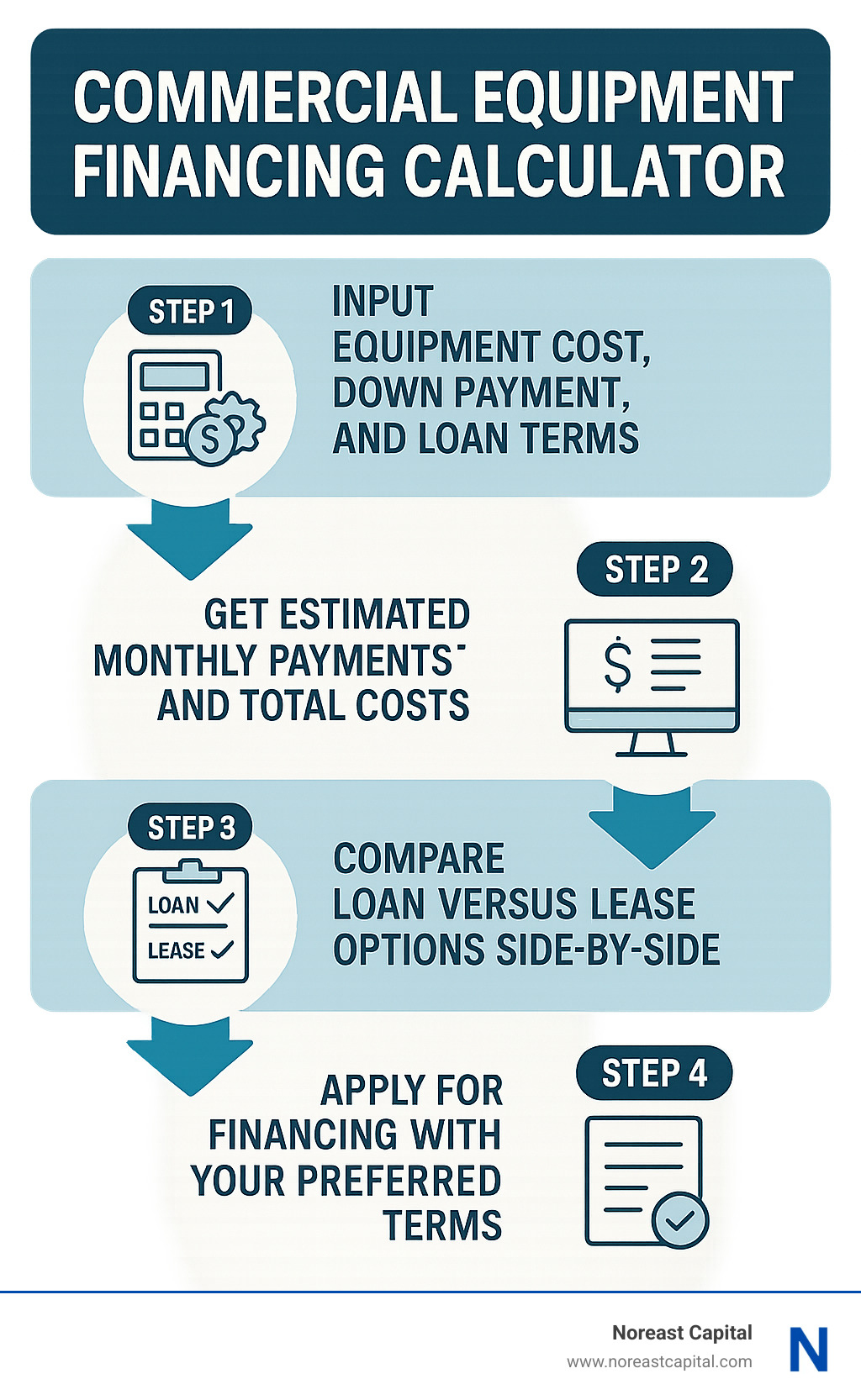
A commercial equipment financing calculator is a digital tool that helps business owners estimate monthly payments, total costs, and financing terms before committing to equipment purchases. Here’s what you need to know:
Key Calculator Functions:
- Estimate monthly payments based on equipment cost, down payment, and loan terms
- Compare financing options between loans and leases
- Calculate total interest costs over the life of the financing
- Determine affordability within your business budget
- Plan cash flow by understanding payment obligations
According to industry research, 80% of businesses lease some of their equipment, making financing calculators essential tools for comparing options and making informed decisions.
When you’re facing the choice between tying up cash in equipment purchases or preserving working capital for operations, a financing calculator becomes your strategic planning partner. It transforms complex financial equations into simple, understandable numbers that guide your business decisions.
Whether you need construction equipment, medical devices, or manufacturing machinery, these calculators help you avoid costly surprises and choose the financing structure that best fits your business model.
I’m Vincent Cerniglia, and through my experience at Noreast Capital Corporation, I’ve helped countless businesses steer equipment financing decisions using tools like the commercial equipment financing calculator. These calculators have proven invaluable for businesses ranging from small startups to Fortune 500 corporations in making strategic equipment acquisition decisions.
Basic commercial equipment financing calculator terms:
How to Use a Commercial Equipment Financing Calculator
Using a commercial equipment financing calculator provides instant insights into potential payment scenarios. It allows you to estimate monthly payments, create realistic budgets, and gain crucial financial foresight. This powerful tool helps compare different financing scenarios side-by-side, empowering you to make confident, informed decisions for your business’s future. It is the first step towards smart equipment acquisition.

Ready to give it a try? Explore our calculators:
What Information Do I Need for a Commercial Equipment Financing Calculator?
To get an accurate estimate from a commercial equipment financing calculator, you’ll need to input a few key pieces of information:
- Equipment Cost: The total purchase price of the equipment you want to acquire.
- Down Payment: The amount you pay upfront, which reduces the total financed amount and monthly payments. It can range from 0-30% of the equipment cost.
- Loan or Lease Term: The duration of your financing agreement, typically 2 to 7 years. A longer term usually means lower monthly payments but more total interest.
- Estimated Interest Rate: A ballpark interest rate (or factor rate for leases) helps fine-tune projections. Actual rates depend on many factors.
- Trade-in Value: The value of any existing equipment you’re trading in, which reduces the amount you need to finance.
To ensure a smooth application process once you’ve used the calculator, it’s wise to have these documents ready:
- Equipment Quote: A formal quote from the vendor detailing the equipment cost.
- Business Bank Statements: Lenders often review these to assess your business’s financial health and cash flow.
- Credit Score Estimate: Both your personal and business credit scores play a significant role in loan approval and interest rates, especially for loans under $350,000.
Understanding the Results from a Commercial Equipment Financing Calculator
Once you’ve plugged in your numbers, the commercial equipment financing calculator provides several crucial outputs that paint a clear financial picture:
- Estimated Monthly Payment: The amount you’ll likely pay each month. This is invaluable for budgeting and determining if the acquisition fits within your operational expenses.
- Total Principal Paid: The original equipment cost you will pay back over the term, excluding interest.
- Total Interest Paid: The total cost of borrowing over the entire term, revealing the overall financial commitment beyond the equipment’s price.
- Amortization Schedule: Some advanced calculators provide a schedule showing how each payment is split between principal and interest, offering a comprehensive view of how the debt is paid down.
- Total Cost of Financing: The sum of the total principal and interest paid, showing the complete financial outlay.
These results empower us to evaluate different scenarios. For a deeper dive into capital equipment financing, check out our Capital Equipment Finance Calculator.
What are the Limitations of a Financing Calculator?
While a commercial equipment financing calculator is a helpful planning tool, it’s important to understand its limitations. The results are estimates, not guaranteed outcomes.
Here’s what these calculators typically don’t account for:
- Estimates only: Results are illustrative and for planning purposes. They don’t guarantee actual rates or terms and are not an offer of financing.
- Not a loan offer: The calculator cannot pre-approve you. A lender determines eligibility and terms after a full application and credit review.
- Excludes fees: Most calculators don’t include additional costs like origination or documentation fees. Factor these in separately to understand the true cost.
- Excludes taxes: Estimates generally don’t include sales tax, property tax, or other applicable taxes.
- No guarantee of approval: Good estimates don’t guarantee approval. Eligibility depends on your credit profile and lender criteria.
- Credit profile impact: The calculator doesn’t know your credit history. Your actual rate will be influenced by your creditworthiness, time in business, and financial stability.
These calculations are estimates. Always seek professional advice when applying for credit, as rates and terms may change.
For a clearer picture of how these factors play out when comparing financing options, explore our Financing vs. Leasing Calculator.
Understanding Your Financing Options and Costs
Commercial equipment financing offers two main avenues: equipment loans and equipment leases. Both help businesses acquire assets without a large upfront capital outlay, but they differ in financial structure, ownership implications, and payment calculations. Understanding these differences is key to choosing the right path for your business.

Whether you’re eyeing heavy machinery or a fleet of vehicles, financing helps conserve your working capital and support your strategic goals. Explore more about:
Equipment Loans vs. Leases: What’s the Difference?
The fundamental choice in equipment financing often boils down to a loan versus a lease. While both help you get the equipment you need, their core mechanics and long-term implications are quite distinct.
Here’s a quick comparison:
| Feature | Equipment Loan | Equipment Lease |
|---|---|---|
| Ownership | You own the equipment from day one. | The leasing company (lessor) owns the equipment. |
| Upfront Cost | Requires a down payment (0-30% typically). | Often requires lower or no down payment. |
| Monthly Payments | Typically higher than lease payments. | Often lower than loan payments. |
| End-of-Term Options | You fully own the equipment once paid off. | Return, renew, or purchase the equipment (buyout options). |
Beyond this general overview, leases come in several flavors:
- Capital Lease (or Finance Lease): Similar to a loan, you use the equipment for most of its economic life and typically own it at the end. It’s treated as an asset and liability on your balance sheet, suitable for heavy machinery.
- Operating Lease: More like renting, you use the equipment for a portion of its life and then return it. It’s ideal for equipment that needs frequent upgrades, like IT hardware.
- $1 Buyout Lease: A popular option allowing you to purchase the equipment for $1 at the end of the term, spreading out payments while ensuring eventual ownership.
- 10% Purchase Lease: Similar to a $1 buyout, but you purchase the equipment for 10% of its original cost at the end of the term, resulting in lower monthly payments.
- Fair Market Value (FMV) Lease: At the end of the term, you can buy the equipment at its fair market value, return it, or renew the lease. This offers maximum flexibility and lower monthly payments.
Understanding these distinctions helps us tailor financing to our specific business needs and goals. Learn more about the nuances:
What Factors Influence Your Rates and Terms?
The “estimated interest rate” in a commercial equipment financing calculator is a placeholder. The actual rates and terms you receive are influenced by several factors that lenders evaluate.
Here are the key factors lenders consider:
- Credit Score: Your personal and business credit scores are paramount. A higher score typically means lower interest rates and better terms, especially for loans under $350,000.
- Time in Business: Lenders prefer stable businesses operating for at least 24 months with consistent revenue, as they are seen as less risky and qualify for better rates.
- Annual Revenue: Higher, consistent revenue demonstrates your ability to repay the financing and signals greater financial health.
- Industry Type: Your industry can influence a lender’s perceived risk and the terms they offer.
- Equipment Type: Lenders assess the equipment’s resale value, lifespan, and specialization. Standard equipment is often easier to finance than custom machinery.
- Equipment Age (New vs. Used): New equipment often gets better rates and longer terms. Used equipment can be financed, but terms may be shorter and rates higher.
- Down Payment Amount: A larger down payment reduces the lender’s risk and can lead to more competitive rates.
All these factors combine to determine the overall risk profile of your financing application. Understanding them helps us prepare and negotiate for the best possible terms. Curious about specific rates? Check out What is a Good Equipment Lease Rate?.
Maximizing the Benefits of Equipment Financing
Equipment financing is a smart, strategic move that helps your business grow and stay competitive. By planning carefully with a commercial equipment financing calculator, you can ensure new equipment helps you reach your business goals. It allows you to get the tools you need without depleting your cash reserves.

This smart way of thinking helps us keep our cash flowing well. It also helps us grab new chances and stay competitive. Want to learn more about how we can help? Check out our options for Capital Equipment Financing and Heavy Equipment Financing.
Key Benefits for Your Business
Commercial equipment financing offers many advantages that can help your business grow and adapt. It’s a useful tool for various financial and operational needs.
Here are some of the main benefits:
- Preserve Cash Flow: Instead of a large upfront payment, financing spreads the cost over time with manageable monthly payments. This frees up cash for daily operations, marketing, or other growth opportunities.
- 100% Financing: Many plans allow you to finance the entire cost of the equipment, often with no down payment required. This helps businesses expand without using cash reserves.
- Tax Advantages: Depending on the financing structure (loan vs. lease), you may gain significant tax benefits. With a loan, you can often deduct interest and depreciation. With a lease, the entire monthly payment may be deductible as a business expense.
- Section 179 Deduction: This tax code allows businesses to deduct the full purchase price of qualifying equipment and software in the year it is placed in service. This can lead to significant tax savings. For details, see the official IRS information on Section 179 Deduction.
- Flexible Payment Structures: Lenders can offer payment plans custom to your business’s cash flow, such as seasonal or deferred payments, to match your revenue cycle.
- Combat Inflation: Locking in a fixed monthly payment protects your business from future price increases due to inflation, making your costs predictable.
These benefits together make equipment financing a powerful way for businesses to get the tools they need. It helps them run well and find new ways to grow. For more about tax benefits, check out our Equipment Financing Tax Benefits page.
How to Reduce Your Total Financing Cost
While a commercial equipment financing calculator provides an estimate, you can take steps to lower the total cost of your financing. Smart planning is key.
Here are some ways to save money:
- Improve Credit Score: A better credit score signals lower risk to lenders, often resulting in lower interest rates. Before applying, check your credit reports, fix errors, and pay down existing debt.
- Increase Down Payment: Paying more upfront reduces the financed amount, which lowers both your monthly payments and total interest paid.
- Choose a Shorter Term: While longer terms have lower monthly payments, they accrue more interest. A shorter term, if your cash flow allows, will reduce your total interest cost.
- Negotiate Equipment Price: Negotiating a lower purchase price means you finance less, saving money on both the principal and interest.
- Shop for Rates: Always get multiple quotes. Interest rates and terms vary significantly between lenders, so shopping around can help you find the best deal.
By using these ideas, we can make our equipment financing work best for us. This helps us get the best terms and save money in the long run.
Frequently Asked Questions about Equipment Financing
Got questions about equipment financing? You’re in the right place! We’re here to break down some of the most common inquiries in a clear, easy-to-understand way. Think of us as your friendly guide through business financing.
How are equipment financing payments calculated?
Ever wonder how those monthly payments are magically figured out? It’s not magic, but a clear formula that helps you budget and plan! When we calculate your equipment financing payments, whether for a loan or a lease, we look at a few key ingredients:
First, there’s the principal amount. This is simply the cost of the equipment you’re financing, minus any upfront payment you make (like a down payment or the value of a trade-in). This is the core amount you’re borrowing.
Next, we factor in the interest rate (for loans) or a factor rate (for leases). This is essentially the cost of borrowing the money. For loans, it’s a percentage, just like a mortgage. For leases, it can be expressed as a factor that’s multiplied by the equipment cost to get your payment.
Finally, we consider the term. This is the length of your financing agreement, usually expressed in months or years. A longer term often means lower monthly payments, but you might pay more in interest over time.
For loans, payments are typically calculated using a standard amortization formula. This means that with each payment you make, a portion goes towards covering the interest, and the rest goes towards chipping away at that principal amount. For leases, the calculation can be a bit more nuanced, often involving the equipment’s residual value (what it’s estimated to be worth at the end of the lease). But don’t worry, a good commercial equipment financing calculator takes all this into account to give you a clear estimate!
What are the typical eligibility requirements for equipment financing?
When you’re looking to finance new equipment, lenders want to make sure it’s a good fit for both of you. They’ll look at a few common factors to determine your eligibility and offer you the best terms. It’s like a quick health check for your business!
First up is Time in Business. Lenders love stability, so they generally prefer businesses that have been up and running for at least 1-2 years. If you’re a startup, don’t despair – some lenders do offer specialized financing, but established businesses often find themselves with more favorable options.
Your Credit Score is also super important. Both your personal and business credit scores play a big role. While the very best rates go to businesses with excellent credit (think 680+), many lenders are willing to work with businesses that have fair or even some “less-than-perfect” credit history (say, around 600+). Why? Because the equipment itself usually acts as collateral, which helps reduce the lender’s risk.
Lenders also want to see your Annual Revenue. This shows them that your business is generating consistent income and has the financial capacity to comfortably make those monthly payments.
The Equipment Type you’re looking to finance matters too. Since the equipment often serves as collateral, lenders assess its value and how easily it could be resold if needed. This is actually a big reason why equipment financing can be easier to qualify for than other types of unsecured business loans – the asset itself backs the deal!
Lastly, you’ll likely need to provide some Financials, like business bank statements. For larger financing amounts, you might also be asked for more detailed financial statements or tax returns. These documents help paint a full picture of your business’s financial health.
Is it better to get a loan or a lease for commercial equipment?
Ah, the age-old question: loan or lease? There’s no single “better” answer, because what’s best truly depends on your unique business goals, your financial situation, and how you plan to use the equipment. It’s all about finding the perfect fit for your business!
Choose a Loan if: You’re looking for long-term ownership and want to build equity in the asset. Loans are a fantastic choice if the equipment has a long, useful life (like heavy machinery that will be with you for years) and you intend to keep it for the long haul. With a loan, you own the equipment from day one, and once it’s paid off, it’s all yours! Plus, you can often benefit from depreciation tax deductions, which can be a big win for your bottom line.
Choose a Lease if: You prefer lower monthly payments, need to upgrade equipment frequently, or like the idea of potentially expensing the payments for tax purposes. Leases are incredibly flexible and are often ideal for equipment that depreciates quickly (like technology) or if you want to minimize your upfront costs and keep more cash flowing in your business. At the end of a lease term, you usually have options: you can return the equipment, renew your lease, or even purchase it. In fact, industry statistics show that 80% of businesses choose to lease some of their equipment, highlighting its popularity for smart cash flow management.
The best choice is the one that aligns perfectly with your business’s strategy for managing assets and planning your finances. To get an even clearer picture of how different options work and what might be right for you, explore How Do Equipment Leasing Companies Work?.
Conclusion
So, what have we learned? A commercial equipment financing calculator isn’t just a fancy gadget; it’s truly a secret weapon for smart business growth. It empowers us to make smart, informed choices, turning tricky financial puzzles into clear, easy-to-understand answers. With this tool, we get the financial insight we need to budget wisely, compare all our options, and plan out those big equipment purchases.
We’ve walked through how to put in your numbers, what the results really mean, and even what the calculator can’t tell you. This knowledge puts you on a confident path. We also dug deep into the differences between equipment loans and leases, finded what affects your rates, and uncovered all the amazing benefits equipment financing brings – like keeping your cash flow healthy and snagging those tax perks.
Using a commercial equipment financing calculator is your very first step towards truly smart business growth. It’s all about taking charge of your financial future and making sure every piece of equipment you get helps your business leap forward.
Ready to make your next big move? For expert guidance and financing solutions that are just right for your unique business, we invite you to explore the options at Noreast Capital. We’re truly here to help your business get the equipment it needs to thrive and succeed.