

Finding the Perfect Commercial Kitchen Space for Your Food Business
Commercial kitchen property for rent is a specialized facility designed to meet health department requirements and equipped with commercial-grade appliances where food entrepreneurs can prepare and produce food products. These spaces offer a cost-effective solution for startups and established food businesses alike.
Quick Guide to Commercial Kitchen Rentals:
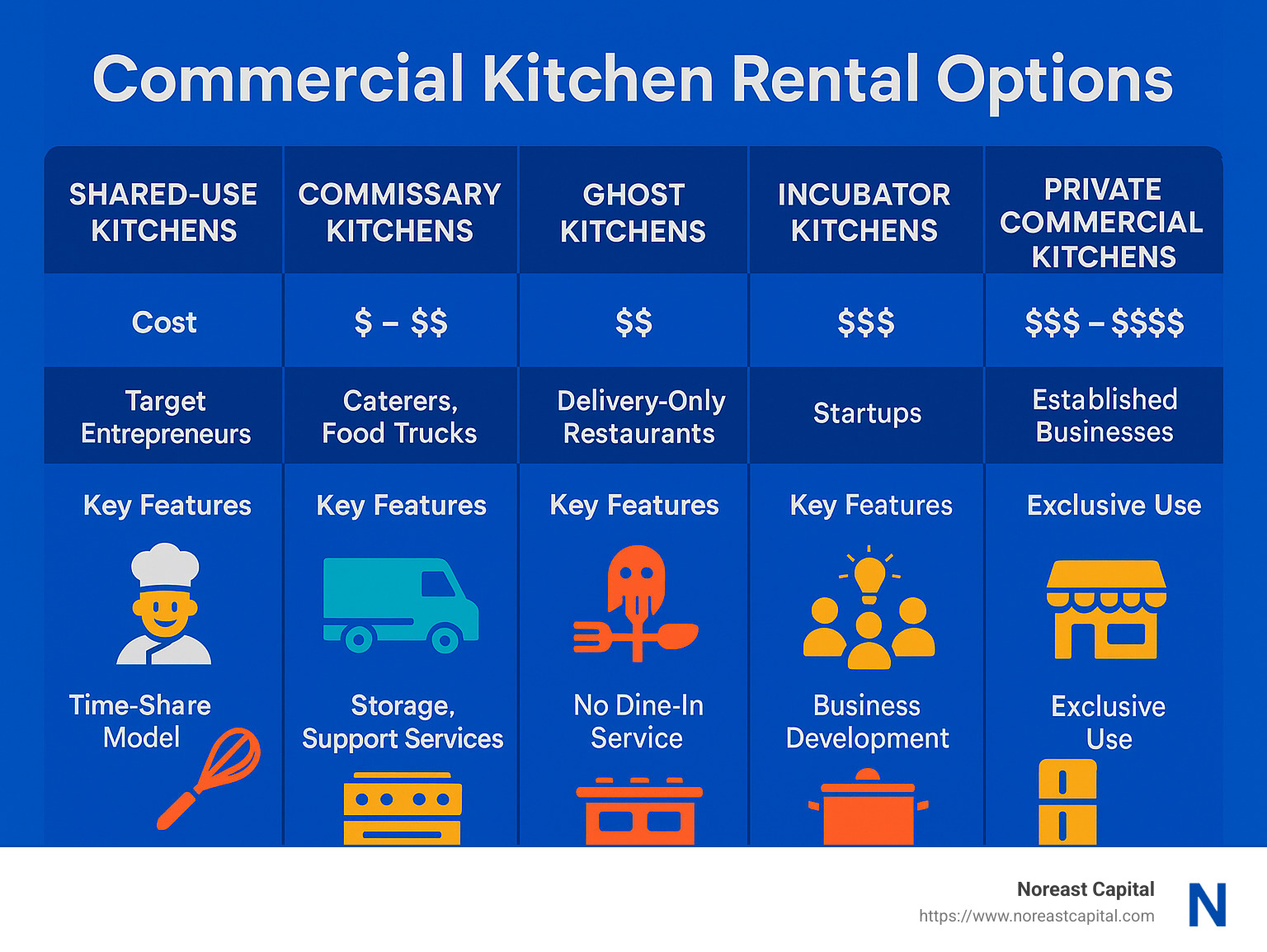
| Type | Cost Range | Best For | Key Features |
|---|---|---|---|
| Shared-Use Kitchen | $15-40/hour | Startups, part-time businesses | Flexible scheduling, shared equipment |
| Commissary Kitchen | $75,000/year (avg) | Food trucks, caterers | 24/7 access, storage options |
| Ghost Kitchen | $2,000-3,700/month | Delivery-only restaurants | Delivery optimization, minimal front-of-house |
| Incubator Kitchen | Varies by program | New food entrepreneurs | Business support, mentorship |
| Private Commercial Kitchen | $17-45/sq ft/year | Established businesses | Exclusive use, customization options |
Food entrepreneurs face significant challenges when starting or scaling their businesses, with kitchen infrastructure being one of the most substantial barriers. Commercial kitchen property for rent provides a solution by offering fully equipped, health department-approved spaces without the massive upfront investment of building your own facility.
The demand for these specialized spaces has grown dramatically in recent years, driven by the explosion of food delivery services, specialty food producers, and catering businesses. According to industry data, the average size of a commercial kitchen is around 1,051 square feet, with rental costs varying significantly based on location, amenities, and lease terms.
I’m Vincent Cerniglia from Noreast Capital Corporation, where I’ve helped numerous food entrepreneurs secure financing solutions for their commercial kitchen property for rent needs and equipment acquisitions. My experience has shown that understanding all available options is crucial for making cost-effective decisions that support business growth.
Basic commercial kitchen property for rent vocab:
– commercial kitchen for rent
– kitchen rental for cooking classes
– kitchen space to let
1. Understanding Commercial Kitchen Property for Rent
When we talk about commercial kitchen property for rent, we’re diving into specialized cooking spaces that are a lifeline for food entrepreneurs. These kitchens are not your average home setups. They’re crafted to meet strict health department regulations, decked out with commercial-grade appliances, and built to handle large-scale food production. This means they tick all the boxes for local, state, and federal food safety standards, making them a game-changer for those in the food industry.
Why are these kitchens so vital? Well, for starters, most places won’t let you sell food made in your home kitchen, unless you’re working under specific cottage food laws. Beyond just staying on the right side of the law, renting a commercial kitchen gives you access to the kind of equipment and space that lets you produce food efficiently—and at scale.
The pandemic shook things up, accelerating trends that were already gaining momentum. The demand for commercial kitchen rentals has skyrocketed as food delivery services, ghost kitchens, and specialty producers have gained traction. Renting a commercial kitchen property is your ticket to joining this booming market.
So, what do you get when you rent one of these facilities? Picture this: commercial-grade cooking equipment like ovens, ranges, and grills; ample refrigeration and freezer space; food prep areas with shiny stainless steel surfaces; and dishwashing stations with all the right sinks. Let’s not forget the ventilation systems, grease traps, and storage areas for all your dry goods and gear. And because convenience is king, there are also loading and unloading zones.
The real beauty of renting—aside from dodging the massive upfront costs of building a kitchen from scratch—is that many of these places come with pre-approved health permits. Some facilities boast that you can start cooking in less than two weeks, which is a huge win when you can’t afford to waste time.
For newcomers, these kitchens eliminate the need for a huge capital investment before you’ve even cooked your first dish. Renting gives you immediate access to professional-grade facilities without breaking the bank. And let’s not forget the community vibe that often comes with shared kitchens; they offer a network of support, collaboration, and even mentorship opportunities that can be invaluable as you grow your business.
Ready to explore options near you? Check out Commercial Kitchens For Rent Near Me.
2. Benefits and Drawbacks of Renting a Commercial Kitchen
Benefits of Renting a Commercial Kitchen
Opting for a commercial kitchen property for rent can be a game-changer for food entrepreneurs. Here’s why many find it the perfect recipe for success:
Cost-Efficiency is a major perk. Building your own commercial kitchen can cost a small fortune—up to $500,000 or more. Renting slashes these upfront costs significantly. Imagine getting started with a fully equipped space at a fraction of the price. As one kitchen owner in Columbia, SC put it, their kitchen is available for a net $75,000 per year, a much more digestible figure than starting from scratch.
Flexibility and Scalability are also big bonuses. Many kitchens offer options to rent by the hour, day, or month. This lets businesses adjust their kitchen time based on production needs—ideal for those testing the waters or dealing with seasonal demand. Take the City Center Market in Florence, for example. Their “rent-by-the-hour” model is a lifeline for small businesses trying to keep overhead low.
Then there’s the Access to Professional Equipment. Instead of buying costly appliances, renters get the luxury of using commercial-grade gear, like the property in Rydalmere, NSW that boasts a pizza oven, deep fryer, and coffee machine, all ready to go.
Plus, the Compliance and Licensing Simplified. Forget navigating the maze of health department approvals. Many kitchens come with pre-approved permits, making it quick and easy to get cooking. The Fairview Kitchens in Santa Ana, CA, are a great example—they offer pre-approved permits that let tenants hit the ground running.
Don’t overlook the Reduced Overhead and Maintenance. Shared-use kitchens often handle utilities, security, and maintenance. This bundling makes budgeting simpler and cuts down on surprise expenses.
Lastly, there are Community and Networking Opportunities. Shared kitchens are more than just spaces; they’re vibrant communities where entrepreneurs swap stories, share resources, and maybe even collaborate on projects. It’s like having a kitchen family cheering you on.
Drawbacks of Renting a Commercial Kitchen
But, like any recipe, there are a few tricky ingredients when renting a commercial kitchen property for rent.
Scheduling Limitations can be a headache. If prime slots are booked, production plans might have to change. This can be problematic for businesses with tight schedules.
Another hiccup is the Lack of Brand Identity and Customization. Rented spaces might not allow for the personal touches that some businesses rely on for branding.
And while shared equipment is great, Shared Equipment Concerns arise if others don’t follow proper protocols. Cleanliness and equipment quality can be at risk if everyone isn’t on the same page.
Potential for Scheduling Conflicts is another issue. No matter how well you plan, conflicts can disrupt your flow, leading to delays.
There’s also the challenge of Limited Storage Options. If the kitchen doesn’t offer ample storage, businesses may have to lug equipment and ingredients back and forth or pay extra for dedicated space.
Finally, Possible Location Constraints can pose problems. The perfect kitchen might not be in a spot that makes sense for your market, necessitating extra logistical planning.
Renting a commercial kitchen is like crafting a gourmet dish—it involves a balanced blend of benefits and drawbacks. Understanding both sides helps make the most of this dynamic option.
3. Types of Commercial Kitchen Properties for Rent
The market for commercial kitchen property for rent has evolved to include various specialized facilities designed to meet different business needs. Understanding these options helps entrepreneurs choose the right space for their specific requirements.

Shared-Use Kitchens
Shared-use kitchens (sometimes called community kitchens) are facilities where multiple food businesses can rent kitchen time on an hourly, daily, or monthly basis. These spaces typically provide flexible scheduling and access to commercial equipment without requiring long-term commitments.
“Shared-use kitchens not only offer fully-equipped, commercially licensed spaces but also include built‐in services like equipment maintenance, cold storage, and extra resources,” notes one industry source. This model is particularly well-suited for startups, part-time businesses, and food entrepreneurs testing new concepts.
The cost to rent a shared-use kitchen generally ranges from $15 to $40 per hour, making it an accessible entry point for new businesses. However, in expensive areas like New York or Los Angeles, rates can be significantly higher.
Commissary Kitchens
Commissary kitchens are designed specifically to serve as home bases for food trucks, caterers, and other mobile food businesses. These facilities typically offer 24/7 access, vehicle parking, waste disposal, potable water access, and extensive storage options.
One property listing in Rydalmere, NSW highlighted its suitability as a commissary: “Move in ready! F&B Retail in a Prime Location” with a “fully equipped commercial kitchen” perfect for catering operations. These spaces often charge monthly rates rather than hourly fees, with costs averaging around $75,000 per year for dedicated access.
Commissary kitchens solve the critical compliance challenge for food truck operators, who are required by most health departments to prepare and store food in licensed facilities rather than in their vehicles.
Ghost Kitchens
Ghost kitchens (also called dark kitchens or virtual kitchens) are commercial facilities optimized for food delivery rather than dine-in service. These spaces have exploded in popularity with the rise of third-party delivery platforms.
A property listing in Santa Ana, CA advertised “20 private, health department approved kitchens” ranging from 225 to 350 square feet, with rents from “$2,300 to $3,700 per month based on size.” These purpose-built spaces often include dedicated areas for delivery driver pickup and specialized packaging stations.
Ghost kitchens eliminate the need for customer-facing space, allowing restaurants to operate with significantly lower overhead while focusing exclusively on delivery and takeout orders.
Explore Ghost Kitchen For Rent options
Private Commercial Kitchens
Private commercial kitchens offer exclusive use to a single business, providing maximum control over scheduling, equipment, and space customization. These facilities typically require longer lease commitments but offer the greatest flexibility for established businesses with consistent production needs.
A listing in Caringbah, NSW advertised a “Strata Factory” with a “food grade kitchen” for $1,225 per quarter in strata levies, plus additional costs. Private kitchens generally lease for $17-45 per square foot annually, depending on location and amenities.
While more expensive than shared options, private kitchens eliminate concerns about scheduling conflicts, cross-contamination, and equipment availability that can arise in shared spaces.
Catering Kitchens
Catering kitchens are specifically designed to support high-volume, event-based food production. These facilities typically feature extensive prep space, large-capacity cooking equipment, and substantial cold storage.
“The property was previously used as a commercial catering food preparation and cooking facility,” noted one listing, highlighting its proven suitability for catering operations. These spaces often include features like loading docks, packaging areas, and ample storage for service equipment.
Find Catering Kitchen For Rent options
Incubator Kitchens
Incubator kitchens combine affordable kitchen access with business development resources, mentorship, and support services designed to help food startups grow. These mission-driven facilities often offer below-market rates and flexible terms to support entrepreneurship.
The City Center Market in Florence described their kitchen as “not just for production; it can also serve as a hub for nutrition education and training,” exemplifying the community-focused approach of many incubator kitchens. These spaces may offer graduated pricing based on business stage and often include business coaching as part of their service model.
4. How to Find Commercial Kitchen Property for Rent
Finding the right commercial kitchen property for rent can feel like searching for a needle in a haystack, but with a bit of savvy and some friendly networking, you’ll be cooking in no time. Whether you’re just starting out or looking to expand your culinary empire, here are some tried-and-true methods to help you locate the perfect kitchen space.
Online Platforms for Finding Commercial Kitchen Property for Rent
The internet is your best friend. Dedicated kitchen rental platforms serve as a great starting point. These specialized websites connect food entrepreneurs with available kitchen spaces, often allowing you to filter by location, amenities, and cost. An example is “The Kitchen Door,” a nifty service that lists shared-use commercial kitchens.
Don’t overlook commercial real estate listings like LoopNet either, which often feature spaces specifically designed for food production. These listings provide essential details, from floor plans and equipment lists to lease terms and compliance status.
For those who enjoy a good treasure hunt, social media groups and forums can be goldmines of information. Communities on Facebook, Reddit, or industry-specific forums often have listings that aren’t on mainstream platforms. You might even stumble across an informal sharing arrangement or a sweet sublease deal.
And remember, local government resources can also point you in the right direction. Cities and economic development agencies often maintain lists of available kitchens, especially those run by non-profits or government bodies.
Check out Rent Commercial Kitchen Space options
Networking and Community Engagement
As you hunt for the best kitchen space, don’t underestimate the power of good old-fashioned networking. Industry associations and food business networks can be invaluable. They often have insider knowledge about available spaces or can introduce you to kitchen owners.
Farmers markets and food events are also great places to make connections. Chat with other producers, gather intel on kitchen spaces, or even explore shared facility arrangements. These events are not just about selling produce; they’re about building community.
Culinary schools and incubator programs sometimes rent their kitchens during off-hours. These culinary institutions are often eager to support budding food entrepreneurs by offering affordable rental options.
And if you’re feeling bold, direct outreach to restaurants or community centers can be incredibly effective. Many of these institutions have kitchens that sit idle during off-peak hours and might be open to negotiating rental agreements.
Lastly, don’t forget about local real estate agents. These professionals often have their ears to the ground and might know about available kitchen spaces that haven’t hit the market yet. Having an agent on your side can also give you an edge in negotiating lease terms.
Explore Commercial Kitchen Rental Los Angeles options
With these strategies in your apron pocket, you’re well equipped to find the ideal kitchen space that meets your culinary dreams. Happy hunting!
5. Legal and Health Requirements for Renting and Operating in a Commercial Kitchen
Operating in a commercial kitchen property for rent is more than just whipping up delicious dishes—it’s also about staying within the lines of a complex web of regulations designed to keep everyone safe and healthy. Let’s break it down so you can cook up a storm without stirring up trouble.
Health Department Licensing and Inspections
First things first, every commercial kitchen needs a nod from the local health department. This isn’t just a one-time stamp of approval—it’s a regular check-up to make sure everything’s shipshape. Inspections usually focus on several key areas like food handling procedures, temperature control for both hot and cold storage, and handwashing facilities. They also check equipment cleanliness, ensure pest control measures are in place, and review waste management systems.
Some kitchens come with a bonus: pre-approved, master health permits. This can fast-track your operations, but you’ll still need to register with the health department and keep up with compliance.
Business Licensing Requirements
Beyond health approvals, getting your business up and running means jumping through a few more hoops. You’ll likely need a business license from your city or county, a sales tax permit if you’re selling food, and possibly special permits for certain items like alcohol. Don’t forget an employer identification number if you’re planning to hire staff. Requirements can vary by location, so it’s best to have a checklist custom to your area.
Insurance Requirements
Insurance might not be the most exciting part of running a kitchen, but it’s crucial. You’ll need general liability insurance to protect against customer issues, product liability coverage for any food-related incidents, and property insurance to cover your equipment. If you have employees, workers’ compensation is a must. Many rental agreements will want to see proof of this coverage, so keep those papers handy.
Food Handler Certification
Most places require at least one certified food handler or manager on site whenever you’re cooking. This usually means going through a training program and passing a test. Some areas extend this requirement to all food workers, while others stick to supervisors. It’s all about keeping your kitchen safe and sound.
Facility-Specific Compliance
Your kitchen needs to be more than just clean—it needs to be compliant with a host of regulations. This includes having proper ventilation systems, grease traps, and cleanable surfaces. You’ll also need handwashing sinks, three-compartment sinks for washing and sanitizing, and adequate refrigeration with temperature checks. In short, every corner of your kitchen should be set up to meet health codes and keep your operation running smoothly.
Allergen Management and Cross-Contamination
In shared spaces, preventing cross-contamination is crucial. This means separate storage areas, clear cleaning protocols, and allergen management plans. Scheduling different types of food prep at different times can also help keep everything safe. It’s all about ensuring what happens in one part of the kitchen doesn’t spill over into another—literally!
Record-Keeping Requirements
Finally, keeping good records is like keeping good friends—it’s invaluable. You’ll need to log things like refrigeration temperatures, cleaning schedules, and supplier information. Tracking employee training and pest control services is also important. These records aren’t just for show—they’re vital during health inspections and if there’s ever a food safety issue.
By following these guidelines, staying compliant can be, well, as easy as pie. Operating in a facility that’s built to meet all these health codes certainly takes a load off, letting you focus more on the culinary magic and less on the paperwork.
6. Evaluating Commercial Kitchen Property for Rent
Finding the perfect commercial kitchen property for rent is like cooking a gourmet meal—every ingredient counts. You need to look beyond the rental rate and dig into the details to ensure the space meets all your culinary needs. Let’s explore the key factors to keep in mind when evaluating potential kitchen spaces.
Key Factors When Evaluating Commercial Kitchen Property for Rent
Location Matters
When it comes to a commercial kitchen, location can make or break your operation. Think about how close the space is to your target market or distribution centers. Is it easy for deliveries and shipments? Consider parking availability for staff and customers, and don’t forget about zoning restrictions that might impact your business. A well-placed kitchen can help ensure smooth operations.
Equipment and Infrastructure
The heart of any kitchen lies in its equipment. You’ll want to carefully assess the type, capacity, and condition of the available cooking equipment. Check the refrigeration and freezer space, as well as the prep surfaces and work areas. Proper ventilation systems, electrical capacity, and gas line availability are also crucial. Some kitchens even come with fancy bells and whistles like loading docks or advanced waste management systems.
Space Layout and Flow
The layout of the kitchen is like the choreography of a ballet—it needs to flow smoothly. Assess the logical workflow from receiving ingredients to cooking and packing. Make sure there’s enough space between equipment for everyone to move safely. Handwashing and dishwashing stations should be well-positioned, and storage areas should be easily accessible.
Storage Concerns
Storage can be a big deal, especially in shared facilities. You’ll want to evaluate the dry storage capacity and security, as well as refrigerated and frozen storage options. Consider how you’ll store equipment between production sessions and if there’s lockable storage for valuable items.
Scheduling Flexibility
In shared kitchens, scheduling can be a juggling act. Understand the hours of operation and how the booking system works. Check the procedures for advance bookings, minimum rental periods, and cancellation policies. It’s also wise to know about peak time availability and any potential for scheduling conflicts.
Lease Terms and Financials
Beyond just the rent, look at the full financial picture. How long is the lease commitment? What’s the security deposit? Are utilities included, or will there be additional charges? Cleaning fees, shared maintenance costs, and any extra charges for storage or equipment use should also be considered.
Compliance and Health Department Status
Compliance is key to running a successful food business. Look into the kitchen’s current health department permits and ratings. Check for any history of violations or compliance issues. Understand whether maintaining these permits will be your responsibility or the landlord’s.
Extra Services and Amenities
Some kitchens come with bonus services that add real value. This might include dishwashing and cleaning services, help with receiving and inventory management, or even shared ingredient purchasing programs. Some facilities offer business support services, mentorship, or marketing opportunities, which can be a real boon.
Community Vibes
In shared environments, the people you share with can make a big difference. Look at the types of businesses using the space and consider potential synergies. Are they complementary or competitors? Consider cleanliness standards and whether there’s potential for collaboration.
Room for Growth
Finally, think about the future. Does the space allow for increased hours or dedicated space if needed? Are there expansion possibilities within the same facility? Flexibility to modify equipment or layout, along with pricing models that scale with your business growth, can make a big difference down the line.
Evaluating these factors will help you choose a commercial kitchen property for rent that not only meets your current needs but supports your business’s growth and success. For equipment needs and leasing solutions, don’t forget to check out Commercial Kitchen Equipment Lease options.
Frequently Asked Questions about Commercial Kitchen Rentals
What are the typical costs associated with renting a commercial kitchen?
When thinking about renting a commercial kitchen property for rent, understand the costs involved, which can vary quite a bit. Hourly rates for shared kitchens usually range from $15 to $40. If you’re in busy areas like New York or Los Angeles, expect to pay on the higher end of that scale. These hourly options are a great fit for businesses that only need kitchen time now and then.
On the other hand, if you’re looking at monthly rates, smaller dedicated spaces, like the ones in Santa Ana, CA, can cost between $2,000 and $3,700 a month. Larger facilities might have you looking at around $75,000 a year, much like the property in Lane Cove, NSW, which is listed at “$75,000 PA Net + GST.”
Don’t forget about the square footage pricing either. Typically, commercial real estate listings offer prices per square foot annually, ranging from $17 to $45, depending on the location and what amenities are included.
It’s also wise to be mindful of other potential costs:
– Security deposits, often equating to 1-2 months’ rent.
– Cleaning fees, which in shared kitchens can run from $25 to $50 per session.
– Storage fees, which might cost between $100 and $500 monthly for dedicated storage spaces.
– Utility charges, which can sometimes be included or might cost extra.
– Insurance requirements, with costs ranging from $500 to $2,500 annually.
A property listing mentioned additional expenses like “Council Rates: $256 per quarter, Water Rates: $220 per quarter (General) and $490 per quarter (Food Grade Commercial Waste), Strata Levies: $1,225 per quarter.” It’s crucial to calculate these ongoing costs into your business planning.
How can equipment financing solutions support the setup of a commercial kitchen?
Setting up a kitchen, even in a rented space, often requires some extra gear. That’s where equipment financing can step in and save the day!
Preserving working capital is one of the big perks. By financing through Noreast Capital, you can get the equipment you need without draining your cash reserves. This freed-up cash can tackle other business essentials like ingredients, marketing, and staffing.
Another advantage is matching costs to revenue. Financing allows you to spread the cost of equipment over time, aligning it with the revenue it helps to generate. This can make managing cash flow a breeze for growing businesses. Plus, there are tax advantages—many lease payments are deductible as business expenses, though it’s always wise to check with your tax advisor.
When it comes to equipment customization, financing offers the flexibility to add specialized tools without making permanent changes to your rented kitchen space.
And let’s not forget scalability. As your business expands, financing makes it easier to upgrade or acquire new equipment without a significant capital outlay, supporting growth within your existing rented facility.
At Noreast Capital, we’re all about helping food entrepreneurs find the right equipment financing solutions to complement their commercial kitchen property for rent, ensuring they can cook up success while keeping their cash flow healthy.
Explore Commercial Kitchen Equipment Lease options
What should be considered when evaluating a commercial kitchen rental?
Choosing the right commercial kitchen property for rent involves a few key considerations. First, think about your production requirements. Does the space meet your specific needs, whether you’re a baker, sauce maker, or caterer?
Next, check scheduling compatibility. Make sure the available rental times work with your production schedule and business model. Some businesses need consistent access, while others operate seasonally or for particular events.
Your budget should also align with the complete cost picture, including rent, utilities, insurance, and any additional charges. It’s essential to ensure the space fits within your financial plan.
Don’t overlook growth potential. Consider if the facility can accommodate your business as it expands, through additional hours, more space, or equipment upgrades.
Equally important is confirming the compliance status of the kitchen. It should meet all relevant health department requirements and have a clean inspection history, as compliance issues can cause operational disruptions.
Review the contract flexibility carefully. Look for terms that offer the right amount of flexibility for your business stage, including minimum commitments, cancellation policies, and renewal options.
Location logistics are also crucial. Evaluate how the kitchen’s location impacts distribution, staffing, and ingredient sourcing, keeping in mind factors like traffic patterns and parking availability.
As one industry expert advises, it’s wise to physically inspect the space and verify the condition of the included equipment before making any commitments. This hands-on approach will help you make an informed decision about any kitchen rental.
Conclusion

Finding the perfect commercial kitchen property for rent is a vital step for any food business aiming to grow and thrive. In recent years, the variety of available options has blossomed, offering food entrepreneurs more choices than ever before. Whether you’re seeking hourly rentals in a shared kitchen or a dedicated private space, there’s something to fit every need and budget.
Renting instead of building comes with many perks. You’ll face significantly lower upfront costs, enjoy reduced maintenance responsibilities, and get access to facilities already equipped with professional-grade equipment and compliance features. As one kitchen operator happily noted, these spaces help “lower cost barriers for start-up small food businesses” while also offering “a space for nutrition education and training.”
But let’s be clear—success isn’t just about finding any kitchen. It’s about finding the right kitchen. This takes planning and a keen eye for detail. Think about the location of the kitchen, the equipment available, the flexibility of scheduling, and the terms of the lease. These factors can make all the difference in how smoothly your operations run and how much room you have to grow. Taking the time to evaluate these elements can help prevent costly mistakes and operational hiccups down the line.
For many food entrepreneurs, combining a well-chosen commercial kitchen property for rent with strategic equipment financing from Noreast Capital can be a winning formula. Renting gives you the infrastructure you need, while financing offers customization through specialized equipment—without draining your cash reserves. This approach allows you to focus on what matters most: your ingredients, marketing, and growth.
The best kitchen is one that meets your current needs and can grow with your business. Whether you’re a caterer needing flexible hourly space, a food truck operator looking for a base, or a specialty food producer in need of dedicated facilities, the right rental can set the stage for your culinary success.
Here at Noreast Capital, we know the challenges food entrepreneurs face in places like Washington DC, Baltimore, and Annapolis. We’re here to offer equipment financing solutions custom to your kitchen rental strategy, helping you build a successful and sustainable food business without stretching your resources too thin.
Explore Commercial Kitchen For Rent options
From prep to plate, every ingredient counts. Make sure your kitchen foundation is one that supports your business recipe perfectly.