

Why Commercial Vehicle Leasing Is Changing Fleet Management
Commercial vehicle lease options provide businesses with flexible alternatives to purchasing fleet vehicles outright, offering predictable monthly payments while preserving cash flow for core operations.
Key Commercial Vehicle Lease Options:
– Open-End Lease – No mileage restrictions, lessee assumes residual risk
– Closed-End Lease – Fixed payments, walk-away option at lease end
– Full-Service Lease – Includes maintenance, insurance, and roadside assistance
– Operating Lease – Off-balance sheet treatment, lower monthly costs
– Finance Lease – Path to ownership, asset appears on balance sheet
Most commercial vehicle leases run 24 to 48 months and cover everything from cargo vans to heavy-duty trucks. Since 2005, full-service lease customers have experienced 98% vehicle uptime, making leasing an attractive option for businesses that need reliable transportation without the burden of ownership.
The leasing market has evolved significantly, with providers now offering customizable terms that match specific business needs. Whether you’re running a delivery service needing high-mileage flexibility or a construction company requiring heavy-duty equipment, there’s likely a lease structure that fits your operational requirements and budget constraints.
As Vincent Cerniglia from Noreast Capital Corporation, I’ve helped businesses nationwide steer commercial vehicle lease options for years, working with companies ranging from small startups to Fortune 500 corporations. My experience as a direct lender has shown me how the right lease structure can transform a company’s cash flow and operational efficiency.
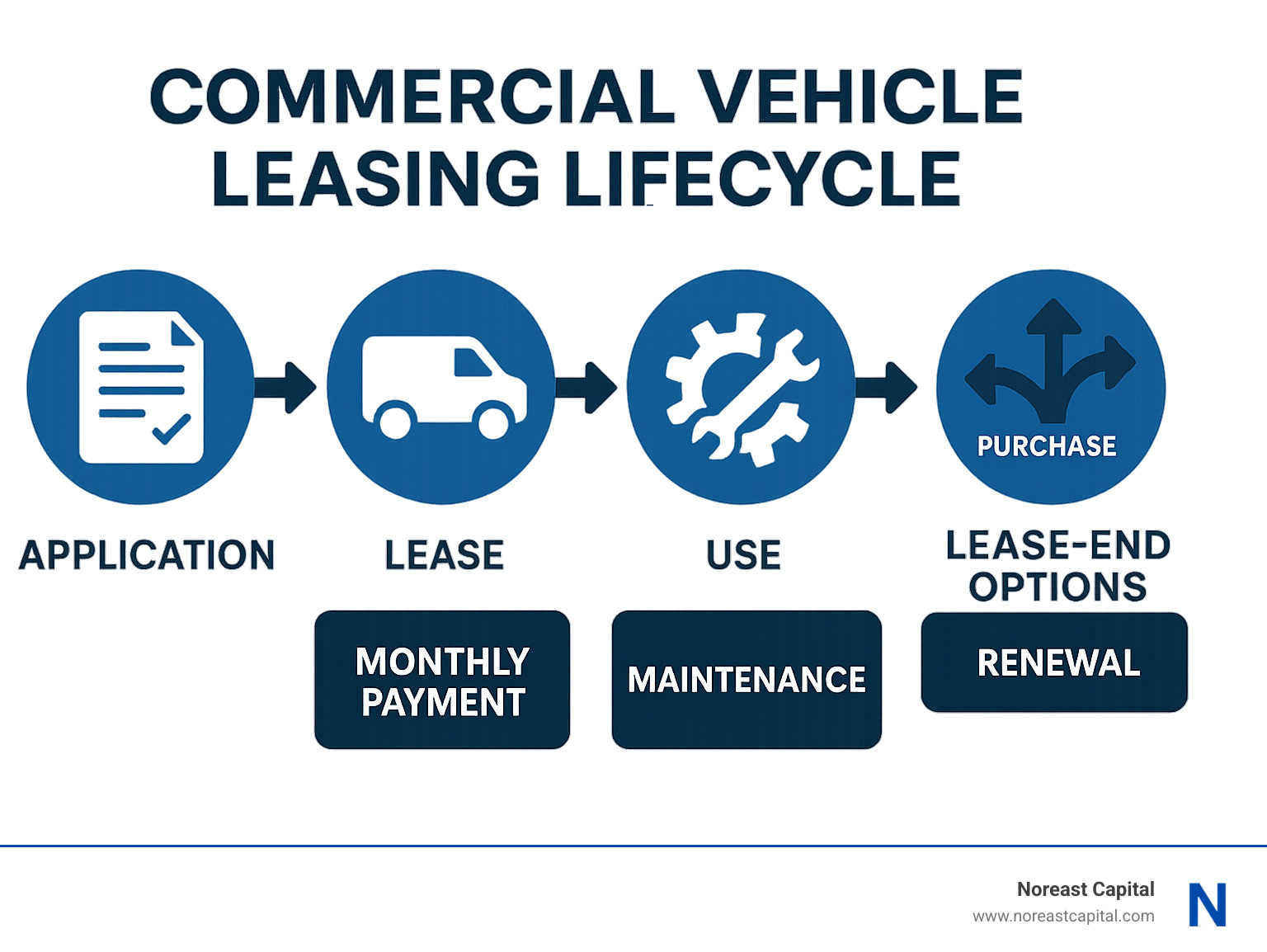
Commercial vehicle lease options terms to know:
– Car lease terms explained
– Car lease negotiation strategies
– Car leasing for businesses
Commercial Vehicle Lease Options Explained
Think of commercial vehicle lease options as smart alternatives to buying vehicles outright. Instead of draining your bank account for a $60,000 delivery truck, you can use that same truck for a fraction of the cost while keeping your cash free for growing your business.
The concept is straightforward: you pay for what you actually use. When you lease, you’re covering the vehicle’s depreciation during your lease term, plus interest and fees. It’s like paying for the “wear and tear” rather than the entire vehicle.
Commercial vehicle lease options work beautifully for all types of businesses. We’ve helped local florists lease cargo vans for flower deliveries and construction companies get heavy-duty trucks for job sites. Most lease terms run 24 to 48 months, giving you the flexibility to upgrade your fleet as your business grows.
Here’s what you need to know about responsibilities: you’ll typically handle insurance and routine maintenance unless you choose a full-service lease that bundles everything together. The tax benefits are often attractive too – lease payments usually count as operating expenses, and under ASC 842 accounting standards, many operating leases can stay off your balance sheet.
For a deeper dive into business leasing basics, our guide on Car Leasing for Businesses covers everything you need to know.
What is commercial vehicle leasing and how does it work?
Commercial vehicle leasing is essentially a long-term rental with a business twist. You get to use the vehicle you need without the hefty upfront cost of ownership.
The magic happens in how payments work. You’re paying for depreciation only – the difference between what the vehicle costs new and what it’s worth when you return it. According to Federal Reserve research on vehicle depreciation, commercial vehicles typically lose 15-25% of their value in the first year alone.
This approach transforms your cash flow. Instead of writing a $50,000 check, you might pay $700 monthly and use the remaining $43,000 to hire staff, buy inventory, or expand your business. Many operating leases also qualify for off-balance-sheet treatment, which can make your company’s financial ratios look healthier to lenders and investors.
Commercial vehicle lease options for different vehicle classes
Different businesses need different vehicles, and lease structures adapt accordingly. Light-duty cargo vans work perfectly for delivery services and contractors who need reliable transportation without breaking the budget.
Medium-duty box trucks serve moving companies and local distributors well. These vehicles, weighing between 10,001 and 26,000 pounds, often require more specialized maintenance considerations that can be bundled into full-service leases.
Heavy-duty tractors and specialty rigs over 26,000 pounds serve long-haul trucking and construction industries. These workhorses often benefit from open-end lease structures because they rack up serious mileage and their residual values can be harder to predict.
Choosing the Right Lease Structure

Picking the right lease structure can make or break your fleet management strategy. Think of it like choosing the right tool for a job – you wouldn’t use a hammer to fix a watch, and you shouldn’t pick a lease structure that doesn’t match how you actually use your vehicles.
The biggest decision you’ll face is between open-end and closed-end leases. Open-end leases give you complete freedom with no mileage limits, but you’re taking on the risk of what the vehicle will be worth at the end. Closed-end leases are the opposite – you get predictable payments and can walk away at the end, but you’ll pay penalties if you drive too much or beat up the vehicle.
Then there’s the question of full-service versus basic leasing. Full-service leases bundle everything together – maintenance, insurance, sometimes even fuel cards. Your monthly payment goes up, but you get to focus on running your business instead of managing vehicle repairs. It’s like having a personal assistant for your fleet.
Operating leases keep vehicles off your balance sheet and typically cost less monthly, while finance leases put you on a path to ownership. The customization options and mileage flexibility you need will help determine which direction makes sense.
For a deeper dive into lease terminology, check out our guide on Car Lease Terms Explained.
| Lease Type | Mileage Restrictions | Residual Risk | Monthly Cost | Best For |
|---|---|---|---|---|
| Open-End | None | Lessee | Lower | High-mileage fleets |
| Closed-End | Yes | Lessor | Higher | Predictable usage |
| Full-Service | Varies | Varies | Highest | Simplified management |
Open-End vs Closed-End Commercial Vehicle Lease Options
The choice between open-end and closed-end commercial vehicle lease options really comes down to one question: how much risk are you comfortable taking on?
Open-end leases put you in the driver’s seat, literally and figuratively. There are no mileage restrictions, so your delivery drivers can take the scenic route without you worrying about penalty fees. You can install custom equipment, paint your company logo however you want, and generally treat the vehicle like you own it.
The catch? At the end of the lease, if the vehicle is worth less than expected, you pay the difference. But here’s the flip side – if it’s worth more, you get that money back. It’s like a bet on how well you’ll maintain the vehicle and what the used vehicle market will look like in a few years.
Closed-end leases are for businesses that want to sleep well at night. You make the same payment every month, and when the lease ends, you hand back the keys and walk away. No surprises, no extra bills, no need to become an expert on used vehicle values.
The trade-off is restrictions. Drive more than the agreed mileage (usually 12,000-15,000 miles per year), and you’ll pay around 15 to 25 cents per extra mile. Return the vehicle with more wear and tear than normal, and you’ll get a bill for that too. But for many businesses, the predictability is worth these limitations.
Flexible terms & end-of-lease choices
Modern leasing isn’t the rigid, one-size-fits-all arrangement it used to be. Today’s commercial vehicle lease options adapt to your business like a good pair of work boots – comfortable and built for what you actually do.
When your lease ends, you’re not stuck with just one option. You can buy the vehicle at the predetermined price if it’s been a reliable workhorse. Many businesses do this with vehicles that have been customized for their specific needs.
If you’re not ready to buy but need more time, most leases offer month-to-month extensions. This gives you breathing room to decide on your next move without scrambling to find replacement vehicles.
The lease-and-upgrade path is popular with businesses that want the latest technology and safety features. You return your current vehicle and lease a newer model, often with improved fuel efficiency or updated safety systems.
For closed-end leases, you always have the simple return option. Just make sure the vehicle meets the return conditions, and you’re done.
Some leasing companies now offer early upgrade programs too. If a newer model would significantly benefit your operations – maybe it gets better fuel economy or has safety features that could lower your insurance costs – you might be able to upgrade before your current lease expires. It’s worth asking about when you’re negotiating your lease terms.
Calculating Lease Costs & Managing Cash Flow
Getting a handle on lease costs isn’t just about knowing your monthly payment – it’s about understanding how those payments are calculated and how they fit into your bigger financial picture. When you break down the numbers, commercial vehicle lease options become much easier to compare and negotiate.
Your monthly payment is built from several key pieces. The capitalized cost is essentially the vehicle’s selling price, including any extras you’ve added. The residual value is what the vehicle is expected to be worth when your lease ends. The money factor is the interest rate in disguise (divide it by 2,400 to see the actual percentage).
Smart cash flow management means looking beyond just that monthly number. You’ll need to budget for insurance, maintenance, fuel, and potentially some end-of-lease charges. The beauty of leasing is that these costs are mostly predictable, making it much easier to plan your finances months or even years ahead.
Tax planning gets interesting with leases. Operating lease payments are typically fully deductible as business expenses, which can provide significant tax benefits. Finance leases work differently – you might need to handle depreciation schedules instead.
For a practical look at how these calculations work in real life, check out our detailed example in Lease Payment on 40k Car.
New vs. Used Commercial Vehicle Lease Options
The new versus used decision often comes down to balancing monthly costs against reliability and features. Both options have their sweet spots depending on your business needs.
New vehicles give you the latest technology, full warranty coverage, and that peace of mind that comes with knowing you’re the first owner. The downside? You’re paying for the steepest part of the depreciation curve.
Used vehicle leases can slash your monthly payments by 20-30% compared to new vehicles. The depreciation curve is much gentler, so more of your payment goes toward actually using the vehicle rather than watching it lose value.
How lease payments are calculated
Understanding the math behind your lease payment puts you in a much stronger negotiating position. It’s actually more straightforward than most people think.
The basic calculation starts with your capitalized cost (the vehicle price) minus the residual value (what it’ll be worth later). Divide that by your lease term to get your depreciation payment. Then you add the finance charge, which is calculated by multiplying the sum of the capitalized cost and residual value by the money factor.
Here’s what else gets added to your monthly bill: acquisition fees typically run $500-1,000, though some lessors waive these for qualified customers. Security deposits are becoming less common, especially if you have good credit.
The good news is that several of these components are negotiable. The capitalized cost works just like negotiating a purchase price. Money factors can vary based on your credit and the lease terms you choose.

Provider Selection, Services, and Compliance

Finding the right leasing provider is like choosing a business partner – you want someone who understands your industry and will be there when things get tough. The cheapest monthly payment isn’t always the best deal if it comes with poor service or hidden fees.
I’ve watched businesses save thousands by choosing providers who offered comprehensive support services rather than just basic leasing. The peace of mind that comes with knowing your fleet is professionally managed often outweighs the extra monthly cost.
Credit requirements vary dramatically between providers. Some work exclusively with businesses that have pristine credit, while others specialize in helping companies with past financial challenges.
Modern commercial vehicle lease options often include advanced services like telematics systems that track vehicle performance and driver behavior. These systems can help you identify maintenance issues before they cause breakdowns and improve overall fleet safety.
For businesses looking at broader equipment financing solutions beyond vehicles, our guide on Commercial Finance Equipment Leasing covers additional options.
Evaluating added services: maintenance, roadside, fleet management
The decision between basic leasing and full-service packages often comes down to one question: Do you want to be in the transportation business or the fleet management business?
Maintenance programs can be game-changers for businesses that lack in-house mechanical expertise. The best programs guarantee uptime levels – some providers achieve 98% vehicle availability through proactive maintenance scheduling.
24/7 roadside assistance becomes critical when your vehicles operate outside normal business hours. Quality programs offer nationwide coverage with guaranteed response times, mobile repair services, and emergency towing.
Fleet management services have evolved far beyond simple GPS tracking. Modern systems provide fuel management programs, driver training modules, and compliance monitoring that can significantly improve operational efficiency.
The key is honestly evaluating your internal capabilities. If fleet management distracts from your core business, full-service programs often provide excellent value despite higher monthly costs.
Can businesses with imperfect credit access commercial vehicle lease options?
Absolutely, and don’t let anyone tell you otherwise. The commercial leasing market includes plenty of providers who understand that credit scores don’t tell the whole story about a business’s ability to succeed.
Tiered approval systems consider much more than just credit scores. Providers evaluate your business cash flow, industry experience, available collateral, and overall relationship potential.
Alternative structures can help bridge credit gaps. Higher security deposits demonstrate commitment and reduce provider risk. Shorter lease terms of 24 months instead of 48 months make providers more comfortable.
The approval process doesn’t have to be intimidating. For detailed strategies on improving your chances and understanding what providers look for, check out our comprehensive guide on Car Lease Approval Process.
Providers want to say yes – they make money by leasing vehicles, not by turning away potential customers. Being upfront about credit challenges and demonstrating how leasing fits into your business plan often leads to creative solutions that work for everyone involved.
Frequently Asked Questions about Commercial Vehicle Lease Options
What are the common misconceptions about leasing?
I’ve heard every leasing myth in the book during my years helping businesses steer commercial vehicle lease options. Let me set the record straight on the biggest misconceptions that trip up business owners.
“Leasing always costs more than buying” is probably the most persistent myth out there. This thinking completely ignores what your cash could be doing elsewhere in your business. If you lease three vehicles in a row, you might pay more total dollars than buying one truck outright. But what if that $50,000 you didn’t spend on a truck earned you $100,000 in new contracts instead?
I’ve watched countless businesses grow faster because they kept their capital working in their core operations rather than tied up in depreciating vehicles. The real question isn’t about total cost – it’s about return on investment.
“You’re just throwing money away with nothing to show for it” makes me chuckle every time. You’re not buying a trophy – you’re purchasing reliable transportation for your business. When you lease, you’re paying for exactly what you need: the ability to serve your customers and generate revenue.
Think about it this way – when you pay rent for your office space, are you “throwing money away”? Of course not. You’re paying for a service that enables your business to operate. Vehicle leasing works the same way.
“Lease restrictions will strangle my business” simply isn’t true with today’s flexible lease structures. Open-end leases eliminate mileage penalties entirely. Many providers happily accommodate business modifications and custom equipment installations. The trick is choosing the right lease type for how you actually use your vehicles.
How do taxes work on leased commercial vehicles?
The tax benefits of leasing often surprise business owners – in a very good way. Commercial vehicle lease options typically offer more immediate tax advantages than purchasing.
Operating leases are beautifully simple from a tax perspective. Your monthly lease payment is usually 100% deductible as a business expense. No complicated depreciation schedules to track. No arguing with your accountant about useful life estimates. Just clean, straightforward deductions that reduce your taxable income dollar for dollar.
Finance leases work differently because the IRS treats them more like purchases. The vehicle shows up on your balance sheet as an asset, and you’ll depreciate it over time while deducting the interest portion of your payments. This might give you larger total deductions eventually, but you won’t get the immediate tax relief that operating leases provide.
Here’s where it gets interesting: Section 179 and bonus depreciation can sometimes make purchasing look attractive on paper. These provisions let you deduct large portions of a vehicle’s cost in the first year. However, they tie up your cash and saddle you with ownership responsibilities.
My advice? Talk to your tax professional about your specific situation. Every business is different, and tax laws change regularly. What works for your neighbor’s construction company might not work for your delivery service.
What happens if I need to exit a lease early?
Life happens, and sometimes businesses need to change direction quickly. Early lease termination isn’t ideal, but it’s definitely possible with the right approach.
Your options typically include paying early termination fees, which usually means covering the remaining payments plus penalties. It’s expensive, but sometimes necessary when business circumstances change dramatically.
Lease transfers can be a lifesaver if your provider allows them. We’ve helped businesses transfer leases to other qualified companies when their needs changed. It’s not always possible, but it’s worth exploring before paying termination fees.
Voluntary repossession sounds scary, but it’s sometimes the most practical option. You return the vehicle and pay any remaining balance after the lessor sells it. The key is working cooperatively with your leasing company to minimize additional costs.
Negotiating a settlement often works better than you’d expect. Most lessors would rather work out a reasonable solution than deal with repossession and remarketing costs. Be honest about your situation and propose alternatives.
The best defense against early termination costs is choosing shorter lease terms when your business future is uncertain. A 24-month lease costs more monthly than a 48-month lease, but it gives you much more flexibility.
I’ve seen businesses need early termination for all sorts of reasons: rapid growth requiring bigger vehicles, economic downturns forcing fleet reductions, or new regulations making current vehicles obsolete. The key is communicating early and honestly with your leasing provider. Most of us would rather find creative solutions than fight over termination fees.
Conclusion

Choosing the right commercial vehicle lease options can be a game-changer for your business. It’s not just about getting vehicles on the road – it’s about finding a solution that keeps your cash flow healthy while giving you the flexibility to grow and adapt.
Think of leasing as your business’s secret weapon. When you’re not tying up huge chunks of capital in depreciating assets, you free up money for the things that really drive growth. Whether that’s hiring new employees, expanding your services, or simply having a safety net for unexpected opportunities.
The beauty of today’s leasing market is that there’s truly something for everyone. Open-end leases work perfectly if your delivery routes change with the seasons or your business is growing faster than you can predict. Closed-end leases give you peace of mind when you want predictable costs and the freedom to walk away. Full-service packages take the headache out of fleet management when you’d rather focus on your customers than oil changes and tire rotations.
We’ve seen businesses transform their operations by making smart leasing choices. The small plumbing company that went from one beat-up truck to a professional fleet of service vans. The growing logistics firm that scaled from local deliveries to regional distribution without breaking the bank. The construction contractor who upgraded to newer, safer equipment while keeping monthly costs manageable.
Even if your credit isn’t perfect, don’t give up. The commercial leasing world has evolved to work with businesses across the credit spectrum. Sometimes it takes a bit more creativity – maybe a larger security deposit or a shorter term – but there’s usually a path forward.
At Noreast Capital, we’ve spent years helping businesses in Maryland, DC, and the surrounding region find the right financing solutions. We understand that every business is different, and cookie-cutter approaches rarely work. That’s why we take the time to understand your specific needs and craft solutions that make sense for your situation.
The decision between leasing and other financing options shouldn’t keep you up at night. Focus on what makes sense for your business today while keeping an eye on where you want to be tomorrow. For a deeper dive into comparing your options, check out our comprehensive guide on Leasing vs. Financing.
The best lease isn’t necessarily the one with the lowest monthly payment – it’s the one that supports your business goals and gives you room to grow. Take your time, ask questions, and work with people who understand your industry and your challenges.
Your fleet should work as hard as you do. With the right leasing strategy, it will.