

Understanding Your 1099 Obligations for Equipment Rentals
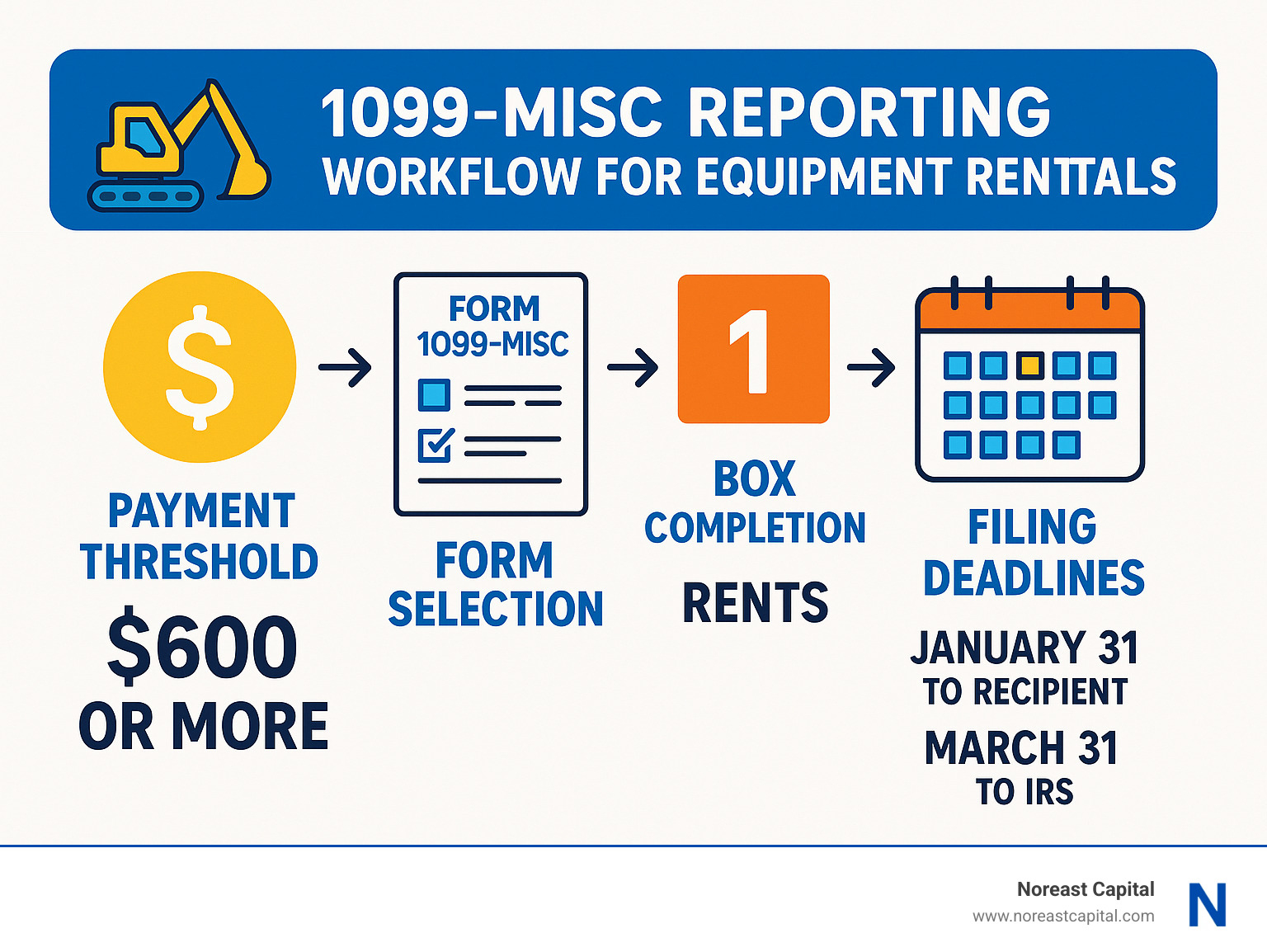
Do I need to send a 1099 for equipment rental? Yes, if you paid $600 or more to a non-corporate entity for equipment rentals during the calendar year as part of your trade or business.
Here’s the quick answer to whether you need to issue a 1099 for equipment rental:
| Requirement | Details |
|---|---|
| Form to Use | Form 1099-MISC (not 1099-NEC) |
| Box to Complete | Box 1 (Rents) |
| Threshold | $600 or more in a calendar year |
| Due to Recipient | January 31 |
| Due to IRS (Paper) | February 28 |
| Due to IRS (Electronic) | March 31 |
| Exceptions | Payments to corporations, payments via credit card/third-party networks |
Let’s be honest – tax compliance probably isn’t what gets you out of bed in the morning. But understanding when to issue a 1099 for equipment rentals can save you from costly penalties and IRS headaches.
Equipment rental payments often trigger 1099 reporting requirements that many businesses overlook. Whether you’re renting a bulldozer for a week or a copier for the year, these transactions might require you to file paperwork with the IRS.
I’m Vincent Cerniglia from Noreast Capital, where I’ve helped countless businesses steer the complexities of equipment financing, leasing, and the associated tax reporting requirements including when do I need to send a 1099 for equipment rental. At Noreast Capital, we not only provide equipment financing solutions but also guide our clients through compliance requirements to ensure their businesses operate smoothly.
Do i need to send a 1099 for equipment rental terms explained:
– does equipment rental go on 1099 misc or 1099 nec
– is equipment rental 1099 reportable
– issue 1099 for equipment rental
Do I Need to Send a 1099 for Equipment Rental? Quick Answer
The short answer is yes – if you’re in a trade or business and you paid $600 or more to a non-corporate entity for equipment rentals during the calendar year, you need to report these payments on Form 1099-MISC, Box 1 (Rents).
Let me explain this with a real-world example that might sound familiar:
John, a construction contractor in Baltimore, occasionally rents specialized equipment for his projects. Last year, he rented a mini-excavator three separate times from a local equipment rental company (a partnership) – paying $300 in March, $450 in July, and $200 in October. None of these individual payments crossed the $600 mark, but together they added up to $950 for the year. This total triggered the 1099-MISC reporting requirement.
“I had no idea I needed to track cumulative payments,” John told us. “I learned the hard way when my accountant flagged this during tax prep. Now I keep a running total for each vendor in my accounting software.”
The IRS is quite clear about this in their Form 1099-MISC Instructions – what matters is the calendar-year total to each vendor, not individual transaction amounts.
Which 1099 form covers equipment rental?
This is where many businesses make a costly mistake. Equipment rentals are reported on Form 1099-MISC, Box 1 (Rents) – not on Form 1099-NEC, which is reserved exclusively for nonemployee compensation.
As Philip Perkins, a tax professional, notes: “The most common mistake I see clients make is misclassifying equipment rental payments on the wrong form. They often put these payments on Form 1099-NEC instead of Form 1099-MISC, Box 1. This misclassification can lead to IRS notices and potential penalties.”

The distinction matters because payments reported on Form 1099-NEC are subject to self-employment tax (currently 15.3%), while rental payments on Form 1099-MISC are not. Misclassifying a $10,000 equipment rental as nonemployee compensation could potentially cost the recipient an extra $1,530 in taxes! That’s a misclassification risk you definitely want to avoid.
Do I need to send a 1099 for equipment rental of less than $600?
No – the IRS only requires reporting when your total payments to a single vendor reach or exceed $600 during the calendar year. This is known as the de minimis rule.
However, there’s an important nuance here that trips up many business owners: the $600 threshold applies to cumulative payments to the same vendor during the calendar year, not to individual transactions.
For example, if you rent a pressure washer for $200 in April, a floor sander for $250 in July, and a concrete mixer for $175 in November from the same rental company, your total payments ($625) would exceed the $600 threshold, requiring a 1099-MISC filing.
Sarah, a small business owner in Annapolis, shared: “I started tracking cumulative rental payments after I missed filing a required 1099. I now set up automatic alerts in my accounting system when vendors approach the $600 threshold.”
This approach is particularly important for partial-year rentals where you might not realize you’ve crossed the threshold until it’s time to prepare your taxes – at which point you’re scrambling for vendor information that should have been collected months earlier.
Thresholds, Exceptions & Special Cases
Navigating 1099 reporting for equipment rentals can feel like walking through a tax maze. While the basic rules seem straightforward, there are several twists and turns that might catch you by surprise. Let’s explore these exceptions together in plain language.
Payments to corporations and LLCs taxed as corporations
Here’s a breath of fresh air for your paperwork load: you generally don’t need to issue a 1099-MISC for equipment rental payments made to corporations, no matter how much you paid them.
This exemption covers payments to:
– C corporations
– S corporations
– LLCs that have elected to be taxed as corporations
Mark, a builder I spoke with in Washington DC, shared his relief: “I saved hours of paperwork when I finded many of my equipment vendors were corporations. Now I collect W-9 forms upfront from all vendors to quickly identify which ones actually require 1099s.”
But here’s the catch – you can’t just assume a vendor is a corporation. You need proof. The best approach is to get a completed Form W-9 before you cut that first check. This form reveals whether your vendor is a corporation and provides their Tax Identification Number (TIN) that you’ll need for proper 1099 reporting. Think of it as your safe harbor in the sometimes choppy waters of tax compliance.

Mixed contracts: equipment + operator services
Here’s where things get interesting. What happens when you rent not just a piece of equipment, but also the person who operates it? For instance, you might rent a crane that comes with a crane operator.
In these cases, the IRS wants you to split the baby (figuratively, of course):
– The equipment portion goes in Box 1 of Form 1099-MISC (Rents)
– The operator’s services go in Box 1 of Form 1099-NEC (Nonemployee Compensation)
As the IRS instructions for Form 1099-MISC state: “If the machine rental is part of a contract that includes both the use of the machine and the operator’s services, prorate the rental between the rent of the machine (report that in box 1) and the operator’s charge (report that as nonemployee compensation in box 1 of Form 1099-NEC).”
Sarah from Virginia told me about her experience: “We hired a crane with an operator for a $5,000 job. Thankfully, the vendor’s invoice clearly split the costs: $3,200 for equipment and $1,800 for the operator. We reported these amounts on separate 1099 forms as required.”
If your invoice doesn’t break down these charges separately, you’ll need to make a reasonable allocation based on fair market values. This fair-value split helps ensure you’re reporting accurately and not accidentally misclassifying payments that could trigger IRS scrutiny.
Rentals paid via credit cards or apps
Now for some genuinely good news that might make your day: if you paid for equipment rentals using a credit card, debit card, or business payment app (like PayPal Business or Venmo Business), you do not need to issue a 1099-MISC at all.
Why this wonderful exception? Because these payments are already being reported to the IRS by the payment processor on Form 1099-K. Having you report them too would be like telling the IRS the same story twice.
Michael, a contractor from Baltimore, couldn’t hide his relief when learning about this: “About 80% of our equipment rentals are paid by company credit card. This significantly reduced our 1099 filing burden once we understood this exception.”
This 1099-K supersedes rule applies regardless of how much you paid or what type of business entity received your payment. It’s one of those rare instances where using plastic actually simplifies your tax life rather than complicating it.

When considering whether do I need to send a 1099 for equipment rental, don’t forget about vehicle and tool rentals, which follow the same rules. Lease-to-own arrangements have special considerations since they might eventually transfer ownership. And self-rental situations (renting equipment to your own business) have their own set of rules entirely.
For a deeper dive into these scenarios, check out Do You Need to Issue a 1099 for Equipment Rental? for more specific guidance custom to your situation.
Filing, Deadlines, Penalties & Recordkeeping
Let’s face it – tax deadlines aren’t exactly circled on your calendar with hearts and smiley faces. But understanding when and how to file 1099 forms for equipment rentals could save you from some serious headaches (and wallet-aches) down the road.
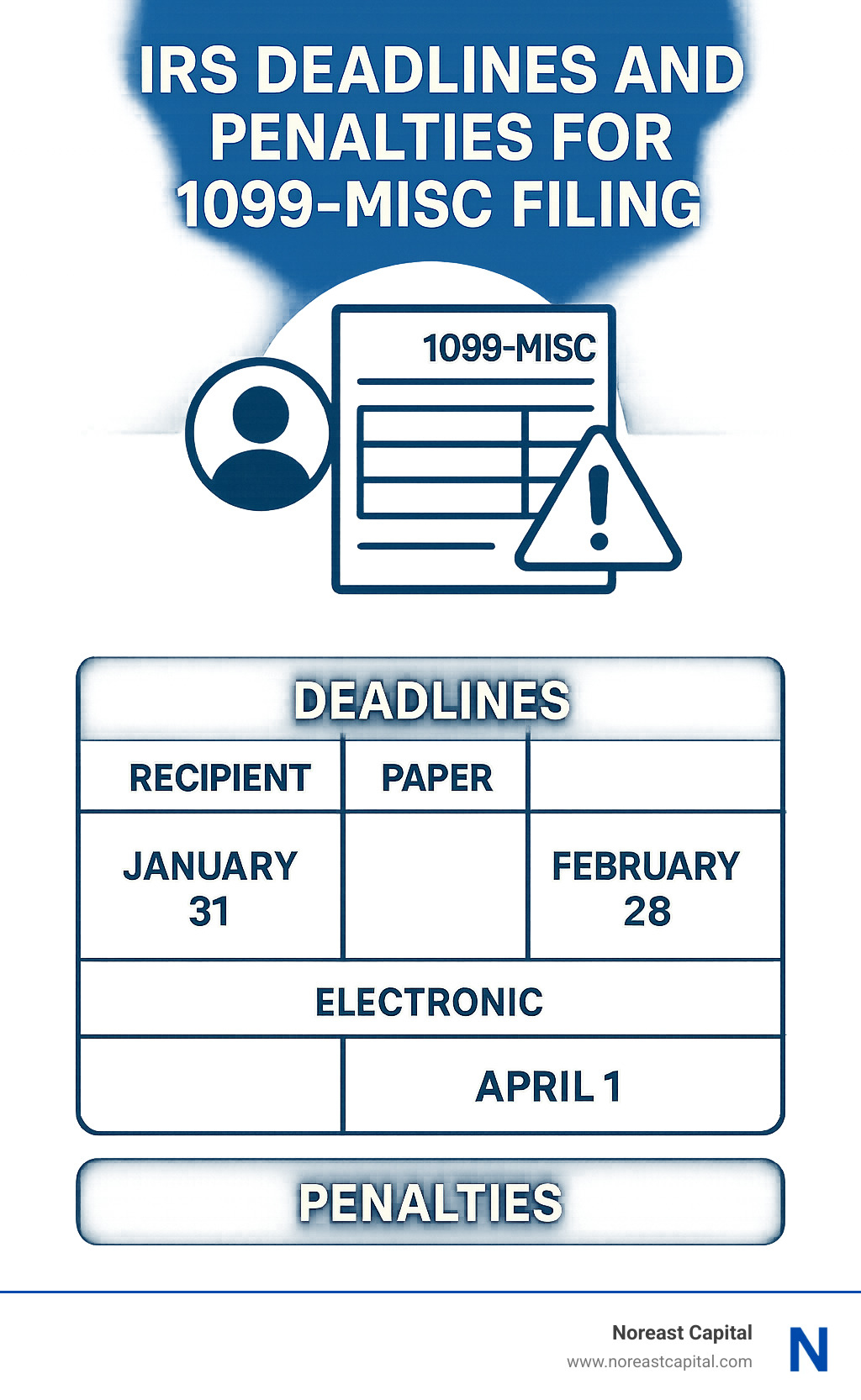
Mark your calendar for these critical deadlines:
| Filing Method | Recipient Copy | IRS Copy |
|---|---|---|
| Paper | January 31 | February 28 |
| Electronic | January 31 | March 31 |
Starting with tax year 2024, if you’re filing 10 or more 1099 forms, you must file electronically. This threshold used to be 250 forms, so many smaller businesses are now affected by this change.
And those penalties? They’re not just a slap on the wrist. The IRS can charge anywhere from $50 to $310 per form depending on how late you file and whether they think you deliberately ignored the rules. That can add up faster than equipment rental charges during construction season!
Step-by-step 1099-MISC prep
“I used to dread 1099 season until I created a system,” shares Emma, a landscaping business owner from Baltimore. “Now it’s just another task I can check off without breaking a sweat.”
Here’s how to handle your equipment rental 1099-MISC forms like a pro:
First, collect W-9 forms from all your equipment rental vendors before you even cut the first check. This simple step gives you their legal name, tax ID, and tells you whether they’re a corporation (which might exempt them from 1099 requirements).
Next, track total payments throughout the year. Most accounting software can do this automatically, flagging vendors as they approach that magic $600 threshold. As Tom from Annapolis told me, “Setting up payment tracking saved me from a frantic December scramble through a shoebox of receipts.”
When it’s time to file, fill out Form 1099-MISC for each qualifying vendor. Report the total rental payments in Box 1 (Rents) – not Box 7, which is a common mistake. If you withheld state taxes, don’t forget to complete Boxes 15-17.
By January 31, you’ll need to furnish copies to your vendors (that’s Copy B), while keeping Copy C for your records. Think of it as a post-holiday gift that nobody asked for!
Finally, file with the IRS by sending Copy A by February 28 if filing by paper (include Form 1096 as your cover sheet) or March 31 if filing electronically.
Avoiding penalties & fixing mistakes
Even the most organized among us make mistakes. The key is knowing how to fix them quickly.
The IRS offers a TIN Matching Program that lets you verify vendor tax identification numbers before filing. This simple step can help you avoid those pesky TIN mismatch notices and the penalties that follow.
If you find an error after filing, don’t panic! File a corrected return as soon as possible. Just mark the “CORRECTED” box on the form and follow the specific correction procedures based on your error type.
Running behind schedule? You can request a 30-day extension using Form 8809. But remember – this only extends your IRS filing deadline, not the January 31 deadline for getting forms to your vendors.
Smart business owners maintain an audit trail by keeping copies of all 1099 forms, W-9 forms, and supporting documentation for at least four years. Your future self will thank you if the IRS comes knocking.
“I received the wrong form for equipment I rented out,” shares Michael from DC. “Instead of a 1099-MISC, they sent a 1099-NEC. One quick call to the payer saved me over $2,000 in potential self-employment taxes. It pays to know the difference!”
When asking yourself “do I need to send a 1099 for equipment rental,” the answer isn’t just about compliance – it’s about protecting your business from unnecessary penalties and keeping your equipment vendors properly informed about their tax obligations. A little attention to detail now can prevent major headaches later.
Frequently Asked Questions about Equipment Rental 1099s
Do I need to send a 1099 for equipment rental if the vendor is an LLC?
The answer isn’t as straightforward as you might hope – it depends entirely on how the LLC is taxed. LLCs are fascinating business entities because they can choose their tax treatment. Some are taxed as sole proprietorships, others as partnerships, and some elect corporate taxation.
Here’s what this means for your 1099 obligations: If the LLC is taxed as a sole proprietorship or partnership, then yes, you need to issue a 1099-MISC for equipment rentals when your payments total $600 or more for the year. However, if that same LLC has elected to be taxed as a corporation, you’re generally off the hook – no 1099 needed.
This tax classification distinction is precisely why collecting W-9 forms before making payments is so important. The form reveals exactly how your vendor’s LLC is treated for tax purposes.
Mark, who runs a construction business in Baltimore, recently told me: “I was honestly surprised to learn that many of the LLCs I work with are taxed as S corporations, which meant I didn’t need to send them 1099s. This saved me significant paperwork and stress during tax season.”
How should I report a single invoice that bundles rental and labor?
Those bundled invoices can be tricky! When you receive an invoice that combines equipment rental with operator services or labor, you can’t just lump everything together on one form. The IRS wants you to split these payments between two different forms:
- Equipment rental portion goes on Form 1099-MISC, Box 1 (Rents)
- Labor/services portion goes on Form 1099-NEC, Box 1 (Nonemployee Compensation)
The cleanest approach is simply asking your vendor to break down these charges separately on their invoice. Most professional vendors understand this request and are happy to accommodate it.
Sarah from Annapolis shared her practical solution: “Whenever we rent a crane with an operator, I specifically ask the vendor to itemize the equipment and operator charges as separate line items on the invoice. This makes our 1099 reporting much simpler and more accurate. Most vendors are used to this request.”
If your vendor can’t or won’t provide this breakdown, you’ll need to make a reasonable allocation based on fair market values for similar equipment rentals and labor in your area.
What happens if I forget to file the 1099-MISC on time?
We’re all human, and sometimes deadlines slip by us. If you miss the filing deadline for your do I need to send a 1099 for equipment rental forms, the best approach is to file them as soon as possible to minimize penalties.
The IRS penalty structure increases based on how late you file:
- 1-30 days late: $50 per form
- 31+ days late but before August 1: $110 per form
- After August 1 or not filing at all: $270 per form
- Intentional disregard: $570 per form
What many business owners don’t realize is that these penalties apply separately to both the recipient copies and IRS copies. This effectively means the penalties could double if you miss both deadlines.
John, who owns a landscaping business, shared his costly lesson: “I missed filing three 1099-MISC forms by about two months last year. The penalties totaled $660 – significantly more than what my accountant would have charged to handle all my 1099 filings in the first place. I won’t make that mistake again.”
If you have a legitimate reason for filing late, include a detailed explanation with your submission. The IRS may waive penalties for circumstances truly beyond your control, like natural disasters or serious illness. But don’t count on leniency for simply forgetting or being too busy.
Conclusion
Let’s face it – tax paperwork isn’t anyone’s idea of a good time. But understanding do I need to send a 1099 for equipment rental requirements is essential for keeping your business in the IRS’s good graces.
Think of this guide as your roadmap through the sometimes confusing terrain of equipment rental reporting. The main landmarks to remember are:
When you’re renting that excavator, forklift, or any other equipment, you’ll need to use Form 1099-MISC, Box 1 (Rents) whenever you pay $600 or more to vendors who aren’t corporations. This $600 threshold isn’t just for single transactions – it’s the total amount you pay that vendor throughout the entire calendar year. Many business owners get tripped up here, so keep a running tally!
“The best advice I give clients is to collect W-9 forms upfront,” says Vincent from Noreast Capital. “It’s much easier to get this paperwork before you cut the first check rather than chasing it down at tax time.”
For those situations where you’re renting equipment that comes with an operator – like a crane with its crane operator – you’ll need to split the baby (so to speak). The equipment portion goes on 1099-MISC while the operator’s services belong on 1099-NEC. This distinction matters because it affects how the income is taxed for the recipient.
Here’s a bit of good news: if you’re paying for rentals with your business credit card or through apps like PayPal Business, you’re off the hook for 1099 reporting. The payment processors handle that reporting through Form 1099-K.
Remember those critical deadlines: January 31 for getting copies to your vendors, and either February 28 (paper filing) or March 31 (electronic filing) for submitting to the IRS. Missing these dates can result in penalties that add up quickly – turning a simple oversight into a costly mistake.
At Noreast Capital, we understand that equipment financing decisions involve more than just picking the right machinery – they come with compliance considerations too. Our team helps businesses throughout Baltimore, Annapolis, and Washington DC steer both the financing and the reporting requirements that come with equipment acquisitions.
We believe that with the right information and a bit of planning, you can manage your equipment rental reporting without breaking a sweat (or breaking the bank on penalties).
For more detailed information about equipment leasing and the associated tax implications, visit our More info about equipment lease 1099 rules page or reach out to our team directly.
While we’ve covered the essentials here, tax situations can vary widely from business to business. We always recommend checking with your tax professional for advice custom to your specific circumstances. After all, the right guidance isn’t just about avoiding penalties – it’s about peace of mind.