

Understanding Your 1099 Obligations for Equipment Rentals
Do you 1099 for equipment rental? Yes, you need to issue a Form 1099-MISC for equipment rental payments of $600 or more made to non-corporate entities during the tax year.
Here’s a quick answer to your question:
| Question | Answer |
|---|---|
| Is equipment rental 1099 reportable? | Yes, when payments total $600+ in a calendar year |
| Which form to use? | Form 1099-MISC (not 1099-NEC) |
| Which box? | Box 1: Rents |
| Exceptions? | Payments to corporations, credit card payments |
| Deadline to furnish? | January 31 of the following year |
Let’s be honest – tax compliance probably isn’t what gets you out of bed in the morning. But understanding when to issue a 1099 for equipment rentals is one of those necessary tasks that can save you headaches (and money) down the road.
I’ve seen plenty of business owners scratch their heads over this, especially since the IRS introduced Form 1099-NEC in 2020. The confusion is understandable! But here’s the simple truth: equipment rental payments belong in Box 1 (Rents) of Form 1099-MISC, not on Form 1099-NEC which is for nonemployee compensation like contractors.
This distinction isn’t just paperwork – it affects how the income is taxed for the recipient, which means getting it wrong could cause problems for both parties.
Hi there! I’m Vincent Cerniglia from Noreast Capital. Over the years, I’ve helped countless businesses steer the complexities of equipment financing and leasing, including sorting out these tricky tax requirements that affect both sides of rental arrangements.

Want to dive deeper into similar topics? Check out these related resources:
– Do you need to issue a 1099 for equipment rental
– Issue 1099 for equipment rental
Do You 1099 for Equipment Rental? IRS Rules Explained
Do you 1099 for equipment rental? The answer is yes—but with some important details you’ll need to understand. According to IRS regulations, when your business pays $600 or more for equipment rental to a non-corporate entity during a calendar year, you must report these payments on Form 1099-MISC, specifically in Box 1 labeled “Rents.”
This requirement covers rentals of all kinds of equipment your business might use—from bulldozers and excavators on construction sites to office copiers, vehicles, audio/visual equipment, or even specialized medical devices. What matters isn’t the type of equipment, but how much you’ve paid and to whom.
The IRS draws a clear line between equipment rentals and services, which directly affects which form you’ll need to use. Equipment rentals go on the 1099-MISC form, while service payments belong on the 1099-NEC form. This distinction isn’t just paperwork—it significantly impacts how the recipient handles their taxes.
“Machine rentals, such as bulldozer rentals, are reported as rents in box 1 of Form 1099-MISC when payments total $600 or more,” the IRS explicitly states in their Form 1099-MISC instructions.
Here’s a simple comparison to help you understand the difference:
| Aspect | Form 1099-MISC (Box 1: Rents) | Form 1099-NEC (Box 1: Nonemployee Compensation) |
|---|---|---|
| Purpose | Reports rental payments | Reports service payments |
| Tax Impact for Recipient | Generally not subject to self-employment tax | Subject to self-employment tax |
| Reporting on Tax Return | Often Schedule E | Schedule C |
| Filing Deadline | Paper: February 28; Electronic: March 31 | January 31 (both paper and electronic) |
| Common Examples | Equipment rentals, real estate rentals | Independent contractor services, freelance work |
When the $600 Threshold Triggers Filing
Do you 1099 for equipment rental payments under $600? No, you don’t need to worry about filing unless your payments to a single vendor reach or exceed $600 during the calendar year.
This is a cumulative threshold—not per transaction. If you rent a skid steer for $200 in March, a mini-excavator for $250 in July, and a concrete mixer for $200 in October from the same vendor, you’ve hit $650 total for the year, triggering the 1099 requirement.
I recently spoke with John, who runs a construction company in Baltimore. He shared, “We used to think we only needed to issue 1099s for single contracts over $600. We learned the hard way that we needed to track cumulative payments to each vendor across the entire year. Now we use accounting software to flag vendors approaching the threshold.”
The $600 threshold follows the calendar year (January 1 to December 31), not your fiscal year if it’s different. This alignment with the tax year makes it easier to track, but it’s still something you need to actively monitor throughout the year.
What Counts as “Rent” vs “Service”?
The distinction between renting equipment and paying for services might seem obvious, but in practice, it can get murky. Here’s the basic rule:
Equipment rental (1099-MISC, Box 1) means you’re paying for the use of the physical equipment itself. Think of renting a floor sander from the hardware store that you’ll operate yourself.
Service payments (1099-NEC) cover labor or expertise performed by someone who isn’t your employee. This would be hiring a floor refinishing company where their workers do the sanding.
The waters get muddy with mixed contracts. Say you rent a crane that comes with an operator, or an audio system with a technician. In these cases, the IRS expects you to split the payment between the two forms.
According to IRS instructions: “If the machine rental is part of a contract that includes both the use of the machine and the operator, prorate the rental between the rent of the machine (report that in box 1) and the operator’s charge (report that as nonemployee compensation on Form 1099-NEC).”
“Yes, per the IRS, Box 1 of a 1099 MISC form should include payments made for the rental of equipment.”
– JulieCo, TurboTax Community Expert
Let’s make this concrete with an example: You pay $1,000 for a bulldozer rental that includes an operator. If the fair market value of just the bulldozer rental is $600, and the operator’s services are valued at $400, you would report $600 on Form 1099-MISC, Box 1 (Rents) and $400 on Form 1099-NEC, Box 1 (Nonemployee Compensation).
This separation matters because rental income and service income are taxed differently for the recipient. Getting it wrong could cause headaches for both parties when tax time rolls around.
Choosing the Right Form: 1099-MISC vs 1099-NEC
Picking the right tax form isn’t just about checking a box—it’s about making sure everyone pays the right amount of tax. Since 2020, the IRS has made this distinction even more important by creating separate forms for different types of payments:

When it comes to do you 1099 for equipment rental situations, Form 1099-MISC is your go-to document. It’s designed specifically for reporting:
- Rents (Box 1) – this is where equipment rentals belong
- Royalties (Box 2)
- Other income (Box 3)
- Medical and health care payments (Box 6)
- Gross proceeds paid to attorneys (Box 10)
On the other hand, Form 1099-NEC serves a completely different purpose. It’s exclusively for:
- Nonemployee compensation (Box 1) – think freelancers, independent contractors, and service providers
- Direct sales over $5,000 (Box 2)
This distinction matters more than you might think. I’ve heard countless stories from frustrated equipment owners like Philip Perkins who shared:
“Almost all the people I work for who send me IRS form 1099s put the money they’ve paid me for equipment rental in the ‘non-employee compensation’ line of the 1099, as opposed to ‘rents’.”
This common mix-up isn’t just annoying paperwork—it hits people right in the wallet.
Tax Impact of Misclassification
Using the wrong form creates real financial consequences for your vendors. Here’s why it matters:
Self-Employment Tax makes all the difference. Income reported on Form 1099-NEC gets hit with a hefty 15.3% self-employment tax for Social Security and Medicare. But rental income properly reported on Form 1099-MISC Box 1? It typically escapes this tax entirely.
The difference shows up in tax return reporting too. Nonemployee compensation usually lands on Schedule C, while rental income belongs on Schedule E.
Let me put this in real dollars: If your vendor receives $10,000 for equipment rental, misclassifying it could cost them an unnecessary $1,530 in self-employment taxes. That’s no small change!
The IRS is crystal clear in their latest instructions: “Enter in box 1 amounts received by the payee for the rental of property… Machine rentals (for example, bulldozer rentals) are reported in box 1.”
Getting this wrong can lead to headaches for everyone—amended returns, unexpected tax bills, and potentially awkward conversations with vendors who suddenly owe more tax than they planned for.
Mixed Contracts: How to Prorate Correctly
Real life is rarely as neat as tax forms want it to be. Many equipment rentals come with operators attached—think crane rentals with operators or sound systems with technicians. Here’s how to handle these situations:
First, determine fair market values for each component. What would the equipment alone cost? What’s a fair price for just the operator’s time?
Next, get clear documentation. The cleanest approach is asking your vendor to provide an invoice that separates these charges clearly.
Finally, issue two forms if necessary. Yes, it’s a bit more paperwork, but it’s the right way to handle things.
Let me share Sarah’s story to show how this works in practice. Her construction company rented an excavator with an operator for $5,000. The vendor’s invoice broke it down: $3,200 for the excavator and $1,800 for the operator’s time. Sarah did it right by issuing:
– Form 1099-MISC with $3,200 in Box 1 for the excavator rental
– Form 1099-NEC with $1,800 in Box 1 for the operator’s services
This kept everything clean for both tax reporting and her vendor’s tax situation.
Want more details about handling these situations? Check out our comprehensive guide on how to issue 1099 for equipment rental.
Exceptions, Entities, and Special Cases
While the general rule is to issue Form 1099-MISC for equipment rental payments of $600 or more, there are several important exceptions and special cases to consider:

Payments to Corporations and LLCs: When You Can Skip the 1099
One of the biggest headaches you can save yourself is knowing when you don’t need to send 1099s at all. Good news – you generally don’t need to issue Form 1099-MISC for equipment rental payments made to corporations, no matter how much you paid them.
This corporate exemption applies to C Corporations, S Corporations, and even LLCs that have elected to be taxed as corporations. It’s like the IRS giving you a free pass on paperwork!
“We spent hours preparing 1099s for all our vendors who exceeded $600, only to realize later that many were corporations and didn’t need 1099s at all,” shares Mark, a business owner in Washington DC. “Now we collect W-9s upfront and save ourselves a lot of work.”
There are two notable exceptions to this corporate rule, though they rarely apply to equipment rentals: payments for medical/health care services and payments for legal services still require 1099s even when made to corporations.
The million-dollar question is: how do you know if your vendor is a corporation? Always request a completed Form W-9 before making payments. This simple step can save you countless hours come tax season. The W-9 requires vendors to indicate their entity type, giving you documentation to back up your filing decisions.
For LLCs, things get a bit trickier. Single-member LLCs (disregarded entities) and multi-member LLCs typically need 1099s unless they’ve elected corporate tax treatment. If an LLC has checked the corporation box on their W-9, you can skip the 1099.
Rentals Paid via Third-Party Networks or Credit Cards
Here’s another paperwork-saver you might not know about: do you 1099 for equipment rental payments made via credit card, debit card, or payment apps like PayPal Business? Nope!
When you pay for equipment rentals using these payment methods, the payment processors themselves handle the reporting through Form 1099-K. Issuing your own 1099-MISC would actually create duplicate reporting, which nobody wants.
For example, if you paid $2,000 for a backhoe rental using your business credit card, you can cross that vendor off your 1099-MISC list. The credit card company has it covered.
The thresholds for 1099-K reporting have been changing in recent years. As of our latest information, payment processors must report when a vendor receives over $600 in payments during the calendar year, though this threshold has been subject to change, so it’s worth staying updated.
Self-Rental and Related-Party Leases
Things get interesting when you’re essentially renting equipment to yourself or between related businesses. The IRS has special rules for these situations that can significantly impact your taxes.
If you rent equipment to a business in which you materially participate, the IRS applies what’s known as the “self-rental rule.” Under this rule, net rental income is treated as non-passive income, while net losses remain passive. As one tax professional colorfully puts it, “Self-rental gives you the worst of both worlds—non-passive income and passive losses.”
A business owner in Annapolis found a way to steer this: “I set up an LLC to hold my equipment, which I then rented to my operating company. My accountant helped me structure it properly to avoid the self-rental rule through grouping, which saved me thousands in self-employment taxes.”
You may be able to make a “grouping election” to combine the rental and business activities into a single economic unit if they meet certain criteria, potentially avoiding the self-rental complications.
Rentals between related parties—like family members or controlled entities—typically receive extra scrutiny from the IRS. Make sure your rental rates reflect fair market value to avoid the IRS potentially recharacterizing the arrangement.
The key with all these exceptions and special cases is proper documentation. Whether it’s collecting W-9s, keeping records of payment methods, or documenting fair market rental rates, good recordkeeping is your best defense if questions ever arise about your 1099 for equipment rental practices.
Avoiding and Fixing Mistakes
Let’s face it – tax paperwork isn’t anyone’s idea of fun, and even careful business owners can make mistakes with 1099 reporting. The good news? Most errors can be fixed without major headaches if you catch them early.

What to Do If You Receive a 1099-NEC for Rental Income
Picture this: You rented out your excavator to a construction company, and come tax season, you receive a Form 1099-NEC instead of the correct 1099-MISC. Don’t panic – this happens more often than you might think.
Your first step should be picking up the phone. Contact the payer directly and politely explain that equipment rental income belongs on Form 1099-MISC (Box 1 for Rents), not on Form 1099-NEC. Most businesses want to get their tax reporting right and will be happy to issue a corrected form once they understand the mistake.
“When I received the wrong form, I was worried about getting hit with extra self-employment taxes,” shares Michael, an equipment owner from Baltimore. “I called the company that sent it, explained the situation, and they issued a corrected form within a week. That five-minute phone call saved me over $2,000 in taxes.”
If the payer isn’t cooperative or doesn’t understand the distinction, you still have options. You can report the income correctly on your own tax return regardless of what the incorrect 1099 says. For equipment rentals, this typically means reporting on Schedule E rather than Schedule C, which keeps you from paying unnecessary self-employment tax on rental income.
For situations where the discrepancy is significant, consider attaching a written explanation to your tax return that clarifies why your reporting differs from the form you received. This can help prevent questions during a potential review.
For more detailed guidance on handling these situations, check out our article on Do You Need to Issue a 1099 for Equipment Rental?
How to File a Corrected 1099-MISC
Now let’s flip the script – what if you’re the one who issued an incorrect 1099? Maybe you used Form 1099-NEC instead of 1099-MISC, or perhaps you entered an incorrect amount. Fixing these mistakes promptly shows good faith and helps your vendors report their taxes correctly.
For paper filers, the correction process involves completing a new form with the right information and clearly marking the “CORRECTED” box at the top. This signals to the IRS that this form replaces a previously submitted one. Remember to send the red Copy A to the IRS and provide fresh Copies B and C to your vendor. You’ll also need to include Form 1096 (the transmittal form) when sending corrections to the IRS.
If you file electronically, the process is typically more streamlined. Most e-filing platforms have specific procedures for submitting corrections, with proper coding to indicate you’re replacing a previously filed return. Follow your software’s guidance carefully to ensure the correction is processed properly.
Don’t delay corrections once you find an error. While there’s no specific penalty just for filing a corrected return, there can be penalties if you know about an error and fail to fix it. The IRS appreciates promptness and accuracy.
Corrected forms must use the same method as your original submission – if you filed paper forms originally, your corrections should be on paper too. Similarly, electronic filers should correct electronically.
“I accidentally put our equipment rental payments on the wrong form last year,” admits Sarah, a small business owner in Virginia. “My accountant helped me file corrected forms, and it was much less painful than I expected. The vendor was grateful we fixed it before tax time, and it helped build trust in our business relationship.”
By understanding how to properly handle these situations, you’ll maintain good relationships with your vendors and stay on the right side of the IRS – a win-win for everyone involved in your equipment rental transactions.
Recordkeeping, Documentation, and Deadlines
Good recordkeeping isn’t just about staying organized—it’s your best defense against potential IRS scrutiny when it comes to equipment rental payments. Let’s look at what you need to keep track of and when those important deadlines hit:
Setting Up Your Accounting System
A well-organized accounting system isn’t just satisfying for the neat freaks among us—it makes 1099 compliance dramatically easier when tax season rolls around:

The key to painless 1099 compliance starts with your accounting setup. In QuickBooks or whatever software you use, create dedicated expense categories specifically for equipment rentals, keeping them separate from service payments. This simple step will save you hours of hair-pulling when it’s time to file.
Always collect and maintain complete vendor information before you cut the first check. This includes their legal name, tax ID number (from their W-9), complete address, and entity type. Your future self will thank you for this organization come January!
“I used to dread tax season until I set up separate accounts in QuickBooks—one for equipment rental and one for contractor services,” shares Maria, a construction company owner in Maryland. “Now I can generate accurate 1099 reports in minutes instead of spending days sorting through jumbled expenses.”
Most accounting programs can help you monitor cumulative payments throughout the year, flagging when a vendor approaches that critical $600 threshold. Set up these alerts early to avoid surprises.
At year-end, your software should be able to generate 1099 reports showing exactly which vendors need forms and the correct amounts to report. This feature alone is worth its weight in gold when you’re racing against IRS deadlines.
IRS Filing and Furnishing Due Dates
Missing IRS deadlines can lead to penalties that add up quickly. Here’s what you need to know about when forms are due:
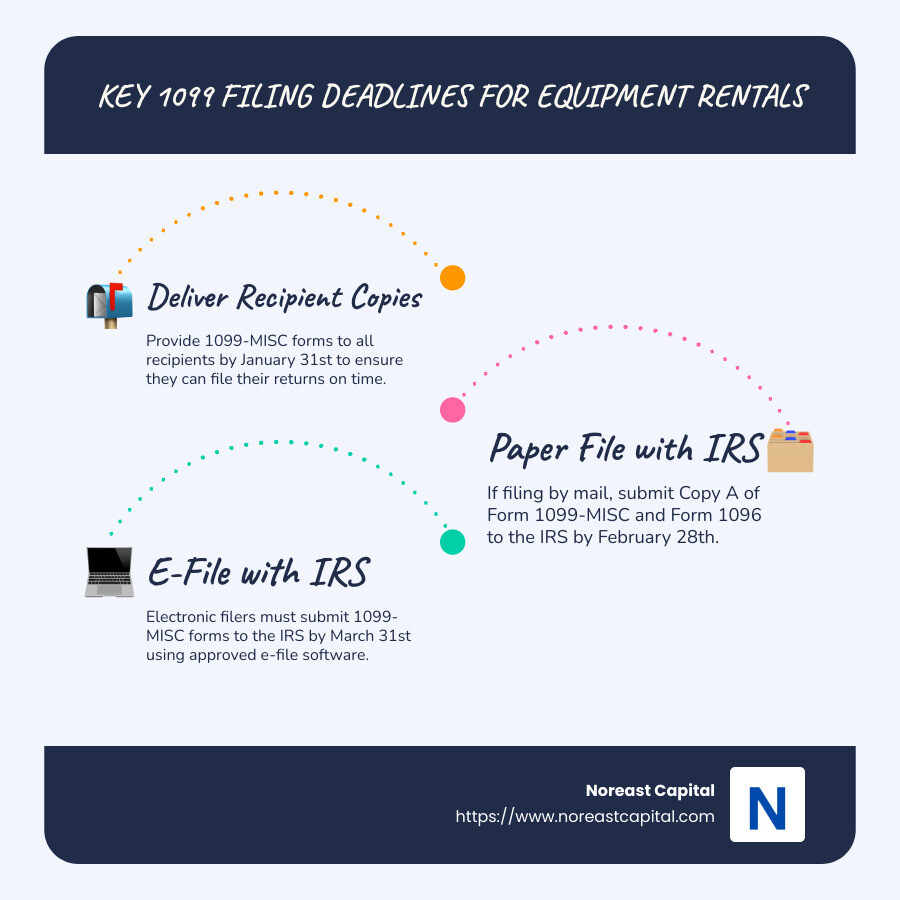
For furnishing copies to recipients, both Form 1099-MISC and Form 1099-NEC must be provided to your vendors by January 31 of the year following payment. This deadline gives recipients time to prepare their tax returns correctly.
When filing with the IRS, the deadlines vary by form and method:
– Form 1099-MISC paper filing is due February 28
– Form 1099-MISC electronic filing is due March 31
– Form 1099-NEC (both paper and electronic) must be filed by January 31
Many business owners don’t realize that state filing requirements may also apply. Each state has its own rules and deadlines for 1099 submissions, so check your specific state’s requirements to stay compliant on all fronts.
Need more time? You can request a 30-day extension for IRS filing using Form 8809, but here’s the catch—no extension is available for furnishing forms to recipients. Those January 31 recipient deadlines are set in stone.
One important change to note: Starting with tax year 2024, the IRS lowered the e-file threshold to just 10 forms. If you file 10 or more information returns of any type combined, you must file electronically. This change affects many small businesses that previously filed paper forms.
“I learned the hard way that missing 1099 deadlines gets expensive fast,” admits John, a small business owner in Virginia. “Now I set calendar reminders for early January to make sure I have everything ready with time to spare.”
Good recordkeeping isn’t just about avoiding penalties—it’s about running your business professionally and maintaining good relationships with your equipment vendors. When you’re organized about tracking your equipment rental payments, tax season becomes just another routine part of business rather than a crisis.
Frequently Asked Questions about Equipment Rental 1099s
Do I need a 1099 for a one-day equipment rental under $600?
If you’re wondering about those quick, one-off equipment rentals, here’s good news: you don’t need to issue a 1099-MISC for equipment rental payments under $600 in a calendar year. The IRS only cares when you cross that $600 threshold.
But here’s where many business owners get tripped up – this is a cumulative total for the year. Let me explain with a real-world example:
Imagine you rent a mini-excavator in March for $450. No 1099 needed yet. But then in November, you rent another piece of equipment from the same vendor for $200. Now your total for the year is $650, which crosses the $600 threshold – so you’ll need to issue that 1099-MISC after all.
I’ve seen many small construction companies miss this detail and scramble at tax time to get their reporting in order. Tracking cumulative totals throughout the year can save you major headaches come January.
Do vehicle rentals follow the same 1099-MISC rules?
Yes, vehicle rentals absolutely follow the same rules as other equipment rentals. When your business pays $600 or more to a non-corporate entity for cars, trucks, vans, or any other vehicle rentals during the calendar year, you must report these payments on Form 1099-MISC, Box 1 (Rents).
This applies whether you’re:
– Renting a box truck for a single delivery
– Leasing a fleet vehicle for several months
– Renting specialty vehicles for particular projects
A landscaping business owner in Baltimore shared his experience with me: “We rent extra trucks during our busy season from a local owner-operator. Since our payments easily exceed $600 annually, we issue a 1099-MISC with the total in Box 1. Our accountant emphasized that vehicle rentals fall under the same rules as any other equipment rental.”
How do I handle lease-to-own agreements?
Lease-to-own arrangements add an interesting wrinkle to 1099 reporting. These agreements straddle the line between rentals and purchases, so let’s break down how to handle them properly:
During the lease period, before ownership transfers, treat the payments as rentals and report them on Form 1099-MISC, Box 1 if they meet that $600 threshold we’ve been discussing.
When the lease-to-own agreement concludes and ownership officially transfers, this final transaction typically transforms into a purchase rather than rent. And here’s the key point – purchases of equipment generally don’t require a 1099 at all.
Some lease-to-own contracts explicitly separate the interest component from principal payments. If yours does this and the interest exceeds $10, that interest portion might need to be reported on Form 1099-INT instead.
One excavation company owner told me about his experience: “We entered a lease-to-own agreement for a backhoe. Our accountant had us issue 1099-MISC forms during the lease period, but when we made the final payment and took ownership, no 1099 was required for that transaction. The documentation from our financing company made it clear which portion was considered the purchase.”
For these more complex arrangements, I strongly recommend consulting with a tax professional who understands your specific situation. The nuances can get tricky, and the tax implications might vary based on how your agreement is structured. You can also find more information about equipment leases and tax reporting on our resources page.
Conclusion
Navigating 1099 requirements for equipment rentals can feel like walking through a tax maze, but with the right knowledge, you can handle it with confidence. Let’s take a moment to recap what we’ve learned about this important business responsibility.
Do you 1099 for equipment rental? Yes, you absolutely need to when your payments to a non-corporate vendor reach or exceed $600 during a calendar year. This is non-negotiable in the eyes of the IRS, and getting it right matters for both your business and your vendors.
Equipment rentals belong on Form 1099-MISC with the amount reported in Box 1 (Rents) – not on Form 1099-NEC. This distinction isn’t just bureaucratic paperwork; it directly affects how your vendors report and pay taxes on their income.
For those tricky situations where you’re paying for both equipment and an operator, don’t forget to split the payment appropriately between the two forms. Your vendors will thank you for getting this right, as it could save them from paying unnecessary self-employment taxes.
The corporate exception is your friend – payments to corporations generally don’t require 1099s. The same goes for payments made via credit card or payment apps like PayPal, as these are reported through other channels.
Staying on top of deadlines is crucial: January 31 for getting copies to your vendors, and either February 28 (for paper filing) or March 31 (for electronic filing) for submitting to the IRS. Missing these dates can result in penalties that no business wants to pay.
Setting up your accounting system properly from the start makes all of this much easier. Create separate categories for equipment rentals and service payments, and you’ll thank yourself when tax season rolls around.
Proper 1099 compliance isn’t just about avoiding penalties – though that’s certainly important. It’s also about maintaining good relationships with your vendors and ensuring everyone reports their income correctly. When you get this right, you create smoother operations for everyone involved.
At Noreast Capital, we understand that equipment financing and leasing arrangements come with their share of tax and reporting considerations. Our team works with businesses across Annapolis, Baltimore, Washington DC, and beyond to steer these requirements while finding equipment financing solutions that keep cash flowing and operations running smoothly.
For more information about equipment leasing and financing options that can help your business access the equipment you need without tying up your capital, visit our equipment lease resources.
With good information and solid recordkeeping practices, you can confidently manage your equipment rental 1099 obligations and focus on what truly matters – growing your business and serving your customers. After all, isn’t that why we’re all here?