

Tax Compliance for Equipment Rentals: MISC or NEC?
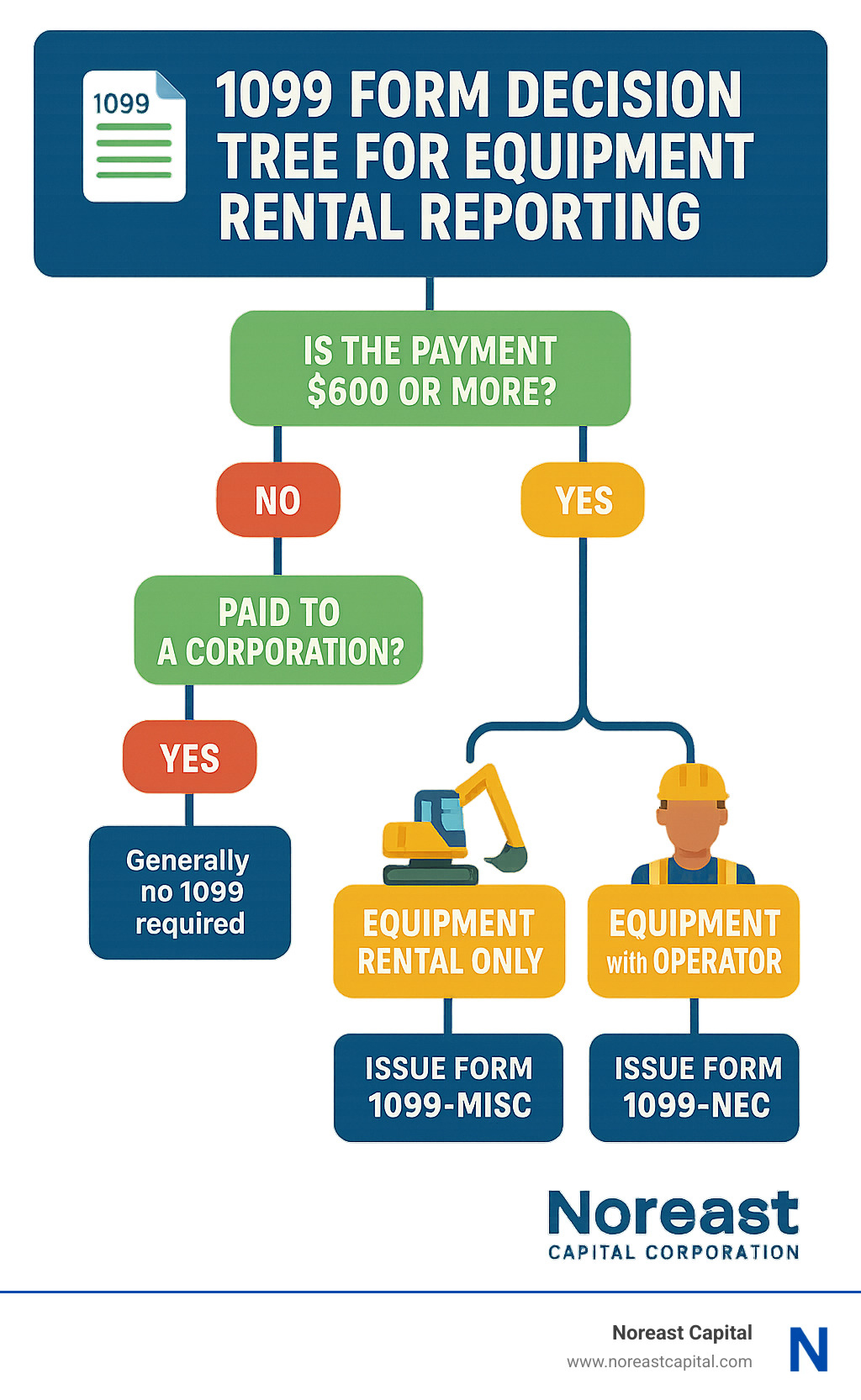
Does equipment rental go on 1099 MISC or 1099 NEC? The short answer is: equipment rental payments belong on Form 1099-MISC (Box 1: Rents), not Form 1099-NEC. Here’s a simple breakdown to help you steer these waters:
| Payment Type | Correct Form | Box | Notes |
|---|---|---|---|
| Pure equipment rental | 1099-MISC | Box 1 (Rents) | For payments of $600+ in a calendar year |
| Equipment rental with operator | Split between forms | Box 1 on 1099-MISC for equipment Box 1 on 1099-NEC for operator | Prorate the payment between equipment rental and operator services |
| Payments to corporations | Generally no 1099 required | N/A | Exception: medical and legal services still need 1099s |
| Payments under $600 | No 1099 required | N/A | Total payments for the calendar year |
Tax season can feel like navigating a maze for business owners who lease equipment. One wrong turn with your paperwork, and you might find yourself facing penalties or creating headaches for your vendors. I’ve seen the confusion when business owners struggle with this common question about proper IRS reporting.
The confusion largely stems from 2020 when the IRS reintroduced Form 1099-NEC, pulling nonemployee compensation out of the 1099-MISC form where it had lived for years. This change left many wondering: does equipment rental go on 1099 MISC or 1099 NEC? While services (like hiring independent contractors) now belong on the NEC form, equipment rentals stayed put on the MISC form.
This distinction matters more than you might think. Misclassifying rental payments as nonemployee compensation could trigger unnecessary self-employment taxes for your vendors or flag your business for IRS scrutiny—neither of which makes for happy business relationships.
I’m Vincent Cerniglia from Noreast Capital Corporation. Having helped countless businesses steer these tricky tax waters while providing nationwide equipment financing solutions, I’ve seen how proper classification saves headaches (and dollars) down the road.
Related content about does equipment rental go on 1099 misc or 1099 nec:
– do you 1099 for equipment rental
– do you need to issue a 1099 for equipment rental
– issue 1099 for equipment rental
Does Equipment Rental Go on 1099-MISC or 1099-NEC?
The IRS gives us a clear answer to this common tax question: equipment rental payments belong on Form 1099-MISC, specifically in Box 1 labeled “Rents.” This applies whether you’re renting a massive excavator or a simple office projector.
According to the official IRS instructions: “Report machine rentals of $600 or more in box 1 (Rents) of Form 1099-MISC.” Even after the IRS brought back Form 1099-NEC in 2020, this rule hasn’t changed a bit.
The key difference is pretty straightforward: 1099-MISC covers various payment types including rents, royalties, and other income, while 1099-NEC is exclusively for nonemployee compensation—basically, payments to people who performed services for your business but aren’t on your payroll.

Pure Equipment Rental Payments—Why 1099-MISC Box 1 Wins
When you’re simply paying to use equipment without anyone operating it for you, the answer is crystal clear. Does equipment rental go on 1099 misc or 1099 nec? It absolutely goes on 1099-MISC, Box 1.
Think about scenarios like renting a bulldozer that your team will operate, leasing a photocopier for your office, borrowing audio equipment for your company conference, or leasing manufacturing machinery. All of these are pure equipment rentals that belong on the MISC form.
As one tax pro put it in an online forum: “Box 1 of a 1099-MISC form should include payments made for the rental of equipment. The IRS instructions specifically list machine rentals as an example of what goes in Box 1.”
This distinction really matters for your vendors. Payments reported on 1099-MISC Box 1 (Rents) aren’t subject to self-employment tax for the recipient, while payments on 1099-NEC typically get hit with both income tax and self-employment tax. Using the wrong form could cost your equipment providers thousands in unnecessary taxes!
Mixed Rentals With Operator Fees—Splitting Between Forms
Now here’s where things get interesting—when you rent equipment that comes with someone to operate it. In these cases, you’re actually paying for two different things: the equipment itself (a rental) and a service (the operator’s expertise and labor).
The IRS doesn’t leave us guessing: “If the machine rental is part of a contract that includes both the use of the machine and the operator, prorate the rental between the rent of the machine (report that in box 1 of Form 1099-MISC) and the operator’s charge (report that as nonemployee compensation in box 1 of Form 1099-NEC).”
In plain English, this means you need to split the payment:
1. Figure out how much of your payment was for just the equipment
2. Put that amount on Form 1099-MISC, Box 1
3. Report the operator’s portion on Form 1099-NEC, Box 1
Philip Perkins, a contractor who’s been on the receiving end of these forms, notes: “Almost all the people I work for who send me IRS form 1099s put the money they’ve paid me for equipment rental in the ‘non-employee compensation’ line of the 1099, as opposed to ‘rents’.” This common mistake isn’t just paperwork—it can significantly increase the tax burden for your equipment providers.
When You Must Issue a 1099-MISC for Equipment Rental
So you’ve rented out some equipment for your business—now what? When tax season rolls around, you’ll need to know if you should be sending out those 1099-MISC forms. Let me break it down for you in simple terms.
You’ll need to issue a 1099-MISC for equipment rentals when you hit all these marks:
Your payments to one vendor totaled $600 or more during the calendar year (even if it was a bunch of smaller payments that added up), you made these payments as part of running your business, you paid someone who isn’t a corporation (like an individual, partnership, or certain LLCs), and you paid using cash, check, or direct deposit rather than a credit card.
Think of the $600 threshold as your magic number. Let’s say you rented a piece of equipment for $55 a month. By month 11, you’ve crossed that $600 line, and boom—you need to issue a 1099-MISC.

With LLCs, things can get tricky. An LLC might be taxed as a sole proprietorship, partnership, or corporation depending on how they’ve set themselves up. This is why getting that W-9 form from your vendors isn’t just a good idea—it’s essential for knowing exactly who needs a 1099 and who doesn’t.
Wondering does equipment rental go on 1099 misc or 1099 nec? As we’ve covered, it’s the MISC form for pure equipment rentals, but knowing when to issue one is just as important as knowing which form to use.
Key Exceptions to Filing
Not every equipment rental requires a 1099-MISC. Here’s when you can skip the paperwork:
When you’re dealing with corporations, you’re generally off the hook. If you’ve rented equipment from a C or S corporation, you typically don’t need to send them a 1099-MISC. But don’t just assume—always get that W-9 form to confirm their status.
Did you swipe your credit card to pay for that rental? Then you’re in luck. When you use credit cards, debit cards, or payment cards, the card issuer handles the reporting, not you.
If your total payments to a vendor stayed under $600 for the year, you can relax—no 1099-MISC needed. The same goes for equipment you rented for personal use rather than business purposes.
And if you paid rent through a real estate agent or property manager, they’re the ones responsible for issuing the 1099-MISC, not you. One less thing on your plate!
For more detailed guidance on this topic, check out Do You Need to Issue a 1099 for Equipment Rental? where we dive deeper into all these scenarios.
Understanding when to issue a 1099-MISC for equipment rentals doesn’t have to be complicated. With these guidelines, you’ll be able to handle your tax reporting with confidence and stay on the right side of the IRS.
Prorating Mixed Contracts: Step-by-Step Guide
When you’re dealing with rentals that include both equipment and an operator, things can get a bit tricky at tax time. The good news is that with a little organization, you can handle these mixed contracts correctly and save your vendors from paying unnecessary taxes.
Think about it this way: when you hire someone who brings their own bulldozer to your job site, you’re really paying for two different things—the machine itself and the skilled person operating it. The IRS wants you to report these separately, and for good reason.
Request itemized invoices from your vendors whenever possible. A clear breakdown showing how much you’re paying for the equipment versus the operator’s time makes tax filing so much easier. If your vendor doesn’t normally itemize, a simple conversation explaining why you need this information often solves the problem.
Your contract language might already have the answer. Take a moment to review the agreement—many contracts specify exactly how payments should be allocated between equipment and labor. This built-in breakdown gives you documentation the IRS would appreciate if questions ever arise.

When invoices come in as lump sums, you’ll need to make a reasonable allocation yourself. Research what similar equipment rents for without an operator in your area. The difference between that rate and what you’re paying can generally be attributed to the operator’s services. Just be sure to document your methodology—keep notes explaining how you arrived at your figures in case the IRS has questions later.
Once you’ve sorted out the split, reporting is straightforward: put the equipment portion on Form 1099-MISC (Box 1) and the operator services on Form 1099-NEC (Box 1). This distinction isn’t just paperwork—it has real financial implications for your vendors.
Wondering if you’re getting this right? Check out our guide on how to properly issue 1099 for equipment rental for more detailed information.
Real-World Example
Let’s bring this to life with a common scenario. Say you hired someone with a bulldozer to level your company’s parking lot, and the total bill came to $1,200. After discussing with the contractor, you learn that:
- $800 represents the bulldozer rental (the machine itself)
- $400 covers the operator’s skilled services
Following the rules we’ve discussed, you’d report $800 in Box 1 of Form 1099-MISC under “Rents” and the remaining $400 in Box 1 of Form 1099-NEC as “Nonemployee compensation.”
This distinction makes a significant difference for your contractor. The $400 reported on Form 1099-NEC will be subject to self-employment tax (currently 15.3%), while the $800 reported as equipment rental on Form 1099-MISC isn’t subject to this tax.
As one grateful equipment provider told me, “Properly splitting these payments saved me over $2,000 in self-employment taxes last year!” That’s why getting this right matters—does equipment rental go on 1099 MISC or 1099 NEC isn’t just a technical question, it has real financial impact for the small businesses you work with.
Taking the time to properly allocate these mixed payments isn’t just good compliance—it’s good business practice that helps maintain positive relationships with your vendors.
Compliance Checklist: Deadlines, Penalties & Required Info
Let’s face it—nobody gets excited about tax deadlines, but missing them can really hurt your wallet! When it comes to equipment rental reporting, staying on top of your 1099 filing obligations isn’t just good practice—avoid those nasty IRS penalties.
Form 1099-NEC has a single deadline—January 31st of the year following payment. This means both the IRS and your vendors need their copies by this date. For 1099-MISC forms (where your does equipment rental go on 1099 misc or 1099 nec question gets answered), you still need to provide copies to recipients by January 31st, but you have a bit more breathing room for the IRS filing: February 28th for paper filing or March 31st if you file electronically.
Speaking of electronic filing—heads up! The IRS recently lowered their e-file threshold dramatically. If you’re issuing 10 or more information returns of any type (yes, that’s combined W-2s, 1099s, and others), you must file electronically. This change took effect January 1, 2024, so many small businesses who previously filed paper forms now need to switch to electronic submission.
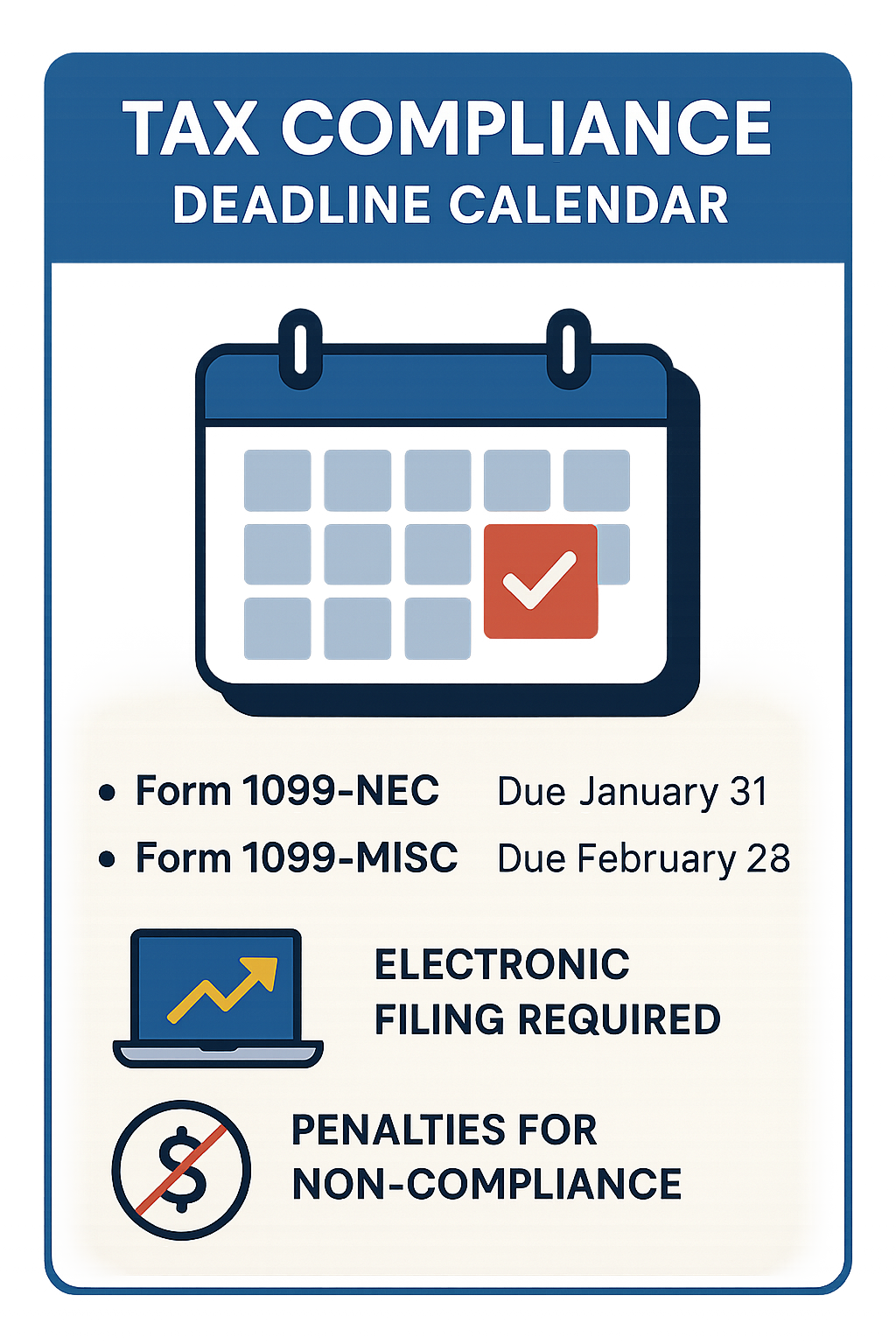
The IRS isn’t playing around with penalties either. Missing these deadlines can cost you anywhere from $50 to $290 per form, depending on how late you file and whether they think you deliberately ignored the rules. That adds up quickly if you have multiple vendors!
And here’s something that catches many businesses off guard: backup withholding. If your equipment rental vendor doesn’t provide their TIN (Taxpayer Identification Number) or gives you one that doesn’t match IRS records, you may need to withhold 24% of their payment for federal income tax. This becomes your responsibility to report and remit to the IRS. Trust me, explaining to a vendor why their payment is 24% short is not a conversation anyone enjoys!
Gathering Vendor Data
Before you can properly file those 1099 forms, you’ll need to collect some critical information from your equipment rental vendors. Think of Form W-9 as your best friend here—it’s the official “Request for Taxpayer Identification Number and Certification” that gathers everything you need in one convenient document.
Make it a habit to request a completed W-9 before you make any payments to new vendors. This simple step will save you frantic year-end emails and calls trying to collect tax information. Your vendor’s legal name, business name (if different), tax classification, current mailing address, and TIN (either an SSN or EIN) are all essential pieces of the 1099 puzzle.
Many states also have their own 1099 filing requirements with separate deadlines and procedures. If you operate in multiple states, you might need to steer different rules for each jurisdiction—another good reason to stay organized from the start!
For the official word on all things 1099, the Official IRS instructions for Form 1099-MISC provide comprehensive guidance that’s regularly updated. The IRS also offers helpful information about backup withholding requirements on their website. When in doubt, these should be your go-to resources for clarifying those tricky does equipment rental go on 1099 misc or 1099 nec questions.
Common Misclassifications and How to Avoid Them
Let’s face it—tax forms can be confusing, and the reintroduction of Form 1099-NEC in 2020 only added to the confusion. The most common mistake I see businesses make is reporting equipment rental payments on Form 1099-NEC instead of where they belong: Form 1099-MISC.
This seemingly small error can create big headaches for your vendors. When equipment rentals get mislabeled as nonemployee compensation on a 1099-NEC, your vendor gets hit with self-employment tax—currently a whopping 15.3%—on income that shouldn’t be taxed this way. Imagine renting out $10,000 worth of equipment and suddenly owing an extra $1,500 in taxes you shouldn’t have to pay!
As one frustrated equipment provider shared: “I’ve been struggling with this issue. Most companies split payments correctly, but 3-4 companies lumped incomes together this year on a 1099-NEC, which could cost me thousands in extra self-employment taxes.”
When you ask “does equipment rental go on 1099 misc or 1099 nec,” the answer is clear—but many businesses still get it wrong.
Best Practices for Accurate Filing
You can avoid these costly mistakes with a few simple practices:
First, always request itemized invoices from your vendors that clearly separate equipment costs from any operator services. This makes proper reporting so much easier when tax time rolls around.
Make sure your contracts use clear language that specifies exactly what portion of payment covers equipment versus services. This clarity helps both you and your vendor at tax time.
Consider implementing software controls in your accounting system that properly categorize different types of payments. Many modern accounting programs can be set up to flag potential 1099 issues before they become problems.
One practice I highly recommend is establishing a review process where a second set of eyes checks your 1099 forms before filing. Sometimes it takes a fresh perspective to spot classification errors.
When in doubt, consult with tax professionals who understand your industry. The cost of professional advice is minimal compared to potential penalties or vendor relationship damage from incorrect reporting.
Don’t forget to educate your accounting team about the distinction between equipment rentals and services. A quick training session could prevent costly mistakes.
As DianeW777, an Employee Tax Expert, clearly explained: “Form 1099-MISC is used to report rental payments made to the property owner. The only use for Form 1099-NEC is for payment of services rendered or nonemployee compensation.”
Correction Process
If you find you’ve filed incorrectly, don’t panic! The IRS has a straightforward correction process:
Complete a new form with the correct information and mark the “CORRECTED” box at the top. File this corrected form with the IRS, provide a copy to your vendor, and include a brief letter explaining the correction.
Acting quickly shows both the IRS and your vendors that you’re committed to getting things right, even when mistakes happen.
Inconsistent reporting between what you file and what your vendor reports can trigger IRS inquiries. For instance, if your vendor reports rental income on Schedule E while you issued them a 1099-NEC (which implies Schedule C income), this discrepancy might flag both returns for review. Nobody wants that extra attention from the tax authorities!
By understanding that “does equipment rental go on 1099 misc or 1099 nec” has a clear answer—MISC, Box 1—and implementing these simple practices, you’ll save your vendors from unnecessary tax burdens while keeping your own business compliant and audit-ready.
Frequently Asked Questions about Equipment-Rental 1099s
Do you need a 1099-MISC for equipment rentals under $600?
No, there’s no need to issue a 1099-MISC if your total payments to a vendor for equipment rentals stayed below $600 for the calendar year. I often remind my clients that while you’re off the hook for the 1099, you should still keep detailed records of these smaller rental payments. After all, they’re legitimate business expenses you’ll want to deduct come tax time!
As one of my construction clients put it, “I track every dollar spent on equipment rentals, whether it’s $60 or $6,000. The deduction is the same either way—only the paperwork changes.”
What if the rental company is an LLC taxed as a corporation?
Here’s where business structure really matters. If you’re renting equipment from an LLC that’s elected to be taxed as a corporation (either C or S), you typically don’t need to send them a 1099-MISC. But don’t just take their word for it!
Always get a completed Form W-9 before making payments. This form is your protection—look specifically at the tax classification checkboxes. If they’ve marked “C Corporation” or “S Corporation,” you can generally skip the 1099-MISC filing. I’ve seen too many businesses make assumptions about vendor status without proper documentation, only to face penalties later.
Can I deduct rent expense if I forgot to issue the 1099?
Yes, you can still deduct those legitimate equipment rental expenses even if you dropped the ball on issuing required 1099s. However—and this is important—those missing 1099s could result in penalties and put a spotlight on your deductions during an audit.
The IRS has been known to disallow deductions for payments that should have been reported on information returns if you can’t show a reasonable cause for the oversight. My advice? If you realize you’ve missed filing required 1099s, submit them as soon as possible, even if they’re late. Better late than never when it comes to protecting thousands in deductions!
Do I need to issue a 1099 for equipment purchases?
Good news here—equipment purchases don’t require a 1099-MISC or 1099-NEC. The 1099 reporting requirement applies to services and certain other payments like rent, not to the purchase of goods or equipment.
There’s one important exception though: if your equipment purchase includes installation or other services exceeding $600, you would need to issue a 1099-NEC for just the service portion. This is where does equipment rental go on 1099 MISC or 1099 NEC becomes relevant again—purchases don’t need forms, rentals go on MISC, and any services go on NEC.
Are lease payments reported on 1099?
Yes, equipment lease payments should be reported on Form 1099-MISC in Box 1 (Rents) when they hit that $600 threshold and meet other reporting requirements. Whether you call the arrangement a “lease” or a “rental” doesn’t matter to the IRS—the tax treatment remains the same.
I’ve seen clients get confused about this terminology, but remember: if you’re paying for the temporary use of equipment (not buying it outright), that’s a lease/rental that belongs on 1099-MISC Box 1.
What if I can’t get a W-9 from my vendor?
If a vendor refuses to provide a completed W-9 form, you’ll need to begin backup withholding at a rate of 24% on payments to them. This isn’t optional—it’s required by the IRS. You’ll report this withholding on your 1099 forms and send those withheld amounts to the IRS.
One client told me, “The vendor changed their tune pretty quickly about the W-9 when I explained I’d have to withhold nearly a quarter of their payment without it!” Most vendors will provide the form rather than deal with the withholding.
Conclusion
Sorting out your 1099 reporting for equipment rentals doesn’t have to give you a headache. After helping countless businesses steer these waters at Noreast Capital, I’ve seen how getting this right can save both you and your vendors from unnecessary tax headaches.
Let me leave you with the essentials you need to remember:
Equipment rental payments belong on Form 1099-MISC, Box 1 (Rents) – not on Form 1099-NEC. This distinction isn’t just paperwork fussiness; it can save your vendors from paying thousands in unnecessary self-employment taxes. When you’re renting that backhoe or industrial printer, does equipment rental go on 1099 MISC or 1099 NEC is a question with real financial impact.
For those mixed situations where you’re paying for both equipment and an operator, remember to split the payment appropriately. The equipment portion goes on 1099-MISC while the operator’s services belong on 1099-NEC. Your vendors will thank you for not lumping everything onto the NEC form.
Keep that $600 threshold in mind – you only need to issue these forms when your payments to a non-corporate entity hit that mark during the calendar year. And always, always collect W-9 forms upfront. It’s much easier than chasing down tax information when you’re already rushing to meet filing deadlines.
Speaking of deadlines, mark your calendar: January 31 for Form 1099-NEC and recipient copies of 1099-MISC, with IRS copies of 1099-MISC due February 28 (paper filing) or March 31 (electronic filing).
Getting this classification right protects both you and your vendors. It ensures everyone pays the correct amount of tax, helps you avoid penalties, and reduces the chance of seeing that dreaded IRS audit letter in your mailbox.
At Noreast Capital, we understand that managing equipment financing involves more than just getting great terms on your leases—it means handling all aspects of equipment management correctly, including tax reporting. By following these guidelines, you’ll confidently handle the does equipment rental go on 1099 MISC or 1099 NEC question that confuses so many business owners.
For more detailed information about equipment lease 1099 rules and how smart equipment financing can benefit your business operations, visit our equipment lease 1099 rules page.