

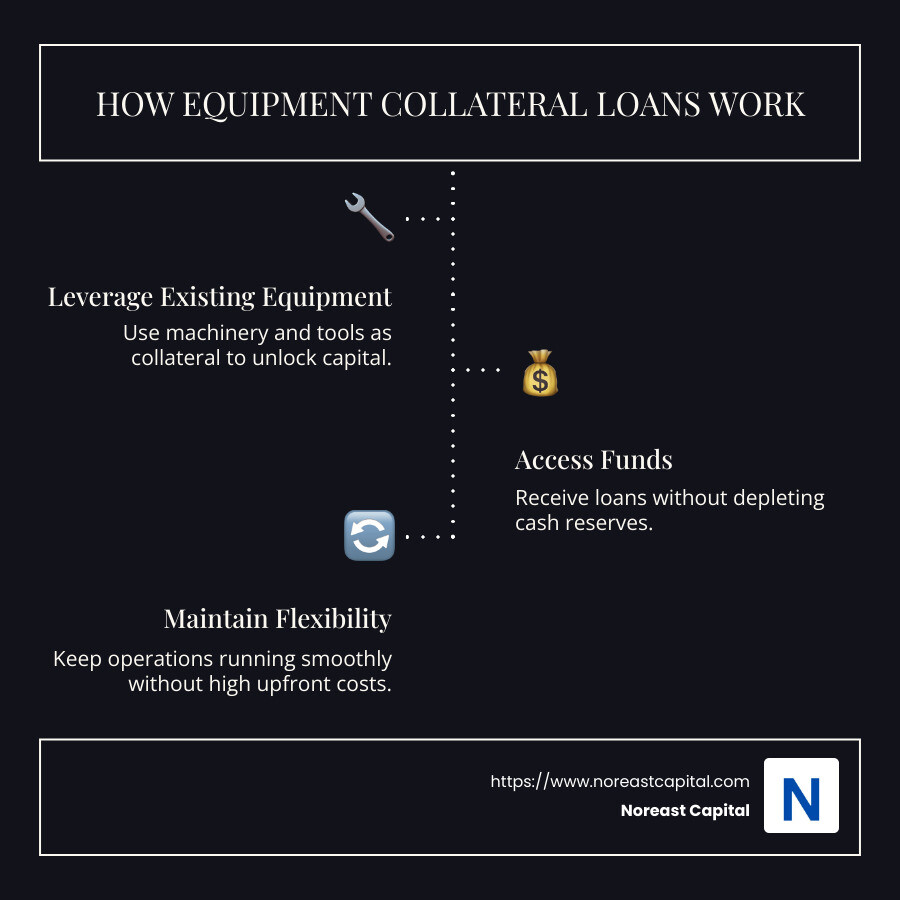
Equipment collateral loans are a game-changer for businesses seeking financial flexibility without high upfront costs. These loans allow companies to leverage their existing equipment as loan security, providing much-needed capital while maintaining cash flow. Quick facts:
- Leverages Equipment: Use existing machinery or tools as collateral.
- Open ups Capital: Access funds without depleting reserves.
- Avoids High Upfront Costs: Keep cash for other priorities.
- Maintains Flexibility: Benefit from operational continuity.
These loans fall under the umbrella of asset-based lending, where the value of tangible assets like machinery and vehicles determines the financing amount. Lenders often prefer this approach due to the reduced risk, as they can repossess and sell the equipment in the event of default.
My name is Vincent Cerniglia, and I specialize in providing equipment financing solutions at Noreast Capital. With expertise in asset-based lending, I help businesses of all sizes open up capital through equipment collateral loans, fostering growth and innovation. Let’s dig deeper into how these loans can be used to their fullest potential.
Basic equipment collateral loans vocab:
– beverage equipment finance
– beverage equipment loans
– food equipment leaseback
Understanding Equipment Collateral Loans
Equipment collateral loans are a type of asset-based financing that can be crucial for businesses looking to secure funds without depleting their cash reserves. Let’s break down what qualifies as equipment for these loans and how the process works.
What Qualifies as Equipment?
In equipment collateral loans, tangible assets are the star players. These are physical items that hold value and can be used as loan security. Common examples include:
- Machinery: Think of construction equipment like excavators or manufacturing machines.
- Vehicles: Includes commercial trucks, vans, and other business-related vehicles.
These assets are ideal for collateral because they have a clear market value and can be appraised with relative ease.
How Equipment Collateral Loans Work
The process of securing an equipment collateral loan involves several key steps:
Valuation: Before anything else, the equipment must be appraised to determine its current market value. This is crucial as the loan amount is typically a percentage of this value. Methods like market value, depreciated value, and replacement cost are often used.
Application Process: Businesses interested in these loans must fill out an application, providing details about the equipment and their financial situation. This might include business tax returns, bank statements, and a list of assets.
Approval: Lenders assess the application based on the equipment’s value and the business’s creditworthiness. A credit score of 550 or higher is often a good starting point, but lenders may also consider other factors like cash flow and industry experience.
Funding: Once approved, the funds are disbursed. These can be used for various business needs, from purchasing new equipment to refinancing existing loans.
Repayment: The borrower repays the loan over an agreed period, which can range from a few years to a decade. Terms are often flexible, accommodating the business’s cash flow and operational needs.

Collateral provides security for the lender, reducing their risk. If the borrower defaults, the lender can repossess the equipment, sell it, and recover the loan amount. This makes equipment collateral loans an attractive option for businesses with valuable tangible assets.
In the next section, we’ll explore the key considerations for these loans, such as equipment valuation methods and loan terms.
Key Considerations for Equipment Collateral Loans
When considering equipment collateral loans, understand how equipment is valued and the terms and interest rates that come with the loan.
Equipment Valuation Methods
Valuing equipment accurately is a crucial step in the loan process. Lenders use several methods to determine the worth of the equipment you’re offering as collateral. Here’s a breakdown of the most common valuation methods:
Market Value: This is the current price of similar equipment in the market. It’s often used when there’s an active market for the machinery. For example, if you own a common model of a construction vehicle, its market value can be easily determined by looking at recent sales of similar vehicles.
Depreciated Value: This method takes the original purchase price and deducts depreciation over time. Factors such as age, usage, and wear and tear are considered. Imagine a truck bought for $100,000 five years ago; its value now would be much less due to depreciation.
Replacement Cost: This estimates what it would cost to replace the equipment with a new or similar model. It’s useful for equipment that has seen significant technological advancements.
Expert Appraisal: Sometimes, professional appraisers are brought in to assess the equipment’s condition, maintenance history, and market demand. This method provides a detailed and accurate valuation.
The valuation significantly impacts the loan amount you can secure. Typically, lenders offer between 50% to 80% of the equipment’s appraised value. So, if your equipment is valued at $200,000, you might secure a loan ranging from $100,000 to $160,000.
Loan Terms and Interest Rates
Once the equipment’s value is determined, understanding the loan terms and interest rates is the next step.
Creditworthiness: Your business’s credit score plays a significant role. A strong credit score can help you secure lower interest rates because lenders see you as a lower risk.
Repayment Periods: Equipment collateral loans usually have repayment periods ranging from three to ten years. This flexibility allows you to choose a plan that aligns with your business’s cash flow.
Flexible Options: Some lenders offer repayment options that can be custom to your business needs, such as monthly or quarterly payments. This can be particularly helpful if your business experiences seasonal fluctuations in revenue.
Interest Rates: These can vary based on several factors, including the equipment’s value and condition, the loan amount, and the term length. Typically, larger loan amounts and shorter terms can result in lower interest rates. However, during periods of low market rates, borrowers might benefit from more favorable loan rates.
Understanding these factors can help you make informed decisions when seeking an equipment collateral loan. With accurate equipment valuation and favorable loan terms, businesses can secure the funding they need while minimizing financial risk.
In the next section, we’ll dig into the benefits and risks associated with equipment collateral loans.
Benefits and Risks of Equipment Collateral Loans
When it comes to equipment collateral loans, understanding the benefits and risks can help businesses make informed decisions. Let’s explore the key points.
Benefits
Capital Access: These loans provide businesses with quick access to capital. Instead of waiting months to save up, you can leverage your equipment to get the funds needed for growth or operational needs. This is especially useful for businesses in construction or manufacturing, where equipment is crucial for daily operations.
Liquidity: By using equipment as collateral, businesses can maintain liquidity. This means they can keep cash on hand for other expenses, rather than tying it up in equipment purchases. Financing allows for smaller, manageable payments over time.
Operational Continuity: With the right funding, businesses can ensure their operations run smoothly. Equipment collateral loans can be used to upgrade machinery, ensuring you have the latest technology to remain competitive. This continuity is vital for businesses that rely heavily on machinery for production.
Risks
Repossession: One of the significant risks is repossession. If you default on the loan, the lender has the right to seize the equipment. This can disrupt operations and lead to financial strain. It’s crucial to have a solid repayment plan in place to avoid this situation.
Depreciation: Equipment naturally loses value over time, a process known as depreciation. If the equipment’s value drops significantly, it might affect your ability to refinance the loan or use it as collateral for future loans. Regular maintenance and upgrades can help mitigate this risk.
Operational Impact: Using equipment as collateral can limit your flexibility. You may need the lender’s approval to sell or upgrade the equipment. This can be a hurdle if you need to adapt quickly to market changes or technological advancements.
Understanding these benefits and risks can help you steer the complexities of equipment collateral loans. By weighing the pros and cons, businesses can make strategic decisions that align with their growth objectives and financial health.
Frequently Asked Questions about Equipment Collateral Loans
Can Equipment Be Used as Collateral for a Loan?
Yes, equipment can be used as collateral for a loan. This type of loan, known as an equipment collateral loan, allows businesses to use their machinery, vehicles, or other tangible assets as security. By doing this, the lender has assurance that if the loan is not repaid, they can repossess the equipment to recover their money. This security often results in more favorable loan terms and interest rates for the borrower.
Using equipment as collateral is common in industries like construction and agriculture, where heavy machinery is essential. The loan amount is usually a percentage of the equipment’s appraised value, which is determined through various valuation methods such as market value or replacement cost.
Do Equipment Loans Require a Down Payment?
Yes, equipment loans typically require a down payment. The down payment is generally a percentage of the equipment’s purchase price. A standard down payment is around 20%, although this can vary based on the lender and the borrower’s creditworthiness.
The down payment reduces the lender’s risk and shows the borrower’s commitment to the purchase. It also lowers the total loan amount, which can lead to lower monthly payments. For businesses, planning for this upfront cost is crucial to ensure they have the necessary funds available when securing the loan.
Is an Equipment Loan Hard to Get?
The difficulty of obtaining an equipment loan depends on several factors, primarily the applicant’s credit score and the application process. Generally, a credit score of 640 or higher is favorable, but some lenders may consider lower scores if other factors, like business cash flow, are strong.
The application process involves providing detailed information about the business, the equipment, and financial health. Lenders will assess the equipment’s value and the borrower’s ability to repay the loan.
While equipment loans can be more accessible than unsecured loans due to the collateral involved, approval still hinges on the lender’s confidence in the borrower’s financial stability. It’s wise to shop around and compare offers to find the best terms for your business needs.
Understanding these aspects can help businesses steer equipment collateral loans effectively. In the next section, we’ll dig deeper into how Noreast Capital can support your business with custom equipment financing solutions.
Conclusion
In today’s competitive business landscape, having the right equipment can be a game-changer. Noreast Capital understands this and offers a variety of equipment financing solutions custom to your business needs. By providing flexible financing options, we empower businesses to grow without the burden of outright ownership costs.
Equipment financing is more than just a way to acquire machinery—it’s a strategic move that can improve your business’s growth potential. By leveraging your equipment as collateral, you can open up capital to invest in other areas of your business, ensuring operational continuity and scalability. This approach not only facilitates immediate access to necessary tools but also helps maintain cash flow, which is crucial for any growing business.
At Noreast Capital, we pride ourselves on being more than just a lender. We are your partners in business growth, offering support and guidance throughout the financing process. Our expertise in the equipment leasing industry allows us to provide solutions that align with your financial goals and operational needs.
Whether you’re in construction, agriculture, or any industry that relies on heavy machinery, our equipment collateral loans can provide the financial flexibility you need. With competitive rates and custom repayment options, we ensure that your business has the resources to thrive.
Explore how our restaurant equipment financing options can benefit your business. Let us help you turn your equipment into a catalyst for growth and success. Together, we can create a brighter future for your business.