

Equipment financing tax benefits 2025: Maximize Savings
The Big Picture: How Acquiring Equipment Can Cut Your Tax Bill
Equipment financing tax benefits can significantly cut your tax bill, but you need to know the rules.
Here’s what you need to know about equipment financing tax benefits:
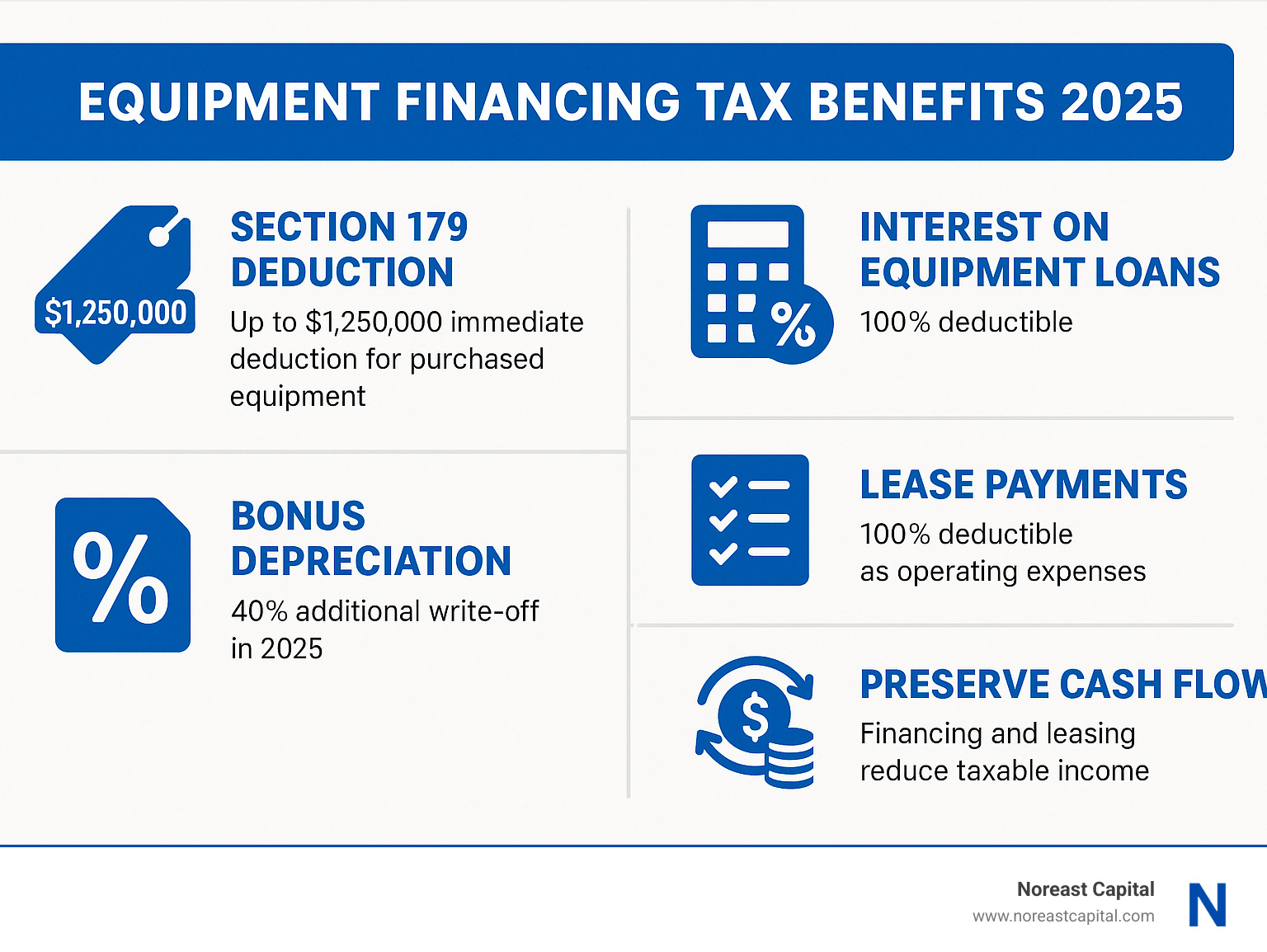
- Section 179 Deduction: Write off up to $1,250,000 of equipment costs in the first year (2025 limit)
- Bonus Depreciation: Deduct 40% of remaining equipment costs immediately in 2025
- Interest Deductions: All loan interest payments are tax-deductible
- Lease Payment Deductions: 100% of lease payments can be written off as business expenses
- No Income Limits: Unlike some deductions, equipment financing benefits work for businesses of all sizes
The goal is simple: get the equipment you need and lower your taxable income. The IRS offers powerful incentives for both financing and leasing to help businesses grow.
However, the wrong financing structure can cost you thousands in missed deductions. Financing can open up immediate write-offs like Section 179, while leasing offers steady, predictable deductions. Both paths offer real tax savings, but the best choice depends on your business situation, cash flow, and growth plans.
I’m Vincent Cerniglia of Noreast Capital. I’ve helped thousands of businesses, from startups to Fortune 500s, use the right equipment financing tax benefits strategy to transform their financial health.
Open up Major Tax Deductions with Equipment Financing (Buying)
When you finance equipment, you take out a loan to purchase an asset your company will own. This ownership is the key that opens up major tax deductions and can dramatically reduce your tax bill.
This happens through two primary mechanisms: depreciation and interest deductions. You get to write off both the cost of the asset itself and the cost of borrowing.
Most businesses use the Modified Accelerated Cost Recovery System (MACRS) for depreciation, which assigns a “useful life” to different types of equipment (e.g., 5 years for computers, 7 for office furniture). This provides consistent deductions that reduce your taxable income each year.
On top of standard depreciation, every dollar you pay in loan interest is also tax-deductible, which lowers the true cost of borrowing. Financing lets you acquire assets without draining cash reserves, keeping working capital free. For more insights, see our guide on the 9 Benefits of Financing Business Equipment.

Maximizing Deductions with Section 179 and Bonus Depreciation
Now we get to the real powerhouses of equipment financing tax benefits: Section 179 and Bonus Depreciation. These are designed to encourage business investment by allowing massive, immediate write-offs.
Section 179 lets you deduct the full purchase price of equipment in the year you buy it, instead of depreciating it over several years. For 2025, you can write off up to $1,250,000 worth of qualifying equipment. This deduction phases out for total equipment purchases over $3,130,000. It works for both new and used equipment, as long as it’s new to your business. For example, a $50,000 equipment purchase could save a business in a 35% tax bracket $17,500 in taxes. You can find details in the Official IRS explanation of Section 179.
Bonus Depreciation works alongside Section 179. For 2025, you can deduct 40% of qualifying equipment costs immediately. Unlike Section 179, Bonus Depreciation has no dollar limit and can create a net operating loss you can carry forward. Typically, you apply Section 179 first, then use Bonus Depreciation on any remaining costs.
Crucially, Bonus Depreciation is phasing out by 20% each year until it disappears in 2027. To maximize these accelerated write-offs, the time to act is now. By strategically using Section 179 and Bonus Depreciation, you can often deduct the entire cost of equipment in year one, freeing up significant cash flow.
Note: Some lease structures, known as capital leases, are treated like loans for tax purposes and may also qualify for these depreciation benefits. Learn more in our guide on the Difference Between a Capital Lease and a Loan.
The Leasing Advantage: How Lease Payments Become Tax Write-Offs
Leasing offers a different approach to equipment financing tax benefits. Instead of buying, you’re essentially renting equipment for a set period. This allows you to use modern equipment without a large cash outlay, and your monthly lease payments are typically 100% tax-deductible as operating expenses.
For example, on a $50,000 piece of equipment, an operating lease could generate $18,597 in tax savings over 36 months (in a 35% tax bracket). Leasing is also ideal for technology that changes rapidly, as you can easily upgrade at the end of your term without the hassle of selling obsolete equipment.
Operating leases also offer off-balance sheet financing. They don’t appear as liabilities, which can improve your financial ratios. The predictable monthly payments and full tax deductibility make budgeting easier and create consistent savings. Learn more in our guides on Equipment Leasing Benefits and Understanding Equipment Leasing.

Operating vs. Capital Leases: What’s the Difference for Taxes?
Understanding the difference between lease types is crucial, as the IRS treats them differently, which impacts your equipment financing tax benefits.
Operating leases are straightforward rental agreements. The leasing company retains ownership, and your entire monthly payment is typically 100% deductible as a business expense. Think of it like office rent: it’s a deductible cost for using the asset, not owning it.
Capital leases (or finance leases) are treated as if you own the equipment for tax purposes. This usually happens if the lease transfers ownership at the end, includes a bargain purchase option, or covers most of the equipment’s useful life. With a capital lease, you can’t deduct the full payment. Instead, you depreciate the equipment and deduct the interest portion of the payments, potentially allowing you to use Section 179 and Bonus Depreciation.
The choice depends on your goals. Want maximum upfront deductions? A capital lease or financing might be best. Prefer lower, consistent payments? An operating lease is often better. For more details, see our resources on How to Account for Leased Equipment and Can Leased Equipment Be Depreciated?.
Are Sales Tax and Other Fees Deductible?
Don’t overlook smaller costs, as they can also provide tax benefits.
- Sales tax: When you purchase/finance, sales tax is added to the equipment’s cost basis and recovered through depreciation. With a lease, it’s usually part of the monthly payment, making it deductible along with the payment and improving cash flow.
- Property taxes: If you own equipment (via purchase, loan, or capital lease), any personal property taxes you pay are typically fully deductible.
- Insurance fees: Premiums to protect your equipment are considered necessary business expenses and are 100% deductible.
- Maintenance and repair costs: Money spent keeping equipment in good working order is a deductible business expense. Some leases bundle maintenance into the deductible monthly payment.
Keeping detailed records is key to maximizing these deductions. For reporting guidance, see our article on Do You Issue a 1099 for Equipment Leases?.
Lease vs. Buy: A Head-to-Head Tax and Financial Comparison
Should you lease or buy? Both options offer compelling equipment financing tax benefits, but they work very differently. Buying through financing is a long-term play where you gain ownership, build equity, and can use powerful deductions like Section 179. Leasing is about flexibility and cash flow, allowing you to use the latest equipment without the commitment of ownership—ideal for fast-changing tech or preserving capital.
The tax implications differ significantly. A $50,000 financed purchase could net $17,500 in tax savings in year one via Section 179. Leasing the same equipment might yield $18,597 in savings spread over 36 months. Your industry also matters: financing a long-lasting bulldozer makes sense for a construction company, while leasing is often smarter for a tech startup’s computers.
For a deeper dive, check out our guide on Lease vs. Buy Equipment.

Comparing Equipment Financing Tax Benefits to Leasing
Let’s put these two approaches side by side to see how the equipment financing tax benefits compare.
| Feature | Equipment Financing (Buying) | Equipment Leasing (Operating Lease) |
|---|---|---|
| Deduction Type | Depreciation (MACRS) + Interest on loan/capital lease payments | Full monthly lease payment as an operating expense |
| Section 179 Eligibility | Yes, for qualifying equipment owned/treated as owned | No, as the lessee does not own the equipment |
| Bonus Depreciation | Yes, for qualifying equipment owned/treated as owned | No, as the lessee does not own the equipment |
| Ownership at End of Term | Yes, we own the equipment | No, the lessor retains ownership (option to buy may exist) |
| Balance Sheet Impact | Asset and corresponding liability are on the balance sheet | Typically off-balance sheet (asset/liability not recorded) |
| Typical Tax Impact | Large, accelerated deductions upfront (Section 179/Bonus Dep.) or consistent depreciation over asset life | Consistent, predictable deductions spread over the lease term |
| Sales Tax Treatment | Often paid upfront, recovered via depreciation | Often paid monthly as part of lease payment, deductible with payment |
In short: financing is best if you want to maximize immediate tax deductions and eventually own the asset. Leasing is better if you prefer steady, predictable deductions and want to keep your balance sheet clean. Both are effective strategies; the right choice depends on your business goals. For a more detailed breakdown, see our article on Equipment Financing vs. Leasing.
Key Factors Beyond Taxes to Consider
While tax benefits are important, don’t let them be your only consideration. Look at the bigger picture.
- Upfront costs and cash flow: Financing often requires a down payment and has higher monthly payments. Leasing usually requires little to no money down and has lower payments, preserving cash flow.
- How long you need the equipment: Financing makes sense for long-life assets. Leasing is better for equipment with short lifecycles, like computers, as it simplifies upgrades.
- Risk of obsolescence: Ownership carries the risk of obsolescence. Leasing allows you to upgrade to the latest technology at the end of the term.
- Control and customization: Ownership offers the freedom to modify or sell the equipment. Leasing has restrictions but often fewer maintenance worries.
- Maintenance and repairs: With ownership, you cover all repairs. Many lease agreements include maintenance, making your costs more predictable.
- Balance sheet impact: Owned equipment appears as an asset and a liability, affecting financial ratios. Operating leases are typically off-balance-sheet, which can make financial statements look stronger.
The key is to align the financing method with your overall business strategy, not just the immediate tax impact.
Your Final Checklist: Why a Tax Pro is Your Best Friend
After exploring the various equipment financing tax benefits, from Section 179 to lease deductions, the most important takeaway is this:
It is absolutely crucial to consult a tax professional when considering equipment acquisition options.
Tax laws are complex and your business situation is unique. A qualified tax advisor or CPA is your best friend in this process because they provide:
- Personalized Guidance: They tailor advice to your specific business structure (LLC, S-Corp, C-Corp), industry, and financial situation to determine the optimal strategy.
- Strategic Planning: An advisor helps you time acquisitions to maximize deductions and choose the best financing structure—loan, capital lease, or operating lease—to meet your short- and long-term goals.
- Up-to-Date Knowledge: Tax laws, like the limits for Section 179 and the phase-out of bonus depreciation, change frequently. A professional stays current on these rules to ensure you don’t miss out.
- Audit-Proofing: They can guide you on proper record-keeping and documentation to support your deductions and protect your business in case of an IRS audit.
- Avoiding Costly Mistakes: A small investment in professional advice can prevent costly errors, missed deductions, or IRS penalties, saving you thousands in the long run.
A tax professional provides a holistic financial view, integrating your equipment strategy into your broader financial plan. Their advice isn’t an expense—it’s an investment that pays dividends in both peace of mind and real financial gains for your business.
Conclusion: Turn Tax Savings into Business Growth
We’ve explored how powerful equipment financing tax benefits—from the immediate write-offs of Section 179 to the steady deductions of operating leases—can help your business grow. Acquiring equipment is a strategic financial move that can save you thousands in taxes and position you for long-term success.
Understanding these benefits allows you to choose the right path for your business. An operating lease can preserve cash flow, while financing with Section 179 offers large upfront deductions and builds equity.
At Noreast Capital, we help businesses see equipment as a strategic investment. When you optimize your equipment financing tax benefits, you free up capital that can be reinvested into hiring, marketing, or product development. It’s about creating a cycle of growth where smart equipment decisions fuel business expansion.
The key is not trying to figure this out alone. Partner with a qualified tax professional who understands your business structure and goals. Work with a financing company that takes the time to explain your options and help you choose the path that makes the most sense for your situation.
Your equipment should work as hard for your business as you do. When you combine the right financing structure with proper tax planning, every acquisition becomes a building block for sustainable growth and improved financial health.
Ready to turn your next equipment purchase into a tax-saving opportunity? We’d love to help you explore your options. Get a no-obligation rate quote for your next equipment acquisition and find how the right financing strategy can benefit both your operations and your bottom line.