

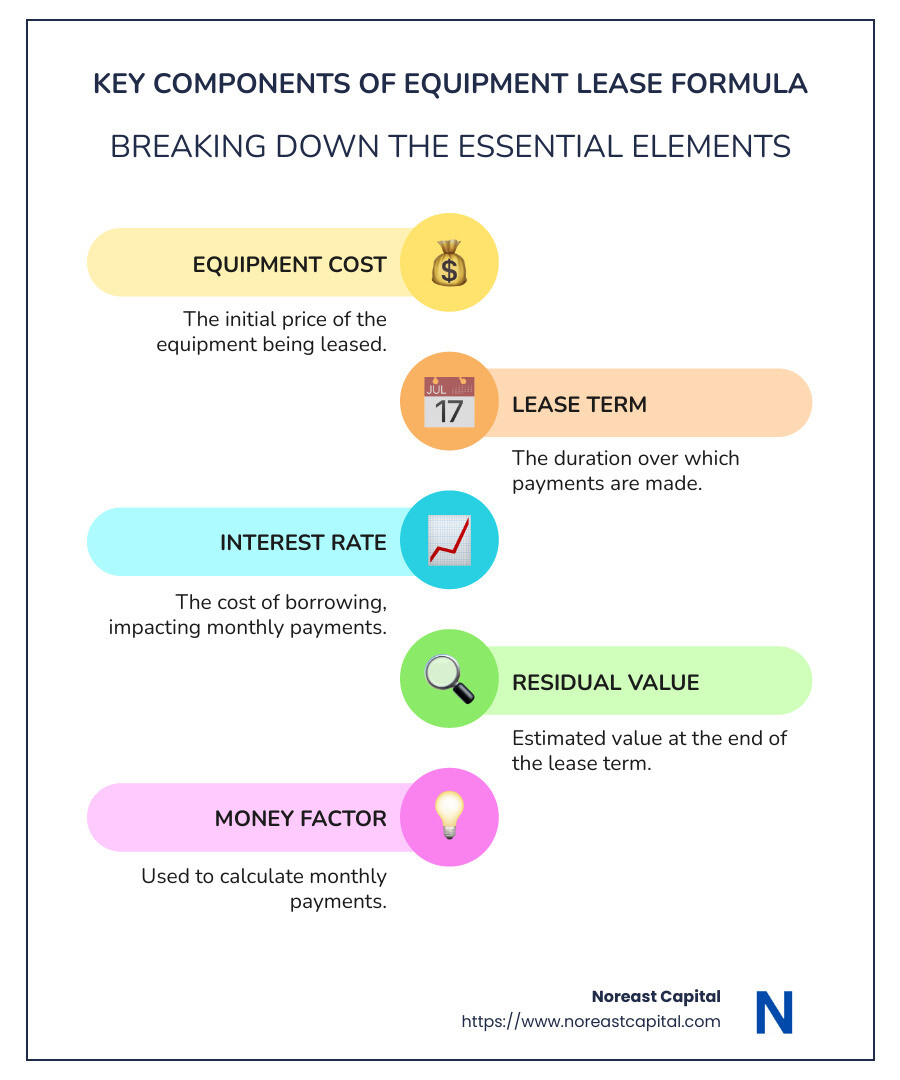
Equipment lease formula is the key to deciphering the true cost of acquiring equipment without the hefty upfront expenditure. Essentially, it comprises these core factors:
- Equipment Cost: The initial price of the equipment.
- Lease Term: Duration over which the lease payments are spread.
- Interest Rate or Money Factor: The cost of borrowing, impacting monthly payments.
- Residual Value: The estimated value of the equipment at the end of the lease.
For small business owners, understanding this formula brings transparency and allows for smart financial planning.
In equipment leasing, businesses gain the advantage of utilizing crucial tools while preserving their capital. Think of it as keeping up with technology trends without the burden of ownership. This approach not only saves precious cash but also keeps cash flow stable, a vital aspect for any business eager to thrive.
As Vincent Cerniglia with years of experience at Noreast Capital, I can vouch for the power of understanding the equipment lease formula for achieving financial clarity. Transitioning our focus now, let’s dig deeper into the mechanics of equipment leasing and the role it plays in securing business growth.
Find more about equipment lease formula:
– capital equipment finance calculator
– equipment leasing calculator
– lease amortization schedule calculator
Understanding Equipment Leasing
When it comes to acquiring business equipment, understanding the difference between leasing and renting can make all the difference.
Lease vs. Rent: Spot the Difference
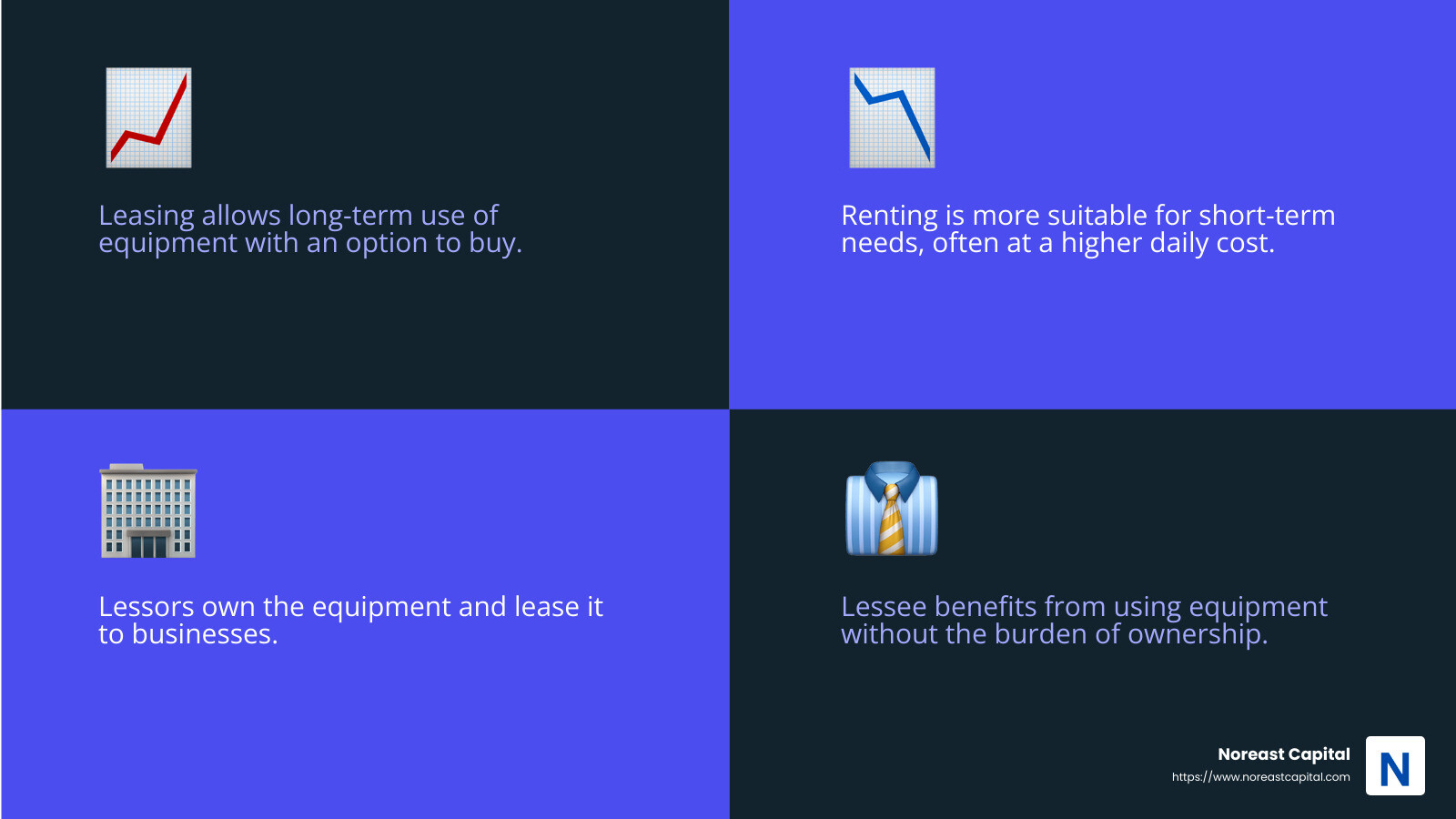
Leasing is often like a long-term commitment. When you lease equipment, you’re agreeing to use it for several years. It’s a great option if you need the equipment for an extended period and want the choice to buy it later. Plus, leases come with specific terms about maintenance and usage.
Renting, on the other hand, is more short-term. Need a piece of equipment for just a few days or weeks? Renting might be your best bet. It’s flexible but can be more expensive on a day-to-day basis compared to leasing.
Imagine you’re running a bakery and your oven breaks down. You might rent a replacement oven for a week. But if you’re opening a new location and need an oven for the long haul, a lease might be more cost-effective.
Who’s Who: Lessor and Lessee
In any lease agreement, there are two main players:
- Lessor: This is the owner of the equipment. They purchase the equipment and lease it to you.
- Lessee: That’s you, the business owner. You get to use the equipment without owning it.
Business Equipment: A Smart Choice
Leasing business equipment is a smart move for many companies. Why? Because it helps you avoid large upfront costs. Instead of paying a big chunk of money to own equipment, you pay smaller, regular lease payments. This keeps your cash flow steady and allows you to invest in other areas of your business.
Statistics show that 80% of businesses lease some of their equipment. This strategy helps them stay updated with the latest technology without draining their cash reserves.
Leasing is especially beneficial for businesses that need to keep up with rapid technological changes. It provides access to the latest equipment without the worry of obsolescence.
By understanding these basics, you’re better prepared to make informed decisions about leasing equipment for your business. Next, let’s explore the different types of equipment leases available and how they can benefit your business.
Equipment Lease Formula: Key Components
Understanding the equipment lease formula is crucial for making informed leasing decisions. Let’s break down the key components: monthly payments, residual value, money factor, and lease rate factor.
Monthly Payments
Your monthly payment is the amount you pay each month for the equipment. It’s determined by several factors:
- Equipment Cost: The initial price of the equipment.
- Down Payment: Any upfront payment you make, which reduces the amount financed.
- Lease Term: The duration over which you’ll make payments, usually ranging from 12 to 60 months.
- Interest Rate: The cost of borrowing, often influenced by your credit score.
Missing a payment can result in the equipment being repossessed, so ensure you can afford the monthly cost.
Residual Value
Residual value is the estimated worth of the equipment at the end of the lease term. It plays a significant role in determining your monthly payments. For instance, if a $50,000 piece of equipment has a residual value of $10,000 after three years, your payments will be based on the $40,000 difference.
Higher residual values generally mean lower monthly payments. This is because you’re financing a smaller portion of the equipment’s total cost.
Money Factor
The money factor is a way to express the interest rate on a lease. It’s akin to the APR on a loan but is presented differently. To convert the money factor to an annual interest rate, multiply it by 2,400.
Example: A money factor of 0.0030 equates to an annual interest rate of 7.2% (0.0030 * 2,400).
A lower money factor means less interest paid over the lease term, making it a key negotiation point.
Lease Rate Factor
The lease rate factor is a multiplier used to calculate your monthly lease payment. It accounts for the interest rate and lease term.
Example: If your equipment costs $100,000 and the lease rate factor is 0.02, your monthly payment would be $2,000 (0.02 * $100,000).
A lower lease rate factor results in lower monthly payments, making it another critical element in the leasing equation.
By understanding these components, you can better steer the leasing process and choose the best options for your business needs. Next, we’ll dig into the different types of equipment leases and how they can benefit your business.
Types of Equipment Leases
When it comes to equipment leasing, understanding the different types of leases is crucial. Each type serves a unique purpose and offers distinct advantages, depending on your business needs. Here’s a breakdown of the most common types:
Capital Lease
A capital lease is like purchasing the equipment but with the flexibility of leasing. It often suits businesses planning to use the equipment long-term. Key features include:
- Ownership Mindset: You’re essentially buying the equipment over time.
- Financial Advantage: It appears on your balance sheet, which can be beneficial for tax purposes.
- End-Term Options: Typically, you can purchase the equipment for a nominal fee at the lease’s end.
Example: A construction company might use a capital lease to obtain heavy machinery for long-term projects.
Operating Lease
An operating lease is more like renting. It’s ideal for assets you plan to upgrade or replace frequently. Key features include:
- Off-Balance Sheet: Keeps your liabilities lower by not appearing on your balance sheet.
- Flexibility: Easier to upgrade to newer equipment at the end of the lease.
- Shorter Terms: Usually has shorter terms than capital leases.
Example: A tech startup might lease computers on an operating lease to ensure they have the latest technology.
$1 Buyout Lease
The $1 buyout lease is a type of capital lease where the lessee can purchase the equipment for $1 at the end of the lease. Key points include:
- Fixed Payments: Monthly payments remain constant.
- Ownership: You can own the equipment for just $1 at the lease’s end.
- Long-Term Use: Ideal for businesses that plan to keep the equipment long-term.
Example: A bakery might use a $1 buyout lease for ovens and mixers they plan to use for many years.
10% Purchase Lease
The 10% purchase lease offers a blend of operating and capital lease benefits. It provides lower monthly payments with the option to buy the equipment for 10% of its price at the end. Key features include:
- Lower Monthly Payments: Due to the residual cost to be paid at the end.
- Flexibility: Option to purchase the equipment at 10% of its value.
- Combination: Mix of operating and capital lease benefits.
Example: A small manufacturing business might use a 10% purchase lease for machinery, balancing lower monthly costs with the option to buy.
Fair Market Value Lease
The fair market value (FMV) lease, also known as a ‘true’ lease, provides flexibility at the end of the lease. You can return, renew, or buy the equipment at its market value. Key features include:
- Flexibility: Choose to return, renew, or buy the equipment.
- Short-Term Use: Ideal for equipment that depreciates quickly.
- Lower Initial Cost: Often has lower initial costs compared to other lease types.
Example: An office might use an FMV lease for copiers, allowing them to upgrade to newer models as technology advances.
Understanding these lease types can help you make informed decisions that align with your financial and operational goals. Next, we’ll explore how to calculate your equipment lease payments accurately.
Calculating Your Equipment Lease Payments
When leasing equipment, understanding the equipment lease formula is essential for making informed financial decisions. Let’s break down the key components that determine your lease payments: equipment cost, down payment, lease term, and interest rate.
Equipment Cost
The first step in calculating your lease payments is knowing the total cost of the equipment. This is the price of the item you wish to lease. For instance, if you’re leasing a machine worth $50,000, this is the figure you’ll start with. Some leasing companies might allow you to include administrative costs in this total, which can affect your monthly payments.
Down Payment
A down payment is usually required at the start of the lease. It reduces the amount you need to finance, thus lowering your monthly payments. Commonly, the down payment is a percentage of the equipment’s cost. For example, a 10% down payment on a $50,000 equipment lease would be $5,000. This upfront payment is crucial for securing the lease and reducing your overall financial obligation.
Lease Term
The lease term is the duration over which you’ll make payments. It typically ranges from 12 to 60 months. A longer lease term can mean lower monthly payments but might result in higher total costs due to interest. Conversely, a shorter term usually means higher monthly payments but less interest paid over time. Choose a term that aligns with your business’s cash flow and equipment needs.
Interest Rate
The interest rate is the cost of borrowing the equipment. It affects how much you’ll pay in total over the lease term. A lower interest rate means lower monthly payments and less interest over the lease’s life. Interest rates can vary based on your credit score, the lease type, and market conditions. For instance, a company with a solid financial history might secure a lease with a 5% interest rate, whereas a startup might face a higher rate.
Putting It All Together
To calculate your monthly lease payments, you’ll need to consider all these factors. Here’s a simple formula to guide you:
[ \text{Monthly Payment} = \frac{(\text{Equipment Cost} – \text{Down Payment}) \times (1 + \text{Interest Rate})}{\text{Lease Term}} ]
Let’s say you’re leasing a piece of equipment for $50,000 with a $5,000 down payment, a 36-month lease term, and a 5% interest rate:
[ \text{Monthly Payment} = \frac{($50,000 – $5,000) \times (1 + 0.05)}{36} ]
This formula will give you an estimate of your monthly payment, helping you manage your budget effectively.
Understanding these components allows you to make informed decisions and find a lease that best suits your business needs. Next, we’ll explore the benefits of equipment leasing and how it can boost your business.
Benefits of Equipment Leasing
Leasing equipment can be a game-changer for businesses, especially when it comes to managing finances and staying competitive. Let’s explore the key benefits: cost savings, flexibility, tax advantages, and cash flow management.
Cost Savings
One of the most appealing aspects of leasing is the cost savings. Instead of shelling out a large sum of money upfront to purchase equipment, you spread the cost over monthly payments. This is particularly helpful for small businesses or startups with limited capital.
Imagine needing a commercial dishwasher that costs $10,000. Buying it outright might strain your finances. Leasing it, however, for $250 a month over four years, keeps more cash in your pocket for other essential expenses.
Flexibility
Leasing offers best flexibility. You can choose between different lease types, like capital leases or operating leases, depending on your needs.
- Capital Leases are great if you plan to keep the equipment long-term and want eventual ownership.
- Operating Leases are ideal for short-term needs or equipment that might become outdated quickly.
This flexibility allows you to upgrade to newer, more efficient equipment easily, ensuring your business remains competitive.
Tax Advantages
Tax benefits are another significant advantage of leasing. Monthly lease payments are often considered a business expense, making them tax-deductible. This can lower your taxable income and reduce your overall tax bill.
For example, under the Section 179 Deduction, you can deduct the full purchase price of qualifying equipment leased during the tax year. This means you get the equipment you need while enjoying a lower tax liability.
Cash Flow Management
Effective cash flow management is vital for any business. Leasing helps by spreading payments over time, avoiding large lump-sum expenditures that could strain your finances.
For instance, instead of paying $50,000 upfront for new kitchen equipment, you could lease it for $1,200 a month. This allows you to allocate funds to other crucial areas like marketing or inventory.
Understanding these benefits helps you decide if leasing is the right choice for your business. Next, we’ll address some frequently asked questions about equipment lease formulas to help you get the most out of this financial tool.
Frequently Asked Questions about Equipment Lease Formulas
Leasing equipment can seem complicated, but it doesn’t have to be. Let’s break down some common questions about equipment lease formulas to make things clearer.
How are equipment lease payments calculated?
Your monthly lease payment depends on a few key factors:
- Equipment Price: This is the total cost of the equipment you’re leasing.
- Down Payment: An initial amount you pay at the start of the lease. Not all leases require this.
- Lease Term: The length of time you’ll be paying for the lease, usually between 12 and 60 months.
- Interest Rate: The percentage charged by the lessor for borrowing the equipment.
To get a rough idea of your monthly payments, you can use this simple formula:
[ \text{Monthly Payment} = \frac{\text{(Equipment Price – Down Payment) + (Interest Rate \times Lease Term)}}{\text{Lease Term}} ]
Imagine leasing a $50,000 piece of equipment with no down payment, a 5% interest rate, and a 36-month term. Your monthly payment would be approximately $1,500.
What is the lease rate factor of equipment?
The lease rate factor is a small decimal number used to calculate your monthly lease payment. It combines the interest rate and lease term into one figure. A lower lease rate factor means lower monthly payments.
Here’s a quick way to calculate it:
[ \text{Lease Rate Factor} = \frac{\text{Monthly Payment}}{\text{Equipment Cost}} ]
For example, if your equipment costs $100,000 and your monthly payment is $2,000, your lease rate factor would be 0.02.
How to calculate lease rentals?
Calculating total lease rentals involves understanding both the residual value and the total cost over the lease term. The residual value is what the equipment is expected to be worth at the end of the lease.
Here’s a basic formula for total lease cost:
[ \text{Total Lease Cost} = (\text{Monthly Payment} \times \text{Lease Term}) + \text{Down Payment} ]
For instance, if you pay $1,500 per month for 36 months with a $5,000 down payment, your total lease cost would be $59,000.
Understanding these components can help you make smarter leasing decisions. By knowing how your payments are calculated and what factors affect them, you can better manage your business’s finances and plan for the future.
Conclusion
At Noreast Capital, we are dedicated to helping businesses thrive through smart equipment financing solutions. By offering flexible leasing options, we empower companies to access the equipment they need without the burden of ownership. This approach not only supports business growth but also improves cash flow management and financial stability.
Equipment leasing with us means you can conserve your working capital and bank lines, allowing you to invest in other critical areas of your business. Whether you’re a startup looking to expand or an established company seeking to upgrade your equipment, our custom financing solutions are designed to meet your unique needs.
By understanding and utilizing the equipment lease formula, businesses can make informed decisions about their equipment investments. Our equipment leasing calculator simplifies this process, enabling you to quickly estimate monthly payments and overall lease costs. This tool is an invaluable resource for planning and budgeting effectively.
In today’s business environment, staying competitive often requires access to the latest technology and equipment. With Noreast Capital’s leasing options, you can keep pace with technological advancements and ensure your operations run smoothly.
Partnering with us means choosing a trusted ally in your business journey. Our expertise in equipment financing is backed by years of experience and a commitment to supporting your growth. Together, we can achieve great things, ensuring your business not only survives but thrives. Thank you for considering Noreast Capital as your partner in equipment financing. Let’s work together to build a successful future.