

The Strategic Choice: Equipment Lease vs Finance
Equipment lease vs finance is a critical decision that impacts your business’s cash flow, tax situation, and operational flexibility. Before diving into the details, here’s a quick comparison:
| Aspect | Equipment Leasing | Equipment Financing |
|---|---|---|
| Ownership | No ownership (except with $1 buyout leases) | Full ownership after loan repayment |
| Upfront Costs | Little to no down payment | Typically 10-20% down payment |
| Monthly Payments | Generally lower | Usually higher |
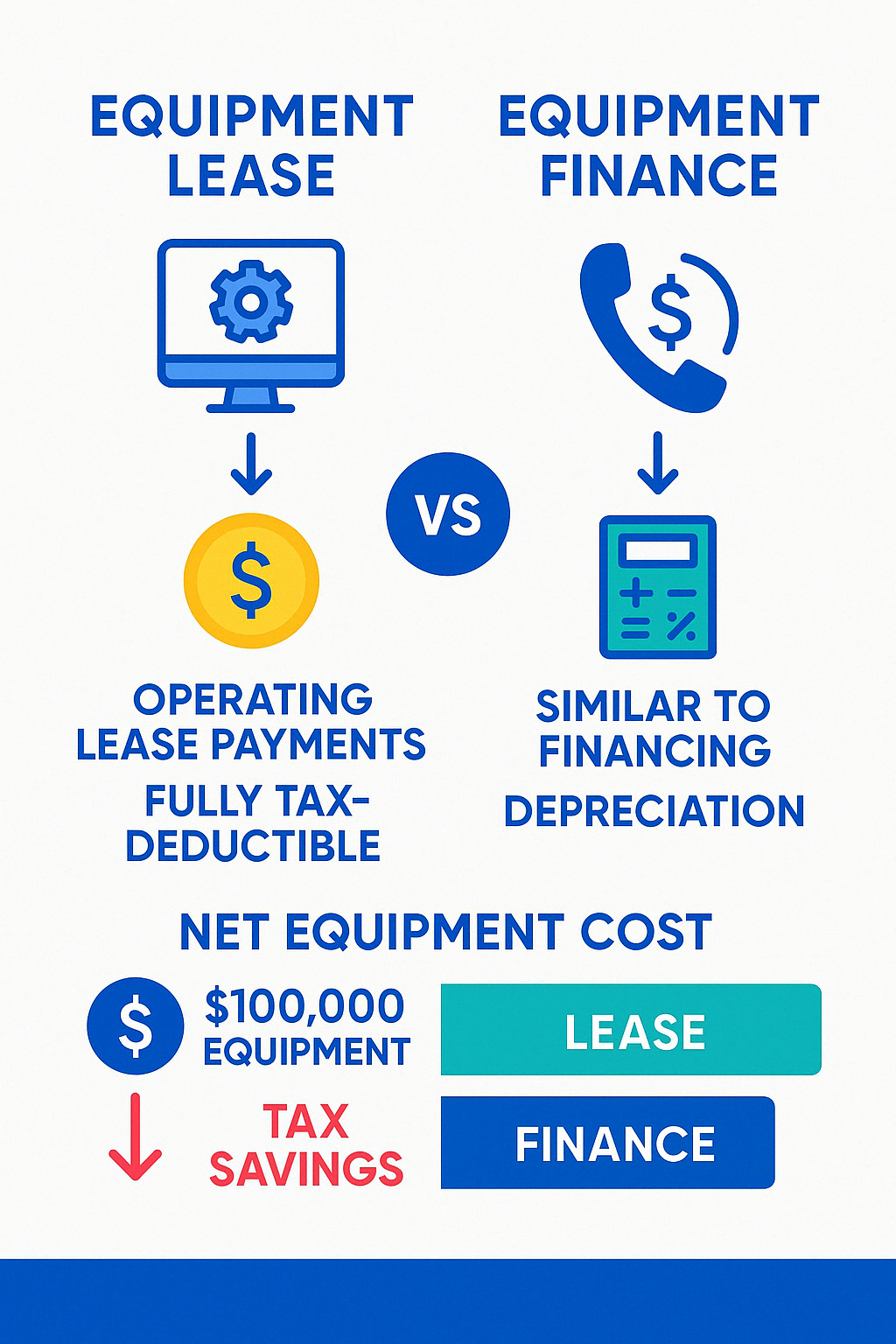
| Tax Benefits | Lease payments fully deductible as business expense | Depreciation deductions and Section 179 benefits |
| End of Term | Return, renew, or purchase options | You own the equipment |
| Best For | Rapidly outdated equipment, short-term needs | Long-term equipment use, building equity |
When getting new equipment for your business, one of the most important decisions you’ll face is whether to lease or finance. This choice can significantly impact your cash flow, balance sheet, and long-term financial health.
Over 80% of commercial power equipment is financed in some way, making this decision a common challenge for business owners. The equipment finance industry is massive—reaching $1.2 trillion and growing over 8% in 2025 alone, according to the Equipment Leasing and Finance Association.
For many businesses, especially those with limited capital or unpredictable cash flow, leasing provides a lifeline to access essential equipment without large upfront investments. Meanwhile, financing offers the path to ownership and potential tax advantages for businesses planning long-term equipment use.
I’m Vincent Cerniglia from Noreast Capital Corporation, where I’ve helped thousands of businesses steer the complexities of equipment lease vs finance decisions as part of our nationwide equipment financing and leasing solutions. Our experience serving clients from small businesses to Fortune 500 corporations has given us unique insights into making this important choice.

Equipment lease vs finance terms to remember:
– Business equipment loan rates
– Equipment leasing benefits
– difference between lease and loan
Understanding Equipment Leasing
When it comes to equipment lease vs finance decisions, understanding the core differences starts with knowing what leasing truly means for your business. Equipment leasing is essentially a rental arrangement that gives your business the right to use equipment for a set period without actually owning it. You’ll make regular payments to the leasing company (the lessor) for the privilege of using their equipment.
“An equipment lease is when the bank provides funds to cover equipment leasing costs, as opposed to purchased equipment,” as one of our financial experts explains. This arrangement has helped countless businesses access necessary equipment without depleting their cash reserves.
At Noreast Capital, we’ve seen how leasing transforms businesses that need to preserve cash flow while still acquiring essential equipment. From family-owned restaurants needing commercial kitchen equipment to construction companies requiring heavy machinery, leasing provides a flexible solution that keeps operations running smoothly.
One of the biggest advantages of equipment leasing is the minimal initial cash outlay. While financing typically requires a down payment of 10-20% of the equipment’s value, leases often require little to no down payment. This difference can be substantial—imagine saving $10,000 upfront on a $50,000 piece of equipment!
I remember working with a small restaurant owner in Baltimore who told me, “I needed three new commercial refrigerators totaling $30,000. With financing, I would have needed $6,000 down—money I simply didn’t have available. Leasing allowed me to get all three units with just the first month’s payment upfront.”
When you lease equipment, the leasing company typically handles maintenance and repairs (depending on the lease type), removing another potential headache from your business operations. At the end of the lease term, you generally have several options: return the equipment, renew the lease, or purchase the equipment at fair market value or a predetermined amount.
For more detailed information about the differences between leasing and buying, check out our resource page on Understanding the Difference Between Lease and Buying.
Types of Equipment Leases
There are two primary types of equipment leases you should know about: operating leases and capital (or finance) leases. The differences between these options can significantly impact your business finances and operations.
Operating Leases
An operating lease works much like a traditional rental arrangement. These leases typically feature:
- Shorter terms (usually less than 75% of the equipment’s useful life)
- The lessor maintains ownership of the equipment throughout the lease
- Fully tax-deductible lease payments as business expenses
- The equipment doesn’t appear as an asset on your balance sheet (though newer accounting standards require recording a right-of-use asset)
- End-of-term options that include returning the equipment or renewing the lease
Operating leases shine when it comes to equipment that quickly becomes outdated. I worked with a tech company in Washington, DC that exclusively uses operating leases for their workstations and servers. This strategy allows them to upgrade to newer technology every 2-3 years without being stuck with obsolete equipment.
Capital/Finance Leases
A capital lease (now called a finance lease under newer accounting standards) functions more like a loan in disguise. These leases typically include:
- Longer terms that often cover 75% or more of the equipment’s useful life
- A purchase option at the end of the lease term (often a nominal amount)
- The equipment appears as both an asset and a liability on your balance sheet
- Your business takes responsibility for maintenance, insurance, and other ownership expenses
- You can claim depreciation tax benefits, similar to if you had purchased the equipment
One popular type of capital lease is the “$1 Buyout Lease,” where you pay slightly higher monthly payments but have the option to purchase the equipment for just $1 when the lease ends. This is essentially a financing arrangement structured as a lease for businesses that want eventual ownership.
A manufacturing client in Annapolis once told me, “We knew we wanted to eventually own our CNC machine, but we needed to preserve cash flow in the short term. The $1 buyout lease gave us the best of both worlds—manageable monthly payments and ownership at the end.”
Another common option is the “10% Purchase Option Lease,” where you can buy the equipment for 10% of its original cost when the lease ends. This typically offers lower monthly payments than the $1 buyout option but requires a more substantial payment if you choose to purchase.

Understanding Equipment Financing
Picture this: You’re eyeing that perfect piece of equipment that could transform your business, but you’re not sure if you should lease it or buy it outright. That’s where equipment financing enters the picture – a pathway to ownership that works quite differently from leasing.
When you finance equipment, you’re essentially taking out a loan to purchase the equipment immediately. You’ll make regular payments over a set period, and once those payments are complete, you own the equipment free and clear – no strings attached.
As one financial expert puts it, “An equipment loan is when the financial institution loans money to an organization for the purchase of equipment. The business can then repay the loan back, with interest, over time.”
Here at Noreast Capital, we’ve seen countless businesses transform through our equipment financing solutions. These options allow you to build equity in your assets while spreading the cost over time – perfect for equipment you plan to use for many years or when ownership strategically matters to your operations.
One Baltimore construction company we worked with chose to finance their excavator because they knew it would be a long-term asset. “The machine will long outlast the 5-year loan term,” the owner told us with a smile. “After those payments are done, we’ll have a valuable asset that continues to generate revenue without ongoing costs.”
The beauty of equipment financing lies in its distinct advantages:
Ownership and Equity Building is perhaps the biggest benefit – each payment builds your stake in the equipment, eventually resulting in full ownership.
Tax Benefits can be substantial too. You can depreciate the equipment over its useful life and potentially take advantage of Section 179 deductions, which many of our clients find extremely valuable come tax season.
With financing, there are No End-of-Term Decisions to worry about. Unlike leasing, you won’t need to decide whether to return, renew, or purchase at the end – you already own it!
Once paid off, the equipment becomes an Asset Leverage opportunity. That excavator or printing press can serve as collateral for future financing needs, opening doors for additional growth.
How Equipment Financing Works
The equipment financing process is straightforward, though it does differ from leasing in important ways.
First comes the Application and Approval stage. You’ll apply for financing, and we’ll evaluate your creditworthiness, time in business, and revenue. At Noreast Capital, we pride ourselves on making this process smooth and quick – often providing decisions within hours for transactions under $150,000. No endless waiting or wondering!
Unlike leasing, financing typically requires a Down Payment – usually 10-20% of the equipment’s value. Think of this as your initial equity stake in the asset. While this upfront cost is higher than with leasing, it contributes to lower monthly payments and faster equity building.
You’ll then follow a Fixed Payment Schedule, making regular monthly payments over a predetermined term. These terms typically run 2-7 years depending on the equipment type and your specific business needs. One restaurant owner we worked with financed their kitchen equipment over 5 years, perfectly matching their business plan timeline.
Interest Rates and Terms can be fixed or variable, and we typically match terms to the expected useful life of the equipment. Our clients appreciate that Noreast Capital offers competitive rates with transparent terms – no hidden surprises lurking in the fine print.
Once all payments are made, the Ownership Transfer happens automatically. The equipment is yours outright with no further financial obligations – a moment worth celebrating!
It’s worth noting how equipment loans differ from traditional bank loans. While both can finance equipment purchases, equipment loans use the equipment itself as collateral. As one transportation client shared, “Traditional banks wanted extensive financial documentation and a lengthy approval process for my fleet expansion. Noreast Capital approved my equipment loan in days with minimal paperwork because the trucks themselves served as collateral.”
We often customize financing structures to match your business rhythm. For seasonal businesses, we might arrange step-up payment plans, allowing lower payments during slow periods and higher payments during peak seasons. It’s all about making the financing work for your specific situation.
For businesses planning long-term equipment use or those wanting to build assets on their balance sheet, financing often makes more sense than leasing. The equipment becomes your property, building equity with every payment while potentially offering significant tax advantages through depreciation.
Want to learn more about the differences between equipment leasing and financing? Check out our detailed guide on the Difference Between Equipment Lease and Loan for even more insights to help with your decision.
Equipment Lease vs Finance: Key Differences
When businesses come to us at Noreast Capital, they often ask about the real differences between equipment lease vs finance options. Let’s break down these differences in a way that actually makes sense for your business decisions.
Ownership: Who Really Owns the Equipment?
The most fundamental difference comes down to who holds the title. With leasing, you’re essentially renting the equipment—the leasing company maintains ownership throughout the term (except in lease-to-own arrangements like $1 buyout leases).
With financing, you own the equipment from day one, though the lender holds a security interest until you’ve paid off the loan. This is similar to how a mortgage works—you own your house, but the bank has a claim on it until you’ve paid them back.
I remember working with a dental practice in Baltimore that was expanding. The dentist told me, “I want to know these expensive dental chairs are really mine.” For her, ownership was psychologically important, so financing made more sense than leasing.
Monthly Payments and Total Cost
Your monthly cash flow situation often drives this decision. Equipment lease vs finance options affect your budget differently:
Leasing typically gives you lower monthly payments, which can be a lifesaver when cash flow is tight. However, if you add up all those payments over time, you’ll usually pay more in total than with financing.
A restaurant owner in Washington, DC shared his experience with me: “I was looking at a $50,000 commercial kitchen setup. The lease payments were $1,050 monthly for 60 months, totaling $63,000. Financing would have cost $1,215 monthly for the same term, totaling $72,900. But with financing, I’d own $50,000 worth of equipment at the end.”
This highlights an important point—with financing, you’re building equity with every payment. With leasing, you’re paying for use, not ownership.
Impact on Your Balance Sheet
Your accountant will definitely have opinions about equipment lease vs finance choices because they affect your financial statements differently:
With traditional operating leases, the equipment stayed off your balance sheet entirely. However, new accounting standards (ASC 842) now require recording a “right-of-use” asset and corresponding liability, though the presentation still differs from owned assets.
Finance leases and loans put the equipment on your books as an asset, with the corresponding debt as a liability. This can affect key financial ratios that lenders and investors look at.
One manufacturing client told me, “My balance sheet already had too much debt. The operating lease structure helped me acquire the equipment without further burdening my debt-to-equity ratio.”
What Happens When the Term Ends?
The end-of-term scenarios create very different situations:
With leasing, you typically have several options: return the equipment, renew the lease, or purchase at fair market value or a predetermined amount. This flexibility can be valuable if your needs might change.
With financing, once you make that final payment, you own the equipment outright with no further financial obligations. The equipment is yours to keep, sell, or trade in as you see fit.
Maintenance Responsibilities and Technology Obsolescence
Who handles repairs and the risk of outdated technology is another key difference:
Leasing (particularly operating leases) often includes maintenance coverage. When something breaks, it’s the leasing company’s problem, not yours. And when the lease ends, you can upgrade to newer models rather than being stuck with outdated equipment.
With financing, you’re responsible for all maintenance and repairs throughout the equipment’s life. You also bear the risk of owning potentially obsolete equipment if technology advances quickly in your industry.
A technology company CEO in Virginia Beach told me, “We lease all our servers because they’re obsolete within three years. Why own something that loses value so quickly?”
For more detailed information about the differences between equipment leases and loans, you might find our resource page helpful: Difference Between Equipment Lease and Loan.
Understanding these key differences between equipment lease vs finance options will help you make the choice that best aligns with your business goals, cash flow needs, and long-term strategy. At Noreast Capital, we’re always happy to walk through these options with you to find the perfect fit for your specific situation.
Advantages and Disadvantages of Equipment Leasing
Equipment Lease vs Finance: Pros and Cons of Leasing
When you’re weighing your options between leasing and financing equipment, understanding the full picture of what leasing offers can make all the difference for your business. Let’s explore the real advantages and potential drawbacks of equipment leasing.
Advantages of Leasing Equipment
One of the most compelling reasons businesses choose to lease is the lower initial investment. While financing typically requires you to put down 10-20% of the equipment’s value upfront, leasing often only asks for the first month’s payment and maybe a security deposit. This difference can be game-changing, especially for growing businesses.
I recently spoke with a bakery owner in Baltimore who told me, “When I needed three commercial ovens for my new location, leasing required just $2,000 upfront instead of the $15,000 down payment for financing. That extra $13,000 helped me stock ingredients and hire staff for our grand opening.”
Leasing also provides superior cash flow management through lower monthly payments compared to financing the same equipment. This breathing room can be crucial during seasonal downturns or when unexpected expenses arise. Your business maintains the flexibility to allocate funds where they’re needed most.
The ability to upgrade equipment regularly is another major benefit that many of our clients at Noreast Capital appreciate. Technology evolves rapidly, and leasing lets you stay current without being stuck with outdated equipment. A graphic design studio we work with leases their computers and specialized printing equipment specifically for this reason, upgrading every two years to maintain their competitive edge.
From a tax perspective, lease payments are generally fully tax-deductible as business expenses. This straightforward approach eliminates the complexity of tracking depreciation schedules that come with equipment ownership. Your accountant will thank you come tax season!
Many operating leases include maintenance coverage, removing that responsibility and unpredictable expense from your plate. This benefit is particularly valuable for specialized equipment that requires expert servicing or frequent upkeep.
Leasing has traditionally offered off-balance sheet advantages, though new accounting standards have modified this benefit somewhat. Still, the balance sheet impact differs from traditional financing in ways that can benefit certain businesses.
Finally, leasing often comes with more accessible qualification requirements than financing. This can be a lifeline for newer businesses or those with less-than-perfect credit histories. We’ve helped countless entrepreneurs get the equipment they needed through leasing when traditional financing wasn’t an option.
Disadvantages of Leasing Equipment
Let’s be honest about the potential downsides too. The most significant drawback is typically the higher long-term cost. While those monthly payments are easier to manage, the total amount paid over the lease term often exceeds what you’d pay to purchase the equipment outright. Our analysis shows businesses typically pay about 15-30% more over the life of a lease compared to financing.
With standard leases, you build no ownership equity in the equipment. Those monthly payments don’t contribute toward owning an asset unless you have a specific lease-to-own arrangement. As one restaurant owner candidly told me, “After five years of leasing my kitchen equipment, I realized I had nothing to show for all those payments when the lease ended.”
Leases also come with contractual obligations that can be restrictive. Breaking a lease early often triggers significant penalties and fees. Make sure you’re comfortable with the full term before signing.
Many leases include usage restrictions – limitations on equipment use, modifications, or even relocation. For some businesses, these constraints can become problematic as their needs evolve.
The end-of-lease considerations can also present challenges. You might face costs for excessive wear and tear, or need to make tough decisions about returning, renewing, or purchasing the equipment when the term ends.
A construction company owner in Washington DC shared his experience: “Equipment lease vs finance seemed simple at first – I chose leasing for lower payments. But at the end of the term, my equipment had significant wear from job sites, and I faced unexpected charges plus the need to either renew at higher rates or scramble to find replacement equipment.”
Understanding these pros and cons helps you make an informed decision about whether leasing aligns with your business goals and financial situation. For many businesses, the immediate benefits of lower upfront costs and predictable payments outweigh the long-term considerations – especially when cash flow is tight or when the equipment will need frequent updating.
Advantages and Disadvantages of Equipment Financing
Equipment Lease vs Finance: Pros and Cons of Financing
When it comes to equipment lease vs finance decisions, understanding the benefits and drawbacks of financing can save your business thousands of dollars and countless headaches. At Noreast Capital, we’ve helped businesses across industries steer these choices, and we’ve seen how financing works in real-world scenarios.
Financing equipment is essentially taking ownership from day one, with the lender holding a security interest until you’ve paid off the loan. This fundamental difference from leasing shapes all the advantages and challenges that come with it.
Ownership and equity building represents perhaps the most compelling reason businesses choose to finance. Each monthly payment isn’t just an expense—it’s an investment that builds your company’s assets. I remember a manufacturing client in Washington, DC who called me five years after financing their CNC machine. “This equipment is still running perfectly,” they told me, “and now that it’s paid off, it’s pure profit for our bottom line. It’ll likely keep producing for another decade—completely payment-free.”
The tax benefits of financing can be substantial and shouldn’t be overlooked. When you finance equipment, you can take advantage of Section 179 deduction (allowing businesses to deduct the full purchase price of qualifying equipment up to $1.22 million in 2024), bonus depreciation (permitting a 60% deduction in the first year as of 2024, decreasing by 20% annually until 2026), and regular depreciation deductions throughout the equipment’s useful life.
These tax advantages can dramatically reduce your net cost. For example, a $100,000 piece of equipment might effectively cost your business just $70,000-$80,000 after these deductions are applied. Your accountant will thank you for the straightforward nature of these deductions compared to tracking lease payments.
With financing, you’ll enjoy complete freedom in how you use your equipment. Need to modify that machine for a special project? Want to relocate it to another facility? As the owner, you don’t need anyone’s permission. This flexibility can be invaluable for growing businesses with changing needs.
Once you’ve completed your financing term, you’ll appreciate the predictable long-term costs—namely, that there aren’t any! Unlike leasing, where you might face another contract renewal or purchase decision, financed equipment is yours free and clear after the final payment.
Owned equipment also provides leverage for future growth. Your paid-off assets can serve as collateral for future financing needs or be sold if your business requirements change. I worked with a construction company that used their fully-paid fleet of equipment as collateral to secure financing for a major expansion project at terms that would have been impossible otherwise.
Despite the higher monthly payments, financing often results in a lower total cost over the equipment’s useful life compared to leasing. The math simply works in your favor if you’ll use the equipment for a long period.
Of course, financing isn’t without its challenges. The higher initial costs can strain your cash reserves. A food processing company owner in Baltimore once shared with me, “The $50,000 down payment on our production line was challenging. We had to delay other planned investments to make it happen.” This 10-20% down payment requirement is often the biggest hurdle for businesses considering financing.
The higher monthly payments compared to leasing the same equipment can impact your cash flow, particularly for growing businesses that need to preserve capital for other opportunities. This is why we often recommend carefully balancing your financing portfolio with some strategic leases for certain equipment types.
As the owner, you’ll bear all responsibility for maintenance, repairs, and insurance. These costs can be unpredictable and should be factored into your total cost of ownership calculations. Some businesses set aside a maintenance reserve fund equal to about 2-3% of the equipment’s value annually to cover these expenses.
Financed equipment appears as both an asset and a liability on your balance sheet, potentially affecting your financial ratios and borrowing capacity. This balance sheet impact is something your financial advisors should evaluate before making your decision.
Perhaps the most overlooked disadvantage is the obsolescence risk. Technology changes rapidly, and financing commits you to equipment that may become outdated before you’ve finished paying for it. A technology company executive once shared with me, “We financed our server infrastructure only to find it inadequate for our needs just three years into the five-year loan. We were stuck making payments on equipment we needed to replace.” This is why leasing often makes more sense for technology and other rapidly-evolving equipment categories.
Finally, equipment financing typically has stricter qualification requirements than leasing. You’ll generally need stronger credit scores and more extensive financial documentation to secure favorable financing terms.
The decision between equipment lease vs finance ultimately comes down to balancing immediate cash flow needs against long-term cost efficiency and ownership benefits. Each business’s situation is unique, which is why we at Noreast Capital take the time to understand your specific circumstances before recommending a solution.
Factors to Consider When Deciding Between Leasing and Financing
Choosing between leasing and financing your equipment isn’t always straightforward. As I’ve seen at Noreast Capital, this decision touches on almost every aspect of your business’s financial health. Let’s walk through the key factors that should guide your choice.

Equipment usage duration might be the most telling factor in your decision. Think of it this way: if you’ll only need the equipment for 1-3 years, leasing makes perfect sense. Why own something you’ll soon outgrow? One of our clients, a construction company in Annapolis, puts it perfectly: “We lease our backhoes for specific 3-year projects but finance our excavators since we know we’ll use them for a decade or more.” It’s about matching the acquisition method to your timeline.
Your cash flow situation matters tremendously too. Starting a new business venture? Leasing’s lower monthly payments can be a lifesaver when every dollar counts. I remember working with a bakery owner who told me, “Those first two years were so tight—leasing our ovens instead of financing them gave us the breathing room to invest in marketing and hire our first employees.” Meanwhile, established businesses with stable cash flow often benefit more from financing’s long-term value.
The risk of obsolescence is something many business owners overlook until it’s too late. Technology equipment becomes outdated at lightning speed these days. Imagine financing a computer system only to find it sluggish and outdated three years into your five-year loan. Not ideal! This is why many of our tech clients prefer leasing for computers and servers, but financing for more durable equipment like manufacturing machinery or vehicles.
Your tax situation can significantly tip the scales in either direction. Financing offers those juicy depreciation and Section 179 deductions that can substantially reduce your taxable income. Just last month, a profitable manufacturing client saved nearly $35,000 in taxes by financing rather than leasing their new production line. But if your business already has plenty of deductions or limited taxable income, leasing’s simpler tax treatment might be preferable.
Balance sheet considerations matter more than you might think, especially if you’re planning to seek additional financing down the road. While operating leases traditionally kept equipment off the balance sheet (a benefit for debt-to-equity ratios), new accounting standards under ASC 842 have changed this somewhat. Financing adds both assets and liabilities to your balance sheet, which can affect how lenders view your financial position.
Your credit profile plays a role too. I’ve seen leasing open doors for newer businesses or those with challenging credit histories when financing wasn’t an option. Leasing typically has less stringent requirements, making it accessible to a broader range of businesses. Financing, while offering better long-term economics, usually demands stronger credit scores and more financial documentation.
Finally, consider your end-of-term plans. If you’re like many of our healthcare clients who want the latest diagnostic equipment every few years, leasing provides a clear upgrade path. But if you’re running a landscaping business with equipment that holds its value and utility for many years, financing leads to that wonderful day when you make your final payment and own your equipment free and clear.
The equipment lease vs finance decision ultimately comes down to balancing immediate needs against long-term goals. What works for one business might be completely wrong for another, even in the same industry.
For more detailed guidance on this topic, take a look at our resource page: Difference Between a Capital Lease and a Loan. And remember, we’re always here to help you steer these waters with personalized advice for your specific situation.
Tax Implications of Leasing vs Financing Equipment
When it comes to equipment lease vs finance decisions, the tax implications can make a substantial difference to your bottom line. This is often where the rubber meets the road for many business owners trying to make the smartest financial choice.
Tax considerations aren’t just about saving money—they can fundamentally change the economics of your equipment acquisition strategy. Let’s break down how each option affects your tax situation in ways that could save your business thousands of dollars.
The Tax Advantages of Equipment Financing
When you finance equipment, you’re considered the owner for tax purposes right from the start. This ownership position open ups several powerful tax benefits:
Section 179 Deduction is perhaps the most significant advantage. This provision allows your business to deduct the full purchase price of qualifying equipment in the year you buy it—rather than depreciating it slowly over many years. For 2025, businesses can deduct up to $1.25 million in equipment costs, which is a substantial tax benefit for most small to medium-sized companies, according to the Internal Revenue Service.
One of our construction clients in Baltimore recently shared, “Being able to write off our entire fleet expansion in year one saved us over $85,000 in taxes. Our CPA was practically giddy when he explained the impact on our tax bill.”
Bonus Depreciation provides additional first-year deduction power. In 2025, this benefit allows businesses to deduct 40% of the equipment cost in the first year. This percentage has decreased from previous years as scheduled in the Tax Cuts and Jobs Act.
Regular Depreciation through the Modified Accelerated Cost Recovery System (MACRS) lets you continue claiming deductions over the equipment’s useful life, even after taking advantage of Section 179 and bonus depreciation for any remaining basis.
Tax Benefits When Leasing Equipment
Leasing offers a different but still valuable set of tax advantages:
With an operating lease, your monthly payments are typically 100% tax-deductible as ordinary business expenses. There’s no need to track complicated depreciation schedules or worry about recapture if you dispose of the equipment early. This simplicity is why many of our clients with seasonal businesses or fluctuating profits prefer leasing.
“I just hand my accountant the lease payment records, and that’s it,” explained a retail client from Washington DC. “No complicated depreciation schedules, no worrying about future tax implications—just a straightforward deduction each month.”
For capital/finance leases (like $1 buyout leases), the tax treatment more closely resembles financing. You may be eligible to claim depreciation and potentially Section 179 deductions, even though the arrangement is structured as a lease.
How Tax Benefits Impact Your Real Equipment Cost
The tax implications dramatically affect the true cost of your equipment. Here’s what this looks like in practice:
Imagine purchasing a $100,000 piece of manufacturing equipment. If you finance it and claim the Section 179 deduction with a 21% corporate tax rate, you’ll save $21,000 in taxes, effectively reducing your net equipment cost to $79,000.
In contrast, if you lease the same equipment over 5 years with $2,000 monthly payments, you’ll deduct a total of $120,000 over the lease term, generating tax savings of $25,200. Your net lease cost after tax savings would be $94,800.
While the lease appears to have higher total costs, the timing of tax benefits matters too. Financing gives you a large upfront tax deduction, while leasing spreads the deductions over time—which might better match your profit patterns.
A Baltimore manufacturing client told us, “Our CPA ran both scenarios for our new production line. The financing option gave us a huge first-year deduction, but we didn’t have enough profit to use it all. The lease option actually saved us more because we could use every dollar of the deductions as they came.”
Making the Right Tax Choice for Your Business
Your specific business circumstances will determine which option provides the best tax advantages. Companies with substantial profits often benefit most from the immediate deductions of financing, while businesses with more modest or unpredictable profits might prefer the steady deductions leasing provides.
Tax laws change frequently, and the rules can be complex. At Noreast Capital, we always emphasize the importance of consulting with your tax professional before making equipment acquisition decisions. Your accountant can analyze your specific situation and help you understand which approach will minimize your overall tax burden.
The tax implications of equipment lease vs finance choices extend beyond the immediate year of acquisition. Your decision today will affect your tax situation for years to come, making it one of the most critical factors in your equipment strategy.
Impact on Balance Sheet and Financial Ratios
The way you choose to acquire equipment—whether through leasing or financing—does more than just affect your monthly payments. It can significantly reshape your company’s financial statements and key performance metrics that lenders and investors use to evaluate your business.
As I’ve worked with hundreds of businesses at Noreast Capital, I’ve seen how these decisions ripple through financial statements in ways that many business owners don’t initially expect.
How Financing Appears on Your Balance Sheet
When you finance equipment, the impact on your financial statements is straightforward but significant:
Your balance sheet immediately shows the full value of the equipment as an asset. That new $250,000 printing press? It appears as a $250,000 addition to your property and equipment section.
At the same time, the loan used to purchase that equipment appears as a liability. This gets split between current liabilities (the portion you’ll pay within the next 12 months) and long-term liabilities (everything beyond that).
As you make payments over time, something beautiful happens—your liability gradually decreases while your equity in the asset grows. It’s like watching the mortgage on your house slowly transform into ownership.
A manufacturing client in Baltimore put it perfectly: “Financing our production line meant taking a short-term hit to our debt ratios, but we’re building equity with every payment. By year three, our balance sheet looked much stronger than if we’d leased.”
How Leasing Affects Your Balance Sheet
The accounting treatment for leases has gone through a significant change in recent years with the implementation of ASC 842 standards:
Before the change: Operating leases were essentially invisible on your balance sheet—a fact that many businesses strategically used to their advantage. You simply recorded the monthly lease expense on your income statement, with no assets or liabilities appearing on your balance sheet.
After ASC 842: Now, most leases require recording both a “right-of-use” (ROU) asset and a corresponding lease liability on your balance sheet. The days of “off-balance sheet” leasing are largely over.
Finance leases (previously called capital leases) have always been recorded on the balance sheet in a manner similar to financed purchases, so they saw less change under the new standards.
The Ripple Effect on Financial Ratios
These different accounting treatments create a cascade of effects on the key financial ratios that matter to lenders, investors, and internal stakeholders:
Debt-to-Equity Ratio – Both financing and leasing (under the new standards) increase your debt and assets. However, financing typically shows a higher initial liability amount, potentially pushing this ratio higher.
Return on Assets (ROA) – Since financing places the full equipment value on your books, it typically results in a lower ROA than leasing (where the ROU asset is often recorded at a lower value than the full equipment cost).
Current Ratio – Both options decrease this important liquidity measure, as a portion of either your loan or lease liability appears in current liabilities. This effect is worth considering if you have loan covenants that require maintaining specific current ratio levels.
Interest Coverage Ratio – Equipment loans typically have a more pronounced negative effect here, as the interest component is usually larger than with operating leases.
A CFO from one of our Washington, DC clients shared this insight: “Before the accounting changes, we strategically used operating leases to keep our debt-to-equity ratio low. Now that both options impact the balance sheet, we focus more on the true economic benefits rather than accounting optics.”
Beyond the Balance Sheet
The impact extends beyond just your balance sheet:
Your income statement treats these options differently too. With financing, you’ll record depreciation expense and interest expense separately. With an operating lease, you typically record a single lease expense line item. Finance leases fall somewhere in between, with both depreciation and interest components.
Your cash flow statement also reflects these choices differently. Principal payments on financed equipment appear in the financing activities section, while interest shows up in operating activities. Lease payments may be classified differently depending on the lease type.
Both options require footnote disclosures in your financial statements, detailing terms, future payment obligations, and other relevant information.
At Noreast Capital, we work closely with our clients to help them understand how different equipment lease vs finance decisions might impact their specific financial situation. We often recommend consulting with your accountant before making major equipment acquisition decisions, especially if you have loan covenants to maintain or are planning to seek additional financing in the near future.
While these accounting impacts are important, they shouldn’t overshadow the fundamental business case for acquiring the equipment. The right choice ultimately depends on your cash flow needs, tax situation, and long-term plans for the equipment.
How the Useful Life of Equipment Impacts the Decision
When you’re weighing equipment lease vs finance options, one of the most practical considerations is simply how long you’ll actually use the equipment. This seemingly simple question can dramatically shift which option makes the most financial sense for your business.
Think of it this way: leasing a car for three years makes sense if you love having a new vehicle regularly. But if you’re the type who drives the same reliable car for 15 years, buying would save you thousands in the long run. The same principle applies to your business equipment.
Short-Term Equipment Needs
For equipment you’ll only use for 1-3 years, leasing typically offers clear advantages. This includes computers, servers, specialized software platforms, and rapidly evolving medical devices.
A tech startup we work with in Baltimore follows this approach religiously. “We lease all our workstations on 2-year terms,” their operations manager told me. “By the time the lease ends, those machines are already starting to feel dated. Why own something that becomes a digital dinosaur so quickly?”
With short-term equipment, leasing lets you:
– Avoid owning obsolete technology
– Easily upgrade at lease-end without hassle
– Maintain predictable monthly expenses
– Skip the headache of disposing of outdated equipment
Mid-Range Equipment Lifespan
For equipment with a 3-7 year useful life – like vehicles, office furniture, or standard manufacturing equipment – the decision becomes more nuanced. This is where your specific business circumstances really matter.
A restaurant owner in Washington DC recently faced this exact dilemma with kitchen equipment. “I was torn about our commercial ovens,” she explained. “They’ll last about five years with our volume. The financing payments were higher, but I ultimately chose that route because I knew we’d stay in this location long-term.”
For mid-range equipment, consider:
– How certain you are about your business needs over the next 5+ years
– Your cash flow situation and tax position
– Whether maintenance costs increase significantly as the equipment ages
– If incremental improvements in newer models would significantly impact your operations
Long-Term Equipment Value
Equipment with 7+ years of useful life – heavy machinery, durable manufacturing equipment, and significant infrastructure – typically favors the financing route. The math simply works better when you can spread payments over 5 years but gain 12-15 years of productive use.
“We finance all our excavators and bulldozers,” a construction company owner in Annapolis told us. “These machines last 12-15 years with proper maintenance. After our five-year loan term ends, we enjoy 7-10 years of payment-free use. That’s where the real value kicks in.”
The Obsolescence Factor
Beyond physical durability, consider how quickly the underlying technology evolves. Equipment in rapidly changing industries faces a different kind of “expiration date” – not when it breaks down, but when it can no longer compete with newer alternatives.
High obsolescence risk equipment (like diagnostic medical technology) generally favors leasing. A medical imaging center director explained their hybrid approach: “We lease our CT scanners because the technology improves dramatically every few years. But we finance our basic X-ray equipment because those technologies have remained relatively stable.”
Moderate obsolescence risk equipment might benefit from lease-to-own options that provide flexibility while still building toward ownership.
Low obsolescence risk equipment (like many types of industrial machinery where the core technology remains stable) usually favors financing because the equipment will remain productive and valuable long after payments end.
Special Considerations for Specialized Equipment
Highly customized or specialized equipment deserves extra attention when making your decision:
Equipment that’s been significantly customized for your specific operation often makes more sense to finance, since it has limited value to others and might be difficult to return at lease-end.
Equipment requiring complex installation or integration with your facilities might favor financing, as relocating it would be impractical and costly.
Industry-specific equipment might have limited leasing options available in the marketplace, making financing the more practical choice by default.
At Noreast Capital, we’ve helped thousands of businesses match their equipment’s expected useful life with the most appropriate acquisition method. We’d hate to see you paying to own equipment that becomes obsolete before you’ve finished paying for it – or leasing equipment that could provide years of payment-free service after purchase.
The right choice ultimately comes down to understanding not just what the equipment costs today, but how long it will truly serve your business tomorrow.
Frequently Asked Questions about Equipment Lease vs Finance
Is it better to lease or finance equipment for tax purposes?
When it comes to the tax implications of equipment lease vs finance decisions, there’s no one-size-fits-all answer. Both options offer distinct tax advantages that could benefit your business depending on your specific situation.
If you choose to finance your equipment, you’ll enjoy several potential tax benefits. The Section 179 deduction lets you deduct the full purchase price of qualifying equipment in the year you start using it—up to $1.25 million in 2025. You can also take advantage of bonus depreciation, which allows for additional first-year depreciation (currently 40% in 2025, as the percentage has decreased according to the schedule established in the Tax Cuts and Jobs Act). Beyond these immediate deductions, you can claim regular depreciation over the equipment’s useful life, and don’t forget that the interest paid on your equipment loan is tax-deductible as well.
Leasing offers its own set of tax advantages. Perhaps the most straightforward benefit is that operating lease payments are generally fully tax-deductible as business expenses. This simplifies your accounting since you don’t need to track complicated depreciation schedules. Leasing may also have less impact on your Alternative Minimum Tax (AMT) situation than purchasing.
“Businesses with substantial taxable income often benefit more from the immediate deductions available through financing,” explains a tax attorney who works with many of our clients at Noreast Capital. “Meanwhile, companies with limited profitability or numerous existing deductions might find leasing’s predictable, spread-out deductions more advantageous.”
Before making your decision, I’d strongly recommend sitting down with your tax professional to determine which approach aligns best with your overall tax strategy and current financial situation. For more detailed information, the U.S. Chamber of Commerce offers excellent resources on this topic.
How does leasing or financing affect my business credit?
Both leasing and financing can help build your business credit profile, though they impact it in slightly different ways.
When you finance equipment, the loan is typically reported to major business credit bureaus, creating a clear record of your payment history. These loans appear as debt obligations on your credit report, which affects your credit utilization ratio. Making timely payments builds a positive credit history, which is crucial for future borrowing. However, equipment loans will affect your debt-to-income ratio, an important metric that future lenders will consider when evaluating your creditworthiness.
Leasing affects your credit profile somewhat differently. Not all leasing companies report to all credit bureaus, so the impact may vary depending on your lessor. Traditional operating leases may have less impact on your credit utilization metrics than loans. Like financing, making timely lease payments can help build a positive credit history. Many businesses find that leasing requires less extensive credit documentation than financing, which can be helpful for newer businesses or those with limited credit history.
One of our transportation industry clients shared this perspective: “When we were expanding rapidly, we used a mix of leasing and financing. The leases helped us preserve our credit capacity for other borrowing needs while still building our credit profile through on-time payments.”
At Noreast Capital, we report payment history to major business credit bureaus for both leases and loans, helping our clients build strong credit profiles regardless of which option they choose.
What happens at the end of a lease term?
The end of a lease term is where leasing and financing truly diverge. While financing culminates in ownership, leasing presents you with several options when the term concludes.
Your first option is simply returning the equipment to the leasing company. You’ll likely be responsible for shipping or transportation costs, and the equipment must be in good working condition, subject to normal wear and tear. Be aware that you may face charges for excessive damage or wear beyond what’s considered normal.
Alternatively, you might choose to renew your lease. This allows you to continue using the same equipment for an extended term, often at lower rates than your original lease. This option provides continued use without requiring a purchase commitment, and you may be able to renegotiate some terms and conditions.
Many businesses decide to purchase the equipment at lease-end. You can exercise whatever purchase option was outlined in your original lease agreement. Purchase prices vary based on the lease type—with a Fair Market Value (FMV) lease, you’ll pay the equipment’s current market value; with a $1 Buyout lease, you’ll pay just $1; and with a 10% Purchase Option, you’ll pay 10% of the original equipment cost.
Finally, you might choose to upgrade to newer equipment. Many leasing companies, including Noreast Capital, offer upgrade options where you return the current equipment and enter a new lease for updated models. This is particularly valuable for technology equipment that evolves rapidly.
A restaurant owner in Baltimore recently shared her experience with us: “At the end of our 36-month lease for kitchen equipment, we evaluated each piece individually. Some items we purchased at fair market value because they still had years of useful life. For others, we upgraded to newer, more energy-efficient models through a new lease.”
At Noreast Capital, we make it a point to work with our clients well before their lease end date to discuss these options and help them make the choice that best serves their business needs. We pride ourselves on transparency regarding end-of-lease terms and conditions, ensuring there are no surprises when your lease concludes.
Conclusion
Navigating the equipment lease vs finance decision isn’t always straightforward. It’s a bit like choosing between renting and buying a home—each option makes perfect sense for different businesses at different stages of growth.
Throughout this guide, we’ve explored the nuances of both approaches, and by now, you probably have a better sense of which direction might work for your business. Let’s take a moment to bring it all together.
Leasing equipment often makes the most sense when cash flow is king. If your business needs to preserve capital for other investments, or if you’re in a growth phase with uncertain equipment needs, the lower upfront costs of leasing can be a lifesaver. I’ve seen countless startups and expanding businesses benefit from this approach.
“We were able to equip our entire commercial kitchen through leasing when we were just starting out,” a restaurant owner in Baltimore told me recently. “There’s no way we could have afforded to purchase all that equipment outright or even finance it with the required down payments.”
Leasing also shines when you’re dealing with equipment that changes rapidly. Why own technology that might be obsolete in three years? The flexibility to upgrade at the end of a lease term keeps your business competitive without the hassle of selling outdated equipment.
On the flip side, financing equipment creates a path to ownership that builds real business assets. For equipment with a long useful life—think heavy machinery, commercial vehicles, or durable manufacturing equipment—financing often provides better long-term value. Once the loan is paid off, you’ll enjoy years of use with no continuing payments.
The tax benefits of ownership can be substantial too. Section 179 deductions and depreciation can significantly reduce the effective cost of your equipment purchase, especially for profitable businesses with substantial tax obligations.
Many of our most successful clients actually use both approaches strategically. They finance stable, long-term assets while leasing equipment that requires frequent updates. This hybrid approach gives them the best of both worlds—ownership where it makes sense and flexibility where it’s needed.
Before making your decision, I encourage you to:
- Take a hard look at your cash flow situation and how much capital you can comfortably allocate to equipment
- Consider how long you’ll realistically use this equipment and its likelihood of becoming obsolete
- Talk with your accountant about your specific tax situation and which approach offers better benefits
- Think about your balance sheet and how equipment acquisition will impact your financial ratios
- Reflect on your long-term business strategy and how equipment fits into that vision
For more detailed information about the differences between leases and loans, our resource page offers additional insights: More info about the difference between a lease and a loan.
At Noreast Capital, we’ve guided thousands of businesses through this important decision. We understand that every business has unique needs and constraints. Whether you ultimately choose leasing, financing, or a combination of both, we’re here to help structure a solution that supports your business goals.
The equipment lease vs finance decision doesn’t have to be overwhelming. With the right information and a trusted partner, you can make a choice that positions your business for success both today and tomorrow.