

Understanding Equipment Rental 1099 Requirements
If you’re dealing with equipment rental 1099 reporting, here’s what you need to know right away:
| Key Information | Details |
|---|---|
| Correct Form | Form 1099-MISC (not 1099-NEC) |
| Where to Report | Box 1 – “Rents” |
| Filing Threshold | $600 or more per vendor per year |
| Due to Recipients | January 31 |
| Due to IRS (Paper) | February 28 |
| Due to IRS (Electronic) | March 31 |
| Exemptions | Payments to corporations, payments via credit card/third-party networks |
Let’s be honest – tax compliance probably isn’t what gets you out of bed in the morning. But understanding when to issue a 1099 for equipment rentals is one of those necessary tasks that can save you headaches (and money) down the road.
Whether you’re renting bulldozers for construction projects or leasing office equipment for your small business, knowing the proper way to report these payments to the IRS is crucial. The rules around equipment rental 1099 reporting are specific, and mistakes can lead to penalties ranging from $50 to $270 per form.
The good news? Handling equipment rental reporting doesn’t have to be complicated. With the right knowledge and approach, you can easily stay compliant while maintaining your cash flow and potentially saving on taxes.
I’m Vincent Cerniglia from Noreast Capital Corporation, where I’ve helped countless businesses steer equipment rental 1099 requirements while providing nationwide financing and leasing solutions for a broad array of business equipment needs.
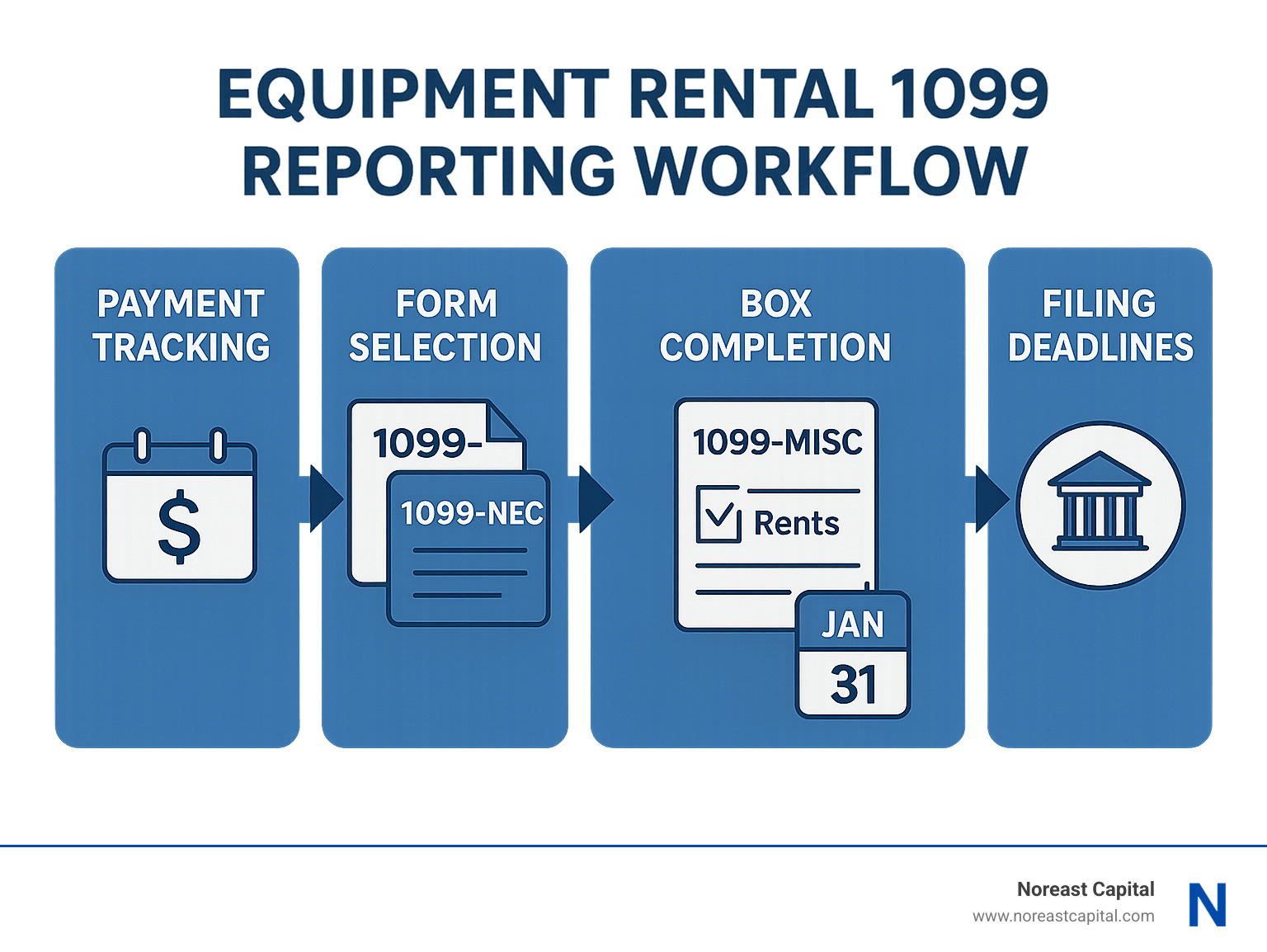
Essential equipment rental 1099 terms:
– does equipment rental go on 1099 misc or 1099 nec
– is equipment rental 1099 reportable
– do i need to send a 1099 for equipment rental
Why This Guide Matters
Getting your equipment rental 1099 reporting right matters for several important reasons:
Accuracy prevents penalties: The IRS can impose penalties ranging from $50 to $270 per incorrect form, depending on how late the correction is made. For businesses working with multiple vendors, these penalties can add up quickly.
Cash flow protection: Proper classification of equipment rental payments (versus service payments) can significantly impact tax liability for both parties involved.
Tax savings opportunities: When equipment rental income is correctly reported on 1099-MISC Box 1 instead of 1099-NEC, recipients may avoid paying the 15.3% self-employment tax on that income.
Audit protection: Clear documentation of equipment rental transactions provides protection in case of an IRS audit.
As one business owner told us after correctly implementing our equipment rental 1099 guidance: “That five-minute phone call to get my client to correct their 1099 saved me over $2,000 in taxes—no small change!”
Step 1 – Confirm Whether a 1099 Is Required
Let’s start with the million-dollar question (though hopefully not that expensive): Do you actually need to file an equipment rental 1099 at all?
I’ve seen plenty of business owners waste hours preparing forms they didn’t even need to file. Let’s make sure that doesn’t happen to you.
Here’s the simple truth about when you need to issue a 1099 for equipment rentals:
You need to file a 1099-MISC with Box 1 completed when you’ve paid $600+ during the calendar year to a non-corporate vendor for equipment rentals as part of your business activities (and didn’t pay via credit card or payment app).
The IRS puts it plainly in their instructions: “Enter amounts of $600 or more for all types of rents, such as real estate rentals paid for office space, machine rentals, and pasture rentals.”
But wait – there are some important exceptions that might save you paperwork! For deeper insights, check out our comprehensive guide: Do You Need to Issue a 1099 for Equipment Rental?
Understand the $600 Rule
Here’s where I see many business owners trip up – that $600 threshold isn’t per payment, it’s the grand total for the entire year to a single vendor.
Think of it like this: Even if you’re just paying someone $75 a month to rent their pressure washer for your side business, by August you’ve crossed the $600 threshold and triggered the equipment rental 1099 requirement.
One of our clients, a landscaping company owner, told me: “I had no idea those small monthly equipment rentals would add up to a 1099 requirement. Tracking cumulative totals from January saved me from a potential penalty.”
That’s why smart business owners track vendor payment totals throughout the year – those small rentals have a sneaky way of adding up!
Identify Exempt Payees
Not all equipment rental providers need a 1099-MISC, and knowing the exceptions can save you significant time and hassle.
The most common exemption? Corporate vendors. If you’re renting that excavator from “Big Jim’s Equipment, Inc.” (a C-Corporation) or an S-Corporation, you can generally skip the 1099-MISC entirely.
However, don’t get too excited about this corporate exemption. It doesn’t apply when you’re paying for:
– Legal services (even to corporations)
– Medical and healthcare payments
– Fish purchases for cash (yes, really!)
– Attorney’s gross proceeds
You also don’t need to send 1099s to tax-exempt organizations, government entities, or foreign entities (though other reporting might be required for the latter).
The best way to protect yourself? Always collect a completed W-9 form before your first payment. This single sheet of paper reveals the vendor’s business structure and tax classification, so you’ll know immediately whether they’re exempt from equipment rental 1099 reporting.
“Getting that W-9 upfront is like an insurance policy,” our compliance specialist often reminds clients. “It takes two minutes to collect but can save hours of headaches and potential penalties down the road.”
Step 2 – Pick the Right Form: 1099-MISC vs 1099-NEC

Choosing the right form might seem like a small detail, but it’s actually one of the most common mistakes I see when it comes to equipment rental 1099 reporting. Trust me, this small mistake can lead to big headaches for both you and your vendors.
Since 2020, the IRS split the reporting between two different forms, and the distinction matters more than you might think:
- Form 1099-MISC is your go-to for rental payments, royalties, prizes, and other miscellaneous income
- Form 1099-NEC is exclusively for payments to people who performed services for your business but aren’t your employees
This distinction isn’t just about keeping the IRS happy – it directly affects how much tax your vendor will pay. Here’s the real impact:
| Payment Type | Correct Form | Where to Report | Subject to Self-Employment Tax? |
|---|---|---|---|
| Equipment Rental | 1099-MISC | Box 1 “Rents” | Generally No |
| Services/Labor | 1099-NEC | Box 1 “Nonemployee Compensation” | Yes (15.3%) |
As tax professional Philip Perkins told us during our research: “Most people misclassify equipment rent as non-employee compensation.” That innocent mistake can cost your vendor an extra 15.3% in self-employment taxes they shouldn’t have to pay!
For the official word on this, you can always check the Official IRS instructions on Forms 1099-MISC & 1099-NEC.
Choosing 1099-MISC for Equipment Rental 1099
When you’re reporting equipment rental 1099 payments, remember this simple rule: always use Form 1099-MISC and put the amount in Box 1 labeled “Rents.”
This applies whether you’re renting a massive bulldozer for your construction site, a copier for your office, a truck for deliveries, or audio equipment for your company event. The equipment type doesn’t matter – what matters is that you’re paying for the use of equipment rather than someone’s labor.
For example, let’s say your landscaping company rented a stump grinder for $800 from a sole proprietor. As long as they’re not a corporation and you didn’t pay by credit card, you’d report this payment on Form 1099-MISC Box 1. Your vendor will thank you because they won’t face that extra 15.3% self-employment tax on this income.
Want to dive deeper into this topic? Check out our detailed guide: Does Equipment Rental Go on 1099-MISC or 1099-NEC?
When to Use 1099-NEC Instead
Form 1099-NEC is reserved specifically for nonemployee compensation – in other words, when you’re paying someone for their time, expertise, or labor rather than for the use of their equipment.
You’ll use 1099-NEC when reporting payments for:
– The freelancer who redesigned your website
– The consultant who helped streamline your operations
– The independent contractor who repaired your roof
– The accountant who prepared your taxes (if not incorporated)
Here’s where it gets tricky: before 2020, nonemployee compensation was reported on Form 1099-MISC Box 7. Now it has its own form entirely – the 1099-NEC with the amount in Box 1. This change has created some confusion, with many businesses still incorrectly reporting equipment rentals on 1099-NEC.
If you’re just paying for equipment with no operator, that’s a rental (1099-MISC). If you’re paying for someone’s services, that’s nonemployee compensation (1099-NEC). And if you’re paying for both? Well, that’s where things get interesting – but we’ll cover that in Step 4 when we talk about splitting invoices.
Step 3 – Gather Vendor Details & Keep Clean Records
Let’s face it – tax season gets a whole lot easier when you’ve been keeping good records all year long. When it comes to equipment rental 1099 reporting, your future self will thank you for being organized from day one.
The cornerstone of proper documentation is the W-9 form (Request for Taxpayer Identification Number and Certification). This little piece of paper is worth its weight in gold because it gives you everything you need:
- The vendor’s legal name (which might differ from their business name)
- Their tax classification (sole proprietor, LLC, corporation, etc.)
- Their all-important tax ID number (EIN or SSN)
- Their mailing address
- Their signature confirming the information is correct
Think of the W-9 as your insurance policy. If there’s ever a question about whether you reported correctly, having this form on file shows you did your due diligence.
For a deeper dive into the nuts and bolts of issuing these forms, check out our comprehensive guide: Issue 1099 for Equipment Rental.
Collect W-9s Early
I can’t tell you how many frantic calls we get in January from business owners scrambling to track down vendor information. Trust me on this one – January is not the time to start hunting down tax IDs!
“I learned this lesson the hard way,” shares Mike, one of our equipment financing clients. “Trying to chase down W-9s from vendors I hadn’t worked with in months was like pulling teeth. Now I get them before I cut the first check.”
Make the W-9 part of your initial paperwork when you first rent equipment. It takes two minutes up front but can save hours of frustration later. Here’s why this matters:
The IRS offers a TIN Matching Program that lets you verify tax IDs before filing, potentially saving you from penalties for incorrect information. But you need those W-9s in hand to use it.
Keep those W-9s for at least four years after filing (longer if you continue working with the vendor). And if someone refuses to provide one? You’re required to implement backup withholding at 24% on payments to them – a headache for everyone involved.
Track Payments in Real Time
“Wait, did we pay that vendor more than $600 this year?” is not a question you want to be asking on January 15th.
Setting up your bookkeeping system to track equipment rental 1099 payments throughout the year isn’t just good tax practice – it’s good business. Most accounting software can be configured to flag vendors approaching that magic $600 threshold.
The secret is creating dedicated expense categories specifically for equipment rentals. This small step makes a world of difference when it’s time to generate 1099 reports.
One construction company owner told us: “I created separate QuickBooks categories for ‘Equipment Rental’ and ‘Contractor Services.’ At tax time, I just run two reports – one for 1099-MISC Box 1 and one for 1099-NEC. What used to take days now takes minutes.”
Be aware that the IRS e-file requirements have changed. Starting in 2024, if you file 10 or more information returns of any type (down from the previous 250), you must file electronically through the IRS FIRE system. This means more small businesses will need to familiarize themselves with electronic filing or work with a tax professional who can handle this.
Good recordkeeping isn’t just about avoiding penalties – though that’s certainly a benefit. It’s about giving yourself peace of mind and making tax compliance a manageable part of running your business rather than a yearly crisis.
Step 4 – Split Invoices That Mix Labor and Equipment
One of the most challenging aspects of equipment rental 1099 reporting occurs when an invoice combines both equipment rental and labor charges. This is common in many industries where equipment is provided along with an operator, such as:
- Construction (excavator with operator)
- Audio/visual services (sound equipment with technician)
- Landscaping (lawn equipment with operator)
In these cases, you need to split the invoice and report each portion on the appropriate form:
– Equipment rental portion → 1099-MISC Box 1
– Labor/operator portion → 1099-NEC Box 1
This distinction is crucial because it affects how the recipient reports and pays taxes on the income. Rental income reported on 1099-MISC Box 1 is typically not subject to self-employment tax, while nonemployee compensation on 1099-NEC is subject to the 15.3% self-employment tax.
For more information on whether equipment rental is reportable on a 1099, check out our guide: Is Equipment Rental 1099 Reportable?
Prorating Mixed Labor and Equipment Rental 1099 Amounts
When an invoice doesn’t clearly separate equipment rental from labor, you’ll need to prorate the charges based on fair market value. Here’s a step-by-step approach:
- Determine the fair market value of the equipment rental alone
- Determine the fair market value of the labor/services alone
- Allocate the total payment proportionally
- Report the equipment rental portion on 1099-MISC Box 1
- Report the labor portion on 1099-NEC Box 1
For example, if you paid $1,000 for a bulldozer with an operator, and the fair market value of renting just the bulldozer is $600, while the operator’s services are worth $400, you would report:
– $600 on Form 1099-MISC Box 1 (Rents)
– $400 on Form 1099-NEC Box 1 (Nonemployee Compensation)
This prorating can save the recipient significant tax dollars. On a $10,000 payment, proper allocation could save up to $1,530 in self-employment taxes (15.3% of the rental portion).
Document the Allocation
Whenever you prorate an invoice, document your methodology. This creates an audit trail that explains your reasoning if questioned by the IRS.
Best practices for documentation include:
- Ask vendors to provide separate invoices or clearly itemize equipment rental versus labor on a single invoice
- Keep notes on how you determined fair market values
- Maintain copies of comparable rental rates to justify your allocation
- Include memo lines on checks or payment systems that specify what portion is for equipment rental
As one tax professional advised: “The IRS looks for consistency and reasonableness in your allocations. If you can show that your methodology is based on fair market values and applied consistently, you’ll be in a much stronger position if audited.”
Step 5 – File, Furnish & Fix Forms on Time

You’ve confirmed you need to file, selected the right form, gathered all the necessary information, and properly split any mixed invoices. Now comes the final hurdle in your equipment rental 1099 journey: meeting those pesky deadlines.
Think of tax deadlines like speed limits – they’re not suggestions, and the penalties for ignoring them can be costly. Even if your forms are filled out perfectly, submitting them late can still result in unnecessary fines.
Here’s your deadline cheat sheet for equipment rental 1099 reporting:
- January 31: Get Copy B to your vendors (the “furnish” deadline)
- February 28: Paper forms must reach the IRS
- March 31: Electronic filing deadline
“I always tell my clients to aim for mid-January completion,” says Maria Chen, a tax professional I spoke with. “That gives you a buffer for any last-minute hiccups and prevents that panicked January 30th scramble.”
Need more time? Form 8809 can buy you an extension for IRS filing, but here’s the catch – it doesn’t extend the January 31 deadline for getting forms to your vendors. The IRS prioritizes people getting their information on time, even if they’re a bit more flexible with their own deadlines.
And heads up – the rules have changed. Starting with tax year 2024, if you file just 10 or more information returns (down from the previous 250), electronic filing is mandatory. This change is part of the Taxpayer First Act and affects businesses of all sizes.
Key Deadlines & E-File Rules
If you’re new to electronic filing, don’t wait until March to figure it out. The process involves more than just uploading a PDF.
To file electronically, you’ll need to steer either the FIRE System (the traditional method) or IRIS (the newer web-based option). Both require obtaining a Transmitter Control Code (TCC) by submitting Form 4419 well in advance.
The formatting requirements are specific and unforgiving – think of it as speaking a language the IRS computers understand. One misplaced character, and your submission might be rejected.
“My first year e-filing was a disaster,” confessed one small business owner. “I waited until mid-March to start the process and couldn’t get my TCC approved in time. The penalties wiped out a week’s profit.”
Many businesses find it more cost-effective to use third-party software or services rather than navigating the technical requirements themselves. According to a recent study, e-filed returns have a 0.5% error rate compared to 21% for paper returns – a compelling reason to accept electronic filing despite the learning curve.
Correcting Errors Quickly
We all make mistakes. Maybe you put an equipment rental 1099 payment in the wrong box, transposed digits in a TIN, or misspelled a vendor’s name. What matters isn’t the mistake itself but how quickly you fix it.
When you find an error on a filed 1099-MISC, take a deep breath and:
- Create a new form with the correct information
- Mark the “CORRECTED” box at the top (this is crucial – it tells the IRS this form replaces a previous submission)
- File the corrected form with the IRS
- Send a copy to your vendor with a brief note explaining the correction
Correction procedures vary depending on the type of error. For example, fixing an incorrect amount requires different steps than correcting a vendor’s TIN. The IRS instructions provide specific guidance for each scenario.
What if you’re on the receiving end of an incorrect 1099? Perhaps a client reported your equipment rental 1099 income on 1099-NEC instead of 1099-MISC Box 1? Don’t just accept it – this could cost you thousands in unnecessary self-employment taxes.
“I politely but firmly requested a corrected form from my client,” shares equipment rental business owner James Rodriguez. “I explained that it wasn’t just paperwork – the incorrect form would cost me over $1,500 in additional taxes. They fixed it within a week.”
If the issuer refuses to correct the form, you can still report the income correctly on your tax return. Include a statement explaining the discrepancy, and report the income on the appropriate line of your return regardless of how it was reported to the IRS.
The goal of all this paperwork isn’t just compliance – it’s ensuring everyone pays their fair share of taxes, no more and no less. Taking the time to get your equipment rental 1099 reporting right is worth the effort for both you and your vendors.
Frequently Asked Questions about Equipment Rental 1099s
What happens if equipment rental income is mistakenly put on 1099-NEC?
It’s a common mix-up that can have serious tax consequences. If you receive a 1099-NEC that incorrectly includes your equipment rental 1099 income, don’t just shrug it off – take action right away.
First, reach out to the payer with a friendly but firm request for a corrected 1099-MISC with the rental income properly reported in Box 1. Most businesses will be happy to fix their mistake once they understand the error.
If they refuse (which happens more often than you’d think), you’ll need to report the income correctly on your tax return anyway – typically on Schedule E rather than Schedule C. Consider attaching a brief explanation to your return that clarifies the discrepancy.
The financial impact can be substantial. When income appears on a 1099-NEC, the IRS presumes it’s subject to that hefty 15.3% self-employment tax. But rental income on 1099-MISC typically isn’t. On a $10,000 equipment rental, this misclassification could cost you an extra $1,530 in taxes!
One of our clients, a small excavator owner, shared his experience: “When I spotted a 1099-NEC for my equipment rental, I immediately called the client and explained the error. They were actually grateful for the education and issued a corrected 1099-MISC within a week. That five-minute phone call saved me nearly $2,000 in self-employment taxes!”
Do vehicle or tool rentals follow the same 1099-MISC rules?
Absolutely! Whether you’re renting out a bulldozer, pickup truck, power tools, or a coffee machine, the equipment rental 1099 rules remain consistent across all equipment types:
Payments of $600 or more go on Form 1099-MISC Box 1 (not NEC), corporations are generally exempt from receiving 1099s, and any payments made via credit card or services like PayPal don’t require a 1099-MISC since they’ll be covered by 1099-K reporting from the payment processor.
This applies whether you’re renting a truck for your monthly deliveries, leasing a copier for your office, renting speakers for your company event, or even leasing specialized medical equipment for your healthcare practice. The IRS treats all these equipment rentals the same way for 1099 purposes.
How do I dispute a client who won’t issue separate 1099s?
This is a frustrating but surprisingly common situation when you provide both equipment and services. When a client insists on lumping everything onto a single 1099-NEC, you have several options to protect yourself.
Education is often your best first approach. Many clients simply don’t understand the equipment rental 1099 rules. Share the official IRS guidelines explaining that equipment rentals belong on 1099-MISC Box 1. A simple, “I’m trying to help us both stay compliant with tax laws” can work wonders.
Make sure your documentation is crystal clear. Design your invoices to separate equipment rental charges from labor/services with distinct line items and subtotals. This makes it easier for clients to issue correct forms and strengthens your position if you need to report differently than your 1099 indicates.
Consider adding specific contract language about tax reporting requirements. One videographer who rents out equipment told us: “I now include a clause in my contracts specifying that equipment rental fees must be reported on 1099-MISC Box 1, while my labor goes on 1099-NEC. Since adding this language, I’ve had much better compliance from clients.”
If despite your best efforts, a client still won’t budge, consult with a tax professional about the best reporting strategy. You can still report the income correctly on your tax return even if your 1099 is wrong – you’ll just need to be prepared to explain the discrepancy if questioned.
It’s not just about saving on self-employment taxes (though that’s certainly important). Proper equipment rental 1099 reporting helps ensure your business income is classified correctly for all tax purposes, potentially affecting everything from qualified business income deductions to how you plan for retirement.
Conclusion
Navigating equipment rental 1099 requirements might seem daunting at first, but it doesn’t have to give you a headache. Throughout this guide, we’ve broken down the process into five manageable steps that can help you stay compliant while potentially keeping more money in your pocket (or your vendor’s pocket).
Let’s recap what we’ve learned:
First, confirm whether you actually need to file a 1099 by checking if you’ve hit that $600 threshold and whether any exemptions apply. Payments to corporations generally don’t require 1099s, which can save you some paperwork.
Second, choose the correct form – and this is crucial – use 1099-MISC for equipment rentals, not 1099-NEC. This small detail can make a big difference in how the income is taxed for the recipient.
Third, gather vendor information early and maintain good records throughout the year. Nothing creates more stress than scrambling for W-9 forms in January when deadlines are looming!
Fourth, properly split invoices that combine equipment and labor charges. This step might take a little extra effort, but it ensures fair tax treatment and can save recipients from paying unnecessary self-employment taxes.
Finally, file and furnish your forms on time, and if you make a mistake, fix it promptly to minimize any penalties. Those January 31 and February/March deadlines come faster than you think!
When you handle equipment rental 1099 reporting correctly, everybody wins. You stay on the right side of the IRS and avoid penalties, while your vendors benefit from proper income classification that could save them significant tax dollars by avoiding that hefty 15.3% self-employment tax on rental income.
Here at Noreast Capital, we understand that equipment financing decisions involve more than just the upfront costs – they have ongoing tax implications too. Our team is ready to help you steer these complexities while providing flexible equipment financing solutions that preserve your cash flow and support your business growth.
As one of our clients recently told us, “Understanding these 1099 rules didn’t just keep me compliant – it actually improved my relationship with vendors because they appreciated that I took the time to get it right.”
For more comprehensive information about equipment lease compliance and the financing options available to your business, check out our detailed guide: More info about equipment lease compliance.
By staying informed and implementing these best practices, you can transform tax compliance from a necessary evil into a strategic advantage for your business. After all, every dollar saved in proper tax reporting is another dollar you can invest back into growing your company.