

Financing Your Farm’s Future
When it comes to growing your agricultural business, having the right equipment isn’t just helpful—it’s essential. Farm tractor loans are specially designed financing solutions that help you acquire the machinery your operation needs without draining your bank account upfront.
Think of these loans as investments in your farm’s productivity rather than just another expense. Most farm tractor loans run between 2-7 years, with current interest rates typically ranging from 6.75% to 8.25% in 2025. You’ll generally need a credit score of at least 650 (though some lenders will work with scores as low as 600 if you have strong collateral). Expect to put down 10-20% as a down payment, and be prepared to provide documentation like income verification, credit history, and details about your farm operation.
Modern tractors represent a significant investment—from $10,000 for smaller compact models all the way up to $90,000+ for the larger workhorses that handle serious acreage. When you consider those numbers, it’s easy to see why smart financing often makes more sense than emptying your cash reserves, especially in an industry where cash flow follows seasonal patterns.
Hi there—I’m Vincent Cerniglia. For over 15 years, I’ve helped farmers steer the sometimes confusing world of farm tractor loans and equipment financing. I’ve worked with operations of all sizes, from small family farms to large commercial enterprises, and I’ve learned that finding the right financing approach is just as crucial as selecting the right equipment. The best financing solution is one that aligns with your farm’s unique seasonal cash flow and long-term goals.

Farm tractor loans aren’t just about getting equipment—they’re about strategically investing in tools that directly impact your farm’s efficiency, output, and ultimately, your bottom line. Whether you’re replacing that trusty old tractor that’s finally given up the ghost, expanding your operation to take on more acreage, or starting a brand new farming venture, the right financing can help you preserve your working capital while still getting the machinery you need to succeed.
For more information about agricultural equipment financing, check out the USDA’s New Farmers resources, which provides valuable guidance for both beginning and established farmers.
Want to explore more options for your equipment needs? Check out these helpful resources:
– Tractor Trailer Financing
– Tractor Financing Calculator
– Rent to Own Tractors No Credit Check
At Noreast Capital, we understand that every farm has unique needs and challenges. That’s why we’re committed to finding financing solutions that work with your operation’s rhythm, not against it.
Understanding Farm Tractor Loans
When it comes to powering your farm operation, a good tractor is worth its weight in gold. But with price tags that can rival a small mortgage, farm tractor loans offer a practical path to ownership without draining your working capital.
Farm tractor loans are specialized financing solutions built around the unique rhythms of agricultural life. Unlike general loans you might get for a car or home renovation, these financial products understand the seasonal nature of farming income and expenses.
What makes these loans special is that they’re self-collateralized – the tractor itself serves as security for the loan. This built-in protection for lenders typically translates to better terms for you compared to unsecured financing options. If payments stop, the lender has the right to reclaim the equipment, which is why they’re willing to offer more favorable rates.
Most farm tractor loans run for 2 to 7 years, though specialized agricultural lenders sometimes extend terms up to 12 years for higher-value equipment. Current interest rates typically fall between 6.75% and 8.25% for fixed-rate loans in 2025, with your specific rate depending on several factors:
- The size of your loan (larger amounts often qualify for lower rates)
- Your credit score and financial history
- How long you’ll be paying (term length)
- Whether you’re buying new or used equipment
- Current economic conditions and interest rate environment
Perhaps the most farmer-friendly feature of these loans is seasonal repayment scheduling. Many lenders understand that your income arrives in waves with harvests, not in steady weekly paychecks. They can structure your payments to align with when you actually have cash flow.
As Bruce McCall, a grain farmer from the Midwest, told me recently: “When we financed our new combine, we arranged for annual payments that coincided with our fall harvest income. This flexibility meant we weren’t scrambling to make monthly payments during our lean spring season.”
How Do Farm Tractor Loans Work?
The mechanics of farm tractor loans are straightforward. After your approval, the lender pays the equipment dealer directly, and you begin making regular payments according to your agreement. Each payment includes two parts: principal (reducing what you borrowed) and interest (the cost of borrowing).
Most agricultural equipment loans use amortization schedules that gradually chip away at your balance over time. This means each payment splits between interest and principal in a carefully calculated way. Early in your loan, more of each payment goes toward interest, while later payments apply more toward principal.
Think of it like this: The lender calculates exactly how much you’ll need to pay over the entire term, then divides it into equal payments (monthly, quarterly, or annual, depending on what works for your farm’s cash flow). As your principal decreases with each payment, the interest portion naturally shrinks too. By your final payment, your balance reaches zero.
Many agricultural lenders offer online calculators that show exactly how each payment breaks down over the life of your loan – a helpful tool when planning your farm finances.
Key Loan Terms & Jargon
The world of farm tractor loans comes with its own vocabulary. Understanding these terms helps you steer your options more confidently:
APR (Annual Percentage Rate) represents the true cost of borrowing, including both interest and fees, expressed as a yearly percentage. Always compare APRs, not just interest rates, when shopping for loans.
Fixed vs. Variable Rates affect your payment predictability. Fixed-rate loans keep the same interest rate throughout the loan term, giving you consistent payments. Variable-rate loans adjust based on market conditions – potentially starting lower but carrying the risk of increasing over time.
Balloon Payment structures feature smaller regular payments with a large final payment. This approach reduces your ongoing obligations but requires planning for that substantial final amount.
Term simply means how long you have to repay – typically 2-7 years for tractors, though some specialized agricultural loans extend longer.
Down Payment is your initial investment, usually 10-20% of the purchase price for farm equipment.
Loan-to-Value (LTV) Ratio tells you what percentage of the equipment’s value a lender will finance. For tractors, expect 80-90% financing on new equipment and 70-85% on used equipment.
Origination Fee is a one-time processing charge, typically 1-2% of your loan amount.
Prepayment Penalty is a fee some lenders charge if you pay off your loan early. Many agricultural lenders waive these penalties, which can be valuable if you have an unexpectedly profitable season and want to reduce debt.
For more detailed information about agricultural financing terminology, check out the USDA’s Farm Loan Programs Glossary.

Tractor Financing Options: Loans vs Leases
Deciding how to pay for your new workhorse isn’t always straightforward. As a farmer, you’ve got several paths to consider, and each one might make more sense depending on your operation’s unique situation.
Equipment Loans
Farm tractor loans are purpose-built financing options designed specifically for agricultural machinery purchases. They typically come with terms between 2-7 years and offer both fixed and variable interest rates to suit your comfort level.
What makes these loans attractive is that the tractor itself serves as collateral, which often translates to better rates than you’d get with unsecured financing. With strong credit, you might even qualify for 100% financing – meaning no down payment required. And the best part? Once you make that final payment, the tractor is all yours.
I recently spoke with a corn farmer from Iowa who told me, “Getting an equipment loan through Farm Credit Mid-America was surprisingly quick. I applied online before lunch and had my approval by dinner time.” This tracks with what many agricultural lenders report – applications under $75,000 submitted before 2pm ET often receive same-day decisions.
Dealer Financing
Walk into any major tractor dealership and you’ll likely be offered their in-house financing program. These dealer options can be quite attractive, especially when they’re running promotions.
Dealer financing often features those eye-catching promotional rates (sometimes as low as 0% for limited periods), streamlined application processes, and the ability to bundle in implements and attachments. Many dealers also tie in extended warranty options and offer relationship benefits for loyal customers who keep coming back.
Personal Loans
While not specifically designed for farm equipment, personal loans can work well for smaller tractors or when buying from private sellers. They typically don’t have strict collateral requirements, offer faster approvals, and give you more flexibility in how you use the funds.
The trade-off? You’ll generally pay higher interest rates than you would with a dedicated farm tractor loan. But for some situations – like grabbing that perfect used compact tractor from a neighbor – the simplicity might be worth it.
Operating vs Finance Lease
Leasing offers a completely different approach to getting the tractor you need without buying it outright. There are two main flavors:
With an operating lease, you’ll enjoy lower monthly payments and the ability to easily upgrade to newer models when the term ends. Maintenance is often included, which can be a real budget-saver. This option works beautifully if you like having the latest technology and don’t want to deal with selling aging equipment.
A finance lease, on the other hand, structures payments so you can purchase the tractor at the end of the term, usually for a nominal amount. Your payments will be higher, but you’re building toward ownership. You’ll typically handle maintenance yourself, making this ideal for farmers who ultimately want to own their equipment but need to spread the cost over time.
Refinancing Existing Equipment
Already own a tractor free and clear? Equipment refinancing lets you tap into that equity while keeping your machinery in the fields. It’s like getting a second mortgage on your house, but for your tractor.
This approach provides immediate working capital with rates that are typically lower than operating loans. Most refinance terms run 2-5 years, using your existing equipment as collateral.
AgDirect, a specialized agricultural lender, notes they offer delayed payments for up to 15 months on used equipment loans – a flexibility that can be invaluable when aligning payments with your harvest schedule.
| Financing Option | Ownership | Tax Benefits | Cash Flow Impact | Best For |
|---|---|---|---|---|
| Equipment Loan | You own it | Depreciation & interest deduction | Higher initial costs, predictable payments | Long-term ownership |
| Operating Lease | Leasing company owns it | Lease payments fully deductible | Lower payments, no down payment | Frequent upgraders |
| Finance Lease | Initially leased, option to own | Some depreciation benefits | Moderate payments, purchase option | Those wanting eventual ownership |
| Dealer Financing | You own it | Same as equipment loan | Often lower initial rates, potential for 0% | New equipment buyers |
| Refinancing | You maintain ownership | Interest deduction | Immediate cash influx | Those needing working capital |
Farm Tractor Loans vs Cash Purchase
The age-old question: should you finance or just write a check? Both approaches have their merits.
When you finance, you preserve your working capital for other needs – seed, fertilizer, labor, or unexpected repairs. There are potential tax advantages through depreciation and interest deductions, and financing often enables you to purchase higher-quality equipment than you might afford with available cash.
Paying cash, however, means no interest costs, no monthly payment obligations, and no debt impacting your borrowing capacity for other needs. There’s also something deeply satisfying about owning equipment outright.
I remember talking with Jen Martinez, a vegetable farmer from California’s Central Valley. She shared: “We saved for years to buy our utility tractor outright. While it felt good to have no payments, we realized afterward that we’d depleted our emergency fund. The next season, when we needed to replace irrigation equipment unexpectedly, we had to finance that at higher rates than what a tractor loan would have cost. In retrospect, financing the tractor would have been smarter.”
Lease, Loan, or Multi-Use Credit Line?
Beyond the standard lease-versus-buy decision, you might also consider a multi-use credit line for maximum flexibility.
Multi-use credit lines let you finance not just your tractor but also implements, seed, fertilizer, and other inputs on a single account. John Deere’s Multi-Use Account™, for example, centralizes all your agricultural purchases on one line of credit, simplifying accounting and sometimes offering promotional terms.
Equipment loans build equity with each payment and give you complete freedom with your tractor – no usage restrictions, no hour limitations, and the ability to modify or customize as needed. Many farmers also appreciate the option to leverage existing equity when upgrading to newer models every few years.
Leasing shines for those who prefer staying current with the newest technology. You’ll typically enjoy lower monthly payments, and many lease programs bundle maintenance, which creates predictable operating costs. For some operations, the off-balance-sheet treatment of certain leases also offers accounting advantages.
Section 179 tax benefits apply differently to each financing option. This valuable deduction allows you to write off the full purchase price of qualifying equipment (up to certain limits) in the year it’s placed in service. While both loans and certain leases can qualify, the specific treatment varies enough that a conversation with your tax professional is essential before making your decision.
For more information about agricultural equipment financing options, check out the American Bankers Association’s Agricultural Banking resources.

For more information about your options, check out our detailed guides on Farm Equipment Leasing and Tractor Financing Options.
Qualifying & Applying for a Tractor Loan
Getting approved for a farm tractor loan isn’t as intimidating as it might seem, especially when you know what lenders are looking for. I’ve helped hundreds of farmers steer this process, and preparation really is the key to success.
Most lenders want to see a credit score of at least 600-650 for standard equipment financing. The good news is that agricultural lenders tend to be more flexible than traditional banks. As FBN Finance points out, while 650 is the standard minimum, some ag-focused lenders will work with scores as low as 600 if you have strong collateral or a solid business plan.
The tractor itself typically serves as collateral for the loan – that’s what we call self-collateralization. For larger loans or if your credit history has a few bumps, lenders might ask for additional security. Coming to the table with a down payment of 10-20% will strengthen your application and potentially secure better terms. I always tell my clients that if you can manage a larger down payment, you’ll likely get more favorable interest rates.
What lenders really care about is your farm’s cash flow. They need assurance that your operation generates enough income to cover the loan payments while keeping up with your other financial obligations. They’ll analyze your revenue patterns, existing debt, and projected income to make this determination.
Before applying, gather these essential documents:
– 2-3 years of personal and business tax returns
– Financial statements (balance sheet and income statement)
– 3-6 months of bank statements
– Farm ownership or lease documentation
– Equipment specifications and purchase agreement
– Proof of insurance
– Business plan (especially important for newer operations)
You can apply online through lender portals or in person at dealerships or financial institutions. The online route has become increasingly streamlined, with Farm Credit Mid-America offering same-day decisions for equipment loans up to $75,000 when submitted before 2pm ET. This quick turnaround can be a lifesaver when you need equipment during critical farming periods.

Eligibility Requirements at a Glance
When it comes to qualifying for farm tractor loans, lenders evaluate several key factors.
Your credit profile matters significantly. Most lenders look for a minimum score of 600-650, a history of responsible debt management, limited recent delinquencies, and a debt-to-income ratio below 45-50%. But don’t worry if your credit isn’t perfect – agricultural lenders understand that farming has unique challenges.
Income verification is another critical piece. Lenders typically want to see at least two years of stable farm revenue through tax returns. What’s great about ag lenders is that they understand seasonal income patterns – they know farmers don’t get paid evenly throughout the year. If you have off-farm income, be sure to highlight it, as this can strengthen your application considerably.
Your farm’s status plays a role too. Established operations generally have an easier approval path, but that doesn’t mean new farmers are out of luck. If you’re part-time, supplemental income can help your case. Owning your property or having long-term leases demonstrates stability, and production history helps verify your revenue projections.
Beginning farmers have special considerations, but also special opportunities. The USDA Farm Service Agency (FSA) offers programs specifically designed for those who might not qualify for conventional financing. Their Direct Farm Ownership loans can provide up to $600,000, while Operating Loans offer up to $400,000 for equipment purchases. These programs often feature more favorable terms for beginning, minority, and women farmers. I’ve seen these programs be absolute game-changers for new agricultural operations.
Step-by-Step Application Timeline
The farm tractor loan process follows a predictable timeline that helps you plan your equipment purchase:
First comes pre-qualification (1-2 days), where you submit basic information to receive a preliminary approval and rate quote without impacting your credit score. I always recommend this step – it gives you a clear picture of your borrowing capacity before you start shopping.
Next, you’ll select your equipment, working with dealers to identify the right tractor and get detailed quotes and specifications for your loan application.
Documentation gathering typically takes 1-7 days. This is where you’ll compile those financial records we discussed earlier – tax returns (especially Schedule F for farm income), financial statements, bank statements, equipment specs, and purchase agreements.
The formal application submission takes about a day once you have everything together. Then comes the lender review (1-5 days), where they’ll check your credit, verify income, assess the collateral value, and conduct a risk assessment. Larger loans might need loan committee review, which can add a day or two.
After approval, the lender prepares loan documents (1-3 days) detailing terms, conditions, and repayment schedules. Closing happens when you sign the final documents and verify insurance coverage. Finally, funding occurs within 1-3 days, with the lender typically sending payment directly to the equipment dealer.
From start to finish, you’re looking at 5-14 days total, though it can be faster if you’re pre-approved or working with lenders offering expedited processes. Some online and dealer-affiliated lenders even offer same-day approvals for qualified applicants.
As James Wilson, an agricultural lending specialist I’ve worked with for years, puts it: “The key to a smooth application process is preparation. Farmers who come in with organized financial documents and clear equipment specifications typically see much faster approvals than those scrambling to gather information after starting the application.”
Want to explore your options further? Check out our detailed guide on getting a Bank Loan for Tractor that walks you through specific banking requirements and alternatives.
Optimizing Taxes, Cash Flow & Risk
Let’s talk about making your farm tractor loan work harder for your operation’s bottom line. With some smart planning, you can turn financing into a strategic advantage through tax benefits, better cash flow, and careful risk management.
The Section 179 deduction is like a farmer’s secret weapon at tax time. Instead of spreading the cost of your new tractor over several years, this provision lets you deduct the full purchase price in the year you start using it. Pretty sweet, right?
For 2025, you can deduct up to $1,220,000 under Section 179, with a spending cap of $3,050,000 before phase-out begins. This means if you buy a $75,000 tractor, you could potentially knock that entire amount off your taxable income this year. For many farmers, that translates to thousands in tax savings.
But wait, there’s more! Bonus depreciation gives you an additional tax advantage, allowing 60% first-year depreciation for 2025 (though this percentage steps down in future years). You can actually combine this with Section 179 for maximum benefit.
And don’t forget – the interest you pay on your farm tractor loan is generally tax-deductible as a business expense. This further reduces what that loan is actually costing you, though you’ll need to keep good records to claim these deductions.
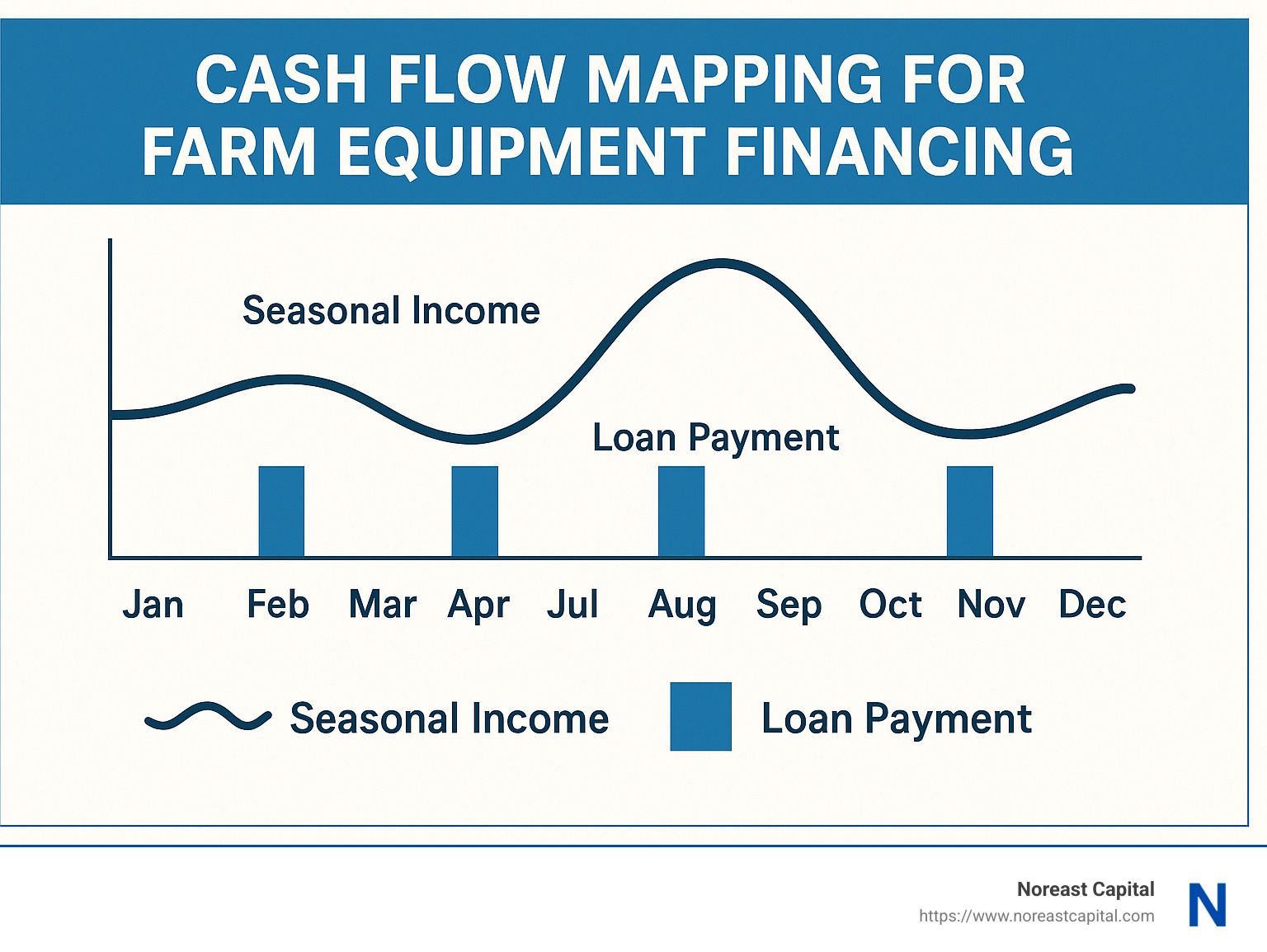
One of the smartest moves you can make is scheduling your loan payments to match your farm’s natural cash flow. Many ag lenders understand farming’s unique rhythms and offer payment options like:
- Annual payments timed right after harvest
- Seasonal payments (higher during your income months, lower during planting)
- Skip-a-payment options for your tightest months
- Delayed first payment options (up to 3-6 months after purchase)
Of course, we should talk about what happens if things go south. Defaulting on a farm tractor loan comes with serious consequences, including equipment repossession, credit score damage, possible deficiency judgments if the repossessed equipment doesn’t cover what you owe, and difficulty getting agricultural financing in the future.
Tax Benefits When Financing vs Leasing
The way you acquire your tractor – through a farm tractor loan or lease – makes a big difference at tax time. Let’s break down how each option affects your tax situation:
When you finance with a loan, you get to deduct the interest as a business expense. You also gain access to those valuable depreciation deductions we talked about (Section 179 and bonus depreciation). Plus, you can deduct property taxes on the equipment and potentially claim a sales tax deduction or credit when you purchase.
Leasing works differently. Your lease payments are typically fully deductible as operating expenses – clean and simple. However, you don’t get depreciation deductions since the lessor (the company you’re leasing from) claims those instead. This simplified tax treatment means fewer calculations at tax time, which some farmers appreciate.
Maria Sanchez, a tax advisor I spoke with recently, put it perfectly: “Understanding the tax implications before choosing between financing and leasing can save thousands of dollars. I’ve seen clients save over $15,000 in a single year by structuring their equipment acquisition to maximize available tax benefits.”
Generally speaking, high-income operations often benefit more from the accelerated depreciation available with purchases, while farms with tighter margins might prefer the predictable deductions of lease payments.
For more detailed information on agricultural tax benefits, visit the IRS’s Farmers Tax Guide.
Managing Cash Flow Through Harvest Cycles
Farming’s feast-or-famine cash flow makes it different from almost any other business. That’s why aligning your farm tractor loan payments with your natural revenue cycles is so crucial for reducing financial stress.
If you’re primarily growing crops, an annual payment structure often works beautifully – one payment after harvest when your bins and bank account are fullest. For dairy farmers or livestock producers with more consistent monthly income, traditional monthly payments might make more sense.
Many lenders now offer delayed first payment options, letting you put that new tractor to work immediately while postponing payments until after your next harvest. These payment delays typically run 3-6 months from purchase, giving your equipment time to help generate the income that will pay for it.
Online calculator tools can be incredibly helpful for visualizing how different payment plans might affect your operation’s cash flow. You can input variables like purchase price, down payment, interest rate, loan term, and payment frequency to find your sweet spot.
Tom Jenkins, a Midwest equipment dealer I talked to recently, shared this insight: “We structure most of our farm tractor loans with annual payments due after fall harvest. Our customers appreciate having their major equipment expenses aligned with their biggest income periods. It’s reduced late payments by over 40% compared to standard monthly schedules.”
For additional resources on managing agricultural cash flow, check out the USDA’s Farm Financial Management resources.
Want to play with some numbers yourself? Check out our Tractor Financing Calculator to see what payment structure might work best for your operation’s unique cash flow patterns.
Special Programs, Government Help & FAQs
Getting your hands on a good tractor doesn’t have to break the bank. There are plenty of specialized programs designed to make farm tractor loans more accessible, especially if you’re just starting out, facing credit challenges, or have unique farming needs.
The USDA Farm Service Agency (FSA) offers some of the most farmer-friendly financing options around. Their Direct Farm Ownership Loans can provide up to $600,000 primarily for land purchases, but these funds can also cover equipment needed to get your operation running. Their Farm Operating Loans offer up to $400,000 specifically for equipment purchases and other expenses, with terms that are often more favorable than what you’d find at traditional banks.
For smaller operations, the FSA’s Microloan program is a true gem. These loans provide up to $50,000 with much less paperwork and a simplified application process. If you’re growing specialty crops, just starting your farming journey, or running a smaller operation, these microloans can be a perfect fit.
“The FSA microloan program was a game-changer for our small vegetable farm,” shares Maria Gonzalez, a beginning farmer in Oregon. “The application process was straightforward, and the loan officer actually understood seasonal farming cycles. That $35,000 loan helped us get our first tractor and irrigation equipment when no traditional bank would even look at us.”
Beyond government help, some agricultural lenders offer patronage dividend programs that effectively give you money back. Farm Credit Mid-America, for example, has returned more than $1.5 billion to customers over the last 9 years through its Patronage program – essentially providing a rebate on interest you’ve paid.
If your credit isn’t stellar, don’t lose hope. Several pathways exist:
- Making a larger down payment (25-30%) can often offset credit concerns
- Finding a co-signer with strong credit can strengthen your application
- Starting with smaller equipment loans helps build positive payment history
- Working with lenders who specialize in helping credit-challenged borrowers
- Offering additional collateral beyond just the tractor itself
For the latest information on government agricultural loan programs, visit the USDA Farm Service Agency’s Farm Loan Programs page.

Frequently Asked Questions about Farm Tractor Loans
What credit score do I need for a farm tractor loan?
Most lenders want to see a score of at least 650, though some agricultural lenders may work with scores as low as 600 if you have strong collateral or a solid business plan. Farm Credit Mid-America takes a more holistic approach, evaluating each application individually rather than setting a hard minimum score requirement. They look at your overall financial picture, not just a number.
Can used tractors be financed?
Absolutely! Used tractors are financed all the time, though the terms might differ from new equipment loans. Typically, you’ll see slightly higher interest rates (about 0.25-0.5% higher than new), shorter maximum terms (often capped at 5 years versus 7 for new), and lower loan-to-value ratios (typically 70-85% versus 80-90% for new). Lenders will also pay closer attention to the equipment’s condition and maintenance history.
AgDirect, a popular agricultural lender, finances both new and used equipment and even offers delayed payments for up to 15 months on used equipment loans. This can be incredibly helpful if you need to buy the tractor now but won’t see income until after harvest.
What happens if I default on a tractor loan?
Nobody likes to think about this scenario, but it’s important to understand the consequences. If you default, you’ll likely face late fees and penalty interest rates first. Your credit score will take a hit, making future borrowing more difficult and expensive. If the situation continues, the lender may repossess the equipment and potentially demand immediate payment of the entire outstanding balance.
If the repossessed tractor doesn’t sell for enough to cover what you still owe, you could face a deficiency judgment for the difference. The good news is that most lenders prefer to work with borrowers facing temporary hardship. They may offer options like payment deferral, loan restructuring, or temporary interest-only payments before taking more drastic measures.
How long do farm tractor loans typically last?
Most farm tractor loans run between 2 and 7 years, with larger, more expensive equipment usually qualifying for longer terms. The sweet spot is finding a term that gives you affordable monthly payments without dragging out the loan so long that you pay excessive interest. Many farmers choose terms that align with either how long they expect to use the equipment or when they plan to upgrade.
Are there special programs for beginning farmers?
Yes, and they’re worth exploring! The USDA FSA Beginning Farmer and Rancher loans offer reduced down payment requirements specifically designed for new farmers. The Farm Credit System’s YoungBeginner program provides competitive rates and flexible terms for those just starting out. Many states also have their own agricultural loan programs with special provisions for beginning farmers. Even some equipment manufacturers offer special rates and programs for first-time equipment buyers.
For more information on beginning farmer programs, check out the National Young Farmers Coalition resources.
Can I finance tractor attachments and implements along with the tractor?
Yes, and it often makes good financial sense to do so. Most lenders will happily finance attachments and implements as part of the same loan package. This approach streamlines your paperwork with a single application and payment, potentially secures lower rates than financing attachments separately, and allows you to match the loan term to the useful life of both your tractor and implements.
How much can I borrow for a farm tractor?
This varies widely based on the lender and your qualifications. Most lenders set minimum loan amounts between $5,000 and $10,000, while maximum amounts depend on your credit profile and farm income, the value of the equipment, your existing debt load and cash flow, and the lender’s specific policies.
For example, Farm Credit Mid-America accepts online applications for equipment loans between $2,000 and $150,000, with higher amounts available through their local offices. At Noreast Capital, we offer flexible financing solutions for both new and used tractors, with options custom to your farm’s unique needs and cash flow patterns.
Conclusion
Navigating farm tractor loans might seem overwhelming at first, but finding the right financing solution can transform your agricultural operation’s productivity and profitability. Throughout this guide, we’ve explored the various options available to help you make an informed decision that aligns with your farm’s unique needs.
At Noreast Capital, we’ve spent years working alongside farmers just like you. We understand that your equipment needs are as seasonal as your harvests, and your financing should reflect that reality. Whether you’re harvesting wheat in the Midwest, tending vineyards in California, or managing a dairy operation in Vermont, we’re committed to finding financing solutions that work with your cash flow—not against it.
The right farm tractor loan isn’t just about getting equipment; it’s about making a strategic decision that supports your farm’s long-term success. When you partner with us, you’re not just getting financing – you’re gaining an ally who understands agricultural operations from the ground up.
We’ve helped farmers across Annapolis, Baltimore, and Washington DC access financing options that truly fit their operations, including:
Traditional equipment loans that build equity with each payment while providing valuable tax benefits through depreciation and interest deductions.
Flexible leasing options that preserve your working capital and offer convenient upgrade paths when technology improves.
Equipment refinancing that open ups the value in your existing machinery to provide working capital when you need it most.
Specialized programs designed specifically for beginning farmers, seasonal operations, and unique agricultural needs.
The financing decision you make today will impact your operation for years to come. With the right approach, your farm tractor loan becomes more than just a way to acquire equipment—it becomes a powerful tool for managing your farm’s financial health, tax position, and growth trajectory.
Our team at Noreast Capital brings decades of combined experience in agricultural finance to your farm’s doorstep. We take the time to understand your operation’s unique challenges and opportunities, helping you steer the complexities of equipment financing with confidence and clarity.
Ready to take the next step? We’d love to have a conversation about your equipment needs and how we can help you find the perfect financing solution. Let us help you cut through the complexity and find a farm tractor loan that helps your operation thrive through every season.