

Making smart financial decisions is crucial for small business owners, especially when it comes to acquiring new equipment. Should you lease or finance? The answer isn’t always straightforward, but a finance lease calculator can be an invaluable tool to help you figure it out. Here’s a quick guide on what you need to consider:
- Leasing offers flexibility and lower upfront costs, making it attractive for business owners looking to maintain cash flow.
- Financing may result in ownership but involves higher initial payments and depreciation concerns.
- A finance lease calculator can provide insights into monthly payments and interest rates, helping you make an informed choice.
For small businesses, understanding how to leverage a finance lease calculator can lead to optimized budget planning and sustainable growth.
I’m Vincent Cerniglia, and as a leader at Noreast Capital Corporation, I’ve helped businesses like yours steer the complexities of leasing and financing. With my experience in the leasing marketplace, I’m here to guide you through using a finance lease calculator effectively.
Finance lease calculator terms to learn:
– capital equipment finance calculator
– equipment lease formula
– lease amortization schedule calculator
Understanding Finance Leases
When it comes to acquiring equipment for your business, understanding the concept of a finance lease is crucial. A finance lease is a type of lease where the lessee (that’s you) has the right to use an asset and is responsible for lease payments over a set term. This arrangement is often beneficial for businesses that need to use equipment without purchasing it outright.
Right-of-Use Asset
In a finance lease, the asset in question is referred to as a right-of-use asset. This means that while you don’t own the equipment, you have the right to use it as if you did. This is an important distinction because it affects how the asset is recorded on your financial statements. Essentially, the right-of-use asset is treated as if it were a purchased asset, which can have implications for your balance sheet and financial reporting.
Lease Liability
Alongside the right-of-use asset, a finance lease also creates a lease liability. This is the obligation to make lease payments over the term of the lease. The lease liability is recorded as a liability on your balance sheet, similar to a loan. This means that while you gain access to the equipment, you also incur a financial obligation that needs to be managed carefully.
Key Benefits:
- Tax Advantages: Lease payments can often be written off as business expenses, which may reduce your taxable income.
- Cash Flow Management: Spreading payments over time helps manage cash flow, allowing you to allocate funds to other business needs.
- Flexibility: At the end of the lease term, you may have options to purchase the equipment, continue leasing, or return it.
By understanding these elements, you can make more informed decisions about whether a finance lease is the right choice for your business. Using a finance lease calculator can further aid in estimating monthly payments and assessing the financial impact on your business.

With a clear grasp of finance leases, you can better plan for your business’s financial future and ensure that your equipment needs are met efficiently.
How to Use a Finance Lease Calculator
A finance lease calculator is a handy tool that helps you estimate the cost of leasing equipment for your business. It simplifies complex calculations, allowing you to focus on what really matters—making informed financial decisions.
Calculating Monthly Payments
To calculate your monthly lease payment, you’ll need a few key pieces of information:
- Capitalized Cost: This is the price of the equipment you’re leasing.
- Residual Value: The estimated value of the equipment at the end of the lease term.
- Lease Term: The duration of the lease, usually in months.
- Money Factor: This is a way to express the interest rate in leasing terms. It’s the lease factor or lease fee, and it can be converted to an annual percentage rate (APR) by multiplying it by 2,400.
The finance lease calculator uses these inputs to determine your monthly payment. Here’s a simplified formula:
[ \text{Monthly Payment} = \frac{(\text{Capitalized Cost} – \text{Residual Value})}{\text{Lease Term}} + (\text{Capitalized Cost} + \text{Residual Value}) \times \text{Money Factor} ]
This formula ensures that your payments cover both the depreciation of the asset and the interest on the lease.
Understanding Interest Rates
The interest rate, represented as the money factor, plays a crucial role in determining the cost of your lease. A lower money factor means lower interest costs, which in turn reduces your monthly payments. It’s important to negotiate a favorable interest rate to keep overall costs down.
Using the Calculator Effectively
When using a finance lease calculator, input accurate data to get reliable results. Consider the following tips:
- Double-Check Values: Ensure that all values, like the capitalized cost and residual value, are correct.
- Adjust for Taxes: Some calculators allow you to include sales tax, which can affect your payment.
- Explore Different Scenarios: Change the lease term or money factor to see how they impact your payments.
By leveraging a finance lease calculator, you can gain insights into the financial implications of leasing equipment. This empowers you to make decisions that align with your business goals and budget constraints.
Next, we’ll explore the key differences between leasing and financing, helping you weigh the pros and cons of each option.
Key Differences Between Leasing and Financing
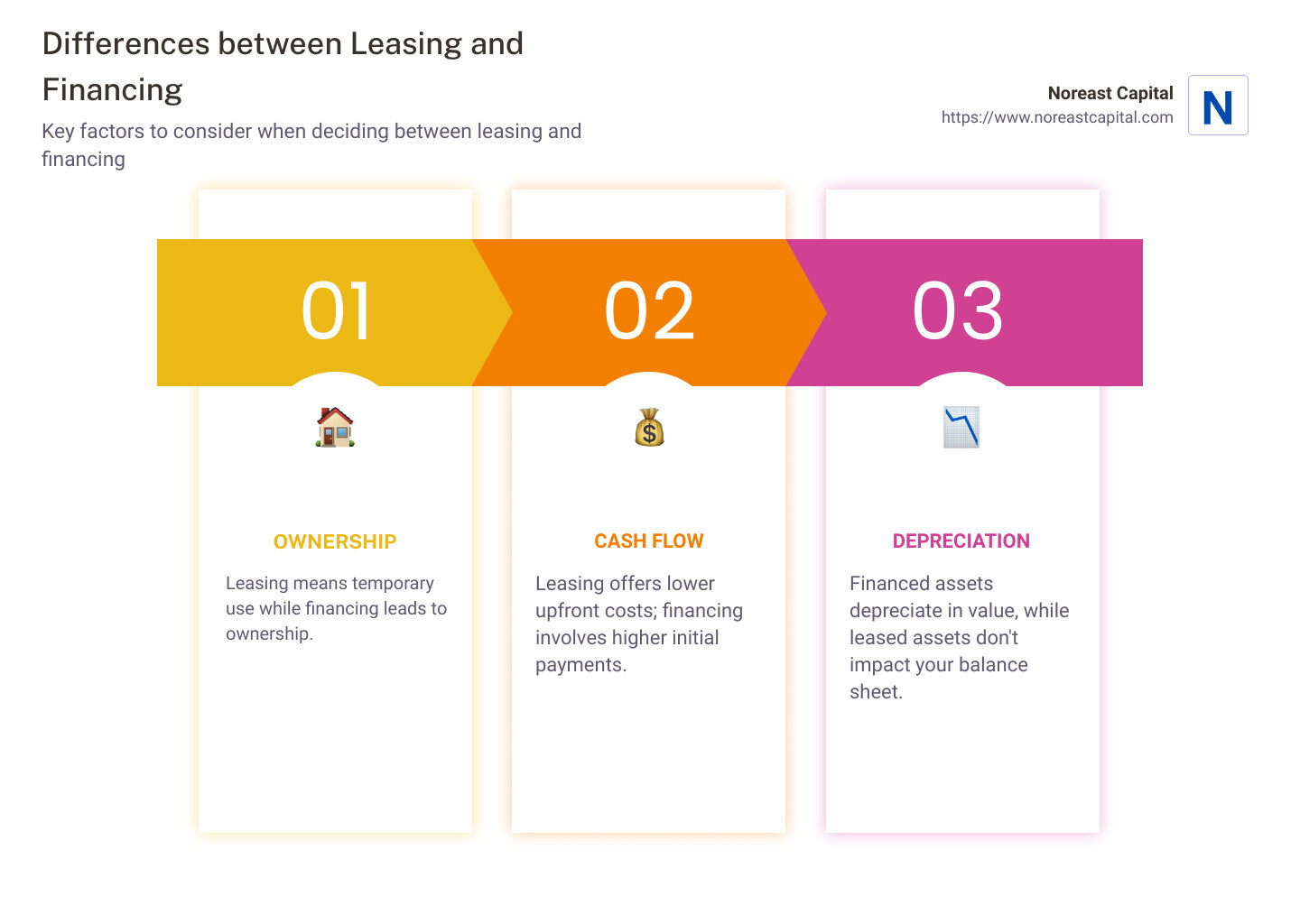
When deciding whether to lease or finance equipment, it’s important to understand the differences in terms of ownership and cash flow.
Ownership
Leasing means you don’t own the equipment. Instead, you pay for the right to use it over a specified period. Once the lease term ends, you can either return the equipment, renew the lease, or sometimes buy it at a reduced price. This is ideal if you need flexibility or if the equipment is likely to become obsolete quickly.
On the other hand, financing means you are purchasing the equipment. You make monthly payments until you own it outright. This can be beneficial if you plan to use the equipment for a long time and want to build equity in the asset.
Cash Flow
Leasing can be a smart move for managing cash flow. Since you don’t need to pay the full price upfront, leasing usually has lower monthly payments compared to financing. This can free up cash for other business needs and help maintain a steady cash flow.
Financing, however, typically involves higher monthly payments. You’re paying down the principal amount and interest, which can strain cash flow, especially for small businesses. But once the equipment is paid off, you no longer have a monthly obligation, which can be a long-term financial advantage.
Decision Factors
When choosing between leasing and financing, consider these factors:
Business Needs: If your equipment needs are short-term or likely to change, leasing offers more flexibility.
Budget: Leasing can be easier on your budget in the short term. Financing requires a larger financial commitment upfront.
Asset Lifespan: If the equipment will serve your business for many years, financing might be more cost-effective in the long run.
Understanding these key differences can help you determine the best option for your business’s financial health and strategic goals.
Next, we’ll explore the benefits of equipment leasing, including tax advantages and cash flow management strategies.
Benefits of Equipment Leasing
Leasing equipment can offer several advantages that make it an attractive option for many businesses, especially those looking to manage cash flow efficiently and take advantage of tax-deductible benefits.
Tax Benefits
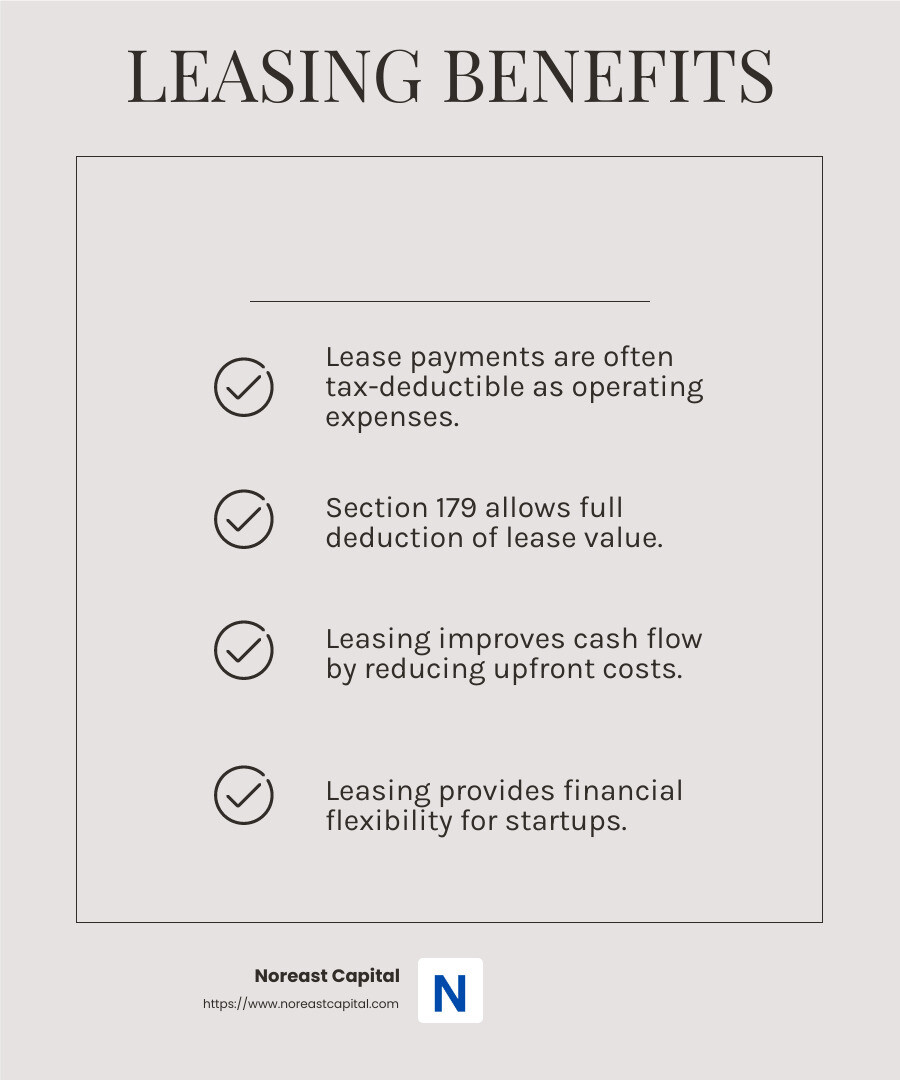
One of the biggest perks of equipment leasing is the potential for tax deductions. Lease payments are often considered an operating expense, which means they can be deducted from your taxable income. This can significantly reduce your tax bill.
In the U.S., the Section 179 Deduction is a tax provision that allows businesses to deduct the full purchase price of qualifying leased equipment. For example, if you lease restaurant equipment worth $10,000, you may be able to deduct this entire amount, potentially saving you thousands in taxes.
Cash Flow Management
Leasing helps improve cash flow management by reducing the need for substantial upfront payments. Instead of paying the full price of equipment, you make smaller, manageable monthly payments. This frees up capital that can be used for other business expenses or investments.
Consider a startup that needs high-tech machinery. By leasing instead of buying, they can keep more money in the bank for unexpected expenses or growth opportunities. This flexibility is crucial for small businesses with limited cash reserves.
Flexibility and Up-to-Date Technology
Leasing also offers flexibility. At the end of the lease term, you can choose to return, upgrade, or purchase the equipment. This is particularly beneficial for businesses in industries where technology evolves rapidly. Leasing allows you to keep up with the latest advancements without being stuck with outdated equipment.
Lower Maintenance Costs
Many lease agreements include maintenance services, which can further reduce your expenses. This means less worry about repair costs, as the lessor often handles maintenance, ensuring the equipment remains in optimal working condition.
Overall, equipment leasing provides financial flexibility and tax benefits that can be crucial for business growth and sustainability. By managing cash flow more effectively and keeping up with technological advancements, businesses can maintain a competitive edge.
In the next section, we’ll address some common questions about finance leases, including how to calculate them and understand key terms.
Frequently Asked Questions about Finance Leases
How to Calculate a Finance Lease?
Calculating a finance lease involves understanding the right-of-use asset and the present value of lease payments. The right-of-use asset represents your right to use the leased asset over the lease term. To calculate it, you’ll need to determine the present value of the lease payments.
The present value is calculated by discounting the future lease payments to their value today. This involves using the interest rate implicit in the lease or your incremental borrowing rate. A finance lease calculator can simplify this process by allowing you to input the lease terms and interest rate to get the present value.
What is the 1% Rule in Car Leasing?
The 1% rule is a simple guideline to evaluate if a car lease deal is reasonable. According to this rule, your monthly payment should be about 1% of the car’s MSRP (Manufacturer’s Suggested Retail Price). For instance, if the car’s MSRP is $30,000, a monthly lease payment of $300 or less would be considered a good deal.
This rule helps you quickly assess the affordability of a lease. However, it’s important to consider other factors like residual value and money factor to fully understand the lease’s cost.
How to Calculate Monthly Lease Payment?
To calculate your monthly lease payment, you need to consider several factors: the car’s residual value, the money factor, and the negotiated price of the car.
Residual Value: This is the estimated value of the car at the end of the lease. It impacts your monthly payment because the lease payments cover the depreciation of the car from its current value to its residual value.
Money Factor: This represents the interest portion of your lease. It’s a small decimal number that, when multiplied by 2,400, gives the equivalent annual interest rate (APR).
Capitalized Cost: Also known as the cap cost, this is the negotiated price of the car. The lower the cap cost, the lower your monthly payment.
A lease calculator can help you input these values to estimate your monthly payment easily. By understanding these components, you can better negotiate your lease terms and ensure you’re getting a fair deal.
In the next section, we’ll dig into the key differences between leasing and financing to help you make an informed decision.
Conclusion
At Noreast Capital, we understand that navigating equipment financing can be daunting. That’s why we’re committed to providing businesses with flexible, custom solutions that empower them to thrive without the burden of ownership. Our equipment financing options allow you to access the latest tools and technology, ensuring your business stays competitive and efficient.
Why Choose Noreast Capital?
Our unique approach to business solutions focuses on maintaining your cash flow while giving you the tools you need to succeed. We offer a range of leasing options that are designed to be tax-deductible, helping you manage your financial resources effectively. Whether you’re a small startup or an established company, our team is here to support your growth every step of the way.
By choosing Noreast Capital, you gain more than just access to equipment—you gain a partner dedicated to your success. Our expertise in equipment leasing, combined with our commitment to customer service, ensures you receive the best possible solutions custom to your unique needs.
Ready to explore how Noreast Capital can help your business? Find more about our services and access our equipment leasing calculator to get started on your journey to smarter financing today.
At Noreast Capital, your success is our mission. We look forward to being part of your business’s growth story.