

Getting Started with Financing a Used Tractor: The Smart Farmer’s Guide
If you’re looking to finance second hand tractor options, here’s what you need to know upfront:
| Quick Guide to Second-Hand Tractor Financing |
|---|
| ✅ Loan amounts: Up to 90-95% of tractor value |
| ✅ Interest rates: 11-24% (traditional banks) or 3.5-15% (US equipment loans) |
| ✅ Approval time: Often within 24-48 hours |
| ✅ Repayment terms: 36-60 months (3-5 years) |
| ✅ Repayment options: Monthly, quarterly, half-yearly, or annual (aligned with crop cycles) |
| ✅ Maximum tractor age: Up to 15-20 years old at loan end |
Finance second hand tractor solutions offer a practical path to equipment ownership when buying new isn’t feasible or economical. A well-maintained used tractor can provide years of reliable service, typically needing major repairs only after 4,000-5,000 work hours, making it a smart investment for budget-conscious farmers and agricultural businesses.
With used tractors starting as low as $12,000 (compared to new models that can cost up to $300,000), financing a pre-owned tractor allows you to preserve capital while still acquiring the equipment you need. Many lenders offer flexible repayment schedules that align with your harvest cycles, helping you manage cash flow more effectively throughout the year.
I’m Vincent Cerniglia from Noreast Capital Corporation, where I’ve helped countless farmers and small businesses secure optimal finance second hand tractor solutions that match their operational needs and financial capabilities. Our direct lending approach enables us to provide nationwide financing solutions for a broad range of agricultural equipment, including used tractors.

Finance second hand tractor further reading:
– tractor financing options
– tractor financing calculator
– tractor trailer financing
How Second-Hand Tractor Loans Work
When you finance second hand tractor purchases, you’re essentially getting a secured equipment loan where the tractor itself serves as collateral. This arrangement offers you better terms than unsecured loans because the lender has something tangible to recover if payments stop.
The Mechanics of Used Tractor Financing
The process is straightforward and designed to get you in the driver’s seat quickly. First, you’ll submit an application with details about yourself and the tractor you’ve got your eye on. The lender then assesses the tractor’s value—looking at make, model, year, and condition—before making a decision.
If approved, the lender places a lien on the tractor (basically their legal claim until you’ve paid in full) and pays the seller directly. You’ll then make regular payments according to your agreement, and once you’ve paid off the loan, that lien disappears—making the tractor completely yours.
“I’m always surprised by how many farmers don’t realize they can finance tractors that are 15 years old or even older,” says Vincent from Noreast Capital. “These workhorses can deliver excellent value for years when properly maintained.”
Most lenders will finance between 60-95% of a used tractor’s value, meaning your down payment might be as little as 5-10%. And the best part? Many lenders can fund your purchase within 24-48 hours of approval, getting you back to work quickly.
Types of Lenders for Used Tractor Financing
The financing landscape offers several options, each with their own advantages:
Traditional banks typically offer the lowest interest rates (around 11-15%) but come with stricter eligibility requirements and longer approval processes. Non-Banking Financial Companies (NBFCs) provide more flexible criteria but higher interest rates (14-24%). Credit unions often offer competitive rates (13-17%) with more personalized service, especially valuable for agricultural communities.
Online lenders shine when you need quick approvals—sometimes within 24 hours—and streamlined applications, though rates may be higher. Equipment dealers offer convenience but not always the best financial terms.
At Noreast Capital, we’ve created equipment financing solutions that combine competitive rates with flexible terms and quick approvals—giving you the best of all worlds without the typical tradeoffs.
Refinancing Options
Already own your tractor outright? Refinancing works like a home equity loan, letting you borrow against your equipment’s value. These loans typically process quickly—often within 24-48 hours—providing capital for other farm expenses or additional equipment.
Refinancing also makes sense if you’re currently financing but have found a better interest rate elsewhere, or if you need to adjust your payment schedule to better align with your seasonal cash flow. Many farmers appreciate the ability to switch to seasonal EMI payments that match their harvest cycles.
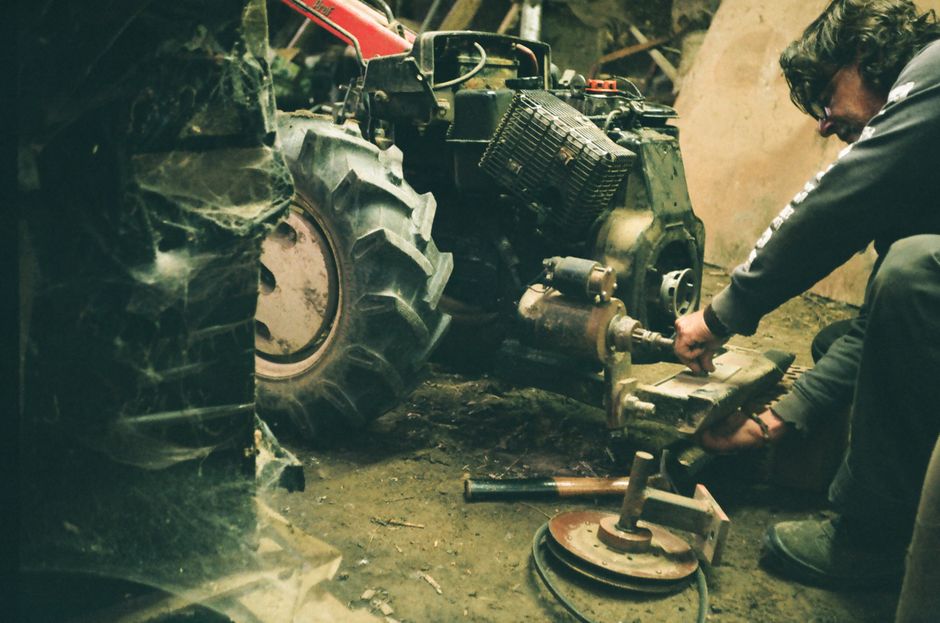
According to scientific research on agricultural equipment lifespan, properly maintained tractors can remain productive for 15-20 years or more, making used tractor financing a smart investment for budget-conscious farmers.
Want to learn more about your options? Check out our detailed guide on Tractor Financing for additional information.
Finance Second Hand Tractor: Benefits, Costs & Repayment Flexibility
The Financial Advantages of Used Tractor Financing
When you finance second hand tractor purchases, you’re making a smart move for your farm’s financial health. Let me walk you through the real benefits that farmers like you experience every day.
First off, you’ll enjoy a significantly lower initial investment. Used tractors typically cost 30-60% less than their shiny new counterparts, even when they’re just a few years old. This means you’ll need a smaller loan, make a more manageable down payment, and face lower monthly payments. Over time, you’ll pay less interest too—keeping more money in your pocket where it belongs.
Think about depreciation for a moment. New tractors, just like new cars, lose value fastest in their first few years. By buying used, you’re letting the previous owner absorb that steep initial depreciation hit. Your equipment will hold its value better relative to what you paid, and if you decide to sell later, you’ll likely recoup a higher percentage of your investment.
“I bought a five-year-old John Deere instead of new and saved nearly $45,000,” one of our customers recently told me. “It had just 2,000 hours on it and runs like a dream. Best decision I made for my operation last year.”
The tax advantages can be substantial too. Interest payments on your loan may be tax-deductible as a business expense. You might also qualify for depreciation deductions, and in some cases, Section 179 deductions that allow you to deduct the full purchase price in the year you buy. (Always chat with your tax professional about your specific situation, of course.)
Perhaps most importantly, financing preserves your cash flow. Rather than emptying your accounts for a tractor purchase, you maintain liquidity for other farm operations, can invest in revenue-generating activities, and keep reserves handy for unexpected expenses or opportunities.
Costs and Terms of Used Tractor Financing
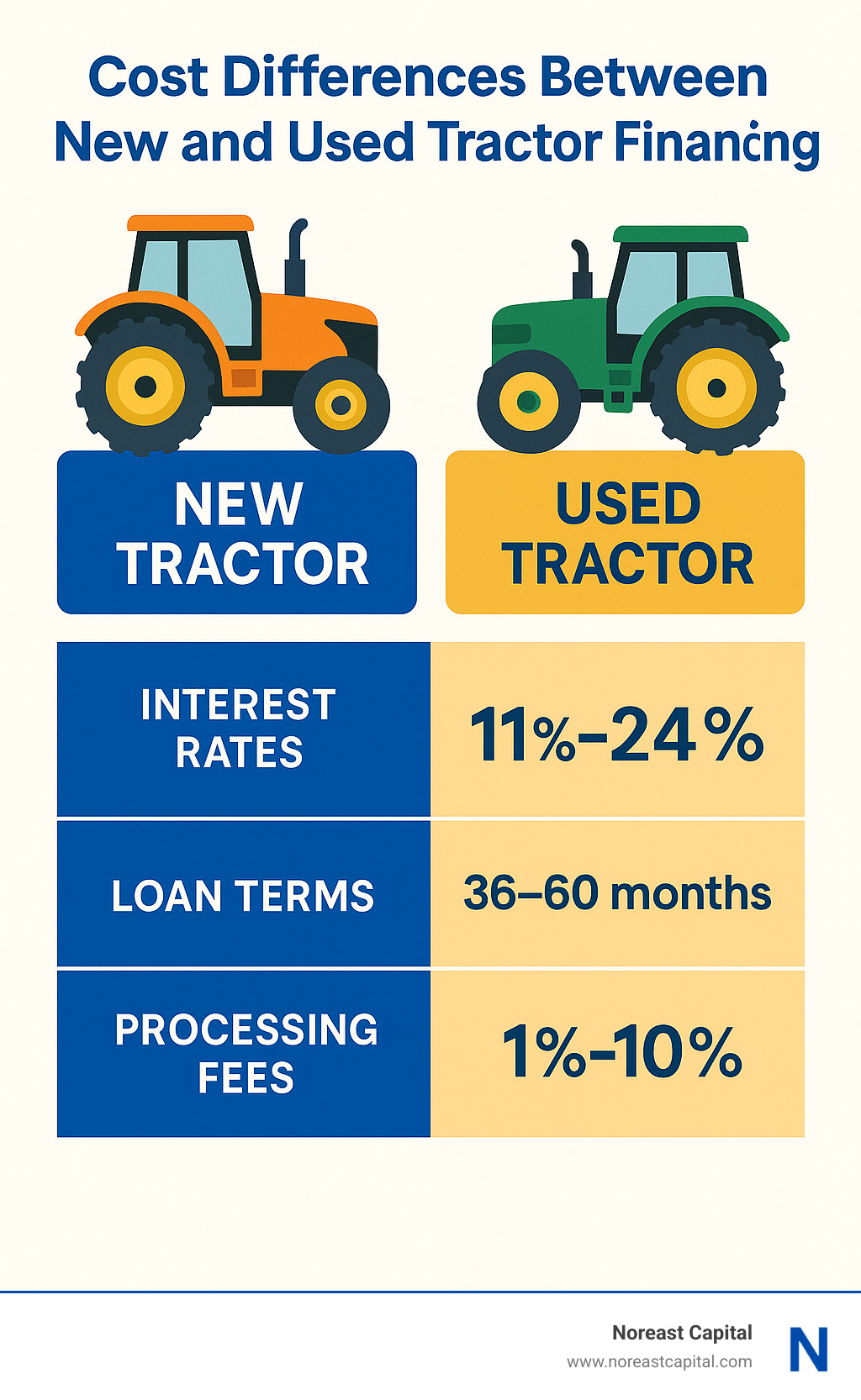
Let’s talk dollars and cents. For traditional financing in developing markets, interest rates typically range from 11-24%. In the US, equipment loan rates can start as low as 3.5% if you have strong credit. Most loans run for 36-60 months (3-5 years), giving you plenty of time to spread out payments.
Be aware of additional costs: processing fees usually range from 1-10% of the loan amount. Some lenders also charge documentation fees, foreclosure charges (around 4% of future principal), and late payment penalties. At Noreast Capital, we’re always upfront about all fees so there are no surprises.
For loan-to-value ratios, most lenders offer 60-90% financing for used tractors, with up to 95% available for certain high-quality models or well-qualified borrowers. Older tractors or those in fair condition typically qualify for lower LTVs—another reason to choose quality used equipment.
Repayment Flexibility: A Farmer’s Best Friend
Here’s where finance second hand tractor options really shine for farmers: repayment flexibility. At Noreast Capital, we understand that farming income isn’t steady like a 9-to-5 job. Your cash flow follows the seasons, and your loan payments should too.
Many lenders, including us, offer payment schedules that align with your farm’s natural rhythm. Monthly payments work well for operations with steady income. Quarterly payments can be aligned with your seasonal sales cycles. Half-yearly payments can be timed perfectly with your major harvest periods. And annual payments can be structured around your primary income season.
One grain farmer who financed through us shared: “Having my tractor loan payments scheduled right after harvest season made all the difference. I’m not scrambling to make payments during planting season when cash is tight.”
This kind of flexibility isn’t just convenient—it can be the difference between financial stress and peace of mind. When your loan works with your farm’s natural cycles instead of against them, you can focus on what you do best: farming.
Want to see exactly how the numbers might work for your situation? Our tractor financing calculator can help you plan your purchase with confidence.
Eligibility, Documents, Interest Rates & Tenure
Wondering who can qualify to finance second hand tractor purchases, and what paperwork you’ll need? Don’t worry—whether you’re a family farmer or a growing agribusiness, let’s break down the details in simple terms.
Who Can Qualify for Used Tractor Financing?
Most lenders want to make sure you’ll put that tractor to good use. If you’re actively farming and can prove it—either through land ownership, a lease, or farm income—you’re halfway there. Farmers usually need to be at least 18 (and not older than 65 by the end of the loan), while businesses should be legally registered and have at least one year of operation under their belt.
A credit score of 600 or higher is the sweet spot for most lenders, but if your score’s a little dusty, don’t fret—there are still ways to qualify. Your lender will also want to see proof of steady income from farming or business activities.
Required Documentation
Gathering your documents before applying can make things much smoother—think of it like prepping your tractor before planting season. Here’s what you’ll likely need:
You’ll want personal ID (like a driver’s license or passport), plus something that shows your address—utility bills or property tax receipts work fine.
On the financial side, recent bank statements (usually from the last 3-6 months) and some proof of income or tax returns will help your case. Lenders almost always check your credit history, so having your credit report handy can speed things along.
For the tractor itself, you’ll need the registration certificate (RC), insurance papers, and either a bill of sale or a quotation from the seller. Some lenders will also ask for a formal tractor inspection report, especially if the equipment is older. And don’t forget, proof of your land ownership or business operation will be needed as well.
“Getting your documents together before you apply is like greasing the wheels on your tractor,” says a Noreast Capital advisor. “It can cut approval time in half!”
Interest Rates and Loan Tenure
Interest rates for used tractor loans can vary, but here’s a quick lay of the land:
- Traditional banks typically offer rates from 11-15%
- NBFCs (non-bank financial companies) are a bit higher, around 14-24%
- Credit unions usually fall in the 13-17% range
Your exact rate depends on a few things: your credit score (higher is better), the tractor’s age and condition, the loan amount and term, and how much you’re putting down up front. Newer tractors and larger down payments can help get you a lower rate.
As for loan terms, most lenders offer 3- to 5-year loans (36-60 months). The key thing to remember is that most will finance a tractor up to about 15 years old at the start, but the tractor shouldn’t be older than 20 years by the time the loan ends.
Fees, Charges, and Penalties
Borrowing to finance second hand tractor equipment does come with some extra costs—so keep your eyes peeled for the fine print. Watch for processing fees (sometimes as much as 10% of the loan), documentation charges, and late payment penalties (which can be steep—think 36% per year on overdue amounts). If you pay off your loan early, expect a foreclosure charge of around 4% on the remaining principal. Returned payments can cost $25-$30, and replacing lost documents usually runs $10-$15.
Options for Borrowers with Poor Credit
If your credit is less than perfect, don’t give up hope. There are still ways to qualify for a used tractor loan:
- Offer a bigger down payment—sometimes 20-30% helps offset a weak credit score.
- Add a co-signer or guarantor with stronger credit.
- Pledge extra collateral beyond the tractor.
- Seek out lenders (like some NBFCs and online outfits) who specialize in low-credit scenarios.
- Consider credit-builder programs that let you finance equipment while working to improve your score.
For more on navigating used tractor financing with unique credit needs, check out Noreast Capital’s used tractor financing guide.

With the right paperwork and a smart approach, you’ll be well on your way to securing the equipment your farm or business needs. And remember, at Noreast Capital, we’re always here to help you finance second hand tractor solutions that truly fit your field.
Step-by-Step Application Process to Finance Second Hand Tractor
Let’s walk through how to get your used tractor financed without the headaches. I’ve helped hundreds of farmers steer this process, and I promise it’s more straightforward than you might think!
Step 1: Determine Budget & Loan Amount
Before diving into applications, take a moment to get crystal clear on your numbers. This step saves so much heartache later!
When calculating your budget, remember to look beyond just the sticker price. You’ll need to account for registration fees, insurance premiums, and any transportation costs to get that tractor to your farm. Don’t forget to budget for immediate maintenance or implements you might need right away.
Think carefully about your down payment. While some of our clients at Noreast Capital qualify for up to 95% financing, putting down 15-20% often leads to better interest rates and lower monthly payments. Plus, it can give your application that extra boost toward approval.
“I always tell farmers to only borrow what makes sense for their operation,” says our equipment specialist. “A good rule of thumb is to calculate how much additional income or time savings the tractor will generate, and make sure your payments fit comfortably within that.”
Need to estimate payments? Our tractor financing calculator can help you play with different scenarios based on loan amounts, rates, and terms.
Step 2: Inspect & Value the Tractor
When you finance second hand tractor purchases, the equipment’s condition directly impacts everything from loan approval to your long-term satisfaction.
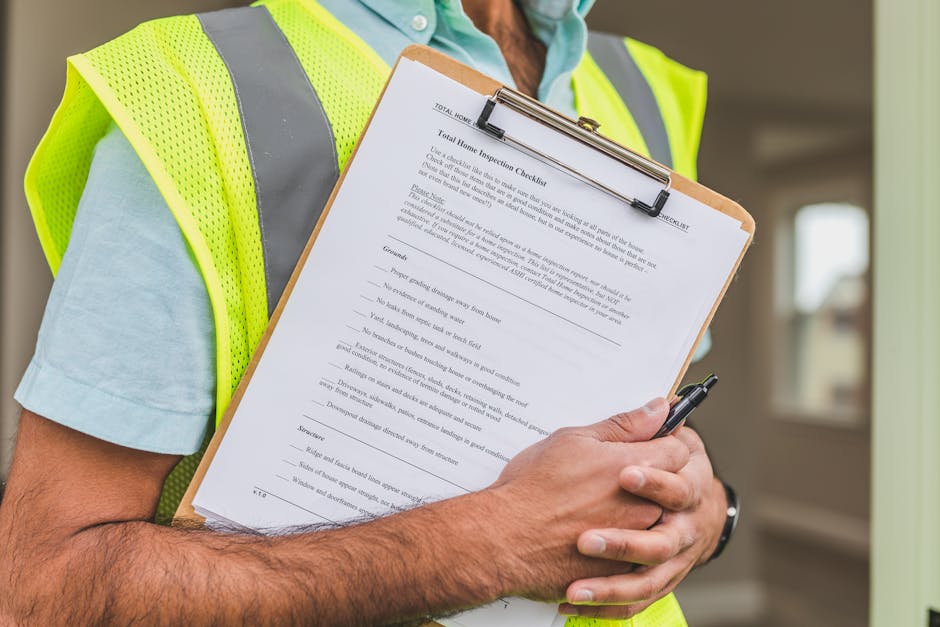
Think of a tractor inspection like dating – you want to know what you’re getting into before making a commitment! Check the engine performance, transmission operation, and hydraulic systems. Pay special attention to the PTO operation, electrical systems, and brakes. Look for fluid leaks and examine the frame for cracks or sketchy-looking welds.
The hour meter reading on a tractor is like mileage on a car – it tells you how much the machine has been used. Generally, 500-600 hours per year is considered average use. If you see a 10-year-old tractor with only 1,000 hours, either you’ve found an amazing deal or something doesn’t add up.
“One client nearly purchased a tractor with a suspiciously low hour reading,” our specialist recalls. “On closer inspection, we finded the meter had been replaced. Getting a professional opinion saved him from a costly mistake.”
Step 3: Gather Documents & Improve Credit
Now it’s time to get your paperwork ducks in a row. Think of this step as setting the stage for a smooth approval process.
Your ID, proof of address, and recent bank statements are standard requirements. You’ll also need income verification through tax returns or profit/loss statements. If you’re farming, documentation showing your land ownership or lease agreement will be essential.
Your credit score matters, but it’s not the only factor. Take a few minutes to review your credit report before applying. Simple actions like disputing inaccuracies or paying down some existing debt can give your score a quick boost. And hold off on applying for any new credit cards or loans until after your tractor financing is secured.
Don’t forget to gather information about the tractor itself – make, model, year, serial number, and current registration details. Photos are incredibly helpful too.
Apply to Finance Second Hand Tractor in Minutes
The application process has come a long way from the days of endless paperwork and branch visits. At Noreast Capital, we’ve streamlined everything to get you back to farming faster.
You can choose to apply online (the quickest option), by phone, or in person if you prefer a face-to-face conversation. Our online application takes about 8-10 minutes to complete, and you’ll need to provide your personal/business information, the financing amount you’re seeking, tractor details, and your preferred repayment schedule.
Supporting documents can now be uploaded digitally, and e-signatures have made the process even more convenient. Your information is protected through secure portals, so you can apply with confidence.
“Most of our clients are pleasantly surprised by how quick the process is,” shares our financing specialist. “We regularly provide pre-approvals within 24 hours because we understand that when you need equipment, you can’t wait weeks for an answer.”
Step 5: Review Offer & Sign Agreement
When your approval comes through, it’s time to put on your reading glasses and review the offer carefully.
Pay close attention to the key terms: loan amount, interest rate (APR), term length, payment amount, and frequency. Check if the down payment required matches your expectations.
Look for any fees hiding in the fine print. Processing fees, documentation fees, early repayment penalties, and insurance requirements should all be clearly spelled out. If something doesn’t make sense, ask! At Noreast Capital, we’re happy to walk through every line of the agreement with you.
Don’t be afraid to negotiate. Interest rates, term length, and even down payment requirements might have some flexibility, especially if you have strong credit or a solid relationship with the lender.
Once everything looks good, sign the agreement and keep copies of all documents. Your future self will thank you if questions ever arise.
Step 6: Transfer Ownership & Insure
After loan approval, you’re in the home stretch! Most lenders, including Noreast Capital, will pay the seller directly once everything is approved. Make sure you receive a proper bill of sale and verify that all promised attachments or implements are included with your tractor.
Next, complete the title transfer paperwork and register the tractor in your name with the lender listed as lienholder. This step is crucial for establishing legal ownership.
Insurance is non-negotiable when financing equipment. You’ll need physical damage coverage to protect the asset and liability coverage to protect against claims. Make sure your policy meets the lender’s requirements and lists them as loss payee.
Step 7: Align Repayment to Crop Cycle
One of the most valuable features when you finance second hand tractor purchases is the ability to align payments with your farm’s cash flow.
Unlike traditional loans with rigid monthly payments, agricultural equipment financing can often be structured around your harvest cycle. You might choose monthly payments if your income is steady year-round, quarterly payments to align with seasonal sales, half-yearly coinciding with major harvest periods, or even annual payments after your primary harvest.
Setting up automatic payments is a smart move – it helps you avoid late fees, builds positive payment history, and removes one more thing from your to-do list.
“A dairy farmer I worked with chose monthly payments that matched his milk income schedule,” explains our Noreast Capital representative. “Meanwhile, our grain farmers typically prefer quarterly or bi-annual payments that line up with when they sell their crops. This flexibility makes managing farm finances so much easier.”
Understanding your prepayment options is also important. Some loans allow extra payments without penalty, which can save you interest in the long run. Others might charge for early payoff, so know the rules before making additional payments.
With these seven steps, you’ll be well on your way to successfully financing that second-hand tractor and putting it to work on your farm!
Compare Lenders, Avoid Pitfalls & Next Steps
Comparing Different Lender Types
When you’re ready to finance second hand tractor purchases, choosing the right lender can be as important as selecting the tractor itself. Each lender type comes with its own set of advantages that might align perfectly with your specific situation.
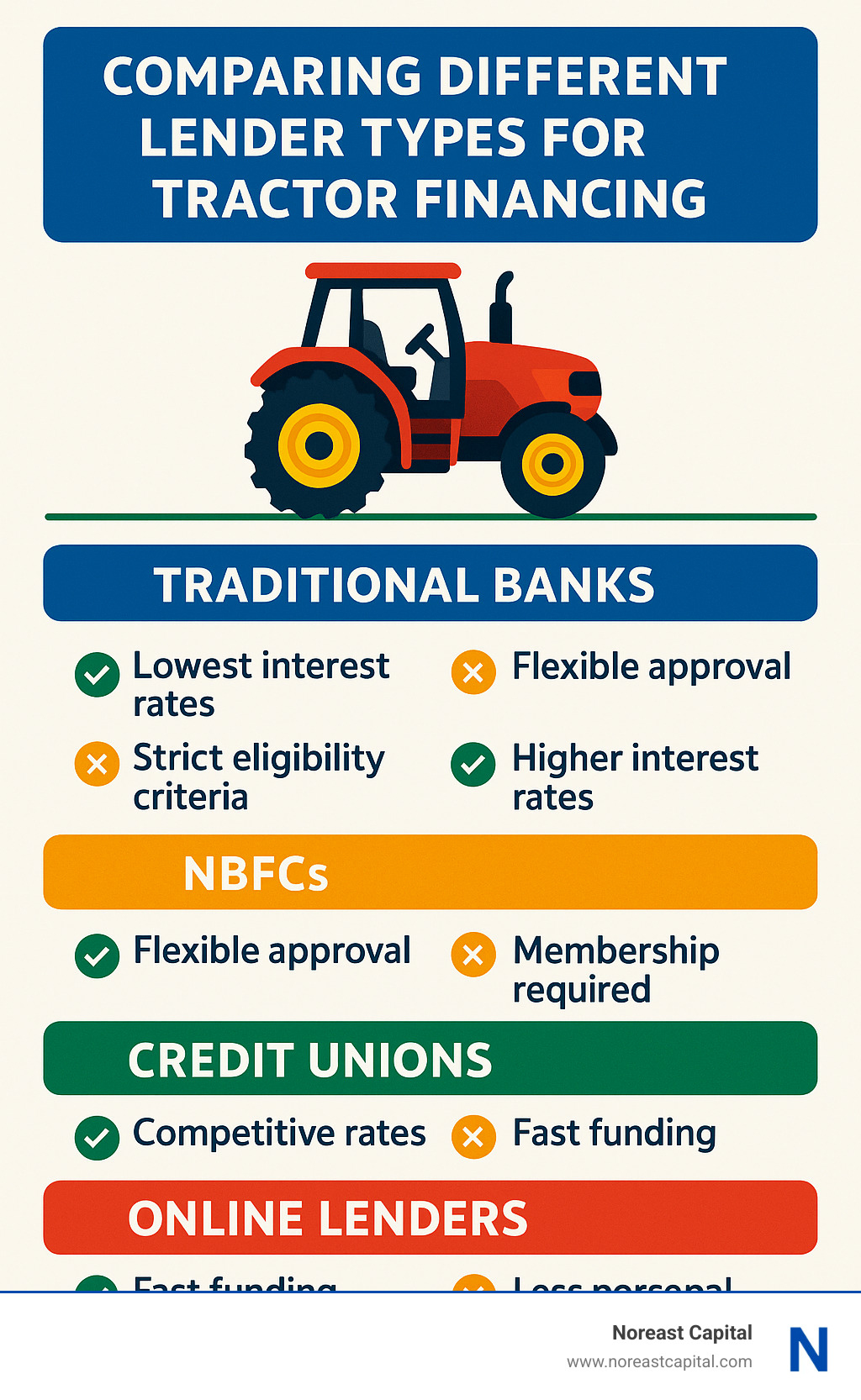
Traditional banks often offer the most attractive interest rates, typically between 11-15%. If you’ve maintained a good relationship with your local bank and have excellent credit, this might be your best option. The familiarity they have with your financial history can work in your favor, sometimes resulting in relationship discounts that further lower your costs. However, be prepared for a more rigorous approval process and less flexibility if your credit isn’t spotless.
“I’ve seen farmers wait weeks for bank approval only to be denied over minor credit issues,” shares our equipment specialist. “That’s when we step in to offer alternatives that better fit their unique situations.”
Non-Banking Financial Companies (NBFCs) shine when flexibility matters more than securing the absolute lowest rate. With interest rates ranging from 14-24%, they’re not the cheapest option, but their specialized agricultural knowledge means they understand the unique challenges farmers face. Their approval processes typically move faster, getting you in the field sooner.
Credit unions offer a middle ground with competitive rates (usually 13-17%) and a member-oriented approach that often translates to more personalized service. Many have deep roots in agricultural communities and understand local farming conditions better than national lenders. The main drawback is the membership requirement, which might limit accessibility for some borrowers.
For the tech-savvy farmer who needs financing quickly, online lenders offer remarkable convenience. Their streamlined digital processes can sometimes deliver same-day approvals with minimal paperwork. This speed comes at a price, though, as rates tend to be higher and the relationship less personal.
Government Programs and Subsidies
Don’t overlook the potential savings available through government programs when looking to finance second hand tractor purchases. The USDA Farm Service Agency (FSA) offers both direct and guaranteed loans specifically designed for farmers who struggle to qualify for commercial credit. These programs often feature more favorable terms than standard commercial loans.
Many states also maintain their own agricultural finance programs custom to local farming needs. These can be particularly valuable if you’re farming in an area with specific agricultural challenges or opportunities.
If you’re using your tractor for commercial operations beyond traditional farming, Small Business Administration (SBA) loans might be worth exploring. Similarly, Agricultural Credit Associations—government-sponsored enterprises—exist specifically to provide credit to rural communities.
“Many farmers don’t realize there are specialized programs that can significantly reduce their financing costs,” explains our Noreast Capital specialist. “We help clients identify and apply for programs they qualify for.”
Common Pitfalls to Avoid
When you finance second hand tractor purchases, watching out for these common mistakes can save you thousands:
Hidden fees can quickly inflate your financing costs. Always request a complete disclosure of all charges—processing fees, documentation fees, late payment penalties, and any other costs that might not be immediately obvious in the quoted interest rate.
A common mistake is focusing too much on the tractor’s purchase price while ignoring its condition. That bargain-priced tractor might end up costing more in the long run if it needs major repairs shortly after purchase. Always invest in a thorough inspection before committing.
Don’t fall into the trap of choosing loan terms based solely on achieving the lowest monthly payment. While lower payments might seem attractive, they often result in a higher total cost over the life of the loan due to extended interest payments.
Misaligning your payment schedule with your income flow can create unnecessary stress. The beauty of agricultural equipment financing is the ability to structure payments around your harvest cycles—take advantage of this flexibility.
“I once worked with a farmer who insisted on monthly payments because the rate was slightly lower,” recalls our financing expert. “Six months later, he was struggling to make payments during planting season when his cash flow was tightest. We refinanced to a semi-annual schedule that matched his harvest income, and the relief was immediate.”
Early Payoff Considerations
If your operation has a particularly good year, you might consider paying off your tractor loan early. Before making this move, check whether your loan includes prepayment penalties—typically around 4% of the remaining principal. Calculate whether the interest savings justify paying this penalty.
Some lenders offer more flexibility with partial prepayments, allowing you to make extra payments without triggering full prepayment penalties. This approach can reduce your overall interest while avoiding hefty charges.
Timing matters too. Many loans waive prepayment penalties after you’ve held the loan for a certain period, so patience might save you money if you’re close to that threshold.
Maintenance Costs and Total Cost of Ownership
When budgeting to finance second hand tractor purchases, your loan payment is just one part of your total ownership cost. Routine maintenance—oil changes, filters, and fluids—typically runs $500-1,500 annually depending on usage hours and tractor size.
Budget for occasional major repairs, particularly if your tractor approaches the 4,000-5,000 hour mark, when many models begin needing more significant attention. Insurance costs, fuel consumption (which tends to be higher in older models), and ongoing depreciation should all factor into your financial planning.
“A well-maintained used tractor can provide excellent service for years with proper care,” notes our equipment specialist. “The key is including maintenance costs in your financial planning.”
Next Steps After Financing
Once you’ve secured financing for your tractor, set yourself up for success by creating a detailed maintenance schedule based on the manufacturer’s recommendations. Keep meticulous records of all services and repairs—this documentation will prove valuable if you decide to sell or trade the tractor later.
Regularly review your loan statements for accuracy and keep an eye on interest rate trends. If rates drop significantly, refinancing might offer substantial savings.
Most importantly, build a relationship with your lender. At Noreast Capital, we pride ourselves on maintaining connections with our clients throughout the life of their loans and beyond, providing support and additional financing options as their operations grow and evolve.
For more information about your financing options, visit our detailed guides on Tractor Financing Options or read the latest scientific research on rural credit access.
Frequently Asked Questions about Finance Second Hand Tractor
How much can I borrow and what down payment is typical?
When you finance second hand tractor purchases, loan amounts typically range from 60% to 90% of the tractor’s value, with some lenders offering up to 95% for well-qualified borrowers.
This means your down payment will generally be:
– Standard down payment: 10-40% of the purchase price
– Excellent credit/newer tractors: As low as 5-10%
– Challenged credit/older tractors: 20-40% may be required
The actual amount you can borrow depends on:
– The tractor’s appraised value
– Your credit profile and income
– The tractor’s age and condition
– Your existing debt obligations
“We’ve seen farmers surprised by how much they can finance on quality used equipment,” says our Noreast Capital representative. “A well-maintained 10-year-old tractor with good documentation can often secure financing terms close to those for newer models.”
Can I get approved with a low credit score?
Yes, it’s possible to finance second hand tractor purchases even with a less-than-perfect credit score. Here’s what to know:
- Collateral strength matters: Since the tractor itself serves as collateral, lenders may be more flexible with credit requirements
- Down payment leverage: Offering a larger down payment (25-30%) can offset credit concerns
- Co-applicant option: Adding a co-signer with stronger credit can improve approval odds
- Specialized lenders: Some lenders focus on agricultural equipment financing for credit-challenged borrowers
- Interest rate impact: Expect higher rates (potentially 5-10% higher than prime offers)
Alternative qualification factors that lenders may consider:
– Strong farm income despite credit challenges
– Significant land holdings or other assets
– Long-term farming experience
– Existing banking relationships
– Explanation for past credit issues (medical problems, divorce, etc.)
“At Noreast Capital, we look at the complete picture, not just a credit score,” our financing specialist explains. “We understand that farming has ups and downs, and we work to find solutions for farmers with various credit backgrounds.”
What happens if I miss a payment or want to prepay?
Missing Payments
If you miss a payment on your used tractor loan:
- Grace period: Most lenders offer a short grace period (typically 10-15 days)
- Late fees: After the grace period, expect fees around 5% of the payment amount or a flat fee
- Interest penalties: Some lenders charge additional interest (up to 36% per annum on the unpaid amount)
- Credit reporting: Late payments beyond 30 days are typically reported to credit bureaus
- Collection process: Continued non-payment will trigger collections
- Repossession risk: As a secured loan, the lender can ultimately repossess the tractor
Communication is key: “Always contact your lender immediately if you anticipate payment difficulties,” advises our Noreast Capital representative. “Many lenders, including ours, can work with you on temporary payment arrangements during genuine hardships.”
Prepayment Options
If you want to pay off your loan early:
- Check for prepayment penalties: Typically around 4% of the outstanding principal
- Partial prepayments: Some loans allow additional payments without penalty
- Timing considerations: Penalties often decrease or disappear after a certain period
- Interest savings calculation: Compare potential interest savings against prepayment fees
- Refinancing option: Sometimes refinancing with a new lender can bypass prepayment penalties
“We structure our loans at Noreast Capital to provide flexibility,” notes our specialist. “We understand that a good harvest or unexpected windfall might put you in a position to reduce debt, and we try to accommodate that without excessive penalties.”

Conclusion
Choosing to finance second hand tractor purchases is a smart move for farmers and agri-businesses wanting more muscle in the field—without emptying the bank account. As we’ve seen throughout this guide, used tractor financing puts real power in your hands: lower up-front costs, steadier equipment value, and flexible payments that move with the rhythm of your farm’s seasons.
A successful financing journey starts with some homework. When you’re shopping for a tractor, don’t just kick the tires—give the engine, transmission, and hydraulics a good look. A solid inspection now can mean fewer headaches (and fewer surprise repair bills) down the line.
Next, it pays—literally—to compare lenders. Interest rates, loan terms, and fees can vary much more than you’d expect. Whether you go with a bank, NBFC, credit union, or online lender, shopping around can save you thousands over the life of your loan. Don’t be shy about asking questions or even negotiating—after all, you wouldn’t accept the first offer at a farm auction, right?
Repayment flexibility is another major win when you finance second hand tractor needs. Aligning your payments with your harvest or sales cycles makes it easier to manage cash flow, especially when times are tight or weather is unpredictable.
Remember to look at the big picture, too. The sticker price is just one part of the story. Be sure to factor in insurance, routine maintenance, fuel, and any repairs that may pop up. Understanding the total cost means fewer surprises and better long-term planning.
And finally, get your paperwork in order before you apply. This includes financial records, proof of income, and all the details about the tractor itself. A little organization now can speed up approvals and may even help you snag a better deal.
At Noreast Capital, we know every farm and every farmer is unique. That’s why our team in Annapolis, Baltimore, and Washington, DC offers flexible, competitive, and personalized finance second hand tractor solutions. Whether you’re buying your first tractor or adding another to your fleet, we’re here to clear the path—so you can focus on what you do best.
A well-chosen, well-maintained used tractor can work as hard as you do, season after season. Let us help you make a financing choice that’s as reliable as your equipment.
Want to get started or learn more? Visit our tractor loan page or reach out to our expert team at Noreast Capital. We look forward to helping you drive your operation forward—with the right equipment, the right financing, and the right support whenever you need it.