

Making the Right Choice: Leasing vs. Financing Your Vehicle
When faced with the decision of how is lease vs finance car calculated, weigh the impact on your finances. Here’s a quick comparison:
- Monthly Payments: Leasing generally offers lower monthly payments than financing.
- Down Payment: Financing may require a higher initial down payment compared to leasing.
- Ownership: Financing leads to ownership after the loan is paid off, while leasing means returning the car at the end.
- Mileage & Wear: Leasing often includes mileage limits and potential fees for wear and tear.
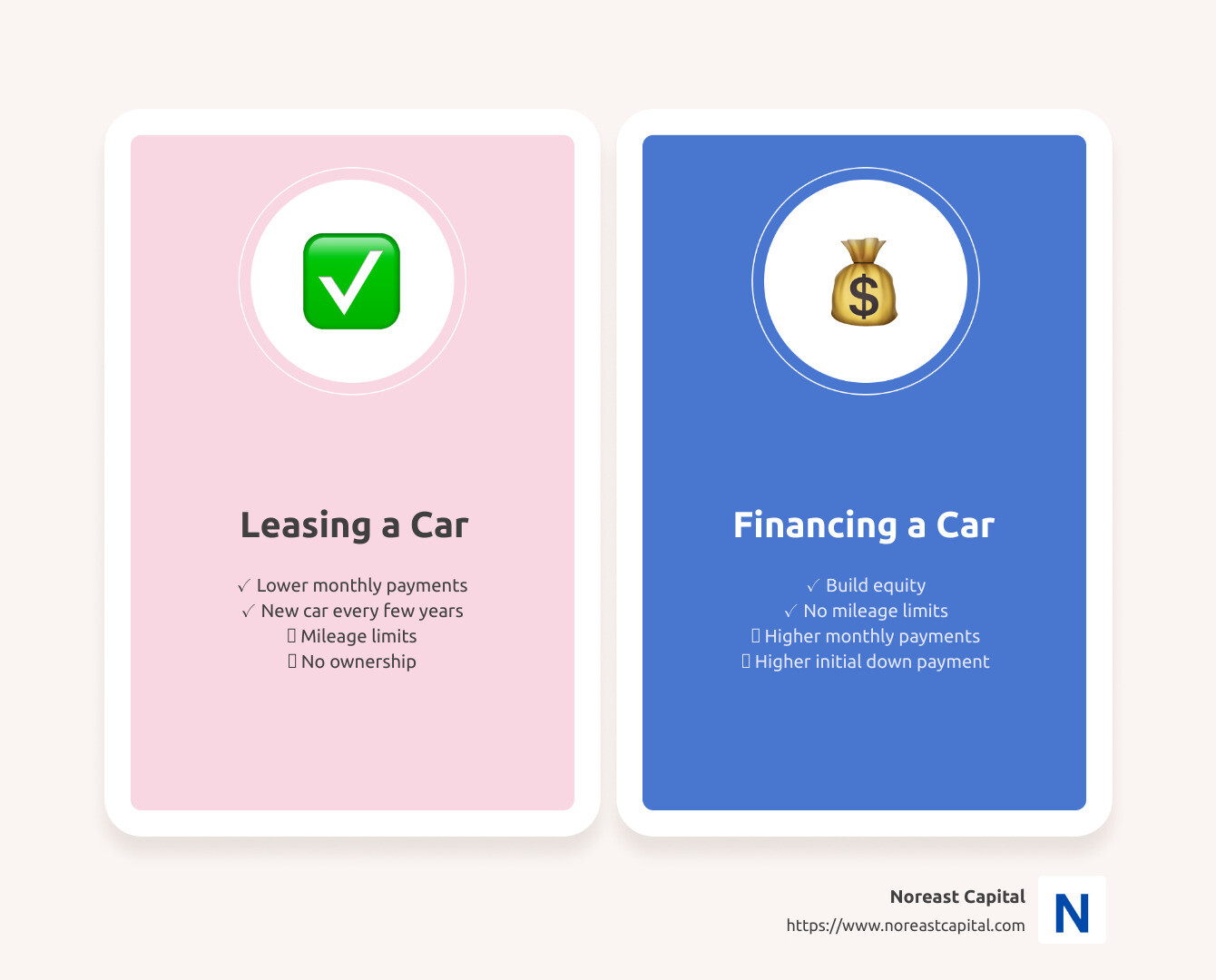
Both leasing and financing have their perks and pitfalls. Leasing often means lower payments and staying in new vehicles, but with mileage restrictions and no ownership. Financing, on the other hand, lets you build equity and avoid fees for excess mileage, but comes with higher monthly payments and upfront costs.
I’m Vincent Cerniglia, an expert in equipment financing and leasing. With years of experience helping businesses steer their options, I’ve seen the financial implications of choosing the right path for your vehicle needs.
Key Differences Between Leasing and Financing
When deciding between leasing and financing a vehicle, understanding the key differences can help you make an informed choice. Let’s break down the main factors: monthly payments, down payment, ownership, equity, mileage limits, wear and tear, and residual value.
Monthly Payments
Leasing generally offers lower monthly payments compared to financing. This is because you’re paying for the vehicle’s depreciation during the lease term, not the entire purchase price.
Financing a car typically involves higher monthly payments. You’re paying off the total purchase price plus interest over the loan term.
Down Payment
Leasing often requires little to no down payment, making it attractive if you want to minimize upfront costs. However, a higher down payment can lower your monthly lease payments.
Financing usually requires a more substantial down payment. It’s recommended to put down at least 20% for a new car and 10% for a used car to reduce the loan amount and monthly payments.
Ownership
Leasing means you don’t own the car. At the end of the lease term, you return the vehicle to the dealer unless you opt to buy it.
Financing results in ownership once the loan is paid off. You can keep the car as long as you want, sell it, or trade it in for another vehicle.
Equity
Leasing doesn’t build equity. You’re essentially renting the car for a set period, so you won’t have an asset at the end of the lease term.
Financing builds equity as you make payments. Once the loan is paid off, the car’s value (minus depreciation) is your equity, which can be used toward your next vehicle purchase.
Mileage Limits
Leasing contracts usually come with mileage limits, typically ranging from 12,000 to 15,000 miles per year. Exceeding these limits can result in hefty fees.
Financing has no mileage restrictions. You can drive as much as you want without worrying about penalties.
Wear and Tear
Leasing agreements often include charges for excessive wear and tear. If the vehicle is returned with more damage than considered normal, you’ll have to pay extra fees.
Financing places all maintenance and repair costs on you, but there’s no penalty for wear and tear when you own the vehicle.
Residual Value
Leasing involves paying for the car’s depreciation. The residual value is what the car is worth at the end of the lease term. This value affects your monthly payments—the higher the residual value, the lower your payments.
Financing means you own the car, so residual value doesn’t directly impact your monthly payments. However, the car’s depreciation will affect its resale value when you decide to sell or trade it in.

Understanding these differences can help you decide whether leasing or financing aligns better with your financial situation and driving habits. Next, let’s dive into how lease vs. finance costs are calculated.
How is Lease vs Finance Car Calculated?
When deciding between leasing and financing a car, understanding how each option is calculated can help you make the best financial decision. Let’s break down the key components involved in calculating lease and finance costs.
Calculating Lease Costs
Monthly Lease Payment
Monthly lease payments are determined by a few key factors:
- Purchase Price: The agreed-upon price of the car, often negotiated down from the MSRP.
- Down Payment: Also known as a capitalized cost reduction, this is the amount you pay upfront to reduce the lease cost.
- Residual Value: The car’s estimated value at the end of the lease term. Higher residual values lower your monthly payments.
- Money Factor: This is the lease equivalent of an interest rate. It’s often presented as a small decimal. To convert it to an interest rate, multiply the money factor by 2,400.
- Lease Term: The duration of the lease, typically ranging from 24 to 60 months.
- Sales Tax: Calculated on the monthly payment in most states.
Fees
- Acquisition Fee: A fee charged by the leasing company to set up the lease.
- Disposition Fee: Charged at the end of the lease to cover the cost of preparing the car for resale.
- Excess Mileage Fee: If you exceed the mileage limit, you’ll pay a fee per extra mile.
- Wear and Tear Fee: Charges for any damage beyond normal wear and tear.
Example Calculation
For a car with a purchase price of $30,000, a down payment of $3,000, a residual value of $18,000, a money factor of 0.002, and a lease term of 36 months, your monthly lease payment might look like this:
- Depreciation Fee: ($30,000 – $18,000) / 36 = $333.33
- Lease Fee: ($30,000 + $18,000) * 0.002 = $96
- Monthly Lease Payment: $333.33 + $96 = $429.33 (plus taxes)
Calculating Finance Costs
Monthly Loan Payment
Monthly loan payments are calculated based on:
- Purchase Price: The total cost of the car after any manufacturer rebates.
- Down Payment: The amount you pay upfront to reduce the loan amount.
- Sales Tax: Typically calculated on the full purchase amount and added to the loan balance.
- Interest Rate: The rate charged by the lender, often influenced by your credit score.
- Loan Term: The length of the loan, usually ranging from 24 to 84 months.
Fees
- Other Fees: These can include registration, title fees, and any additional charges from the dealership.
Example Calculation
For a car with a purchase price of $30,000, a down payment of $6,000, an interest rate of 5%, and a loan term of 60 months, your monthly loan payment might look like this:
- Loan Amount: $30,000 – $6,000 = $24,000
- Monthly Payment: Using a loan payment calculator, this comes to approximately $452.91 (plus taxes and fees)
Total Cost and Equity
When financing, you build equity in the car as you make payments. The total cost includes the purchase price, interest paid over the loan term, and any fees. Once the loan is paid off, the car’s resale value becomes your equity.
Resale Value
The resale value is what you could potentially sell the car for after the loan is paid off. This depends on factors like the car’s make, model, and condition.

Understanding these calculations can help you decide whether leasing or financing aligns better with your financial situation and driving habits. Next, let’s explore the pros and cons of leasing a car.
Pros and Cons of Leasing a Car
Pros of Leasing a Car
1. Lower Payments
Leasing a car typically means lower monthly payments compared to financing. This is because you’re only paying for the car’s depreciation during the lease term, not the full purchase price. For example, if a car’s purchase price is $30,000 and its residual value after a 3-year lease is $18,000, you only pay for the $12,000 difference, plus interest and fees.
2. New Car Smell
Leasing allows you to drive a new car every few years. This means you can enjoy the latest models and technology without the long-term commitment. It’s perfect for those who love the new car smell and the latest features.
3. Maintenance
Most leased cars are under the manufacturer’s warranty during the lease term. This means lower out-of-pocket costs for repairs and maintenance. Some leases even include free oil changes and routine maintenance, saving you even more.
Cons of Leasing a Car
1. Mileage Limits
Leases come with mileage limits, usually 12,000 to 15,000 miles per year. If you exceed this limit, you’ll pay penalties, typically ranging from $0.15 to $0.30 per mile. This can add up quickly if you have a long commute or love road trips.
2. No Ownership
When you lease a car, you don’t own it. At the end of the lease, you must return the car unless you decide to buy it. This means you’re making payments on something that doesn’t become an asset.
3. Perpetual Payments
If you continually lease cars, you’ll always have a monthly payment. Unlike financing, where you eventually pay off the loan and own the car outright, leasing means you never stop paying.
4. Customization Limits
Leased cars must be returned in their original condition, minus normal wear and tear. This means you can’t make significant modifications or customizations. If you love personalizing your vehicle, leasing might not be the best option.
Understanding these pros and cons can help you decide if leasing aligns with your lifestyle and financial goals. Next, let’s dig into the advantages and disadvantages of financing a car.
Pros and Cons of Financing a Car
Ownership
Ownership is the biggest advantage of financing a car. Once you pay off your loan, the car is yours. No more monthly payments, and you can keep the car as long as you want. This can be a big relief, especially if you plan to drive the car for many years.
Equity
When you finance a car, you build equity. Equity is the difference between what the car is worth and what you still owe on your loan. If your car’s value is higher than your remaining loan balance, you have positive equity. This can be useful if you decide to sell or trade in the car before your loan term ends.
No Mileage Limits
Financing a car means you don’t have to worry about mileage limits. You can drive as much as you want without facing penalties. This is ideal for people with long commutes or those who love taking road trips.
Higher Payments
One downside of financing is that it often comes with higher payments compared to leasing. You’re paying off the entire purchase price of the car, plus interest. This can make your monthly payments significantly higher than a lease.
Maintenance Costs
When you own a car, you’re responsible for all maintenance costs. After the manufacturer’s warranty expires, any repairs or maintenance come out of your pocket. This can add up, especially as the car ages and requires more frequent repairs.
Resale Value
The resale value of your car can be a gamble. While financing allows you to eventually own the car, its value can depreciate quickly. If the car’s market value drops significantly, you might find yourself with negative equity, where you owe more than the car is worth. This can be problematic if you want to sell or trade in the car.
Understanding these pros and cons can help you decide if financing aligns with your lifestyle and financial goals. Next, let’s explore the various tools and calculators available to help you compare leasing and financing options.
Tools and Calculators for Lease vs Finance
When deciding whether to lease or finance a car, the right tools and calculators can make a world of difference. These resources help you understand the financial implications of each option, making it easier to choose the best path for your needs.
Online Calculators
Online calculators are a great starting point. They simplify complex calculations and provide quick estimates. For example, the lease vs. buy car calculator helps you compare monthly payments and total costs between leasing and financing.
Input Variables
To get accurate results from these calculators, you need to input several variables. Here are the key ones:
- Purchase Price: The negotiated price of the car.
- Down Payment: The amount you pay upfront.
- Sales Tax Rate: Varies by state; affects the total cost.
- Interest Rate: For financing, this is the loan interest rate. For leasing, it’s the lease money factor.
- Loan Term: The length of the loan or lease term.
- Residual Value: The car’s estimated value at the end of the lease.
- Fees: Includes acquisition, disposition, and any other fees.
Comparison Tools
Comparison tools allow you to see side-by-side estimates, making it easier to weigh the pros and cons. Most calculators will show you:
- Monthly Payments: What you’ll pay each month for leasing vs. financing.
- Total Cost: The overall cost over the term, including interest and fees.
- Depreciation: How much value the car will lose over time.
- Equity: For financing, how much value you’ll own in the car at the end of the term.
Monthly Payments
Monthly payment estimates are crucial for budgeting. Leasing usually offers lower monthly payments because you’re only paying for the car’s depreciation plus interest and fees. Financing payments are higher as you’re paying off the entire purchase price, plus interest.
Total Cost
Total cost calculations give you a long-term view. Leasing might cost less monthly but can be more expensive over time due to fees and penalties. Financing could be costlier upfront but may save you money in the long run if you keep the car for many years.

By using these tools and calculators, you can make an informed decision that aligns with your financial goals and lifestyle. Next, let’s dive into some frequently asked questions about leasing and financing to further clarify your options.
Frequently Asked Questions about Lease vs Finance
Is it cheaper to lease a car or finance?
The answer depends on your financial goals and how long you plan to keep the car.
Short Term: Leasing is often cheaper in the short term. Monthly lease payments are typically lower than finance payments because you’re only paying for the car’s depreciation during the lease term, plus interest and fees.
Long Term: Financing can be more economical in the long run. Although monthly payments are higher, you own the car at the end of the term, which means you can sell it and recoup some of your costs. Leasing means perpetual payments if you lease again and again.
Equity: With financing, you build equity in the car. Once the loan is paid off, the car is yours. With leasing, you don’t gain any equity; you return the car at the end of the lease term.
What is the 1% rule in car leasing?
The 1% rule is a quick way to determine if a lease deal is good. According to this rule, your monthly lease payment should be around 1% of the car’s purchase price.
Example Calculation:
– Purchase Price: $45,000
– 1% of Purchase Price: $450
If your monthly lease payment is close to $450, it’s considered a good deal. This rule helps you quickly gauge if the lease terms are favorable without diving into detailed calculations.
How to calculate lease or buy?
To decide whether to lease or buy, you need to calculate the net cost for both options. Here’s a breakdown of how to do it:
Net Cost of Buying:
1. Upfront Costs: Includes down payment and any relevant fees or taxes.
2. Lost Interest: The potential earnings if you invested your down payment instead.
3. Outstanding Loan Balance: The remaining amount you owe on the car loan.
4. Market Value: The car’s estimated value at the end of the loan term.
Net Cost of Leasing:
1. Upfront Costs: Includes down payment and lease-related fees.
2. Lease Payments: Total of monthly payments over the lease term.
3. Lost Interest: The potential earnings if you invested your down payment instead.
By comparing these amounts, you can determine which option is more cost-effective for you. Use online calculators to simplify this process and get a clear picture of your financial commitment.
For example, the Credit Karma lease vs. buy car calculator can help you input all these variables and compare the results.
Next, let’s explore the pros and cons of leasing a car to further clarify your options.
Conclusion
Deciding whether to lease or finance a car can be complex, but understanding the key factors can help simplify your decision.
Summary: Leasing often offers lower monthly payments and the chance to drive a new car every few years. However, it comes with mileage limits and no ownership at the end of the term. Financing, on the other hand, means higher monthly payments but you eventually own the car, building equity over time.
Decision Factors: When deciding, consider your financial goals, how long you plan to keep the car, and your driving habits. If you value lower monthly payments and prefer driving a new car often, leasing might be the better option. If you want to build equity and avoid mileage restrictions, financing could be more beneficial.
Noreast Capital: At Noreast Capital, we understand that choosing between leasing and financing is a significant decision. We offer customized financing solutions to fit your unique needs, whether you’re looking to lease or buy.
Equipment Financing: Beyond cars, Noreast Capital specializes in equipment financing. We provide flexible terms and competitive rates to help businesses acquire the equipment they need without straining their cash flow.
Commercial Solutions: Our expertise extends to commercial solutions, ensuring that businesses can thrive with the right financial tools. From restaurant equipment to office technology, we support your growth with custom financing options.
For more details on the differences between leasing and financing, visit our service page.
In conclusion, whether you choose to lease or finance, the right decision depends on your personal and financial goals. At Noreast Capital, we’re here to help you make an informed choice that aligns with your needs. Your success is our priority, and we’re committed to providing the financial support you need to achieve your dreams.