

How much is a lease payment on a 30000 car? This is a question many small business owners ask when considering leasing a vehicle to maintain cash flow while avoiding the high upfront costs of ownership. Typically, a lease payment for a $30,000 car might range from $400 to $600 per month. This estimate can vary based on several factors like the lease term, the vehicle’s residual value, and the money factor, which is similar to the interest rate on a loan.
Leasing a vehicle is akin to renting it long-term rather than owning it outright. It allows you to drive a new car every few years without worrying about owning a depreciating asset. This flexibility often appeals to those who use their vehicles for business purposes, providing an opportunity to operate with the latest equipment without enduring the steep depreciation curve associated with buying a new car. In our article, we’ll dig into the specifics of lease payments and explore whether leasing or owning is the best strategy for your business needs.
I’m Vincent Cerniglia, an expert in leasing solutions at Noreast Capital Corporation. With years of experience guiding businesses on leasing practices, I understand the nuances of costs associated with questions like “how much is a lease payment on a 30000 car”. Let’s explore the most strategic and financially sound choices available to you.
how to calculate lease payment
how to calculate lease payment for car
how to calculate payoff amount on car lease
Understanding Lease Payments
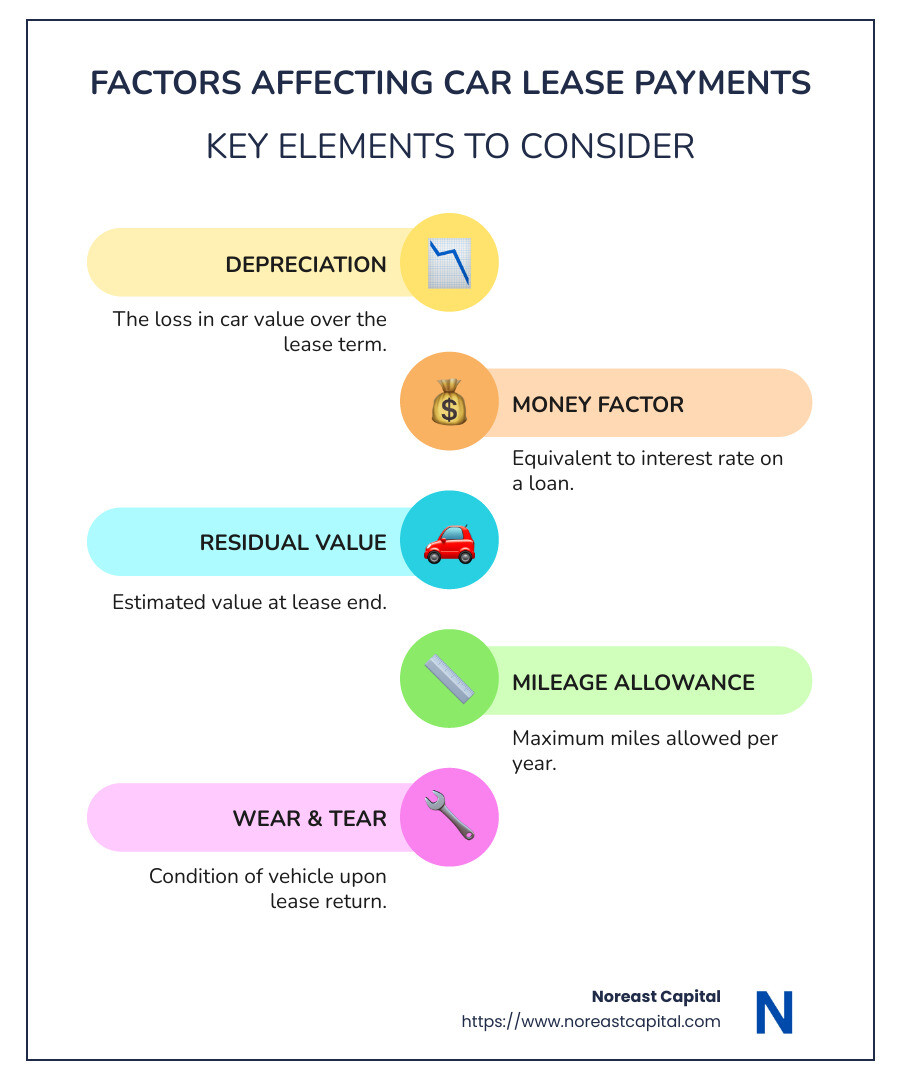
When you lease a car, you’re essentially renting it for a set period and paying for its use during that time. The amount you pay each month is your lease payment, and it’s determined by a few key factors: the residual value, the money factor, and the initial cost of the vehicle.
Lease Payment Calculation
To understand how much is a lease payment on a 30000 car, you need to break down the calculation into parts. The lease payment is mainly composed of depreciation, finance charges, and taxes.
Depreciation: This is the difference between the vehicle’s initial price and its residual value at the end of the lease. If a $30,000 car has a residual value of $15,000 after three years, you’re paying for the $15,000 difference spread over the lease term.
Finance Charge: Think of this as the interest on a loan. It’s calculated using the money factor, which is a small decimal number. The lower the money factor, the less interest you’ll pay. The money factor is derived from the interest rate using the formula: money factor = interest rate / 2400.
Taxes and Fees: Depending on where you live, sales taxes and other fees might be added to your monthly payment.
Residual Value
The residual value is what the car is expected to be worth at the end of the lease. It’s a crucial part of the lease payment calculation. A higher residual value means lower monthly payments because you’re paying for less depreciation. For instance, if a car is worth 50% of its original value after three years, the residual value for a $30,000 car would be $15,000.
Money Factor
The money factor is similar to the interest rate in a loan. It affects the finance charge portion of your lease payment. A lower money factor means lower finance charges. For example, a 4% interest rate would translate to a money factor of 0.00167 (4 / 2400). Maintaining a good credit score can help you secure a lower money factor, reducing your overall lease cost.
Understanding these elements can help you estimate and plan for your monthly lease payments effectively. It’s all about balancing the depreciation, finance charge, and your budget to ensure leasing fits your financial strategy.
How Much is a Lease Payment on a $30,000 Car?
When considering a lease for a $30,000 car, the monthly payment is a key factor. To estimate how much is a lease payment on a $30,000 car, you need to look at three main components: depreciation, finance charges, and taxes.
Monthly Payment Estimate
Let’s break down what makes up your monthly lease payment:
Depreciation: This is the largest part of your payment. It covers the loss in value of the car over the lease term. For a $30,000 vehicle, if the residual value (what the car is worth at the end of the lease) is $15,000, you’ll pay for the $15,000 difference. If your lease is for 36 months, the depreciation component of your monthly payment would be roughly $416.67 ($15,000/36).
Finance Charge: This is like paying interest on a loan. It’s calculated using the money factor, which is a small decimal derived from the annual interest rate. For instance, with a 4% interest rate, the money factor would be 0.00167. The finance charge is calculated by adding the capitalized cost (initial price minus down payment and trade-in value) and the residual value, then multiplying by the money factor. For a $30,000 car, if the capitalized cost is $25,000 and the residual value is $15,000, the finance charge would be around $66.67 per month.
Taxes: Depending on where you live, sales taxes and other fees may be added to your monthly payment. For example, with a 7% tax rate, the tax added to your monthly payment would be based on the combined depreciation and finance charge.
Putting It All Together
By combining these elements, you can estimate your monthly lease payment. For our example, a rough estimate would be:
- Depreciation: $416.67
- Finance Charge: $66.67
- Taxes: (Depreciation + Finance Charge) × Tax Rate
This calculation gives a ballpark figure of around $500 per month, but actual payments can vary based on factors like negotiated terms, down payment, and local taxes.
Understanding these components helps you make an informed decision and manage your budget effectively when leasing a $30,000 vehicle.
Factors Influencing Lease Payments
When leasing a car, several factors can influence your monthly payments. Let’s explore some of the key elements that could affect your lease on a $30,000 vehicle.
Mileage Allowance
Most leases come with a mileage cap. This is the maximum number of miles you can drive each year without incurring extra charges. In the U.S., the standard mileage limit is typically between 10,000 and 15,000 miles per year.
Exceeding the Limit: If you drive more than your allowance, you might face penalty charges ranging from 5 to 20 cents per mile over the limit. For instance, driving 1,000 miles over the limit could cost you an extra $50 to $200 at the end of your lease.
High Mileage Leases: If you expect to drive more, consider a high mileage lease. While these may have higher monthly payments, they can save you from hefty overage fees.
Wear and Tear
Leased vehicles are expected to be returned in good condition. However, normal wear and tear is acceptable. Here’s what you need to know:
Normal vs. Excessive Wear: Normal wear includes minor scratches or small dents. Excessive wear might involve larger damages or significant interior stains, which could result in additional charges.
Avoiding Extra Costs: To avoid these costs, maintain your car well. Regular cleaning, timely repairs, and minor fixes before returning the car can help you dodge penalties.
Insurance: Consider wear and tear insurance if you’re concerned about potential damages. This can cover some of the costs associated with excessive wear.
Maintenance
Regular maintenance is crucial to keep your leased vehicle in good shape and avoid penalties.
Routine Checks: Follow the manufacturer’s maintenance schedule, including oil changes, tire rotations, and brake inspections. This not only prevents excessive wear but also ensures the car runs smoothly.
Responsibility: While lessees are typically responsible for routine maintenance, some leases may include maintenance packages. These can simplify upkeep and potentially save you money.
By understanding these factors—mileage allowance, wear and tear, and maintenance—you can better estimate your lease payments and avoid unexpected costs. This knowledge helps you drive smart and manage your lease effectively.
Steps to Calculate a Lease Payment
When you’re trying to figure out how much is a lease payment on a $30,000 car, break down the calculation into simple steps. Here’s how you can do it:
1. Determine the Capitalized Cost
The capitalized cost, or cap cost, is the vehicle’s price that the lease is based on. It’s like the starting point for your lease calculation.
- Negotiated Vehicle Price: Begin with the price of the car, which in this case is $30,000.
- Subtract Cap Cost Reductions: This includes any trade-in value or down payment. For example, if you trade in a vehicle valued at $1,000 and make a $2,000 down payment, these amounts reduce your cap cost.
- Add Fees: Include any fees or charges that aren’t paid upfront. These may include acquisition fees or dealer fees.
Example: For a $30,000 car with a $1,000 trade-in and $2,000 down payment, your adjusted cap cost might be $27,000.
2. Consider Trade-In Value
If you have another car to trade in, its value can significantly lower your lease payments.
- Trade-In Value: This is the amount your dealer credits you for your old car. It’s deducted directly from the capitalized cost.
Example: If your trade-in is worth $1,000, it reduces the cap cost by that amount, meaning you’re essentially leasing a $29,000 car instead of a $30,000 one.
3. Calculate the Down Payment
A down payment is the money you pay upfront to reduce the capitalized cost further.
- Impact on Lease: The more you pay upfront, the lower your monthly lease payments will be.
- Budget Considerations: Ensure your down payment fits your budget without straining your finances.
Example: A $2,000 down payment on a $30,000 car reduces the cap cost, making your monthly payments more affordable over the lease term.
Putting It All Together
By understanding these steps—capitalized cost, trade-in value, and down payment—you can better estimate your lease payments. This approach helps you manage your finances smartly and ensures you’re getting the best deal possible.
Next, we’ll dive into some frequently asked questions about lease payments to further clarify any uncertainties you might have.
Frequently Asked Questions about Lease Payments
What is the lease payment on a $30,000 car?
When leasing a $30,000 car, your monthly payment is influenced by several factors. These include the lease term, which is typically 36 to 48 months, the residual value of the car at the end of the lease, and the money factor, which is similar to an interest rate.
For example, if the car’s residual value is $15,000, you are essentially paying for the $15,000 depreciation over the lease term. If the money factor (converted from an interest rate) is 0.00167, this will also affect your monthly payments. Typically, you might expect a monthly payment of around $400 to $500, depending on these variables.
How to calculate lease monthly payment?
To calculate the monthly lease payment, you need to understand a few key terms:
Residual Value: This is the car’s estimated value at the end of the lease. It’s crucial because it determines how much of the car’s value you’re paying for during the lease.
Money Factor: Think of this as the lease’s interest rate. It’s usually a small decimal number. For instance, a money factor of 0.00167 is equivalent to a 4% annual interest rate.
The basic formula to calculate the lease payment is:
- Depreciation Fee: (Capitalized Cost – Residual Value) / Lease Term
- Finance Charge: (Capitalized Cost + Residual Value) x Money Factor
- Monthly Payment: Depreciation Fee + Finance Charge + Taxes
This calculation helps you understand the breakdown of your monthly payments.
How much would a $30,000 car payment be?
If you were to finance a $30,000 car through an auto loan, the interest rate plays a huge role in determining your monthly payments. For example, with an interest rate of 4% over a 60-month term, your monthly payment could be approximately $552. This differs from a lease, where you’re only paying for the car’s depreciation and use, not its full value.
Understanding these elements can help you decide whether leasing or buying is the better option for your financial situation.
Conclusion
At Noreast Capital, we believe that understanding the intricacies of leasing can empower businesses and individuals to make smarter financial decisions. Leasing, especially through our custom solutions, offers a strategic advantage by allowing access to necessary equipment without the burden of ownership.
Equipment Leasing and Cash Flow Management
Leasing is a powerful tool for cash flow management. By choosing to lease, you can preserve capital and maintain liquidity. This is crucial for businesses looking to invest in growth rather than tying up funds in depreciating assets. Our leasing options provide flexibility and predictable expenses, making it easier to manage budgets.
Moreover, leasing can offer tax benefits and potential cost savings on maintenance. Regular upkeep is often included in lease agreements, saving you unexpected repair costs. Plus, you avoid the depreciation hit that comes with owning a vehicle or equipment outright.
Why Choose Noreast Capital?
Our commitment is to deliver the best leasing experience custom to your needs. With locations in Annapolis, Baltimore, and Washington, DC, we’re strategically positioned to serve businesses across the region. Our expertise in commercial equipment finance ensures you receive the most suitable and cost-effective solutions.
Whether you’re considering leasing a $30,000 car or any other equipment, our goal is to support your financial health and operational efficiency. By choosing Noreast Capital, you’re opting for a partner dedicated to your success.
For more information on how to calculate lease payments and explore our leasing options, visit our How to Calculate a Lease Payment page. Let’s drive smarter together!