

Mastering Lease Accounting: The Essentials
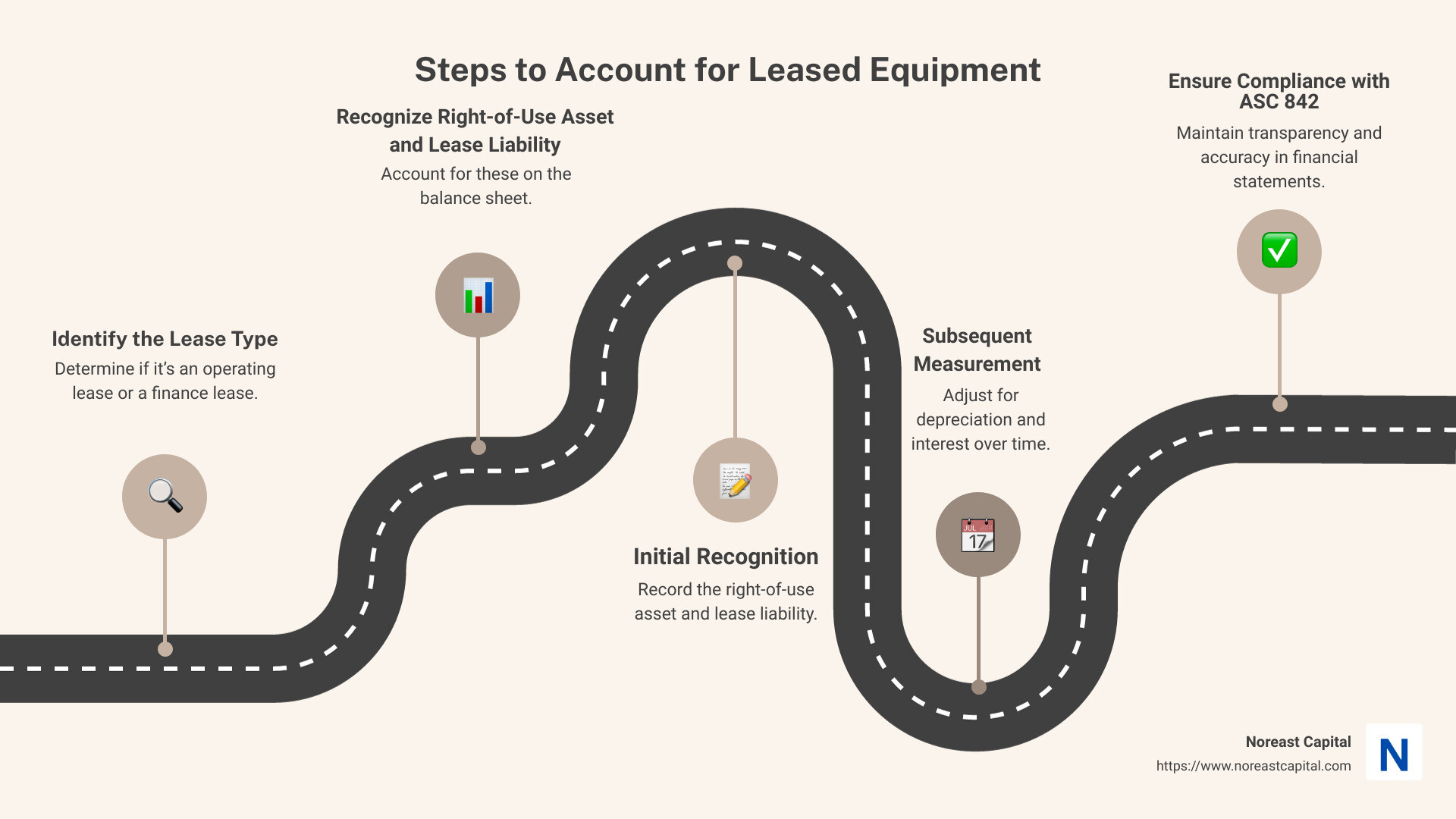
How to account for leased equipment can greatly impact your business’s financial health. Accounting for a leased asset typically involves the following steps:
- Identify the lease type: Determine if it’s an operating lease or a finance lease.
- Recognize right-of-use asset and lease liability: Account for these on the balance sheet.
- Initial recognition and subsequent measurement: Record and adjust for depreciation and interest over time.
ASC 842 is a game-changer in how leases are handled on financial statements. This new standard requires lessees to recognize almost all leases on the balance sheet, reflecting both a right-of-use asset and a lease liability. This shift aims to provide more transparency and comparability in financial reporting.
Why It Matters
Understanding how to account for leased equipment is crucial for maintaining accurate financial statements. It affects key financial ratios and can influence decisions by investors and creditors. Proper lease accounting ensures compliance with ASC 842, helping your business stay on the right side of financial regulations.
I’m Vincent Cerniglia, with a wealth of experience in equipment leasing and finance through Noreast Capital. Over my career, I’ve helped countless businesses steer the complexities of how to account for leased equipment. Now, let’s dive into the specifics.
Understanding Lease Types
When it comes to leasing equipment, understanding the different types of leases is crucial. The two primary types are operating leases and finance leases. Both have distinct characteristics and accounting requirements under ASC 842. Let’s break them down.
Operating Lease
An operating lease is similar to renting. The lessee uses the asset but does not own it. Ownership remains with the lessor. This type of lease is ideal for assets that may become obsolete quickly, such as technology or specialized equipment.
Balance Sheet
Under ASC 842, operating leases must be recorded on the balance sheet. This means the lessee will recognize a right-of-use asset and a lease liability. This change aims to provide a more accurate picture of a company’s financial obligations.
Income Statement
The lease payments for an operating lease are recorded as operating expenses. These payments are typically spread evenly over the lease term, making it easier to predict and manage costs.
Finance Lease
A finance lease, previously known as a capital lease, involves the transfer of ownership risks and rewards to the lessee. Essentially, the lessee is treated as the owner of the asset for accounting purposes.
Criteria
To classify a lease as a finance lease under ASC 842, one or more of the following criteria must be met:
- Ownership of the asset transfers to the lessee by the end of the lease term.
- The lease includes a purchase option that the lessee is reasonably certain to exercise.
- The lease term covers the majority of the asset’s economic life.
- The present value of lease payments equals or exceeds substantially all of the asset’s fair value.
- The asset is so specialized that it has no alternative use to the lessor at the end of the lease term.
Balance Sheet
Like operating leases, finance leases are recorded on the balance sheet. The lessee recognizes a right-of-use asset and a lease liability. However, because the lessee is considered the asset’s owner, the asset is also subject to depreciation.
Income Statement
For finance leases, the lessee must account for both interest expense on the lease liability and depreciation expense on the right-of-use asset. This typically results in higher expenses at the beginning of the lease term, which gradually decrease over time.

Understanding these differences is key to mastering how to account for leased equipment. Whether you choose an operating lease for flexibility or a finance lease for ownership benefits, each has its unique impact on your financial statements.
Next, we will dive into the specifics of initial recognition under ASC 842 and how to properly record these leases in your books.
How to Account for Leased Equipment
Initial Recognition
When you first sign a lease for equipment, you need to recognize both a right-of-use asset and a lease liability on your balance sheet. This is a requirement under ASC 842.
Right-of-Use Asset: This is the value of the equipment you have the right to use during the lease term.
Lease Liability: This represents the obligation to make lease payments in the future.
Journal Entry:
When you start the lease, you will make the following journal entry:
Dr. Right-of-Use Asset
 Cr. Lease Liability
The amounts for both entries will be the present value of the lease payments you are obligated to make over the lease term.
Subsequent Measurement
After the initial recognition, you need to measure the right-of-use asset and lease liability over time. This involves recording depreciation, interest expense, and lease payments.
Depreciation: The right-of-use asset is depreciated over the lease term. This is similar to how you would depreciate owned equipment.
Interest Expense: The lease liability incurs interest, which you need to record. This is based on the discount rate used to calculate the present value of the lease payments.
Lease Payments: Each lease payment you make reduces the lease liability. Part of each payment goes towards interest expense and part towards reducing the principal amount of the lease liability.
Journal Entries:
Here are the typical journal entries you will make during the lease term:
Depreciation Entry:
Dr. Depreciation Expense
 Cr. Accumulated Depreciation - Right-of-Use Asset
Interest and Lease Payment Entry:
Dr. Interest Expense
 Dr. Lease Liability
 Cr. Cash
The interest expense is calculated on the remaining lease liability balance. The lease liability reduction is the remaining portion of the lease payment after accounting for interest.
By following these steps, you ensure that your financial statements accurately reflect the costs and obligations associated with your leased equipment. This makes your balance sheet a more realistic representation of your company’s financial health.
Next, we will look at specific journal entries for leased equipment to make this process even clearer.
Journal Entries for Leased Equipment
Accurately recording leased equipment in your books is crucial. It ensures that your financial statements reflect the true costs and obligations of your business. Let’s break down the journal entries for leased equipment into three parts: Recording a New Lease, Lease Payments, and Amortization and Interest.
Recording a New Lease
When you first enter into a lease, you need to recognize the right-of-use asset and the lease liability on your balance sheet. Here’s how you do it:
- Calculate the Present Value of Lease Payments: Determine the present value of all future lease payments using the discount rate (usually the lessee’s incremental borrowing rate).
- Initial Journal Entry: Record the right-of-use asset and lease liability.
Example Journal Entry:
Dr. Right-of-Use Asset  $100,000
 Cr. Lease Liability    $100,000
This entry records the asset you have the right to use and the liability you owe for future lease payments.
Lease Payments
Each lease payment you make will reduce your lease liability and include an interest expense portion. Here’s how to account for it:
- Interest Expense Calculation: Calculate the interest expense on the remaining lease liability balance.
- Reduce Lease Liability: Subtract the interest expense from the total lease payment to find the lease liability reduction.
Example Journal Entry:
Dr. Lease Liability      $90,000
 Dr. Interest Expense     $10,000
 Cr. Cash              $100,000
In this example, you pay $100,000, where $10,000 is interest, and $90,000 reduces the lease liability.
Amortization and Interest
Over the lease term, you need to amortize the right-of-use asset and recognize interest expenses on the lease liability. Here’s how to do it:
- Amortization of Right-of-Use Asset: Spread the cost of the asset over its useful life.
- Interest Expense: Continue to calculate and record interest on the remaining lease liability.
Example Journal Entry for Amortization:
Dr. Depreciation Expense  $93,798
 Cr. Right-of-Use Asset $93,798
This entry spreads the cost of the right-of-use asset over its useful life.
Example Journal Entry for Interest:
Dr. Interest Expense      $9,729
 Cr. Lease Liability    $9,729
This entry records the interest expense on the remaining lease liability.
By following these steps, you ensure that your books accurately reflect the costs and obligations associated with your leased equipment. This makes your balance sheet a more realistic representation of your company’s financial health.
Next, we will explore the challenges and opportunities with ASC 842, including data collection and lease management.
Challenges and Opportunities with ASC 842
Data Collection
ASC 842 brings new challenges and opportunities in how to account for leased equipment. One major challenge is data collection. Accurate data is crucial for compliance and financial reporting.
Key Data Points:
– Lease Term: The duration of the lease, including any options to extend or terminate.
– Lease Payment: Fixed and variable payments over the lease term.
– Discount Rate: The rate used to calculate the present value of lease payments.
Collecting this data can be daunting, especially for companies with many leases. However, having accurate data ensures compliance and improves financial transparency.
Lease Management
Managing leases effectively is another critical aspect. With ASC 842, companies must track and report leases on their balance sheets. This requires robust lease management practices.
Software Solutions: Investing in specialized lease management software can streamline data collection, compliance, and reporting. These tools can automate calculations, generate reports, and ensure that all leases are accounted for correctly.
Compliance: Regular audits and reviews can help maintain compliance. Keeping up-to-date with any changes in accounting standards is also crucial.
Financial Reporting
ASC 842 significantly impacts financial reporting. Leases must now be reported as right-of-use assets and lease liabilities on the balance sheet. This change aims to provide a more accurate picture of a company’s financial obligations.
Key Reporting Elements:
– Right-of-Use Asset: Represents the lessee’s right to use the leased asset.
– Lease Liability: Represents the obligation to make lease payments.
Accurate financial reporting under ASC 842 can improve transparency and investor confidence.
Opportunities
While ASC 842 presents challenges, it also offers opportunities for improvement. Improved data collection and lease management can lead to better financial planning and decision-making.
Improved Transparency: More accurate financial statements provide a clearer picture of a company’s financial health.
Better Decision-Making: Access to detailed lease data can help companies make informed decisions about their leasing strategies.
By addressing the challenges and leveraging the opportunities, companies can steer ASC 842 successfully.
Next, we will address some frequently asked questions about how to account for leased equipment.
Frequently Asked Questions about How to Account for Leased Equipment
What is needed to record lease liability?
To record lease liability, you need three key pieces of information:
1. Lease Term: This is the non-cancellable period of the lease, plus any periods covered by an option to extend if the lessee is reasonably certain to exercise that option.
2. Lease Payments: These include fixed payments, variable lease payments that depend on an index or rate, and amounts expected to be payable under residual value guarantees. Also, include the exercise price of a purchase option if the lessee is reasonably certain to exercise that option.
3. Discount Rate: The rate implicit in the lease if it can be readily determined. If not, use the lessee’s incremental borrowing rate, which is the rate the lessee would have to pay to borrow the funds necessary to obtain an asset of similar value in a similar economic environment.
How do you calculate the right-of-use asset?
Calculating the right-of-use asset involves several components:
Initial Direct Costs: These are costs that are directly attributable to negotiating and arranging the lease, such as commissions and legal fees.
Lease Incentives: Any payments made by the lessor to incentivize the lessee to enter into the lease should be deducted from the right-of-use asset.
Prepayments: Any lease payments made by the lessee at or before the commencement date should be included in the right-of-use asset.
Example Calculation:
If a company enters into a lease with annual payments of $100,000, incurs $5,000 in initial direct costs, receives $10,000 in lease incentives, and makes a $20,000 prepayment, the right-of-use asset is calculated as follows:
- Lease Liability: Present value of $100,000 annual payments
- Add Initial Direct Costs: $5,000
- Subtract Lease Incentives: $10,000
- Add Prepayments: $20,000
This gives you the initial measurement of the right-of-use asset.
How do you classify a lease under ASC 842?
Under ASC 842, leases are classified into two categories:
Finance Lease: This type of lease transfers substantially all the risks and rewards of ownership to the lessee. A lease is classified as a finance lease if it meets any one of the following criteria:
– Ownership transfers to the lessee by the end of the lease term.
– The lease contains a bargain purchase option.
– The lease term is for the major part of the remaining economic life of the asset.
– The present value of lease payments amounts to substantially all of the fair value of the leased asset.
– The asset is so specialized that it has no alternative use to the lessor at the end of the lease term.
Operating Lease: If none of the finance lease criteria are met, the lease is classified as an operating lease. In an operating lease, the ownership remains with the lessor, and the lessee only has the right to use the asset.
Understanding these criteria helps in correctly classifying and accounting for leases, ensuring compliance with ASC 842.
By addressing these frequently asked questions, we aim to clarify the complexities of how to account for leased equipment. Understanding lease liability, right-of-use asset calculations, and lease classification under ASC 842 can help you steer the new standards with confidence.
Conclusion
Navigating the complexities of how to account for leased equipment doesn’t have to be daunting. At Noreast Capital, we specialize in providing custom equipment leasing solutions that help businesses like yours stay compliant and financially agile.
Equipment Leasing
Leasing equipment allows you to use the latest technology without the hefty upfront costs. This not only improves your cash flow but also helps you hedge against obsolescence. As we’ve discussed, a properly structured lease can offer faster write-offs, letting you reinvest those savings back into your business.
Financial Solutions
Our financial solutions are designed to be flexible and practical. We understand that every business has unique needs, and our goal is to provide options that make the most sense for your situation. Whether you need office equipment, medical devices, or catering tools, we have leasing plans that can help you get what you need without tying up your capital.
Compliance
Staying compliant with accounting standards like ASC 842 is crucial for accurate financial reporting. Our leasing solutions are structured to meet these standards, ensuring that your financial statements reflect the true nature of your lease obligations. This not only helps in maintaining transparency but also improves your credibility with stakeholders.
In summary, mastering the books when it comes to leased equipment is achievable with the right knowledge and support. Noreast Capital is here to provide you with the tools and expertise you need to make informed decisions.
Ready to explore your leasing options? Learn more about our office equipment financing solutions and take the next step towards financial flexibility and compliance.