

How to calculate lease payment for car is a common question among those interested in the flexibility and financial benefits that car leasing can offer. If you want to quickly understand this process, here are the essential steps:
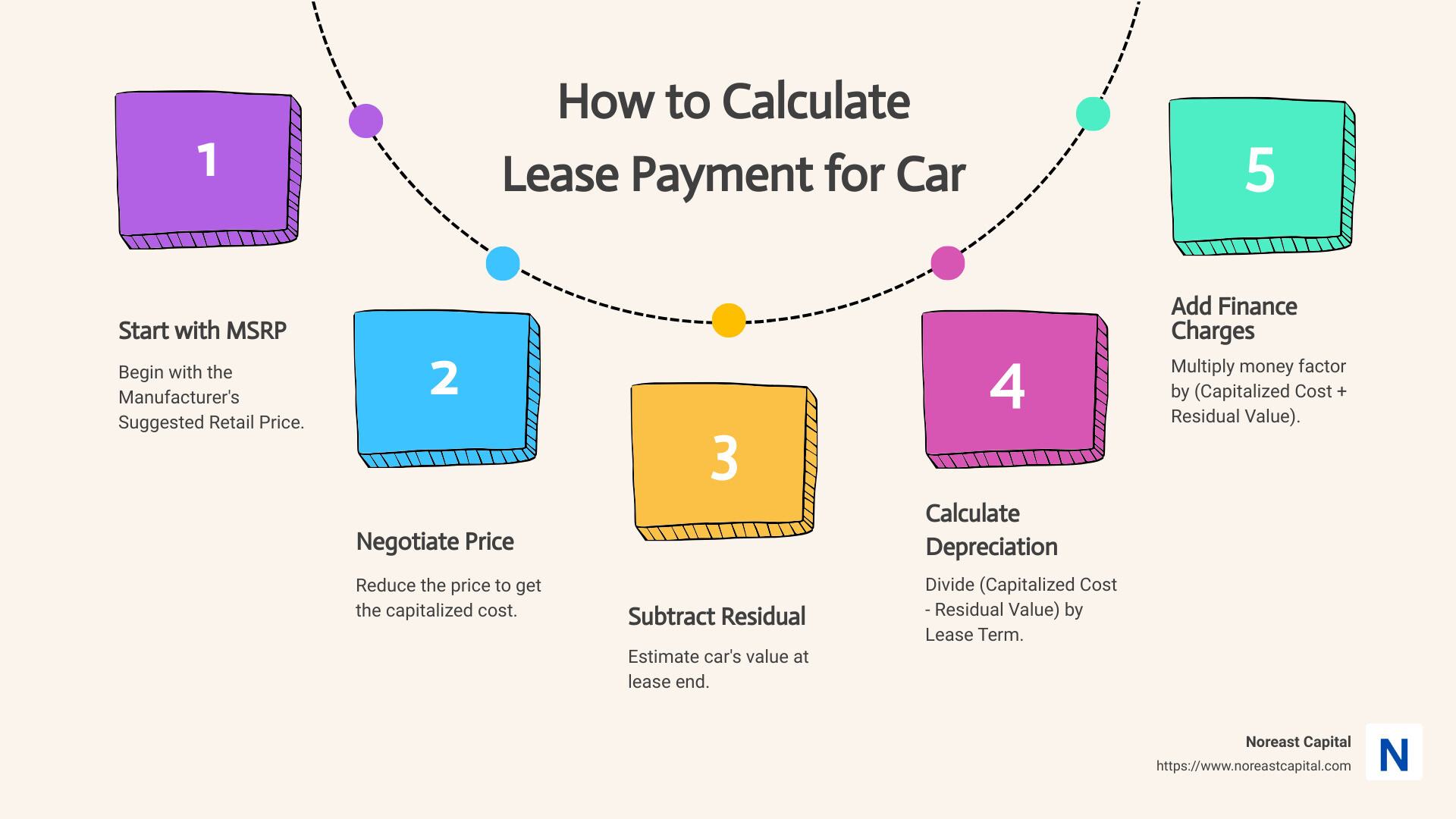
- Start with the car’s MSRP (Manufacturer’s Suggested Retail Price).
- Negotiate the sales price to a lower amount, known as the capitalized cost.
- Subtract the residual value, the estimated value of the car at the end of the lease.
- Calculate the monthly depreciation: (Capitalized Cost – Residual Value) / Lease Term.
- Determine the money factor (interest rate), and multiply it by the sum of the Capitalized Cost and Residual Value to get the monthly finance charge.
- Add the monthly depreciation and finance charge to find the total before tax.
- Include sales tax to get the total monthly lease payment.
Leasing comes with advantages like avoiding high upfront costs and allowing access to newer models, but it’s crucial to understand the financial elements involved.
Leasing a car provides the perfect balance for business owners seeking to maintain cash flow while accessing necessary vehicles. As Vincent Cerniglia of Noreast Capital, I’ve spent years refining the expertise needed to break down the complexities of how to calculate lease payment for car easily for businesses. This knowledge ensures you can make informed decisions custom to your financial planning and leasing needs.
Understanding Car Lease Payments
When leasing a car, understanding the key components of lease payments is crucial. Let’s break down the three main factors: depreciation, residual value, and money factor.
Depreciation
Depreciation is the reduction in a car’s value over time. In a lease, you’re essentially paying for the car’s depreciation during the lease term. To calculate this, subtract the residual value from the capitalized cost (negotiated price). This gives you the total depreciation amount, which is then divided by the number of months in the lease to get the monthly depreciation fee.
Residual Value
The residual value is the estimated worth of the car at the end of the lease. It’s a crucial number because it affects both your monthly payments and the buyout price if you decide to purchase the car at the end of the lease. Higher residual values mean lower monthly payments, as you’re paying for less depreciation.

Money Factor
The money factor is the interest rate you pay on the lease. It’s a small decimal number that represents the finance charge on your lease. To get the monthly finance charge, multiply the money factor by the sum of the capitalized cost and residual value.
Here’s a quick tip: To convert the money factor to an annual percentage rate (APR), multiply it by 2,400. This can help you compare lease offers to traditional car loans.
Understanding these elements will help you grasp how lease payments are structured and enable you to make informed decisions. Knowing how to calculate these factors can lead to better financial planning and potentially save you money over the lease term.
How to Calculate Lease Payment for Car
Calculating a car lease payment can feel like solving a puzzle, but breaking it down into simple steps can make it much easier. Let’s walk through a step-by-step calculation and explore the factors affecting lease payments.
Step-by-Step Calculation
Capitalized Cost: This is the starting point for your lease. It’s essentially the negotiated price of the car, also known as the adjusted capitalized cost. This includes any fees and subtracts any down payments or trade-in credits.
Monthly Depreciation: Once you have the capitalized cost, subtract the residual value (the car’s value at the end of the lease) to find the total depreciation. Divide this by the number of months in the lease to find the monthly depreciation cost.
Monthly Rent Charge: The monthly rent charge is the cost of financing the car. Calculate this by multiplying the sum of the capitalized cost and the residual value by the money factor.
MSRP: The Manufacturer’s Suggested Retail Price (MSRP) is the price the manufacturer recommends. It’s important because it helps determine the residual value of the car.
Lease Term: This is the duration of your lease, usually expressed in months. Common lease terms are 24, 36, or 48 months.
Factors Affecting Lease Payments
Mileage Limits: Most leases come with a mileage cap, such as 10,000 to 15,000 miles per year. Exceeding these limits can result in costly penalties, so it’s important to choose a mileage limit that matches your driving habits.
Wear and Tear: Leases often have standards for acceptable wear and tear. If the car is returned in worse condition than expected, you might face additional charges.
Maintenance: While many leases cover routine maintenance, it’s wise to check what’s included. Keeping up with maintenance can help avoid charges for excessive wear and tear.
By understanding these elements, you can confidently calculate your lease payment and make informed decisions. Knowing how each factor affects the payment can also help you negotiate better terms and avoid surprises.
Tips for Negotiating a Better Lease
Negotiating a car lease can save you a lot of money and make the process smoother. Here are some key strategies to help you get the best deal:
Negotiation Strategies
Research and Prepare: Before heading to the dealership, know the car’s MSRP, the residual value, and the money factor. This information will help you understand the lease terms and identify areas for negotiation.
Negotiate the Capitalized Cost: Treat the lease negotiation like a car purchase. Focus on lowering the capitalized cost. This is the car’s price before any fees are added or credits are subtracted. The lower this cost, the lower your monthly payments.
Understand the Money Factor: Think of the money factor as the lease’s interest rate. It’s expressed as a small decimal, and even a slight reduction can save you money over the lease term. If you have good credit, leverage it to negotiate a lower money factor.
Trade-In Value
Simultaneous Offers: If you plan to trade in your old car, get a quote for both the trade-in value and the new lease simultaneously. This prevents the dealer from offering a low sale price on the vehicle and compensating with a low trade-in value.
Separate Negotiations: Consider negotiating the trade-in and the lease separately. This can help ensure you’re getting the best deal on both fronts.
Special Offers
Seasonal Promotions: Dealerships often have special offers, especially when they need to clear out inventory for new models. September is a common time for such promotions. Use these to your advantage.
Loyalty Programs and Incentives: Some manufacturers offer loyalty incentives for returning customers or special deals for new customers. Always ask if there are current promotions you qualify for.
End-of-Month Deals: Dealers are often more willing to negotiate at the end of the month to hit sales targets. Timing your negotiations during this period can lead to better offers.
By implementing these strategies, you can negotiate a lease that fits your budget and needs. The more informed and prepared you are, the better your chances of driving away with a great deal.
Frequently Asked Questions about Lease Payments
What is the 1% rule in car leasing?
The 1% rule is a quick way to evaluate whether a car lease is a good deal. It suggests that your monthly lease payment should be about 1% of the car’s MSRP (Manufacturer’s Suggested Retail Price). For example, if a car has an MSRP of $35,000, then a monthly payment of $350 would align with the 1% rule. This rule doesn’t account for additional costs like taxes or fees, but it’s a useful starting point to assess lease offers.
How do you calculate the payoff on a car lease?
Calculating the payoff on a car lease involves understanding the buyout amount, which is essentially what you would pay to own the car outright before the lease ends. Here’s how to calculate it:
Residual Value: This is the car’s estimated value at the end of the lease. You’ll find it in your lease contract.
Remaining Payments: Add up the total of all remaining monthly payments.
Fees and Taxes: Include any additional fees or taxes required to complete the buyout.
The payoff amount is typically the sum of the residual value and any remaining payments, plus any applicable fees. If you’re considering a buyout, compare this amount to the car’s current market value to ensure it’s a good financial decision.
Is leasing a car worth it?
Deciding if leasing a car is worth it depends on your personal circumstances and preferences. Here are some factors to consider:
Equity: Leasing a car means you don’t build equity as you would with a purchase. At the end of the lease, you return the car with no ownership.
Mileage Overages: Leases often have mileage limits, typically around 10,000 to 15,000 miles per year. Exceeding these limits can result in additional charges.
Financial Status: Leasing can be beneficial if you prefer lower monthly payments and like driving a new car every few years. However, it may not be the best choice if you aim for long-term ownership and financial savings.
Leasing offers flexibility and lower upfront costs, but weigh these benefits against potential drawbacks, such as mileage restrictions and lack of ownership. Consider your driving habits, financial goals, and lifestyle needs when deciding if leasing is right for you.
Conclusion
Navigating car leasing can be complex, but understanding how to calculate lease payments can provide clarity and confidence. At Noreast Capital, we specialize in equipment leasing solutions that align with your business goals, ensuring you maintain cash flow management without the burden of ownership.
Leasing a car, much like the equipment leasing we offer, allows you to use high-value assets while preserving capital for other business needs. This flexibility can be crucial for businesses looking to expand or manage their resources effectively.
By mastering the art of calculating lease payments, you can make informed decisions that benefit your financial health. Whether it’s understanding depreciation, residual values, or money factors, having a clear grasp of these concepts empowers you to negotiate better terms and avoid unnecessary costs.
For more insights on how to calculate lease payments and explore our leasing solutions, visit our Noreast Capital service page. Here, you’ll find resources custom to help you make the most of your leasing experience, ensuring your business thrives with the right equipment at the right time.
Accept the benefits of leasing with us, and let Noreast Capital be your partner in achieving financial success and operational efficiency.