

Open uping the Benefits of Leasing: A Vital Financial Strategy
How to calculate lease payment is a question many business owners face when trying to manage capital effectively. Here’s a quick step-by-step guide to simplify the process:
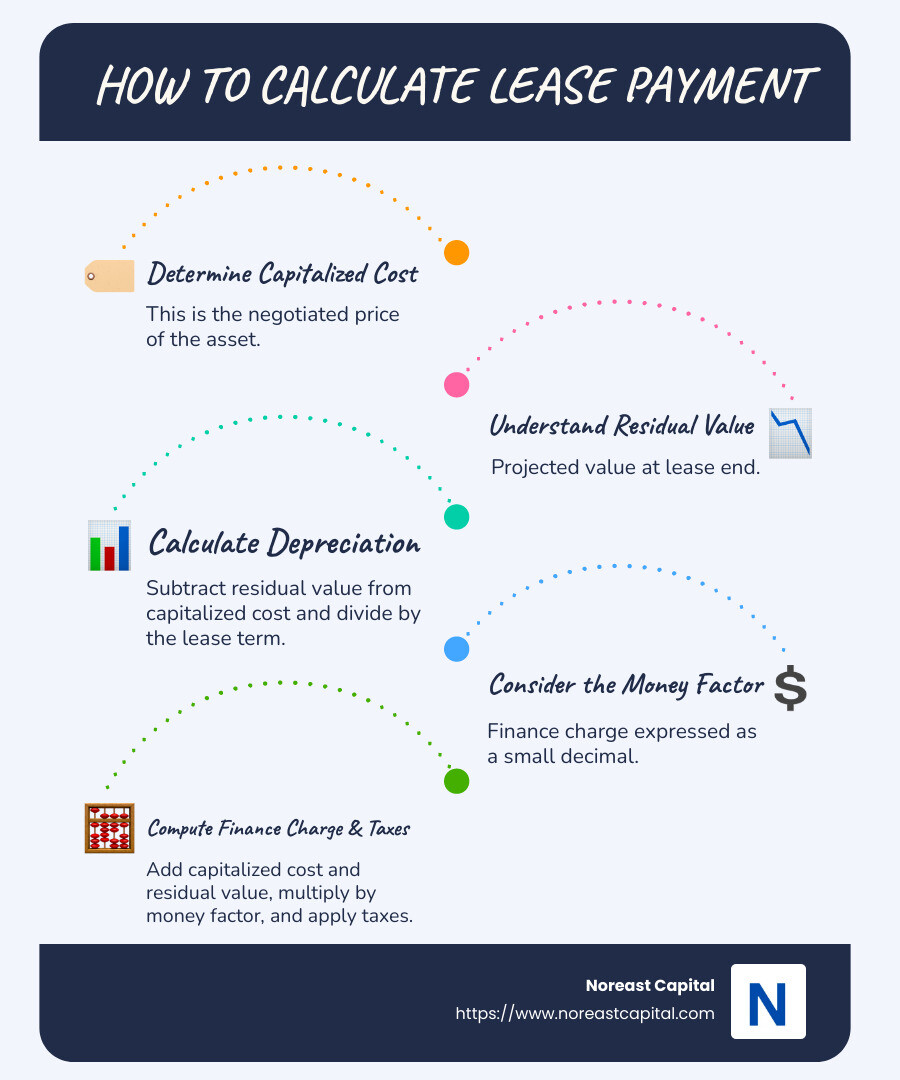
- Determine the Capitalized Cost: This is the negotiated price of the equipment or vehicle.
- Understand the Residual Value: This is the projected value of the asset at the end of the lease.
- Calculate the Depreciation: Subtract the residual value from the capitalized cost and divide by the lease term.
- Consider the Money Factor: This is the finance charge expressed as a small decimal.
- Compute the Finance Charge: Add the capitalized cost and residual value, then multiply by the money factor.
- Include Applicable Taxes: Apply your local sales tax rate if relevant.
By following these steps, you’ll grasp the essentials to calculate lease costs and understand what factors affect your payments. Leasing offers lower upfront costs, access to the latest technology, and flexibility, aligning perfectly with strategies to maintain cash flow and preserve capital.
I’m Vincent Cerniglia from Noreast Capital. With decades of experience in equipment financing and a focus on how to calculate lease payment for businesses, I am here to guide you through leasing’s potential to optimize your financial strategy. Let’s explore the key elements that make leasing a smart choice for managing business growth.
Handy how to calculate lease payment terms:
– how to calculate leasing installment
– how to calculate payoff amount on car lease
Understanding Lease Components
When diving into how to calculate lease payment, get familiar with the key elements that form any lease agreement. Let’s break down these components: MSRP, Capitalized Cost, Residual Value, Money Factor, and Lease Term. Understanding each of these will give you a clearer picture of what you’re paying each month.
MSRP (Manufacturer’s Suggested Retail Price)
MSRP is the price the manufacturer suggests for the vehicle or equipment. It’s the starting point for negotiations and helps determine the lease’s residual value. Think of it as the “sticker price” you see when you first look at a vehicle.
Capitalized Cost
The Capitalized Cost is what you and the dealer agree upon after negotiations. It includes any discounts or rebates that reduce the cost. This is the actual price you’ll use to calculate your lease payments. A lower capitalized cost means lower monthly payments.
Residual Value
Residual Value is an estimate of the asset’s worth at the end of the lease term. It’s crucial because it affects how much you pay each month. A higher residual value means the asset has depreciated less, which generally leads to lower payments. For example, if a car’s MSRP is $30,000 and its residual value is 50%, its value at lease end would be $15,000.
Money Factor
The Money Factor is like the interest rate on a loan. It’s a small decimal that represents the finance charges on the lease. To convert it to an approximate annual interest rate, multiply by 2,400. For instance, a money factor of 0.00125 is roughly equal to a 3% interest rate.
Lease Term
The Lease Term is how long the lease lasts, usually expressed in months (like 36 or 48 months). It influences your monthly payment. Generally, shorter lease terms mean higher payments, but less depreciation over time.
By understanding these components, you can better anticipate your lease payments. For instance, if you have a car with an MSRP of $30,000, a capitalized cost of $28,000, a residual value of 50%, a money factor of 0.00125, and a 36-month lease term, these figures will guide your calculations. You’ll use them to find depreciation costs, finance charges, and ultimately, your monthly lease payment.

Equipped with this knowledge, you’re ready to explore the next steps in calculating your lease payment. Let’s move on to figuring out depreciation, finance charges, and tax rates.
How to Calculate Lease Payment
When you break down how to calculate lease payment, you need to focus on three main components: depreciation, finance charge, and tax rate. These elements will determine your total monthly lease cost.
Depreciation
Depreciation is the decrease in value of the vehicle over the lease term. To find the monthly depreciation cost, subtract the residual value from the capitalized cost, then divide by the number of months in the lease term.
Example: If your car’s capitalized cost is $28,000 and the residual value is $15,000 over a 36-month lease, the monthly depreciation cost would be:
[
\text{Monthly Depreciation Cost} = \frac{\text{Capitalized Cost} – \text{Residual Value}}{\text{Lease Term}} = \frac{28,000 – 15,000}{36} = 361.11
]
This means you’ll pay $361.11 each month just for the car’s depreciation.
Finance Charge
The finance charge compensates the lessor for the financing provided. Calculate it by adding the capitalized cost and the residual value, then multiplying by the money factor.
Example: With a capitalized cost of $28,000, a residual value of $15,000, and a money factor of 0.00125:
[
\text{Finance Charge} = (\text{Capitalized Cost} + \text{Residual Value}) \times \text{Money Factor} = (28,000 + 15,000) \times 0.00125 = 53.75
]
So, the finance charge adds $53.75 to your monthly payment.
Tax Rate
Sales tax can vary by location and leasing terms. To include it, multiply your base payment (sum of depreciation and finance charge) by your local tax rate.
Example: If your base payment is $414.86 ($361.11 + $53.75) and your sales tax rate is 8%:
[
\text{Monthly Tax} = \text{Base Payment} \times \text{Tax Rate} = 414.86 \times 0.08 = 33.19
]
Add this tax to your base payment to get the total monthly lease payment.
Total Monthly Lease Payment
Combine these figures to find your total monthly lease payment:
[
\text{Total Monthly Lease Payment} = \text{Base Payment} + \text{Monthly Tax} = 414.86 + 33.19 = 448.05
]
In this example, you would pay approximately $448.05 each month for the lease.
Understanding these calculations helps you make informed decisions and anticipate your monthly expenses. Next, we’ll dig into estimating your overall monthly lease payments, including other potential costs.
Estimating Monthly Lease Payments
Once you’ve calculated the depreciation and finance charge, it’s time to estimate your monthly lease payment. This involves adding sales tax and considering any additional fees that may apply.
Base Payment
Your base payment is the sum of the monthly depreciation cost and the monthly finance charge. This is the core of your lease payment, covering both the vehicle’s loss in value and the cost of financing.
For instance, if your monthly depreciation cost is $361.11 and the finance charge is $53.75, your base payment would be:
[
\text{Base Payment} = 361.11 + 53.75 = 414.86
]
This means you’ll start with a base payment of $414.86.
Sales Tax
Sales tax varies by state and sometimes even by county. Some areas tax the entire value of the lease, while others only tax the monthly payments. To calculate the monthly tax, multiply your base payment by your local sales tax rate.
Example: With a base payment of $414.86 and a sales tax rate of 8%:
[
\text{Monthly Tax} = 414.86 \times 0.08 = 33.19
]
This tax adds $33.19 to your monthly payment.
Total Monthly Payment
Finally, add the monthly tax to your base payment to determine your total monthly lease payment:
[
\text{Total Monthly Lease Payment} = 414.86 + 33.19 = 448.05
]
In this example, your total monthly lease payment would be $448.05.
By understanding these steps, you can accurately estimate your monthly lease payments and budget accordingly. This clarity helps avoid surprises and ensures you’re financially prepared throughout the lease term. Next, we’ll address some common questions about lease payments to further clarify any uncertainties.
Frequently Asked Questions about Lease Payments
What is the formula to calculate a lease payment?
Calculating a lease payment might seem daunting, but it’s actually straightforward once you break it down. The formula to calculate a lease payment involves a few key components: depreciation, finance charge, and sales tax.
Here’s a simplified formula:
[
\text{Lease Payment} = \left(\frac{\text{Net Capitalized Cost} – \text{Residual Value}}{\text{Lease Term}}\right) + \left((\text{Net Capitalized Cost} + \text{Residual Value}) \times \text{Money Factor}\right) + \text{Sales Tax}
]
Steps to Calculate:
- Depreciation: Subtract the residual value from the net capitalized cost and divide by the lease term.
- Finance Charge: Add the net capitalized cost and residual value, then multiply by the money factor.
- Sales Tax: Multiply the base payment (sum of depreciation and finance charge) by your local sales tax rate.
By following these steps, you can determine your monthly lease payment.
How do you calculate the total lease amount?
To find the total lease amount, you need to consider not just the monthly payments, but also any upfront costs and fees associated with the lease.
Components of Total Lease Amount:
- Total Monthly Payments: Multiply the monthly lease payment by the number of months in the lease term.
- Upfront Costs: Include any down payment, acquisition fees, or other initial charges.
Formula:
[
\text{Total Lease Amount} = (\text{Monthly Lease Payment} \times \text{Lease Term}) + \text{Upfront Costs}
]
Example:
If your monthly lease payment is $448.05 and your lease term is 36 months, with upfront costs of $2,000:
[
\text{Total Lease Amount} = (448.05 \times 36) + 2000 = 16,129.80
]
This means the entire cost over the lease period would be $16,129.80.
How much is a lease payment on a $45,000 car?
Let’s walk through an example to see how much a lease payment might be on a $45,000 car.
Assumptions:
- Capitalized Cost: $43,000 (after negotiations)
- Residual Value: 50% of MSRP ($22,500)
- Money Factor: 0.00125
- Lease Term: 36 months
- Sales Tax: 8%
Calculation:
Depreciation:
[
\frac{43,000 – 22,500}{36} = 569.44
]Finance Charge:
[
(43,000 + 22,500) \times 0.00125 = 82.81
]Base Payment:
[
569.44 + 82.81 = 652.25
]Sales Tax:
[
652.25 \times 0.08 = 52.18
]Total Monthly Payment:
[
652.25 + 52.18 = 704.43
]
In this scenario, the monthly lease payment would be $704.43.
Understanding these calculations ensures you’re well-prepared to discuss lease terms and make informed decisions. Up next, we’ll explore more about the financial benefits of leasing and how it can fit into your financial planning.
Conclusion
Leasing with Noreast Capital offers a strategic advantage for businesses looking to optimize their financial planning. Our leasing solutions allow you to use the latest equipment without the burden of ownership, helping you maintain cash flow and invest in growth opportunities.
Why Choose Leasing?
Leasing provides several benefits, including:
- Lower Upfront Costs: Preserve your capital for other business needs instead of tying it up in equipment purchases.
- Access to Cutting-Edge Technology: Easily upgrade at the end of the lease term, ensuring you always have the latest tools.
- Tax Advantages: Potential deductions, like the Section 179 Deduction, can significantly reduce your tax burden.
Noreast Capital: Your Partner in Success
At Noreast Capital, we understand that every business is unique. That’s why we offer:
- Customizable Solutions: Tailor your lease to fit your specific needs and financial goals.
- Expert Guidance: Benefit from our industry knowledge and experience to make the best leasing decisions.
- Streamlined Process: Our efficient processes ensure you get the equipment you need without unnecessary delays.
Leasing is not just a financial decision; it’s a strategic choice that can drive business efficiency and growth. By partnering with us, you’re not just getting equipment—you’re gaining a partner committed to your success.
Ready to Explore Leasing Options?
Contact us today to discuss how we can help you achieve your business’s equipment financing needs, save money, and stay at the forefront of your industry. Let’s work together to ensure your business thrives, one lease at a time.