

How to calculate payoff amount on car lease is a common question for many who have enjoyed their leased vehicle and are considering making it their own. Calculating this amount involves a few straightforward steps.
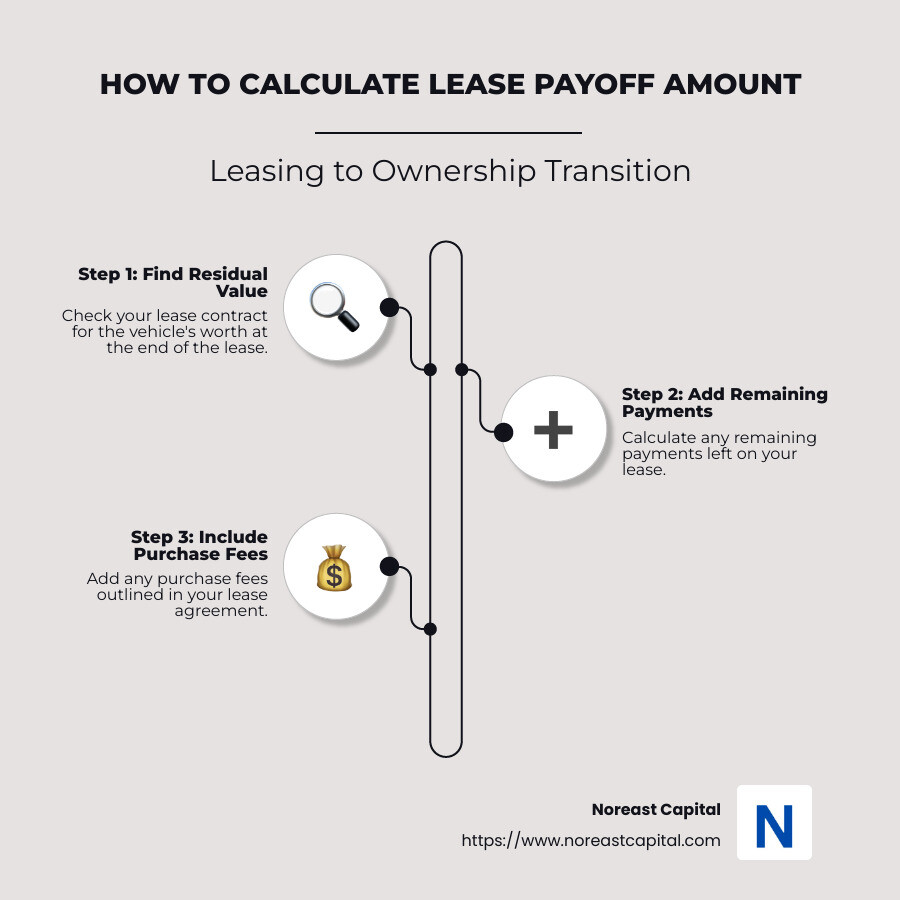
- Locate the residual value in your lease contract. This is an estimate of your vehicle’s worth at lease-end.
- Identify any remaining lease payments you owe.
- Add these figures together, along with any purchase fees, to determine your total payoff amount.
Successfully navigating a lease payoff requires a strategic approach to car ownership and financial planning. It marks a transition from leasing to long-term ownership, impacting both personal or business finances.
I’m Vincent Cerniglia. With experience in equipment financing and leasing, I’ve helped businesses and individuals understand complex financial commitments like lease payoffs. Through Noreast Capital, I focus on making leasing solutions accessible and clear, helping you make confident financial decisions about how to calculate payoff amount on car lease.
Understanding Lease Payoff Amount
When you’re nearing the end of your car lease and considering buying out the vehicle, understanding the lease payoff amount is crucial. This figure represents what you’ll need to pay to own the car outright. Let’s break down the key components that make up this amount.
Payoff Amount
The payoff amount is the total cost to buy your leased vehicle. It includes several elements from your lease agreement. Knowing this amount helps you decide if purchasing the car is a good financial move.
Lease Contract
Your lease contract is your primary resource. It outlines the terms and conditions of your lease, including the residual value and any fees. Always refer back to this document to understand your financial obligations.
Residual Value
The residual value is a critical part of your payoff calculation. It’s the estimated value of the car at the end of the lease, predetermined when you signed the lease contract. This number is fixed and doesn’t change over the lease term.
To calculate your lease payoff amount, add the residual value to any remaining lease payments and possible purchase fees. This gives you a clear picture of what you’ll need to pay to transition from leasing to owning your vehicle.
Understanding these components will help you make informed decisions about your car lease and ownership options.
How to Calculate Payoff Amount on Car Lease
Eager to own your leased car? Calculating the payoff amount is your first step. Here’s a simple guide to help you crunch the numbers.
Step-by-Step Calculation
Check Your Lease Statement: Start by reviewing your monthly lease statement. Look for the buyout or payoff amount. If it’s listed, this figure includes the residual value, remaining payments, and possibly a car purchase fee.
Determine the Residual Value: This is the car’s estimated value at the end of the lease. You’ll find this number in your lease contract. It’s a key part of the payoff amount.
Calculate Remaining Payments: Add up any lease payments left until the end of your contract. This will give you the total remaining payments.
Consider the Car Purchase Fee: Some leases include a purchase option fee. Check your contract for this detail, as it will add to your payoff amount.
Assess Actual Value: Use trusted resources to find the current market value of your car. This helps you know if you’re getting a good deal compared to the residual value.
Add It All Together: Combine the residual value, remaining payments, and any purchase fees. This total is your lease payoff amount.
Tools and Resources
Trusted Car Valuation Tools: Use these to check your car’s actual market value. It helps you compare with the residual value to see if buying the car is a smart move.
Car Payment Calculators: Use these tools to estimate monthly payments if you finance the buyout. It helps you plan your budget and see what you can afford.
By following these steps and using the right resources, you can confidently calculate the payoff amount on your car lease. This will guide you in deciding whether to proceed with the buyout or explore other options.
Factors Affecting Lease Buyout Decision
Deciding whether to buy out your car lease involves several key factors. Understanding these can help you make a financially sound decision.
Early vs. Lease-End Buyouts
Depreciation and Market Value
When considering a lease buyout, it’s important to look at depreciation. Cars lose value over time, which is called depreciation. The market value of your car might be higher or lower than the residual value stated in your lease contract. If the market value is higher, buying the car could be a good deal. But if it’s lower, you might want to reconsider.
Negotiation Leverage
Timing plays a big role in negotiation. A lease-end buyout often gives you more leverage. As the lease nears its end, dealers might offer better deals to avoid taking the car back. They know they might have to sell it at auction for less than the residual value.
In contrast, an early buyout can limit your negotiation power. Dealers know you’re eager to end the lease early, often because of excess wear or mileage. This can give them the upper hand in negotiations.
Early Buyout Considerations
An early buyout might be your only option if you’re close to exceeding mileage limits or if the car has more wear and tear than expected. However, be prepared for less flexibility in terms of price.
Waiting until the lease ends can be beneficial. You can negotiate a better purchase price, especially if the car’s market value is less than the residual value. Dealers might be more willing to lower the price to avoid the hassle of reselling the vehicle.
By understanding these elements, you can better decide between an early or lease-end buyout. This knowledge helps you weigh the pros and cons and choose the best option for your situation.
Frequently Asked Questions about Lease Payoff
How are lease payoffs calculated?
Calculating a lease payoff amount involves a few key elements. The first is the residual value. This is the estimated value of the car at the end of your lease, as stated in your lease contract.
Next, you need to consider the remaining payments. These are the payments you would still owe if you continued leasing until the end of the contract.
Lastly, don’t forget about any car purchase fees. Some leasing companies charge a fee if you decide to buy the car.
To find the total payoff amount, you add the residual value to the remaining payments and any purchase fees. This gives you a clear picture of what it will cost to buy out your lease.
What is a payoff amount at the end of a lease?
The payoff amount at the end of a lease is what you pay to own the car. It includes the residual value and any car purchase fees. If you’ve made all your payments, there are no remaining payments to add.
Dealers may sometimes offer a better deal if they think you’re considering returning the car. This is because selling the car at auction might fetch less than its residual value.
How to calculate the value of my car at the end of my lease?
To calculate the value of your car at lease-end, consider depreciation and the current market value. Depreciation is how much the car’s value has dropped since you started the lease.
You can use tools like Kelley Blue Book to find the car’s current market value. This tool provides an estimate based on the car’s make, model, year, mileage, and condition.
Compare this market value to the residual value in your lease contract. If the market value is higher, buying the car could be a smart move. If it’s lower, you might want to negotiate the buyout price or reconsider purchasing the vehicle.
Understanding these calculations will help you make an informed decision about your lease payoff.
Conclusion
Navigating the path from leasing to ownership can seem daunting, but understanding the lease payoff amount is a crucial step. At Noreast Capital, we simplify this process, offering custom financial solutions that align with your business needs. Whether you’re looking to transition from leasing to owning a vehicle or need equipment leasing for your business, our expertise ensures you maintain cash flow while gaining the assets you need.
Our focus on equipment leasing allows businesses to use essential tools without the burden of ownership. This approach not only saves money but also provides flexibility. By leasing, you can easily upgrade to newer equipment, ensuring your business remains competitive.
For those considering purchasing their leased vehicle, remember to evaluate factors like residual value, remaining payments, and any associated fees. These components are key to calculating the payoff amount accurately. Tools like the Kelley Blue Book can help assess your car’s current market value, guiding your decision-making process.
By partnering with us, you gain access to financial solutions designed to support your growth. We believe in empowering businesses to make informed decisions, ensuring that leasing or buying options align with strategic goals.
Explore how we can assist you with your equipment financing needs by visiting our service page. Let Noreast Capital be your partner in achieving financial success and operational efficiency.