

Understanding 1099 Requirements for Equipment Rentals
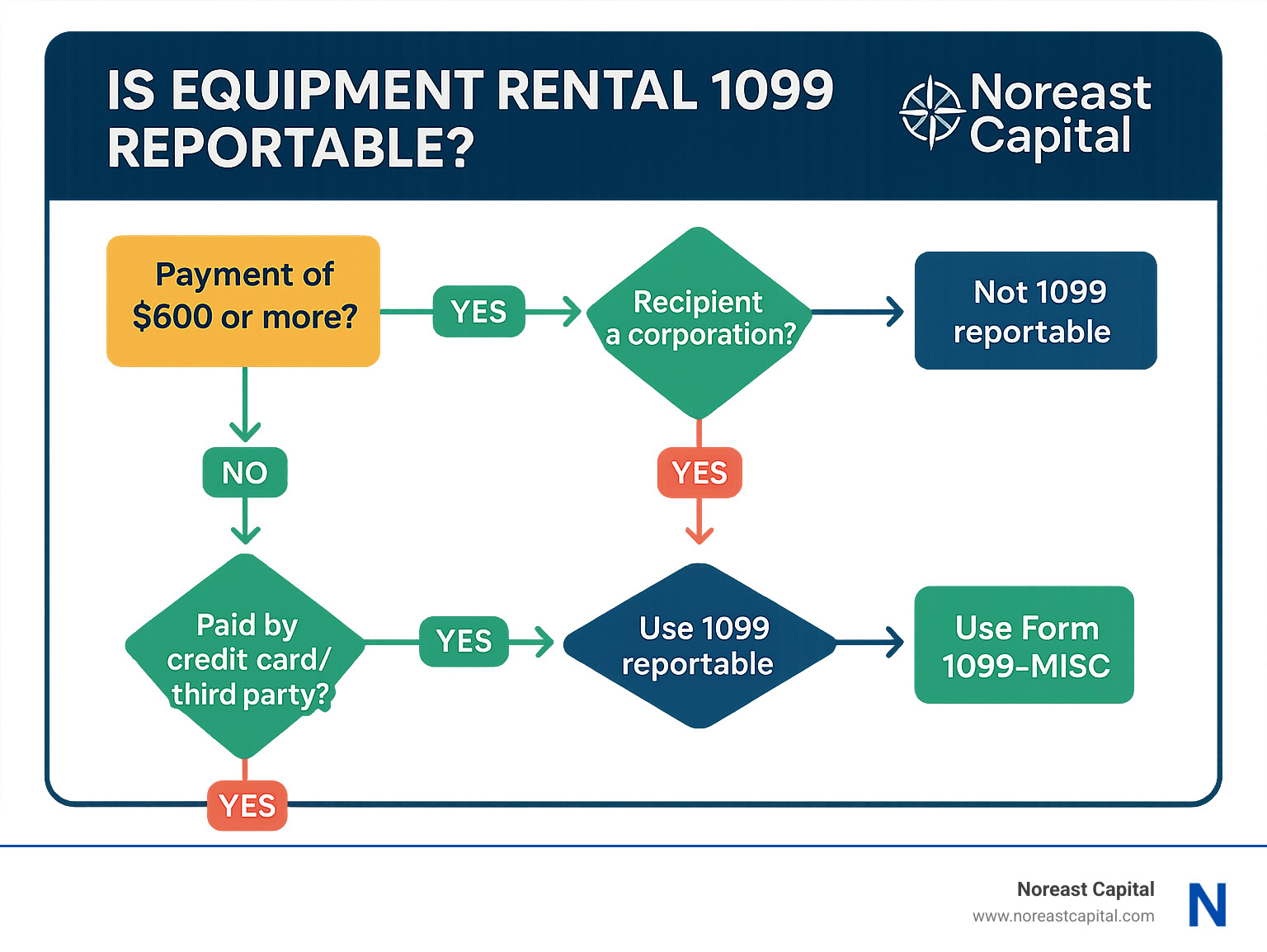
Is equipment rental 1099 reportable? Yes, equipment rental payments are reportable on Form 1099-MISC when:
| Requirement | Details |
|---|---|
| Payment Threshold | $600 or more in a calendar year to a single vendor |
| Form to Use | Form 1099-MISC (not 1099-NEC) |
| Specific Location | Box 1: Rents |
| Filing Deadline | January 31 to recipients; February 28 (paper) or March 31 (electronic) to IRS |
| Exceptions | Payments to corporations, payments via credit card/third-party networks, personal use rentals |
When your business rents equipment—whether it’s heavy machinery, office copiers, or specialized tools—you need to understand your tax reporting obligations. The IRS requires businesses to report rental payments of $600 or more made during the course of trade or business using Form 1099-MISC.
Unlike services which are reported on Form 1099-NEC, equipment rentals fall under “rents” and must be reported in Box 1 of Form 1099-MISC. This distinction is crucial for proper compliance and avoiding penalties that can range from $50 to $280 per form.
Many business owners mistakenly report equipment rentals as nonemployee compensation or overlook reporting altogether, potentially triggering IRS scrutiny and unnecessary complications.
I’m Vincent Cerniglia from Noreast Capital Corporation, where I’ve guided countless businesses through equipment financing decisions and helped them steer the complexities of equipment rental 1099 reportable transactions. My experience as a direct lender in the equipment financing marketplace has given me knowledge of the tax implications businesses face when leasing equipment.
Easy is equipment rental 1099 reportable glossary:
– does equipment rental go on 1099 misc or 1099 nec
– do you 1099 for equipment rental
– issue 1099 for equipment rental
Is Equipment Rental 1099 Reportable? Core Rules at a Glance
When it comes to tax reporting, the IRS classifies equipment rental payments as “rents.” According to IRS guidelines, rent is payment for the use of property, which includes machinery and equipment. This classification is critical because it determines which form and box you’ll use for reporting.
Is equipment rental 1099 reportable? Absolutely. The IRS requires businesses to report equipment rental payments of $600 or more in a calendar year on Form 1099-MISC, specifically in Box 1 designated for “Rents.”
Philip Perkins, a tax professional quoted in our research, notes: “Most people misclassify equipment rental payments under nonemployee compensation, which causes complications with the IRS.” This common mistake can lead to unnecessary scrutiny and potential penalties.
The $600 threshold applies to the aggregate total paid to a single vendor throughout the calendar year. Even if no single payment reaches $600, you must issue a 1099-MISC if the cumulative amount reaches or exceeds this threshold.
Only payments made in the course of your trade or business trigger 1099 reporting requirements. Personal payments are never reportable, regardless of the amount.
Failure to file required 1099 forms can result in significant penalties. These penalties range from $50 per form for forms filed within 30 days of the due date, up to $280 per form for intentional disregard of filing requirements. With these potential costs, it’s far better to comply with reporting requirements than risk penalties.
Annual $600 Threshold in Practice
The $600 threshold for equipment rental 1099 reportable payments is cumulative over the calendar year, not per transaction. Let’s look at how this works in practice:
Example 1: You rent a bulldozer for $250 in March, another for $400 in July, and a third for $100 in November from the same vendor. The total is $750 for the year, exceeding the $600 threshold. You must issue a 1099-MISC reporting $750 in Box 1.
Example 2: Your business makes monthly payments of $55 for equipment rental to a single vendor. Though each payment is well below the threshold, the annual total comes to $660, triggering the 1099-MISC reporting requirement.
This cumulative approach applies regardless of how the payments are structured. Whether you’re making regular monthly lease payments or occasional lump-sum rentals, you need to track the total amounts paid to each vendor throughout the year.
As one business owner shared in a forum discussion: “I was surprised to learn that my small monthly copier rental payments added up to a reportable amount. I had to scramble at year-end to get the vendor’s W-9 information.”
Exceptions in Plain English
Not all equipment rental payments require 1099 reporting. Here are the key exceptions in straightforward terms:
Personal-use rentals: If you rent equipment for personal use rather than business purposes, no 1099 is required. For example, renting a power washer for your home doesn’t trigger reporting requirements.
Credit card or third-party network payments: If you pay for equipment rentals using a credit card, debit card, or third-party payment network (like PayPal), you don’t need to issue a 1099-MISC. The payment processor will issue Form 1099-K for these transactions when applicable thresholds are met.
Payments under $600: If your total payments to a vendor don’t reach $600 in a calendar year, no 1099 is required.
Payments to corporations: Generally, payments to corporations are exempt from 1099-MISC reporting requirements. However, there are exceptions for certain types of corporations, which we’ll cover in a later section.
As the IRS states in their instructions: “Payments by credit card or payment card and third-party network transactions must be reported on Form 1099-K and are not subject to reporting on Form 1099-MISC.”
Forms, Boxes, Thresholds & Exemptions
It’s easy to get tangled up in the paperwork jungle, especially when it comes to choosing the right IRS form for reporting equipment rentals. Let’s keep it simple: for reporting rental payments—like that backhoe or office printer you leased—Form 1099-MISC is your go-to. More specifically, you’ll use Box 1: Rents on this form.
Meanwhile, Form 1099-NEC is for reporting nonemployee compensation—think payments to freelancers or service providers. It’s a common mix-up, but equipment rentals do not go on 1099-NEC. Since 2020, the IRS makes this distinction clear to help everyone avoid misreporting headaches.
Let’s break down the basics:
| Aspect | Form 1099-MISC | Form 1099-NEC |
|---|---|---|
| Used for | Rents, royalties, other income | Nonemployee compensation |
| Equipment rentals go in | Box 1: Rents | Not used for equipment rentals |
| Due to recipients | January 31 | January 31 |
| Due to IRS (paper) | February 28 | January 31 |
| Due to IRS (electronic) | March 31 | January 31 |
| Threshold | $600 for rents | $600 for services |
Here’s a key update for 2024: if you’re filing 10 or more information returns (including any type of 1099), you must e-file. Gone are the days when only big companies had to worry about this; now, even small businesses hit the e-filing mark pretty fast.
Before you make any payments, always get a filled-out Form W-9 from your vendor. This simple step saves headaches later, making sure you have the right legal name, tax classification, and TIN (Taxpayer Identification Number) for your 1099 reporting.
Still wondering about the difference between these forms? Check our detailed guide on does equipment rental go on 1099 misc or 1099 nec.
Is Equipment Rental 1099 Reportable for Purchases vs Rentals?
This is one of the most common questions our team at Noreast Capital hears: Is equipment rental 1099 reportable if you’re actually buying the equipment? Here’s the scoop—purchases of equipment are not reportable on any 1099 form. Buying an asset (like a forklift or computer) isn’t “renting,” so there’s no 1099-MISC or 1099-NEC needed for a straightforward purchase.
But what about add-on services? If you pay someone $800 to install or set up that new equipment, you may need to report that payment on Form 1099-NEC (since it’s a service, not a rental).
And then there’s the tricky case of capital leases. Sometimes, a lease is really a purchase in disguise for accounting and tax reasons. If you’re not sure how your lease is classified, definitely check with your tax pro. The reporting rules can change based on the lease details and your company’s accounting method.
Corporate, Government & Tax-Exempt Payees
Not every equipment rental payment—even those over $600—needs to be reported on a 1099. The biggest exception? Payments to corporations. Most equipment rental vendors are C or S corporations, which means you usually don’t have to send them a 1099-MISC. There are some exceptions though; for example, if you make payments to a corporation for legal or medical services, reporting is still required.
Other exempt payees include government agencies (federal, state, or local) and tax-exempt nonprofits. Payments to these groups are off the hook as far as 1099 reporting goes.
To sort it all out, always collect a completed Form W-9 from your vendors. It will clearly show their tax classification, so you’ll know if you’re off the hook for a 1099 or not. Don’t guess based on a company name—double check their W-9 so you’re covered if the IRS ever comes knocking.
And remember, as simple as this all sounds, it’s easy to slip up. When in doubt, ask for help or check our resources at Noreast Capital. Staying compliant keeps your business safe—and your accountant happy!
Special Situations: Mixed Contracts & Lease Types
Equipment rentals aren’t always as straightforward as renting a bulldozer for a week and calling it a day. Sometimes, you’ll find yourself in what we call “mixed contracts”—situations where your rental comes bundled with additional services or special terms that make the answer to is equipment rental 1099 reportable a little trickier.

Take, for example, renting heavy equipment with an operator. Now you’re dealing with both a rental payment and a payment for services. The IRS wants you to treat these as two separate payments—even if they’re all lumped together on one bill. Equipment rental goes on Form 1099-MISC, Box 1, while the operator’s labor (that’s a service!) goes on Form 1099-NEC, Box 1.
Here’s how it looks in real life: Let’s say you hire a crane and operator for $1,500. The contract spells out $900 for the equipment and $600 for the operator. You’d report $900 on the 1099-MISC and $600 on the 1099-NEC. Nice and tidy!
But what if the invoice doesn’t break it down? No problem—just ask your vendor for an itemized invoice. If they can’t (or won’t) provide one, make a good-faith estimate based on fair market rates. Keep your documentation handy in case you ever have to show how you came up with those numbers.
Other types of rentals—like vehicles, copy machines, coin-operated amusements, or even uniforms—are handled the same way. If you’re just paying to use the equipment, is equipment rental 1099 reportable? Yes, report those payments on 1099-MISC, Box 1, once you hit that $600 annual threshold.
When services and rental fees are bundled together on a single invoice, it’s crucial to split out the amounts for proper reporting. For example, if you get a $2,000 bill for a backhoe with an operator, and you know from market research that the backhoe alone would normally cost $1,200, then you can reasonably allocate $1,200 to equipment rental (reportable on 1099-MISC) and the remaining $800 to operator services (reportable on 1099-NEC). The key here is consistency—once you decide on a method, stick to it throughout the year, and keep notes in your records detailing how you determined your split.
As one seasoned tax pro told us: “If you’re paying for both machine and muscle, report the rental and the service separately. The IRS likes to see clear lines, not blurred ones.”
Don’t forget: If either portion (rental or service) meets its $600 threshold separately, you’ll need to issue the appropriate form for each.
Is Equipment Rental 1099 Reportable When Paid by Credit Card or 3rd Parties?
Now, what about when you pay for equipment rental with a credit card or through a platform like PayPal? In this case, the answer to is equipment rental 1099 reportable changes. When you use a card or third-party payment network, you don’t have to issue a 1099-MISC. These transactions fall under Form 1099-K, which the payment processor handles—not you.
This rule covers all payments that would normally go on a 1099-MISC or 1099-NEC, including equipment rentals. The IRS is clear about this: “Payments made with a credit card or payment card and certain other types of payments, including third-party network transactions, must be reported on Form 1099-K by the payment settlement entity and are not subject to reporting on Form 1099-MISC.”
This also means that if you rent equipment through an online marketplace or facilitator and pay using their system, that platform—not your company—handles any necessary reporting. So, less paperwork for you!
One last note: If you pay merchant fees to the credit card processor or platform, these fees are not reportable on 1099-MISC, either.
In short, if you’re handling mixed contracts or special lease types, always separate services from rents, document your process, and remember how the payment method affects your reporting duties. And if you ever feel stuck, don’t hesitate to check out our in-depth resources or talk to a friendly expert here at Noreast Capital. We’re here to help you stay compliant—and stress-free!
Filing Compliance, Deadlines & Error Handling
Let’s face it – nobody loves paperwork, but staying on top of your 1099 filing requirements is crucial for avoiding those nasty IRS penalties. I’ve worked with hundreds of equipment financing clients who found that a little preparation goes a long way!

The 1099-MISC calendar has three dates you absolutely need to circle:
– January 31 – Get those forms to your equipment rental vendors
– February 28 – Paper filing deadline with the IRS
– March 31 – Electronic filing deadline with the IRS
Here’s a tip that’s saved many of our clients headaches: collect those W-9 forms upfront, before you even cut the first check. Think of it like fastening your seatbelt before driving – a small action that prevents big problems. When vendors drag their feet on providing their tax information, remind them that without a valid TIN, you’re required to withhold 28% of their payments (backup withholding). It’s amazing how quickly those W-9s appear when money is on the line!
“I learned this lesson the hard way,” one of our construction clients told me. “Trying to chase down tax information from 20 different equipment vendors in January while also closing my books was a nightmare I never want to repeat.”
The IRS doesn’t play around when it comes to late or incorrect filings. Penalties start at $50 per form for those filed within 30 days after the deadline, jumping to $110 if you’re more than a month late but file by August 1. Wait any longer, and you’re looking at $270 per form – ouch! And if they determine you intentionally disregarded the requirements? That’ll be $550 or more per form.
Starting in 2024, if you’re filing 10 or more 1099 forms of any type, electronic filing is mandatory through the IRS FIRE system. Many of our clients find that tax software or online filing services make this process much smoother.
For the most current information straight from the source, check the latest research on deadlines from the IRS website.
Step-by-Step 1099 Preparation Checklist
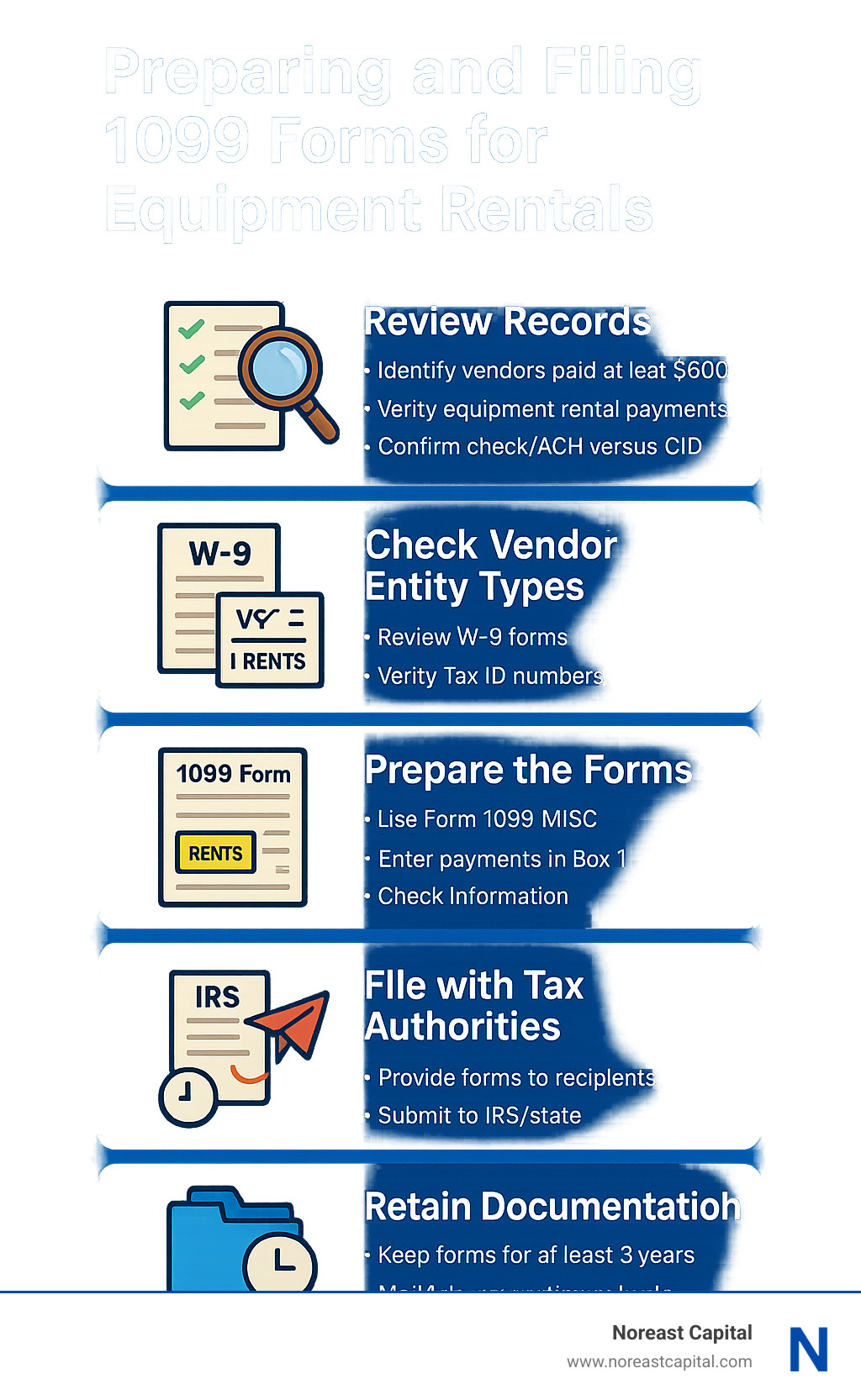
Think of 1099 preparation like cooking a complex meal – following the recipe step by step makes all the difference between success and disaster. Here’s your foolproof recipe for equipment rental 1099 reportable transactions:
First, review your records thoroughly. Pull reports of all vendors you’ve paid $600+ during the year and highlight those equipment rental payments. This is also when you’ll separate payments made by check or ACH (reportable) from those made by credit card or PayPal (not reportable on 1099-MISC).
Next, check each vendor’s entity type using their W-9 forms. Many equipment rental companies are corporations and therefore exempt from 1099 reporting. This step alone often cuts my clients’ 1099 workload in half! If you have access to the IRS TIN Matching system, it’s worth verifying those tax ID numbers to avoid corrections later.
When you’re ready to prepare the forms, be meticulous. Use the current year’s Form 1099-MISC and report equipment rental payments in Box 1: Rents. Triple-check all the information – a single typo in a tax ID number can trigger unnecessary notices.
For filing with tax authorities, remember your deadlines: January 31 for recipient copies, then February 28 (paper) or March 31 (electronic) for the IRS. If you’re filing paper forms, don’t forget Form 1096 as your cover sheet. Many states also require 1099 filings, so check your local requirements.
Finally, retain all documentation for at least 3 years (4 years if you did any backup withholding). This includes copies of the 1099s, supporting invoices, and payment records. As one of our clients who survived an IRS audit told me, “The documentation you keep is as important as the forms you file.”
Correcting a 1099 After Filing
We all make mistakes, and fortunately, the IRS has procedures for fixing them. If you find an error on a 1099 you’ve already provided to a vendor but haven’t yet filed with the IRS, simply prepare a new form with the correct information, write “CORRECTED” at the top, give it to the recipient, and file it by the deadline.
For forms already filed with the IRS, the process is a bit more formal. Complete a new 1099-MISC with the right information and check the “CORRECTED” box at the top. For paper filers, you’ll need to submit this with a new Form 1096. Electronic filers should follow the FIRE system’s specific procedures for corrections.
One common misconception I see is people marking forms as “VOID” when making corrections. As the IRS clearly states: never check the “VOID” box when making corrections. That’s for an entirely different purpose!
“I accidentally transposed two digits in a vendor’s TIN,” a client once told me. “I filed the correction within a week of finding it, and the IRS waived the penalty because I acted quickly and could show it was an honest mistake.”
The timing of your correction matters. For incorrect TINs or payee names, file as soon as possible. For incorrect amounts or other information, try to file within the same calendar year. While penalties may still apply for corrected returns, they’re often reduced if you can show the error wasn’t due to intentional disregard.
At Noreast Capital, we understand these paperwork requirements can be tedious, but they’re an essential part of maintaining your equipment leasing deductions. When you work with us for your equipment financing needs, we’re always happy to provide guidance on these related tax matters – it’s just one more way we help keep your business running smoothly.
Conclusion
Let’s take a breath—1099 reporting for equipment rentals may seem daunting, but you’re more than capable of handling it. Here’s what you truly need to remember, in plain English:
If you’re renting equipment for your business and you pay a vendor $600 or more total in a year, the answer is clear: is equipment rental 1099 reportable? Yes, it is. Those payments belong in Box 1 (“Rents”) on Form 1099-MISC, not on 1099-NEC. This might seem like a small detail, but getting it right helps you avoid headaches (and IRS penalties).
Keep an eye on the cumulative total you pay each vendor—not just the size of each check. Even small monthly payments can add up faster than a bulldozer in a hurry.
But there are a few welcome exceptions: if you rent from a corporation, pay by credit card, use a third-party network, or are renting for personal (not business) use, you’re generally off the hook for filing a 1099-MISC. Still, always get a W-9 and double-check the vendor’s status—don’t just trust the business card!
For mixed contracts—say, renting both equipment and an operator—be sure to prorate the payment between “rent” (1099-MISC) and “service” (1099-NEC). A little extra effort here saves a lot of confusion later.
Timing matters. Send forms to vendors by January 31 and file with the IRS soon after (February 28 for paper, March 31 for electronic). Hold onto your records and copies of 1099s for at least 3–4 years in case the IRS ever comes knocking.
Getting 1099s right isn’t just about dodging penalties. It also helps protect your business’s valid deductions for equipment rental expenses—because nothing ruins tax season faster than a disallowed deduction.
At Noreast Capital, we know that equipment leasing is about more than just machines. It’s about setting your business up for success, saving you money, and keeping your cash flow healthy. We’re here to help you steer the tricky bits—like whether equipment rental is 1099 reportable—so you can focus on growing your business.
If you want more details or hands-on help, check out our resource on leasing & 1099s. And remember, you’re not alone in this. With a little organization, a good checklist, and the right support, you’ll breeze through 1099 season.
Stay informed, stay compliant, and keep building your business with confidence. We’re here if you need us!