Why You Need to Issue 1099 for Equipment Rental
If your business rents equipment and you’ve paid an unincorporated vendor $600 or more during the tax year, you must issue 1099 for equipment rental. Here’s a quick breakdown to make this clear:
- Form Used: IRS Form 1099-MISC
- Threshold: $600 or more paid annually per vendor
- Reportable Payments: Equipment rental payments to individuals, partnerships, LLCs
- Exceptions: Generally, payments to corporations are exempt
- Deadline: Provide form to vendor by January 31; file with IRS by February 28 (paper) or March 31 (electronic)
If you’re renting equipment, issuing a 1099 isn’t just good bookkeeping—it’s mandatory for IRS compliance.
I’m Vincent Cerniglia, a finance expert from Noreast Capital Corporation, with extensive experience helping small businesses steer equipment financing, tax compliance, and the intricacies involved when you issue 1099 for equipment rental. In this guide, I’ll walk you step-by-step through everything you need to know.

Understanding Form 1099-MISC for Equipment Rental
When you issue 1099 for equipment rental, you’ll be working with Form 1099-MISC—a document that might seem intimidating at first but is actually quite straightforward once you understand its purpose and proper use.
What is Form 1099-MISC?
Form 1099-MISC is essentially the IRS’s way of tracking miscellaneous income that falls outside regular employee wages. Think of it as the government’s method of ensuring everyone reports their income correctly—whether you’re the one paying for equipment rental or the one receiving payment.
For equipment rentals specifically, these payments belong in Box 1, labeled “Rents.” This might seem obvious, but it’s a common source of confusion.
I’ve seen this confusion with many clients. As Philip Perkins, an equipment rental provider, points out: “Almost all the people I work for who send me IRS form 1099s put the money they’ve paid me for equipment rental in the ‘non-employee compensation’ line of the 1099, as opposed to ‘rents’.”
This mix-up happens frequently, but placing rental payments in the wrong box can create headaches for both parties when tax time rolls around.
How Form 1099-MISC Differs from Other 1099 Forms
Since 2020, the 1099 landscape has changed a bit. The IRS now requires nonemployee compensation (like payments to independent contractors for services) to be reported on Form 1099-NEC instead of 1099-MISC. But here’s what matters for you: equipment rental payments still belong on Form 1099-MISC in Box 1.
Here’s a simple breakdown of which form to use for common payment types, updated for 2025:
| Type of Payment | Form to Use | Box Number | Threshold |
|---|---|---|---|
| Equipment Rental | 1099-MISC | Box 1 (Rents) | $600+ |
| Services/Labor | 1099-NEC | Box 1 (Nonemployee Compensation) | $600+ |
| Royalties | 1099-MISC | Box 2 | $10+ |
| Attorney Fees | 1099-MISC | Box 10 | $600+ |
This table highlights why it’s crucial to understand which form to use—different payment types have different reporting requirements, and some even have different thresholds.
The Importance of Correct Classification
Getting the classification right isn’t just about keeping the IRS happy (though that’s certainly important!). Proper classification affects how both you and the recipient report income and expenses on your respective tax returns.
As a TurboTax Community Expert clearly states: “Yes, per the IRS, Box 1 of a 1099 MISC form should include payments made for the rental of equipment.”
When you issue 1099 for equipment rental correctly, you’re helping ensure smooth tax filing for everyone involved. The equipment owner knows exactly how to report their rental income, and you have documentation showing you’ve properly reported your business expenses.
Think of accurate 1099 reporting as a courtesy to your equipment rental partners as well as protection for your own business. It’s one of those situations where doing things right the first time saves everyone time, money, and stress later on.
When Do You Need to Issue a 1099 for Equipment Rental?
Understanding exactly when you need to issue a 1099 for equipment rental can feel a bit confusing at first. But don’t worry—once you grasp the basics, it’s straightforward. Let’s explore the specifics so you can handle your tax compliance with confidence (and maybe even a smile).

The $600 Threshold and Equipment Rental
The IRS makes the rules pretty clear: if your business pays a non-corporate entity—such as an individual, partnership, or LLC—$600 or more in total for equipment rental during the entire tax year, you need to issue a 1099 for equipment rental.
Notice that key phrase: “in total.” This means you must track cumulative amounts. Even if each payment is less than $600, the yearly total is what matters most. For example, let’s say you rent construction equipment from a local contractor for $55 per month. While each monthly payment is small, your annual total will hit $660—placing you comfortably above the $600 threshold. In this case, you’re required to provide the vendor with a Form 1099-MISC.
Common examples of equipment rental transactions include renting construction equipment like bulldozers, cranes, or excavators. You might even rent office equipment such as copiers or postage machines. Some businesses rent specialized machinery custom to their specific industries or technology equipment like computers and audio/visual gear.
Tax expert Andra Picincu summarizes it well: “Any business paying at least $600 annually for equipment rental to an individual or unincorporated company should issue Form 1099-MISC.” That’s a straightforward guideline you can follow confidently.
Exceptions and Exemptions for Equipment Rental 1099s
Of course, with most tax rules, there are some notable exceptions. And on the bright side, knowing these exemptions can save you from doing unnecessary paperwork.
Corporate Exemption
One of the most significant exceptions to remember is the corporate exemption. Generally speaking, you’re off the hook for issuing a 1099 if you rent equipment from an incorporated business (including S corporations). Even if you pay $5,000 annually for equipment rental, if that vendor is a corporation, no 1099-MISC is required.
As one online community expert pointed out, “Payments to incorporated businesses don’t typically need a 1099-MISC unless they’re for legal or medical services.”
To figure out if your vendor is incorporated, simply ask them to fill out a W-9 form. The W-9 clearly states the vendor’s tax classification, so you’ll instantly know whether you need to issue that 1099 or not—easy!
Other Exemptions
You can also skip issuing a Form 1099-MISC in the following situations:
- Payments you’ve made through credit cards or third-party payment networks. These are already reported by the payment processor using Form 1099-K.
- Payments made to tax-exempt organizations or government agencies—no 1099 paperwork needed there.
- Transactions involving merchandise or inventory purchases (since these aren’t rental or service payments).
One common question business owners ask is, “Do I need to issue a 1099 for equipment purchase?” Thankfully, the answer is a clear “no.” Equipment purchases are asset acquisitions and not considered rentals or services, so they don’t require reporting on Form 1099.
By understanding these exceptions and exemptions, you’ll streamline your paperwork and stay firmly compliant with IRS rules—without unnecessary stress.
At Noreast Capital, we’ve spent years helping small businesses steer equipment financing and tax compliance. We know how important (and tedious) tax rules can feel, so we’re here to help simplify your journey.
Let’s move forward and look at exactly how to issue a 1099 for equipment rentals correctly.
How to Properly Issue a 1099 for Equipment Rental
Now that you know when you need to issue 1099 for equipment rental, it’s equally important to understand how to do it correctly. Don’t worry—this isn’t rocket science (or even IRS science!). I’ll walk you through a clear step-by-step process, so you can confidently stay compliant and keep those equipment rentals stress-free.
Information Needed to Issue a 1099 for Equipment Rental
Before you dive into filling out Form 1099-MISC, you’ll need to gather a few key pieces of information. Getting organized upfront will save you time and headaches when tax season rolls around.
First, you’ll need details about the equipment provider—the business or individual you’re paying. Be sure to get their legal name, exactly as it appears on their tax returns, their Tax Identification Number (TIN)—either an EIN (Employer Identification Number) for businesses or an SSN (Social Security Number) for individuals, and their complete mailing address.
Additionally, you can include an account number if you have one set up in your accounting or tracking system, but that’s optional.
Next, you’ll need your company’s information handy. This includes your company’s legal name (the one registered with the IRS), your own Employer Identification Number (EIN), and your complete business mailing address. It’s also smart to include contact information—name and phone number of someone who can answer questions related to the form (usually that’s your accountant or finance manager, though “Bob in accounting” will do in a pinch!).
A helpful tip to make all of this easier: Request a completed Form W-9 from your equipment rental provider when you first start doing business. That way, you already have all the required info neatly packaged and ready to go at tax-time.

Filling Out Form 1099-MISC Correctly
Now comes the important part: actually filling out the form. Accuracy matters here, so grab a coffee, put on some relaxing music, and let’s do this step-by-step!
Start by entering your payer information—your business details—in the top-left area of Form 1099-MISC. Next, input the recipient details (the equipment rental provider’s information) in the section below your company details. Double-check spellings and numbers—mistakes here can trigger unwanted IRS headaches.
When it comes to equipment rental payments, the magic happens in Box 1 “Rents”. Enter the total sum you paid for equipment rentals during the entire calendar year in this box. Don’t confuse “Rents” with “Nonemployee Compensation”—that’s a separate issue (and a common mistake)!
If you withheld any federal or state taxes (not common in most equipment rental scenarios, but possible), you’ll note those amounts in Box 4 (“Federal Income Tax Withheld”) and Box 17 (“State Tax Withheld”). Box 18 (“State Income”) is where you’ll report the rental amount subject to state tax if applicable.
And a gentle reminder from your friendly neighborhood tax expert: Don’t let anyone persuade you that Form 1099-NEC is correct for equipment rentals—that form is reserved for nonemployee compensation (think freelancers and contractors). Stick with the trusty Form 1099-MISC for your equipment rental needs, and you’ll be golden.
Filing Deadlines and Submission Methods
Deadlines matter in taxes, just as much as they do in sports (nobody likes a buzzer-beating scramble!). Here are the key dates you need to keep in mind when you issue 1099 for equipment rental:
You’ll need to send Copy B of Form 1099-MISC to your equipment rental provider by January 31. This gives them enough time to report the income on their personal or business tax returns.
For filing with the IRS, if you’re submitting your forms on paper, the deadline is February 28. However, if you’re filing electronically (highly recommended—it’s quicker, easier, and less paper-intensive), your deadline extends to March 31.
Starting with tax year 2024 and continuing into 2025 and beyond, the IRS lowered its threshold for mandatory electronic filing from 250 information returns to just 10. If you’re filing electronically, you’ll do that through the IRS FIRE (Filing Information Returns Electronically) system. Be sure to set up your FIRE account well before the deadline—don’t wait until the last minute (like you did with that holiday shopping last year!).
If you’re filing by paper (fewer than 10 forms), you’ll also need to complete Form 1096 (Annual Summary and Transmittal of U.S. Information Returns) and mail it along with your 1099-MISC forms to the IRS.
Common Mistakes to Avoid When Issuing a 1099 for Equipment Rental
Issuing 1099 forms for equipment rental can feel straightforward—but even savvy business owners occasionally slip up. The good news? Most errors are easy to avoid once you’re aware of them. Let’s look at the most common mistakes and how you can steer clear of them (and keep the IRS happy!).
Misclassifying Equipment Rental Payments
One of the most frequent errors businesses make is putting equipment rental payments in the wrong box or using the wrong form entirely. We’ve all been there—tax forms can blend together when you’re juggling paperwork. But correctly classifying your payments is critical.

Incorrect Classification on Form 1099-MISC vs. Form 1099-NEC
Since the IRS reintroduced Form 1099-NEC in 2020, plenty of folks have mistakenly used it to report equipment rentals. Equipment rental payments belong on Form 1099-MISC, Box 1 (Rents)—not Form 1099-NEC. The NEC form is strictly for payments to independent contractors or freelancers for services rendered.
As equipment provider Philip Perkins has pointed out, “Almost all the people I work with who send me IRS form 1099s put the money they’ve paid me for equipment rental in the ‘non-employee compensation’ box instead of ‘rents.'” Making that error is easy—but it’s one the IRS notices. Save yourself the headaches by clearly separating equipment rental payments from compensation for services.
Handling Mixed Payments
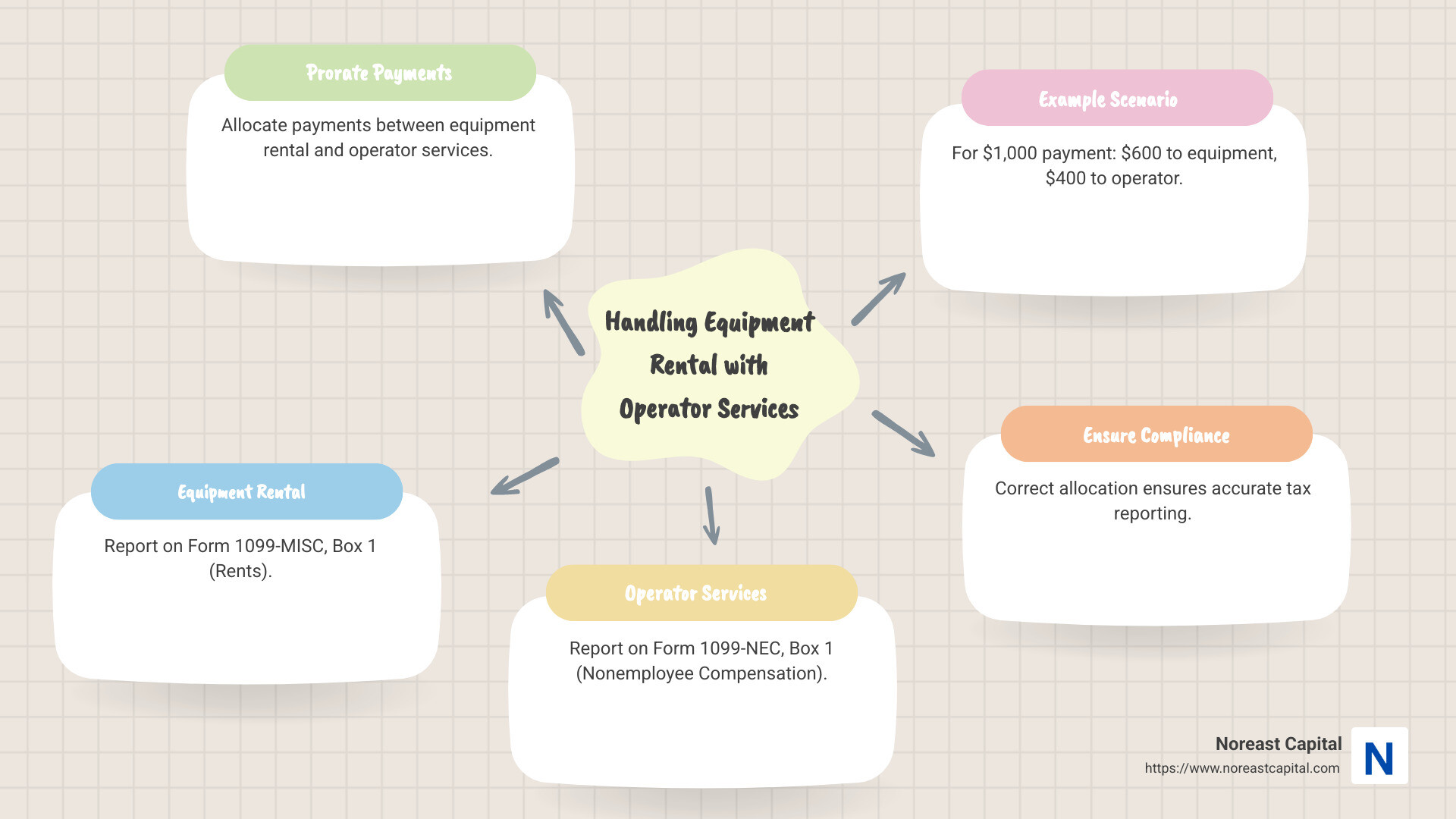
Sometimes, you might have arrangements where your payment includes both equipment rental and operator services. For instance, you rent a crane along with a crane operator who manages it onsite. In this case, you need to prorate those payments:
- Report the equipment rental portion on Form 1099-MISC, Box 1 (Rents).
- Report the operator’s service fees separately on Form 1099-NEC, Box 1 (Nonemployee Compensation).
It might seem like extra work, but this clear separation helps you stay compliant and keeps your records accurate.
Missing Deadlines and Potential Penalties
Deadlines matter—a lot. Missing IRS deadlines for issuing and filing 1099 forms can hurt your wallet with hefty fines. Penalties range from $50 to $270 per form, depending on how late you file. If the IRS thinks the oversight was intentional, that penalty can balloon up to a whopping $550 per form (or 10% of the total amount). Ouch!
Here’s how the penalties typically shake out:
- Forms filed less than 30 days late: $50 per form
- 31 days late through August 1: $110 per form
- Filed after August 1 or never filed: $270 per form
- Intentional disregard (not filing purposely): $550 per form or 10% of amounts owed
And remember, these penalties apply separately to the copy sent to the IRS and the one you send to the vendor. That means you’re potentially doubling the penalty, making a missed deadline doubly painful.
Consider using accounting software to automate tracking and issuing your 1099 forms—saving you time and potential headaches. If your business files more than 10 information returns annually, you’ll also need to e-file, since the IRS lowered the e-filing threshold from 250 to 10 forms beginning with tax year 2024—a requirement that remains in place for 2025 and beyond.
Other Common Mistakes
Aside from the big ones we’ve already covered, a few smaller—but just as important—mistakes can trip up businesses:
Incorrect TIN (Taxpayer Identification Number) or Name: Always double-check the vendor’s W-9 to ensure you have the correct legal name and tax ID. Simple typos can trigger IRS notices.
Missing or Incomplete Addresses: Make sure you have the vendor’s current mailing address, including ZIP code. It’s an easy detail to overlook, but an important one.
Incorrect Amounts: Always cross-check your totals against accounting records to report accurate amounts. Small miscalculations can cause unnecessary tax headaches down the road.
Assuming Corporate Status Without Verification: Payments to corporations usually don’t require a 1099—but never assume your vendor is incorporated. Request a completed W-9 form upfront to know their status for sure.
Filing Unnecessarily: Before you rush to file, confirm that the payment actually requires a 1099. Equipment purchases, for example, aren’t reported on 1099s because they’re asset acquisitions—not rentals or services.
A tax expert wisely advises: “Double-check all information (names, addresses, tax IDs) to avoid errors that could lead to penalties.” Taking an extra moment to verify your forms can save you from headaches later.
At Noreast Capital, we’ve seen how these common mistakes can frustrate even seasoned business owners. Staying compliant doesn’t need to be overwhelming—just a little awareness and careful planning can make a huge difference.
So next tax season, grab your coffee, breathe easy, and confidently issue 1099 for equipment rental without breaking a sweat—or the bank!
Frequently Asked Questions about Issuing a 1099 for Equipment Rental
If you’re navigating the ins and outs of when you need to issue 1099 for equipment rental, you’re not alone! Here at Noreast Capital, we regularly receive questions from small businesses about this topic. To save you time and trouble, we’ve rounded up clear, practical answers to your most common questions.
Is equipment lease 1099 reportable?
Yes indeed! Equipment lease payments need to be reported on Form 1099-MISC if your total payments to a non-corporate vendor add up to $600 or more over the year. This applies across the board, whether you’re leasing construction equipment, office machinery, vehicles, or technology tools.
For instance, let’s say you’re leasing a copier machine for $80 a month. Once you hit that 8-month mark ($640 total), congratulations—you’ve reached the reporting threshold! You’ll need to issue a Form 1099-MISC to the leasing vendor. Just remember to always report these equipment lease payments in Box 1 (“Rents”) of the form.
Do I need to issue a 1099 for equipment purchase?
Good news: No, you don’t need to issue a 1099 for equipment purchases! Equipment purchases are considered asset acquisitions—not rental or service payments—so they’re not reportable on Form 1099-MISC or any 1099 form.
Instead, you’ll treat these purchases as capital assets on your balance sheet. From there, you’ll depreciate them over their useful life or claim deductions like Section 179 expensing or bonus depreciation, depending on your tax situation. (See? Taxes can be fun!)
Are lease payments reported on 1099?
Absolutely! Lease payments, including equipment leases, are definitely reportable if they reach the $600 threshold. Make sure to include these payments in Box 1 (“Rents”) of Form 1099-MISC. This rule applies to all sorts of lease arrangements: monthly equipment rentals, longer-term leases, lease-to-own deals (just the rental portion), and even those special arrangements where you have the option to purchase later on.
Though, that there’s a big exception here: payments to corporations are usually exempt from 1099 reporting for leases. Always double-check your vendor’s status by getting them to fill out a Form W-9 before you start leasing. It’ll make your reporting process a breeze!
Do I need to issue a 1099 for car or truck rental?
Yes, if you’re renting a car, truck, or other vehicle for business purposes from an individual or non-corporate vendor, and payments hit that magic number—$600 or more—you’ll need to issue 1099 for equipment rental.
A quick note on advice you might see floating around online: some older articles may suggest using Form 1099-NEC for vehicle rentals. This isn’t correct. Vehicle rental payments belong on Form 1099-MISC, Box 1 (“Rents”), not on Form 1099-NEC. Keep things simple and avoid confusion by placing these payments in the right box.
What if I rent equipment with an operator?
Things can get a little tricky when you rent equipment along with an operator—like hiring a bulldozer and a person to run it. In situations like these, you’ll need to divide (“prorate”) the payment between equipment rental and operator services.
Let’s say you pay a total of $1,000. If the equipment rental alone would typically cost around $600 and the operator’s services would be valued at about $400, here’s what you’d do:
- Report the $600 equipment rental on Form 1099-MISC, Box 1 (“Rents”).
- Report the $400 operator payment on Form 1099-NEC, Box 1 (“Nonemployee Compensation”).
This might seem a bit cumbersome at first, but proper allocation helps keep everything clear and compliant—trust us, your accountant will thank you later!
Still feeling a bit unsure? Don’t worry—you’re not alone! At Noreast Capital, we’ve helped countless small businesses steer equipment leasing, financing, and tax reporting. If you have more questions or want personalized guidance, explore our helpful guide: Do You Issue a 1099 for Equipment Leases?
Conclusion: Ensuring Compliance When You Issue 1099 for Equipment Rental
Properly managing your reporting obligations when you issue 1099 for equipment rental isn’t just a smart business practice—it’s essential for staying compliant and avoiding headaches at tax time.
We’ve covered a lot in this guide, but let’s quickly recap the critical points to keep in mind:
First, always use Form 1099-MISC to report equipment rental payments (remember, Box 1 labeled “Rents”). The magic number to trigger this requirement is $600 or more paid annually to a non-corporate vendor. Keep an eye out for exemptions too—payments to corporations generally don’t need a Form 1099.
Next, timing matters. Don’t procrastinate! You’ll need to send your vendor their copy by January 31, then file with the IRS by February 28 if submitting paper forms or March 31 for electronic filing. And double-check that all the names and Tax ID Numbers match up. Nothing ruins your day faster than an IRS notice about mismatched data.
Getting these details right helps you dodge penalties—which can range anywhere from $50 to $550 per form. Those can add up fast, so it’s worth taking a moment now to set things straight.
But compliance isn’t just about avoiding fines. Accurate 1099 reporting helps strengthen vendor relationships. Just like they say, “Good fences make good neighbors,” well, good reporting makes happy vendors. It also simplifies tax preparation when April comes around and supports your business deductions—every penny counts!
At Noreast Capital, we know you didn’t start your business because you love filling out IRS forms (but hey, if you do, more power to you!). Our real goal is to let you focus less on paperwork and more on building your business.
That’s why we offer more than just flexible equipment leasing options. Our team is always ready to support you in navigating your equipment financing and tax reporting responsibilities. Whether you’re in Annapolis, Baltimore, or Washington DC, we’ve got the local expertise and experience to help you confidently steer through tax compliance.
Proper compliance when you issue 1099 for equipment rental is about laying a strong foundation for your business growth. If you have more questions or just need a little extra help, don’t hesitate to reach out. Visit our resource page on Do You Issue a 1099 for Equipment Leases? for more information, or contact us directly.
We’re here to make the complicated stuff simple—so you can get back to what you do best, running your business!