

Cut Your Grass, Not Your Cash Flow: The Smart Way to Lease a Riding Mower
Looking to lease a riding mower without emptying your wallet? Here’s what you need to know:
| Leasing Basics | Quick Facts |
|---|---|
| Average Monthly Payment | $66-$106 per month |
| Typical Lease Term | 12 months to ownership |
| Credit Requirements | Often no traditional credit check needed |
| Approval Amount | Up to $2,500 for eligible applicants |
| What’s Included | Free delivery and setup with many providers |
| Early Purchase | Options available to buy sooner at discount |
When you lease a riding mower, you’re entering an agreement that lets you use professional-grade lawn equipment with manageable payments instead of a large upfront purchase. This approach has become increasingly popular, with 41% of Americans having credit scores below 700, making traditional financing difficult for many homeowners and small business owners.
The lease-to-own model offers a practical solution for anyone wanting to maintain beautiful grounds without straining their budget. Most programs provide flexible weekly, biweekly, or monthly payment schedules that align with your cash flow, and many include maintenance during the lease period.
I’m Vincent Cerniglia from Noreast Capital, where I’ve helped countless business owners and homeowners lease a riding mower through our equipment financing solutions that prioritize preserving cash flow while providing access to quality equipment.
Lease a Riding Mower: The Basics
Ever wondered what it actually means to lease a riding mower? Think of it as a pathway to ownership through manageable payments. Unlike traditional financing, a lease-to-own agreement means the leasing company (that’s us!) purchases the mower first, then you make regular payments until it becomes yours. No complicated loan terms or bank approvals—just a straightforward path to owning the equipment you need.
Most of our customers complete their ownership journey in about 12 months, though we also offer 18 and 24-month options for those fancy zero-turns or premium models that might stretch your budget otherwise. And don’t worry about breaking the bank—our approvals typically go up to $2,500, covering most quality riding mowers on the market today.
What I love most about helping folks lease a riding mower is seeing the relief on their faces when they realize they don’t need perfect credit or thousands in cash to start mowing their lawn properly. Instead of emptying your savings account, you can get started with a modest initial payment and then make regular installments that actually fit your monthly budget.
More info about Riding Mower Rent to Own

Step-by-Step to Lease a Riding Mower
Getting your hands on that shiny new riding mower is refreshingly simple. First, you’ll complete a quick application with basic info—just your age (must be 18+), contact details, and income sources. Most folks finish this online in under five minutes.
Once approved, you’ll make your initial payment—sometimes as little as $59 depending on the model you choose. This kicks off your lease agreement and gets the wheels turning (literally!). After processing your first payment, we’ll schedule delivery, which is often free within 15 miles of our location.
The best part? You choose payment cycles that match your paycheck schedule—weekly, bi-weekly, or monthly options mean you can align your mower payments with when money actually lands in your account. Payments typically start on your next payday that falls at least 10 days after delivery.
As Mike from Baltimore told me last spring, “I was cutting grass with my new zero-turn the same week I applied. The whole process was painless, and the delivery guys even showed me how to use all the features I didn’t know existed!”
Who Should Lease a Riding Mower?
If you’re wondering whether leasing makes sense for you, I’ve found four types of people who benefit most from our lease a riding mower programs:
Homeowners with Larger Properties save countless hours with a riding mower instead of pushing a walk-behind across a quarter-acre or more. When summer temperatures soar, sitting beats sweating! Leasing makes this time-saving equipment accessible without emptying your savings account.
Landscaping Businesses thrive when they preserve capital for growth opportunities. Monthly lease payments typically run lower than loan payments, improving your cash flow exactly when you need it most—during expansion phases or seasonal rushes.
Seasonal Users love our flexible payment options. If you only need serious cutting power from April to October, why should you make the same payments in January? Some of our programs offer seasonal adjustments with higher payments during busy months and lower ones during off-seasons.
Equipment Upgraders appreciate the ability to regularly refresh their equipment. Technology and features improve every year, and leasing gives you a clear path to upgrade when your term ends instead of being stuck with outdated equipment.
Sarah, a landscaper from DC, recently told me, “Leasing our fleet of mowers lets us scale up during spring and summer without tying up our operating capital. It’s been a game-changer for our growth—we added three new crew members this year!”
More info about Lease to Own Lawn Mower
Why Lease Instead of Buy? Benefits, Trade-Offs & Model Choices
Let’s be honest – buying a riding mower outright can take a serious bite out of your savings. That’s why many homeowners and landscapers are choosing to lease a riding mower instead. The biggest advantage? You don’t need thousands of dollars upfront to start mowing your lawn like a pro.
This approach makes particular sense when you consider that about 41% of Americans have credit scores below 700, making traditional loans either impossible to get or loaded with sky-high interest rates. Why put yourself through that financial stress when there’s a simpler option?
For business owners, leasing comes with potential tax perks too. Those monthly lease payments may be fully deductible as business expenses (though I always recommend chatting with your accountant about your specific situation). Plus, when technology improves or your needs change, leasing makes it much easier to upgrade your equipment without the hassle of selling your old machine first.

When selecting your perfect grass-cutting companion, you’ve got options:
Push mowers work great for smaller yards under ¼ acre, with lease payments starting around $35 per installment. Traditional riding mowers with steering wheels are perfect for medium to large properties between ¼ and 2 acres, with payments averaging $66 per installment. If you’ve got a sprawling property over an acre with obstacles like trees and gardens, a zero-turn mower with those distinctive lap bars (shown in the image above) will save you tons of time – these start around $106 per installment. More info about Lease Zero Turn Mower
Let’s compare how different ways of getting a mower stack up:
| Feature | Leasing | Loan Financing | Cash Purchase |
|---|---|---|---|
| Initial Cost | $59-100 down | 10-20% down payment | Full amount upfront |
| Monthly Cash Flow Impact | Lower fixed payments | Higher fixed payments | None after purchase |
| Maintenance | Often included | Owner’s responsibility | Owner’s responsibility |
| Ownership Timeline | 12-24 months | Immediate with debt | Immediate |
| Credit Requirements | Minimal/flexible | Good credit needed | None |
| Tax Treatment (Business) | May be fully deductible | Interest deductible | Depreciation over years |
| End of Term Options | Own, return, or upgrade | Own with final payment | Already own |
Cash-Flow & Budget Certainty
One thing my customers love about leasing is knowing exactly what they’ll pay each month. No surprises, no unexpected repair bills breaking your budget – just a predictable payment you can plan around.
This is especially valuable if your income fluctuates seasonally. Many of our landscaping customers appreciate our seasonal payment options, where they can pay more during their busy spring and summer months, and less during the winter when business slows down.
I’m particularly proud of our “Ultimate Forgiveness Program” at Noreast Capital. It takes away a lot of the worry about what happens if things don’t go perfectly. We forgive half of any excess hours used on your leased equipment and up to $250 in return-condition damages. It’s just one way we try to make equipment leasing less stressful and more human.
Bad or No Credit Friendly
Here’s where leasing really shines – you don’t need perfect credit to lease a riding mower. While banks might slam the door in your face over a less-than-stellar credit score, our lease-to-own programs look beyond just that FICO number.
When you apply with us, we do a soft credit inquiry (the kind that doesn’t hurt your credit score) and consider factors like your income stability and banking history. This approach opens doors for:
Credit rebuilders who are working their way back from financial setbacks, young adults just starting to establish their credit history, small business owners whose personal credit took hits during startup phases, and really anyone with stable income but credit challenges in their past.
Once approved, your approval stays valid for 90 days, giving you plenty of time to choose the perfect mower without feeling rushed.
As Mark from Delaware told me recently, “After my business struggled during COVID, my credit was a mess. I figured I’d be stuck with my ancient push mower for years. But Noreast approved me in about 10 minutes, and now I’m saving three hours every weekend with my new riding mower. My back thanks you!”
More info about Lease to Own Lawn Mowers No Credit Check
Counting the Cost: Payments, Terms, Maintenance & End-of-Lease Paths
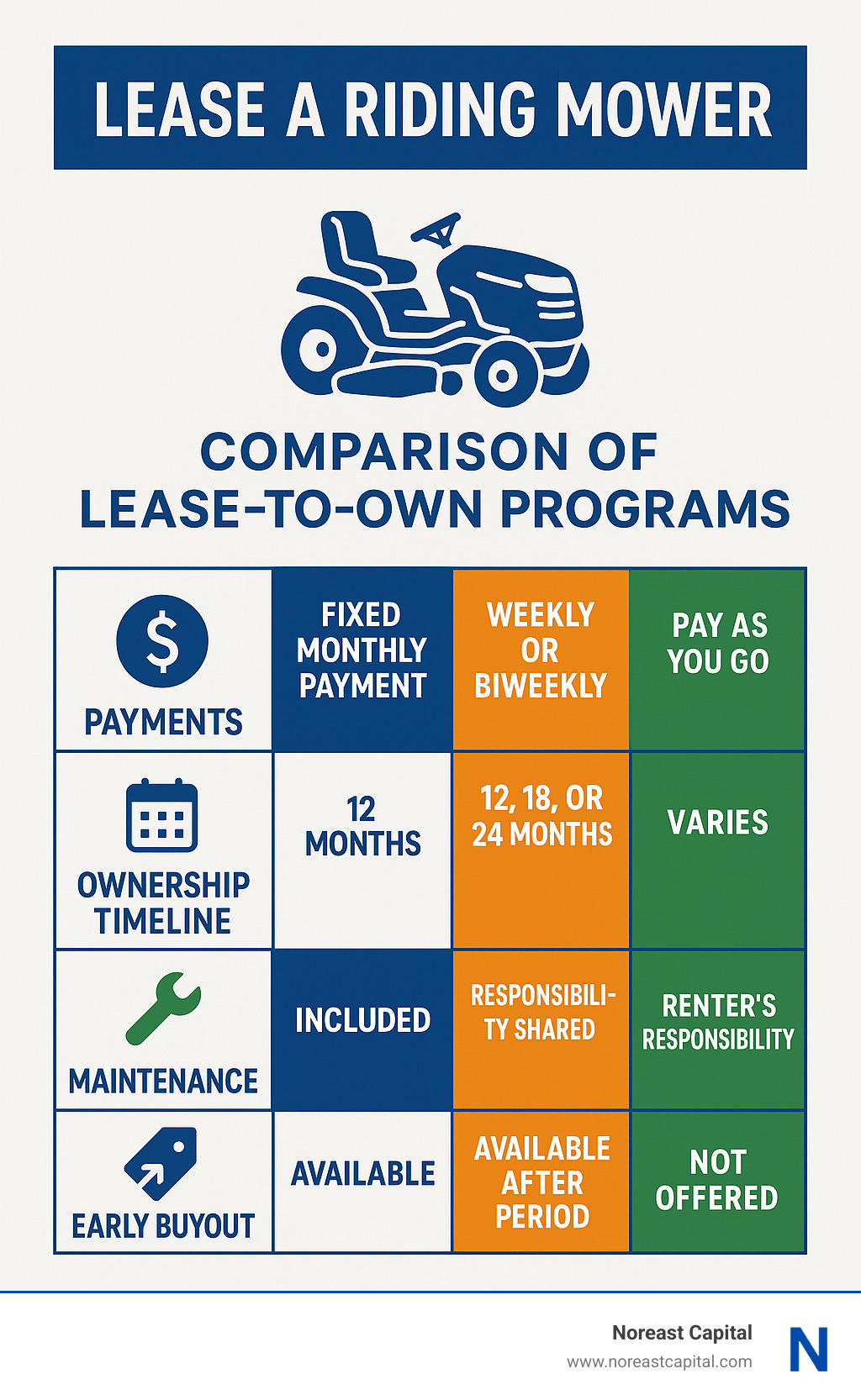
When you lease a riding mower, knowing exactly what you’re paying for helps you make a smart decision for your lawn and your wallet. Most folks find themselves paying between $66 for standard riding models and $106 for those fancy zero-turn mowers that make cutting around trees a breeze. The beauty of these programs is how flexible the payment schedules can be – weekly, bi-weekly, or monthly – whatever matches when your paycheck lands.
Most lease-to-own agreements run for 12, 18, or 24 months, with everything spelled out upfront so there are no surprises. Yes, you’ll end up paying more than the retail price when all is said and done, but that extra covers some valuable perks: convenience, maintenance services, and the opportunity to get quality equipment without perfect credit or emptying your savings account.

One of the hidden gems of leasing is the maintenance that often comes included. Regular upkeep is crucial for these machines – it extends their life and keeps them cutting efficiently. Many programs even offer damage forgiveness up to $250, which means you won’t be sweating the small stuff if something minor happens.
There’s an environmental angle worth considering too. Newer riding mowers meet stricter emissions standards than older models, so your leased mower might be kinder to the environment than that ancient used one you were eyeing on Craigslist. For the environmentally conscious, this is worth noting. Latest research on small-engine emissions shows significant improvements in newer models.
Early Buyout & Return Scenarios
Life happens, and plans change – that’s why most lease-to-own programs build in flexibility:
Most companies offer a 90-day same-as-cash option, which is exactly what it sounds like: pay off the retail price within three months, and you won’t pay any extra fees. It’s like an interest-free loan for a quarter of a year! After that window closes, you’ll typically have percentage-based buyout options, with the payoff amount shrinking as you make more payments.
I recently spoke with Mark from Virginia who told me, “When my tax refund came in bigger than expected, I decided to pay off my mower lease early. The process took one phone call, and I saved almost a third of what I would have paid completing all the payments. The money I saved went straight into my daughter’s college fund.”
If you need to end your lease early, most agreements let you return the equipment without those annoying restock fees that often come with traditional financing. This peace of mind is invaluable when your circumstances are unpredictable.
For growing businesses, many leasing programs offer upgrade paths that let you switch to a different model mid-lease, carrying your payment history with you. This feature is perfect if your lawn care needs expand or change. More info about Lease to Own Lawn Mower
What Happens If the Mower Breaks?
One of the biggest headaches of equipment ownership is dealing with repairs – but when you lease a riding mower, that stress often disappears. Most lease-to-own agreements include basic maintenance throughout the lease period, removing the uncertainty of unexpected repair costs.
If mechanical issues pop up with your leased mower, the process is typically straightforward: contact customer service, and they’ll coordinate warranty service or repairs. For issues covered under the agreement, repairs are usually performed at no extra cost. Even for normal wear and tear problems, the leasing company typically foots the bill.
Of course, you do have some responsibilities as the lessee. You’ll need to handle basic maintenance like cleaning the deck after use and checking oil levels regularly. Operating the equipment according to the manufacturer’s guidelines is essential, as is promptly reporting any issues before they worsen. Keeping simple records of maintenance you perform is also a good practice.
Sarah, a homeowner with a two-acre property in Maryland, shared her experience: “When my riding mower started making an unusual noise, I called Noreast Capital expecting a hassle. Instead, they had a technician at my house the next morning. He fixed the issue on the spot, and I was back to mowing that afternoon – all at no cost to me. That kind of service is why I’ll never go back to buying outright.”
Getting Approved: Requirements & Application Checklist
Ready to lease a riding mower? The application process is refreshingly simple compared to traditional financing. Here’s what you’ll need to qualify:
You must be at least 18 years old with a valid Social Security Number or ITIN. You’ll also need an active checking account where payments can be withdrawn and proof that you have income coming in regularly. Everything is handled electronically, so you’ll need to be comfortable with e-signing documents.
It’s worth noting that not every state allows these lease-to-own programs. Currently, Minnesota, New Jersey, Vermont, Wisconsin, and Wyoming have restrictions on certain lease arrangements. If you call one of these states home, don’t worry! Just reach out to us directly, and we’ll discuss alternative financing options that might work better for your situation.

Are you leasing for your business or personal use? The process differs slightly. Business leases might require additional paperwork like your business license or tax ID numbers, while personal leases focus more on verifying your individual income.
Most providers deliver within about 15 miles of their location. If you live further out, just ask about delivery options or whether you can arrange to pick up your new mower yourself.
Can You Lease a Riding Mower with Bad Credit?
Absolutely! This is where lease a riding mower programs truly shine. Unlike banks that seem to obsess over your credit score, our leasing approach uses a soft inquiry that won’t ding your credit score and looks at the whole picture of who you are.
We consider factors like how stable your income is, your banking history, how long you’ve been at your job, how long you’ve lived at your current address, and sometimes even personal references. We’re looking for reasons to say “yes,” not reasons to turn you down.
“After my bankruptcy, I couldn’t get approved anywhere,” shared one Washington, DC resident. “The lease-to-own option got me the equipment I needed to start my lawn care side business, which has now grown into my full-time job.”
If your credit situation is particularly challenging, don’t lose hope. Some programs offer options with a slightly larger initial deposit or the possibility of adding a co-signer. More info about Lease to Own Lawn Mowers No Credit Check
Documents & Timeline to Own
Getting your paperwork together ahead of time speeds things up considerably. Have these ready:
- A government-issued photo ID (driver’s license or passport)
- Your most recent pay stubs or other proof of income
- Your bank account information (both routing and account numbers)
- Contact information for personal references if requested
The approval process moves at lightning speed compared to traditional financing. Many of our applicants receive their decision within just 10 minutes of hitting “submit.” Once you’re approved, the journey to your new mower follows a clear path: you’ll receive approval notification (often the same day), electronically sign your lease documents, make your initial payment, and schedule delivery—which typically happens within 2-30 days.
Your regular payments begin on your next scheduled payday, and before you know it—usually after about 12 months of payments—that shiny riding mower is all yours.
The whole process from clicking “apply” to owning your mower is designed to be straightforward and hassle-free. We believe getting approved for equipment financing shouldn’t be more complicated than actually using the equipment itself!
Frequently Asked Questions about Leasing a Riding Mower
How long until I own it?
Most people who lease a riding mower become owners after just 12 months of payments. You can choose whether you want to pay weekly, every two weeks, or monthly – whatever works best with your paycheck schedule.
If you’re eyeing one of those fancy zero-turn models or a higher-end machine, you might see 18 or 24-month options to keep your payments more budget-friendly. Don’t worry about confusion here – your lease agreement spells out exactly how many payments stand between you and ownership.
Your journey to ownership begins right after you make that first payment and get your mower delivered. We’ll sync up your payment schedule with your paydays, with your first regular payment happening on your next payday that falls at least 10 days after delivery.
“I was surprised how quickly the year went by,” one of our customers from Richmond told me. “Before I knew it, the final payment was made and that beautiful red riding mower was all mine – just in time for spring.”
Can I upgrade or swap models mid-lease?
Life happens, and your lawn care needs might change while you’re still in your lease period. Maybe your lawn maintenance side gig is taking off, or perhaps you’ve realized that zero-turn would save you an hour each weekend.
Good news – most lease providers understand this and offer flexibility. If you find yourself needing more horsepower, a wider cutting deck, or want to switch from a traditional riding mower to a zero-turn, just reach out to your leasing company.
In most cases, the payments you’ve already made won’t go to waste. Many providers consider your payment history when structuring your new agreement, sometimes applying a portion of what you’ve already paid toward the new equipment (though specific terms vary).
As one customer from Annapolis shared, “I started with a basic riding mower, but as my landscaping business grew, I needed something faster. Noreast Capital helped me upgrade to a zero-turn model mid-lease with minimal hassle.”
What fees should I watch for?
When you lease a riding mower, the process is designed to be straightforward, but it’s smart to understand all potential costs upfront:
Processing fees might apply depending on your location, though reputable companies always disclose these before you sign anything. Late payment fees can crop up if you miss scheduled payments, so setting up automatic payments is often a good idea.
If you return equipment with damage beyond normal wear and tear, you might face some charges – though many programs (including ours) offer damage forgiveness up to a certain amount, typically around $250. Most programs let you return equipment anytime without penalties, but it’s always wise to double-check your specific agreement.
While many providers offer free delivery within a certain radius (typically 15 miles), you might see additional charges if you live further away. Don’t be shy about asking about this before signing!
The silver lining here is that trustworthy leasing companies like Noreast Capital are transparent about all fees upfront. Take a few minutes to review your lease agreement, and you shouldn’t encounter any unwelcome surprises down the road.
“What I appreciated most,” a Baltimore homeowner told us, “was how clearly everything was explained. The representative walked me through exactly what I’d be paying and when. No hidden fees popped up later – exactly what was promised.”
Conclusion
Leasing a riding mower truly offers the best of both worlds – access to professional-grade equipment without draining your savings account. Throughout my years at Noreast Capital, I’ve seen how these flexible programs have helped everyone from first-time homeowners to established landscaping businesses keep their properties looking pristine while keeping their finances healthy.
When you’re weighing whether to lease a riding mower, consider what matters most to you. Are you trying to preserve cash for other priorities? Do you want the freedom to upgrade to newer models every few years? Is your credit situation making traditional financing difficult? These questions can guide you toward the right decision for your specific circumstances.
Your property’s characteristics play a big role too. That sloped backyard or collection of ornamental trees might make a zero-turn model worth the slightly higher monthly payment. Or perhaps your seasonal business would benefit from the flexible payment schedules that align with your busiest months.

At Noreast Capital, we’ve built our lease-to-own programs around real people’s needs. We understand that life doesn’t always follow a perfect financial path, which is why our approvals look beyond just credit scores. We’ve helped customers throughout Annapolis, Baltimore, and Washington, DC transform their properties without changing their bank accounts into empty vaults.
One of my favorite customer stories comes from a retired teacher in Baltimore who told me, “I thought I’d have to hire a service to maintain my yard after my old mower died. Now I’m enjoying my retirement on my new riding mower instead of worrying about how to afford lawn care.” These kinds of stories remind me why flexible equipment financing matters.
Whether you’re tired of pushing a mower across your acre lot every weekend or you’re a landscaping professional looking to expand your fleet without tying up your working capital, leasing a riding mower could be your ideal solution. Our programs are designed to be straightforward, with clear paths to ownership and no hidden surprises along the way.
Ready to spend less time worrying about your lawn equipment and more time enjoying your beautiful property? Learn more about lease-to-own lawn mower programs today, or reach out to our team for a personalized consultation. At Noreast Capital, we’re committed to flexible equipment financing that keeps your grass and cash flow equally green.