

Lease amortization schedule calculator is a term that’s often tossed around in finance, particularly when discussing leases. But what exactly does it mean, and why should it matter to a business owner?
Here’s the quick scoop:
– Lease: A contract allowing you to use equipment for a specific period without owning it.
– Amortization: Way to track how payments split between reducing principal and covering interest, over time.
– Schedule: A detailed list showing each payment, how it’s split, and remaining balance throughout the lease.
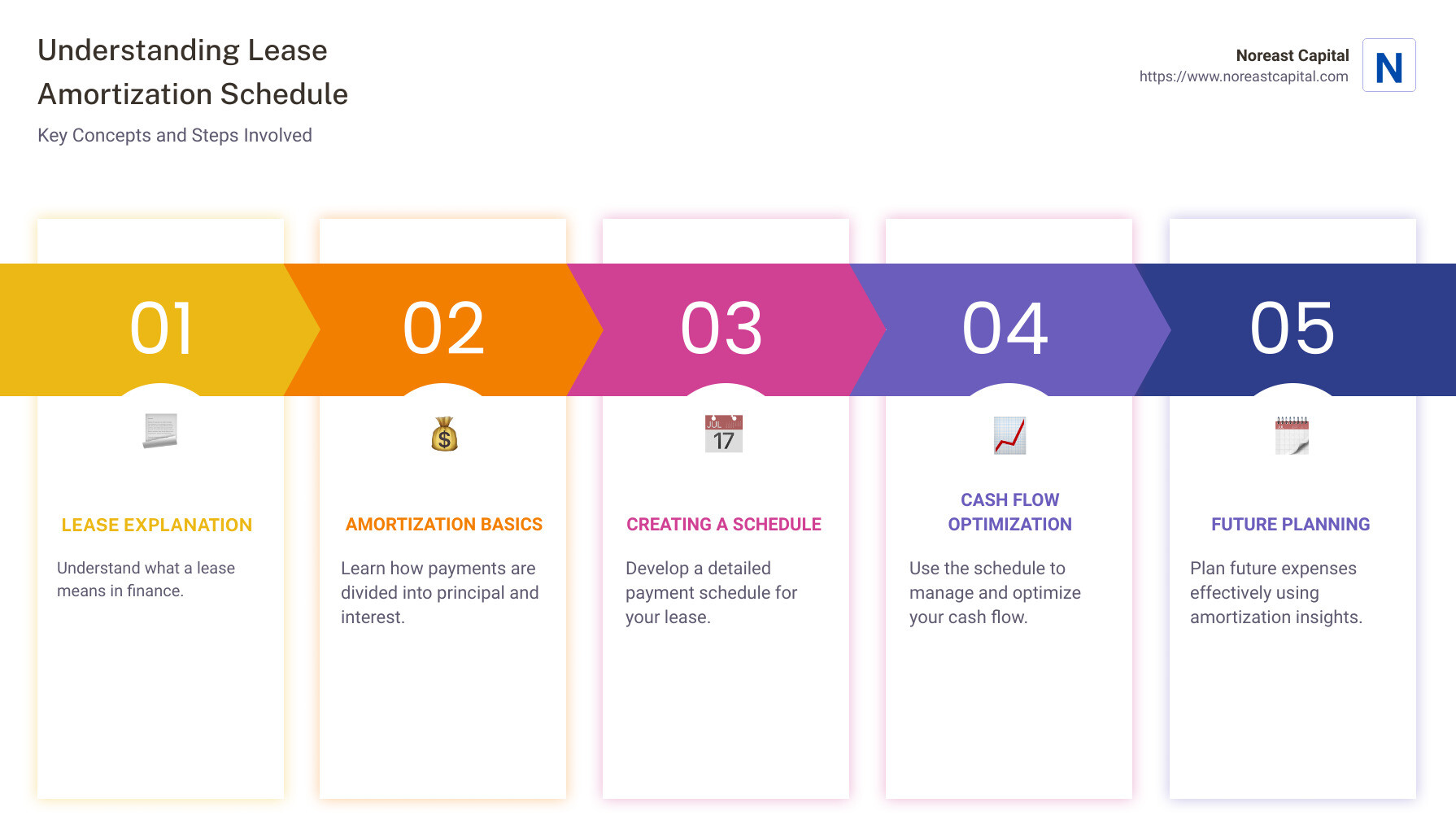
Understanding these concepts is vital. A lease amortization schedule calculator helps you see how your lease payments are distributed over time, optimize your cash flow, and plan for future expenses effectively.
Hi there, I’m Vincent Cerniglia, a seasoned expert in equipment financing and leasing solutions. With extensive experience as a direct lender at Noreast Capital, I can explain the lease amortization schedule calculator for you, ensuring it becomes a straightforward tool in managing your business finances.
Understanding Lease Amortization
When you hear “lease amortization,” think of it as the process of spreading out your lease payments over time, just like paying off a loan. This helps you see exactly where your money is going each month. It’s a handy way to understand how much of your payment goes toward reducing the lease balance and how much covers interest.
Intangible Assets and Residual Value
Now, let’s break down two important terms: intangible assets and residual value.
Intangible Assets: These are non-physical items like software or licenses. They can also be leased, just like physical assets. When you lease an intangible asset, you’re essentially paying to use it for a set period.
Residual Value: This is what the asset is expected to be worth at the end of the lease. Think of it as the asset’s future value. For example, if you lease a car, the residual value is what the car should be worth when the lease ends. This value helps determine your monthly lease payments.

Understanding these concepts is crucial for making informed leasing decisions. The residual value can affect your lease payments. A higher residual value usually means lower monthly payments, as you’re essentially “borrowing” less value from the asset.
Why Lease Amortization Matters
Lease amortization is more than just a financial term. It’s a tool that helps you plan your finances. By knowing how your payments are split and what your asset will be worth at the end, you can manage your cash flow better and make smarter business decisions.
Real-Life Example
Consider a business leasing a piece of equipment valued at $50,000. If the residual value is set at $20,000 after three years, the lease payments will be based on the $30,000 difference. This knowledge allows the business to plan its budget and future expenses more effectively.
Understanding lease amortization and these key terms can make a big difference in how you manage your business finances. It’s about clarity and control over your financial commitments.
Next, we’ll dive into how to calculate a lease amortization schedule, making these concepts even more practical and useful for your business planning.
How to Calculate a Lease Amortization Schedule
Creating a lease amortization schedule might sound daunting, but with the right tools and a bit of guidance, it becomes straightforward. Let’s break it down into simple steps using a spreadsheet, the NPV function, and interest calculations.
Using a Spreadsheet
A spreadsheet is your best friend when it comes to calculating a lease amortization schedule. It allows you to organize data neatly and perform calculations efficiently. Begin by setting up columns for each component of your lease payment: payment date, total payment, interest portion, principal portion, and remaining balance.
The NPV Function
The NPV (Net Present Value) function is a powerful tool in spreadsheets that helps you calculate the present value of future lease payments. This is important because it allows you to understand the true cost of your lease over time.
To use the NPV function, input your lease payment amounts as a series of cash flows. The function will discount these payments back to their present value using a specified interest rate. This gives you a clearer picture of your financial commitment.
Interest Calculation
Interest calculation is a crucial part of creating a lease amortization schedule. Each payment you make includes an interest portion, which is the cost of borrowing the asset.
To calculate the interest for each period, multiply the remaining balance by the periodic interest rate. Subtract the interest from your total payment to find out how much goes toward reducing the principal. This process helps you see how much of your payment is actually reducing your lease liability.
Putting It All Together
Here’s a simple example to illustrate:
Start with the Lease Details: Assume a lease amount of $30,000 with an interest rate of 5% annually, over a period of 3 years.
Calculate Monthly Rate: Convert the annual rate to a monthly rate (5%/12).
Set Up Your Spreadsheet: Use columns for each month, listing the total payment, interest, principal, and remaining balance.
Use NPV for Present Value: Input your monthly payments into the NPV function to understand the present value of your lease.
Calculate Interest and Principal: For each month, compute the interest on the remaining balance, then subtract it from the total payment to find the principal portion.
By following these steps, you’ll create a detailed lease amortization schedule that shows you exactly how your payments break down over time. This clarity can help you make informed financial decisions and manage your budget effectively.
Next, we’ll explore how a lease amortization schedule calculator can simplify this process even further, making it accessible for anyone, regardless of their financial expertise.
Lease Amortization Schedule Calculator
Creating a lease amortization schedule manually can be time-consuming. That’s where a lease amortization schedule calculator comes in handy. It simplifies the process by automating calculations, saving you time and reducing errors.
Lease Payment Calculator
A lease payment calculator is a tool that helps you determine your monthly lease payments based on several factors: the lease amount, interest rate, and lease term. It takes the guesswork out of calculating payments, offering a straightforward way to see what you’ll owe each month.
Here’s how it works:
- Input Details: Enter the lease amount, interest rate, and lease term.
- Calculate Payments: The calculator processes these inputs to provide your monthly payment.
- Adjust Variables: If needed, adjust the variables to see how changes impact your payment.
This tool is especially useful when you’re comparing different lease options or negotiating terms.
Effective Interest Rate
Understanding the effective interest rate of your lease is crucial. This rate reflects the true cost of borrowing, including compounding effects, and is often higher than the nominal rate. The lease payment calculator can also provide this information, helping you assess the financial impact of your lease.
To find the effective interest rate, the calculator considers:
- Nominal Rate: The stated interest rate on your lease.
- Compounding Periods: How often interest is applied (e.g., monthly, quarterly).
By knowing the effective interest rate, you can better evaluate the overall cost of your lease and compare it to other financing options.
Monthly Payment Breakdown
One of the main benefits of using a calculator is understanding your monthly payment breakdown. Each payment consists of two parts: interest and principal. Knowing how much goes to each can help you manage your finances more effectively.
- Interest Portion: This is the cost of using the leased asset.
- Principal Portion: This reduces the remaining balance of your lease.
The calculator provides a clear breakdown, showing you exactly how much of your payment is reducing your lease liability versus covering interest costs.
Using a lease amortization schedule calculator streamlines the process, making it easy to understand and manage your lease payments. Whether you’re leasing equipment, vehicles, or other assets, this tool ensures you have a clear picture of your financial commitments.
Next, we’ll guide you through creating a lease schedule in Excel, offering a step-by-step approach for those who prefer a hands-on method.
Step-by-Step Guide to Creating a Lease Schedule in Excel
Creating a lease schedule in Excel might sound daunting, but with a few simple steps, you can track your lease payments and liabilities with ease. Here’s how you can do it:
Setting Up Your Excel Spreadsheet
- Open Excel: Start by opening a new Excel spreadsheet.
- Create Columns: Set up columns for each key component of your lease schedule. You’ll need columns for Period, Payment Date, Lease Payment, Interest Expense, Principal Reduction, and Remaining Liability.
- Enter Initial Values: In the first row, enter your initial lease liability as the starting balance.
Using Formulas for Expense Calculation
With your columns ready, you’ll use Excel formulas to calculate the interest expense and principal reduction for each period.
- Interest Expense Formula: Use the formula
=Remaining Liability * (Interest Rate/12)to calculate the interest for each period. Place this formula in the Interest Expense column. - Principal Reduction: Subtract the interest expense from the total lease payment to find the principal reduction. Use
=Lease Payment - Interest Expensefor this calculation. - Update Remaining Liability: Reduce the remaining liability by the principal reduction using
=Previous Remaining Liability - Principal Reduction.
Reducing Lease Liability
This is where the magic happens. As you fill out each row for subsequent periods, your formulas will automatically update, showing how much of each payment goes toward reducing your lease liability.
- Copy Formulas: Drag the formulas down through the rows to apply them to each period. Excel will automatically adjust cell references, making it easy to extend your schedule over the entire lease term.
- Monitor Changes: Watch as your remaining liability decreases with each payment. This gives you a clear view of how your lease obligation is being reduced over time.
Finalizing Your Lease Schedule
- Review and Adjust: Double-check your formulas and inputs for accuracy. Adjust any values if necessary.
- Visualize Data: Consider adding a chart to visualize how your lease liability decreases over time. This can provide a helpful visual representation of your lease amortization.
By following these steps, you’ll have a comprehensive lease schedule in Excel that tracks your payments, interest expenses, and liability reduction. This hands-on approach not only helps you understand your financial commitments better but also empowers you to make informed decisions about your leases.
Next, we’ll tackle some frequently asked questions about lease amortization to further deepen your understanding.
Frequently Asked Questions about Lease Amortization
How does a lease amortize?
Lease amortization is like peeling away layers of an onion—each payment reduces the overall liability bit by bit. When you lease an asset, you’re essentially spreading out the cost over time, similar to paying off a loan.
Each payment you make is divided into two parts: interest expense and principal reduction. The interest expense is the cost of borrowing, while the principal reduction lowers the outstanding liability. Over time, the interest portion decreases, and more of your payment goes toward reducing the principal.
Think of it like paying off a car loan. At first, more of your payment covers the interest, but as the loan progresses, more goes toward the actual car cost. The same concept applies to lease amortization.
How to calculate lease amortization schedule?
Calculating a lease amortization schedule might sound tricky, but it doesn’t have to be. You can use a spreadsheet to make it easier. Here’s how:
- Set Up Your Spreadsheet: Create columns for each component: Period, Payment, Interest Expense, Principal Reduction, and Remaining Liability.
- Use the NPV Function: The Net Present Value (NPV) function can help you figure out the present value of lease payments. This is important for understanding the total cost of the lease over time.
- Calculate Interest and Principal: Use formulas to calculate the interest expense and principal reduction for each payment period. For example,
Interest Expense = Remaining Liability * Interest RateandPrincipal Reduction = Payment - Interest Expense. - Update Remaining Liability: Subtract the principal reduction from the remaining liability to see how much you still owe.
By following these steps, you can create a clear and organized schedule that shows how each payment affects your lease liability.
How to prepare a lease schedule in Excel?
Excel is your friend when it comes to preparing a lease schedule. It allows you to track every detail with precision. Here’s a simple guide:
- Open Excel: Start with a blank spreadsheet.
- Create Columns: Set up columns for Period, Payment Date, Lease Payment, Interest Expense, Principal Reduction, and Remaining Liability.
- Enter Initial Values: Begin with your initial lease liability in the first row.
- Use Formulas: Implement formulas to calculate interest and principal for each period. For example, use
=Remaining Liability * (Interest Rate/12)for interest expense. - Copy and Drag: Once your formulas are set, drag them down the rows to apply them to each period. Excel will automatically adjust the calculations for you.
- Visualize: Consider adding a chart to see how your liability decreases over time.
By leveraging Excel’s capabilities, you can easily manage and visualize your lease amortization, making financial tracking a breeze.
Next, let’s dig into more specific questions about lease amortization to further clarify any lingering doubts.
Conclusion
At Noreast Capital, we understand that navigating equipment leasing can be daunting. Our mission is to simplify this journey for you, providing clear and effective financial solutions custom to your business needs.
Equipment leasing offers the flexibility to use state-of-the-art equipment without the hefty upfront costs of purchasing. This approach helps businesses maintain cash flow and allocate resources to other critical areas, ensuring growth and stability.
Our financial solutions are designed to be straightforward and accessible. We offer customizable leasing options, allowing you to select terms that align with your operational goals. Whether you need a short-term lease or a long-term arrangement, we have you covered.
By leveraging our lease amortization schedule calculator, you can easily plan and manage your lease payments. This tool helps you understand how each payment reduces your liability, keeping you informed and in control.
We are committed to being your partner in success. Our team is here to support you every step of the way, ensuring that your leasing experience is smooth and beneficial. Visit our Equipment Leasing Calculator to explore how our solutions can meet your business needs.
Thank you for considering Noreast Capital as your trusted partner in equipment leasing. Together, we can achieve great things.