

Why Understanding Lease Amortization Schedules with Residual Value Matters
A lease amortization schedule with residual value is your roadmap to understanding exactly how each lease payment breaks down into interest and principal components when the leased asset retains value at the end of the term. Here’s what you need to know:
Key Components:
– Payment Amount – Your monthly or periodic lease payment
– Interest Portion – Cost of borrowing calculated on remaining liability
– Principal Portion – Amount reducing your lease liability
– Residual Value – Asset’s predetermined worth at lease end (typically 45-60% of original value)
– Liability Balance – Remaining amount owed after each payment
Why It Matters:
– Lower monthly payments because you’re only financing the depreciation
– Better cash flow management for your business
– Required for compliance with ASC 842 and IFRS 16 accounting standards
– Essential for accurate financial reporting and budgeting
The residual value acts as a guaranteed future worth of the asset. For most cars, this ranges from 45% to 60% of the original MSRP after a 36-month lease. This means you’re only paying for the difference between the asset’s cost and its residual value, plus interest on the full amount.
Understanding this process helps you make smarter equipment financing decisions and maintain proper financial records. Whether you’re leasing a delivery truck, manufacturing equipment, or office technology, knowing how your payments amortize gives you control over your cash flow planning.
I’m Vincent Cerniglia, and through my work at Noreast Capital Corporation, I’ve helped countless businesses steer the complexities of equipment financing and lease amortization schedule with residual value calculations. My experience as a direct lender has shown me that understanding these schedules is crucial for making informed leasing decisions that protect your bottom line.

Quick look at lease amortization schedule with residual value:
– business equipment finance calculator
– calculate lease residual value
– calculate monthly lease payment
Why You Need This Guide
Creating an accurate lease amortization schedule with residual value isn’t just about crunching numbers—it’s about compliance, financial transparency, and making informed business decisions. Here’s why this matters for your business:
Compliance Requirements: Under ASC 842 and IFRS 16, leases longer than 12 months must be reported on your balance sheet. This means you need accurate schedules showing both the right-of-use asset and lease liability.
Audit-Ready Documentation: When auditors review your books, they’ll expect to see detailed amortization schedules that clearly show how each payment is allocated between interest and principal.
Cash Flow Planning: Understanding exactly how much of each payment goes toward interest versus principal helps you forecast future cash needs and plan for equipment upgrades or replacements.
Lease Amortization Basics: Why Residual Value Matters
Here’s where things get interesting with a lease amortization schedule with residual value—it’s completely different from your typical loan payment breakdown. When you lease equipment, you’re essentially paying for the privilege of using something while it loses value, not buying it outright.
The residual value is the game-changer here. Let’s say you’re eyeing that $50,000 piece of manufacturing equipment. With a $20,000 residual value, your monthly payments only cover the $30,000 difference. But here’s the twist—you’re still paying interest on the full $50,000 value. This structure actually keeps your monthly payments lower while spreading the interest cost across the entire asset value.
According to scientific research on asset depreciation patterns, most business equipment follows predictable depreciation curves. For vehicles, you can typically expect residual values between 45% to 60% of the original MSRP after a 36-month lease term.

The math behind your monthly payment breaks down into two main pieces: the depreciation portion (Asset Cost minus Residual Value, divided by number of payments) and the interest portion (Asset Cost plus Residual Value, multiplied by the money factor). This formula explains why higher residual values mean lower monthly payments.
Key Components of Any Schedule
Every lease amortization schedule with residual value tells the same story through five key players. Your payment amount stays the same each month—maybe $407 for that $30,000 vehicle we mentioned earlier.
The implicit rate is your lease’s built-in interest rate, sometimes disguised as a “money factor.” Here’s a quick conversion trick: multiply the money factor by 2,400 to get your APR. So a money factor of 0.00125 equals 3% APR.
Each payment splits between interest and principal portions. Early in your lease, more money goes toward interest. As time passes, more goes toward principal. The interest portion gets calculated by multiplying your remaining liability balance by the periodic interest rate. The principal portion is simply your total payment minus the interest—this is what actually reduces what you owe.
Your liability balance shows exactly how much you still owe on the lease. It shrinks with each principal payment until it reaches zero (or the residual value, depending on how your lease is structured).
Residual Value’s Direct Impact
The residual value creates something unique in lease accounting that you won’t see with traditional loans. Instead of financing the entire asset cost, you’re only covering the expected depreciation gap. This is exactly why lease payments typically run lower than loan payments for the same piece of equipment.
Guaranteed versus unguaranteed residuals make a big difference in your risk exposure. With guaranteed residuals, you’re on the hook if the asset’s actual value falls short of the guarantee. Unguaranteed residuals put that risk squarely on the lessor’s shoulders—not yours.
Many leases throw in purchase options at or near the residual value. This gives you flexibility to buy the asset if it’s worth more than expected, or simply walk away and return it if values take a dive.
Want to dive deeper into these calculations? Our guide on Calculate Lease Residual Value walks you through the process step by step.
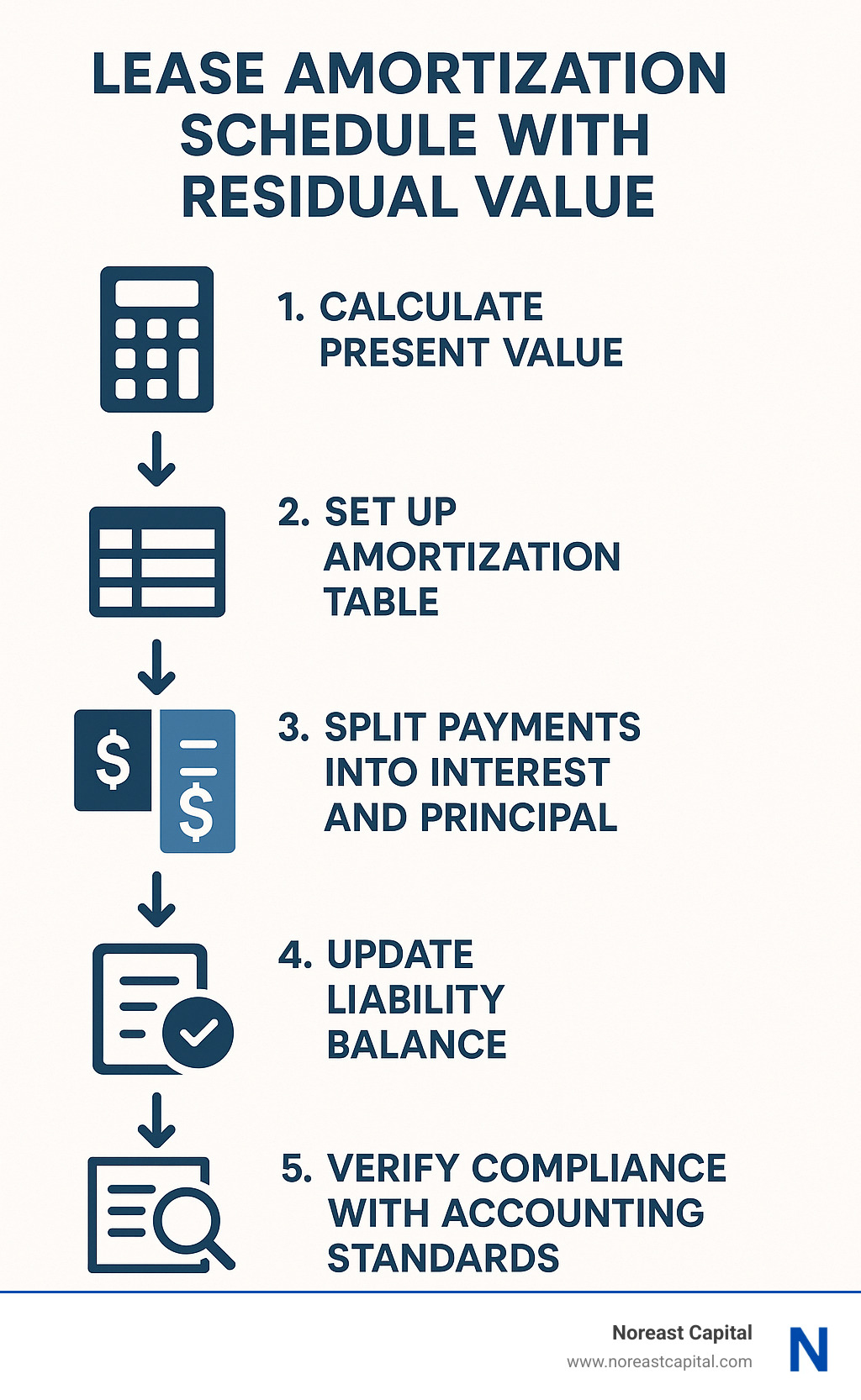
Building a Lease Amortization Schedule with Residual Value: Step-By-Step
Building your own lease amortization schedule with residual value might seem daunting, but it’s actually quite manageable once you understand the process. Think of it like following a recipe – get the ingredients right, follow the steps, and you’ll have exactly what you need.
The biggest difference between finance leases and operating leases shows up in how you recognize expenses. Finance leases split costs into interest expense and amortization expense, while operating leases use a single straight-line lease expense. Both types still require the same underlying amortization schedule.
| Component | Finance Lease | Operating Lease |
|---|---|---|
| Initial Recognition | Lease Liability & ROU Asset | Lease Liability & ROU Asset |
| Expense Recognition | Interest + Amortization | Straight-line Lease Expense |
| Balance Sheet Impact | Separate Asset/Liability | Combined Expense Recognition |
| Residual Treatment | Included in Liability | Affects ROU Asset Calculation |
Setting up your Excel spreadsheet is straightforward. Start by creating input fields for your key variables: lease term, payment amount, interest rate, residual value, and whether payments happen at the beginning or end of each period. These inputs feed into all your calculations.
Next, build your column headers across the top: Period, Payment Date, Cash Payment, Interest Expense, Principal Payment, and Liability Balance. This creates the framework for your entire schedule.
Here’s where Excel becomes your best friend: use the Goal Seek function to back-solve for the initial liability balance. Set your final balance to zero (or the residual value), and let Excel figure out what your starting liability should be.

One detail that trips up many people: payment timing. Whether payments happen at the beginning or end of each period affects your present value calculations. The difference is usually small – less than 0.2% over a 60-month lease – but consistency matters for compliance purposes.
If you’d rather skip the Excel work entirely, our Lease Amortization Schedule Calculator handles all these calculations automatically.
Calculating the present value when crafting a lease amortization schedule with residual value
The present value calculation is where your lease amortization schedule with residual value really begins. This number becomes your initial lease liability, so accuracy here sets the foundation for everything else.
Excel’s NPV function makes this calculation manageable. For beginning-of-period payments, use =NPV(rate, payment_range) + initial_payment. For end-of-period payments, simply use =NPV(rate, payment_range).
Choosing the right discount rate can be tricky. You’ll use either the lease’s implicit rate (if you know it) or your incremental borrowing rate. The incremental borrowing rate represents what you’d pay to borrow money for similar terms and security.
Don’t forget about balloon payments if your lease includes a guaranteed residual payment. This future payment needs to be discounted back to present value along with your regular payments.
Splitting each payment in a lease amortization schedule with residual value
Once you have your initial liability, every payment in your lease amortization schedule with residual value splits into two parts: interest and principal. Think of it like a mortgage payment – early payments are mostly interest, while later payments are mostly principal.
The interest calculation is straightforward: multiply your opening liability balance by the periodic interest rate. For a 6% annual rate, your monthly rate would be 6% ÷ 12 = 0.5%. Apply this percentage to whatever liability balance remains at the start of each period.
Your principal payment is simply your total cash payment minus the interest expense. This amount directly reduces your liability balance and grows larger over time as the interest portion shrinks.
The liability roll-forward continues this pattern throughout the lease term. Your new balance equals the opening balance minus the principal payment. Keep going until your liability reaches zero (or the residual value, depending on your lease structure).
Journal entries depend on whether you’re dealing with an operating or finance lease. Operating leases use a single lease expense line item, while finance leases separate interest expense from amortization expense.
Advanced Considerations & Pro Tips
Working with a lease amortization schedule with residual value gets more complex when you dig into the real-world details that can make or break your calculations. Let me walk you through the advanced considerations that separate the pros from the beginners.
Payment timing is one of those details that seems minor but matters more than you’d think. Most equipment leases use beginning-of-period payments (period 0), meaning your first payment happens when you sign the lease, not at the end of the first month. While this timing difference only affects present value by less than 0.2% over a 60-month lease, getting it wrong can throw off your entire schedule.
Escalation clauses are becoming increasingly common, especially with inflation concerns. Many leases include annual increases of 3-5%. For example, if your lease starts at $7,500 monthly with 3% annual bumps, you’ll need to calculate each year’s payment separately using the formula: New Payment = Prior Payment × (1 + Escalation Rate).
Variable payments add complexity. Some leases include components based on usage, performance metrics, or market indices. Under ASC 842, you can only include variable payments that depend on an index or rate in your initial measurement. Usage-based variables stay off the books until they actually occur.
Solving for the implicit rate when you know the payment but not the rate requires numerical methods like Newton-Raphson iteration, which involves setting up the lease payment equation and solving for the rate that makes the present value equal the asset’s fair value.
The operating versus finance lease classification creates different recognition patterns that affect your amortization approach. Operating leases use straight-line expense recognition over the lease term, while finance leases require separate interest expense on the liability plus amortization of the right-of-use asset.
For more detailed calculation methods, check out our Equipment Lease Formula guide.

Automating Schedules vs DIY Excel
Let’s be honest about Excel’s limitations when building a lease amortization schedule with residual value. While Excel can absolutely handle the math, it’s like using a screwdriver when you really need a power drill.
Excel works fine for understanding the mechanics and handling a few simple leases. You can set up formulas, create your columns, and get accurate results. But once you’re dealing with multiple leases, modifications, or complex terms, Excel becomes more burden than benefit.
The manual approach has real drawbacks: formula errors creep in easily, lease modifications require rebuilding entire schedules, managing large lease portfolios becomes overwhelming, and there’s no automated compliance reporting.
Specialized lease software offers significant advantages like automated schedule generation, built-in ASC 842 and IFRS 16 compliance, easy modification handling, and portfolio-level reporting with audit trails.
My recommendation? Start with Excel to understand how the calculations work, then move to specialized tools for operational efficiency. Understanding the manual process helps you validate software results and catch any discrepancies.
For quick calculations without the Excel hassle, try our Equipment Leasing Calculator to see how automation can simplify your workflow.
Real-World Example & Tools
Nothing beats seeing how a lease amortization schedule with residual value works in practice. Let’s walk through a real example that shows exactly how the numbers break down month by month.
Our Example: You’re looking at leasing a commercial delivery vehicle for your business. The truck costs $30,000 new, but after crunching the numbers, you decide leasing makes more sense for your cash flow. Here’s what the deal looks like:
The vehicle will be worth $17,400 at the end of your 36-month lease—that’s 58% of its original value, which is pretty typical for commercial vehicles. With a 5% annual interest rate (that’s 0.417% monthly), your payment comes out to $407 per month.
Here’s where it gets interesting. You’re not financing the full $30,000. Instead, you’re only paying for the depreciation—the difference between what the truck costs today and what it’ll be worth when you’re done with it. That’s just $12,600 spread over three years.

Here’s how your first few months look:
| Period | Beginning Balance | Payment | Interest | Principal | Ending Balance |
|---|---|---|---|---|---|
| 0 | $12,600 | $407 | $0 | $407 | $12,193 |
| 1 | $12,193 | $407 | $51 | $356 | $11,837 |
| 2 | $11,837 | $407 | $49 | $358 | $11,479 |
| 3 | $11,479 | $407 | $48 | $359 | $11,120 |
Notice how the pattern works? Your payment stays the same at $407, but each month, less goes to interest and more goes to paying down the principal. That’s because you’re paying interest on a smaller balance each time.
The accounting side is straightforward too. Each month, you’ll record your lease expense and reduce your lease liability. For month one, your journal entry looks like this: debit lease expense for $407, credit cash for $407, and credit your lease liability for the $356 principal portion.
By month 36, your balance hits zero, and you can either walk away or buy the truck for its residual value of $17,400. The beauty of this structure is that you’ve only tied up $407 per month instead of the much larger loan payment you’d have if you bought the truck outright.
Interactive Calculators & Templates
We know that building these schedules from scratch can be time-consuming, especially when you’re trying to compare different scenarios. That’s why we’ve put together tools that do the heavy lifting for you.
What makes our calculators different is that they’re built specifically for equipment financing. You can plug in your numbers and immediately see how changes affect your bottom line. Want to see what happens if you negotiate a higher residual value? Just adjust the slider and watch your monthly payment drop.
Scenario planning becomes simple when you can model different lease terms side by side. Maybe you’re debating between a 36-month lease with higher payments versus a 48-month lease that’s easier on monthly cash flow. Our tools show you the total cost of each option, including the interest you’ll pay over the life of the lease.
For detailed guidance on the calculations behind these tools, check out our comprehensive guide on How to Calculate a Lease Payment.
These tools help you move beyond just looking at monthly payments to understanding the complete financial picture. After all, the lowest monthly payment isn’t always the best deal if you’re paying more in total interest or getting stuck with unfavorable terms.
Frequently Asked Questions about Lease Amortization & Residuals
When I work with business owners on their lease amortization schedule with residual value calculations, I hear the same questions over and over. Let me clear up the most common confusion points that come up in my daily conversations with clients.
How does operating vs finance lease amortization differ?
This is probably the question I get asked most often, and for good reason—the accounting treatment creates very different expense patterns on your books.
Operating leases keep things simple. You record a single straight-line lease expense over the entire term. Think of it like spreading peanut butter evenly on toast—the expense stays consistent month after month. Your right-of-use asset amortization acts as a balancing item to make sure your total expense equals your total cash payments.
Finance leases work more like traditional loans. You’ll see separate interest expense and asset amortization on your books. This creates what we call a “front-loaded” expense pattern—you’ll pay more in the early months and less toward the end of the lease.
Here’s where it gets interesting: under IFRS 16, all leases get treated as finance leases. But if you’re following ASC 842 in the US, you still get to choose between operating and finance treatment based on specific criteria.
The practical impact? Your lease amortization schedule with residual value will look identical for cash flow purposes, but your income statement will tell a different story depending on which classification you use.
What happens if the asset’s market value is below the residual?
This scenario happens more often than you might think, especially with technology equipment or vehicles in volatile markets. The financial impact depends entirely on how your lease is structured.
With a guaranteed residual, you’re essentially providing insurance to the lessor. If your lease shows a $17,400 residual value but the asset is only worth $15,000 at lease end, you’ll need to pay that $2,400 difference. It’s like being responsible for the “shortfall” between expectations and reality.
Unguaranteed residuals shift the risk back to the lessor. In this case, you can simply return the asset without any additional payment, regardless of its actual market value. The lessor takes the hit if values decline more than expected.
Purchase options give you flexibility. When lease end arrives, you can compare the predetermined purchase price to the asset’s actual market value and make the choice that benefits your business most.
I always tell my clients to think carefully about guaranteed residuals—they can provide lower monthly payments, but they also transfer market risk to your balance sheet. Make sure you’re comfortable with that trade-off before signing.
Does payment timing really change the present value?
The short answer is yes, but probably not as much as you’d expect. The timing difference between beginning-of-month and end-of-month payments affects your present value calculations by less than 0.2% over a typical 60-month lease.
Here’s what really matters: the discount rate you choose has a much bigger impact on your calculations. Even a small 0.4% change in your discount rate will affect your present value far more than whether you pay at the beginning or end of each period.
My recommendation? Pick a payment timing convention—either beginning or end of period—and stick with it consistently across all your leases. This consistency becomes crucial when auditors review your books or when you’re comparing different lease options.
The key insight is that while payment timing does matter mathematically, it’s the consistency of your approach that matters most for compliance and financial reporting. Focus your energy on getting the discount rate right and maintaining consistent methodology across your lease amortization schedule with residual value calculations.
Conclusion
Creating a lease amortization schedule with residual value isn’t just about crunching numbers—it’s about giving yourself the financial clarity you need to make smart business decisions. Think of it as your roadmap to understanding exactly where every dollar of your lease payment goes.
The compliance piece is straightforward but crucial. With ASC 842 and IFRS 16 requirements, you need accurate schedules that show auditors exactly how you’re handling lease accounting. No guesswork, no approximations—just clean, defensible documentation that keeps you on the right side of accounting standards.
But here’s where it gets really valuable for your business: understanding these calculations transforms how you evaluate equipment financing options. Instead of just comparing monthly payments, you can see the true cost structure. You’ll know whether that lower payment comes from a better interest rate or just a higher residual value that might bite you later.
The cash flow benefits are immediate and measurable. When you lease that $30,000 delivery truck with a 58% residual value, you’re only financing $12,600 through your monthly payments. That’s a significant difference in cash flow compared to financing the full purchase price. Your working capital stays in your business where it belongs.
At Noreast Capital, we’ve watched countless businesses transform their equipment acquisition strategy once they grasp these concepts. Whether you’re expanding operations in Baltimore, opening a new location in Annapolis, or scaling up in Washington DC, understanding lease structures helps you preserve cash flow while getting the equipment you need.
The real beauty of mastering these calculations is the confidence it gives you. No more wondering if you’re getting a fair deal or feeling lost when reviewing lease proposals. You can evaluate offers side-by-side, negotiate from a position of knowledge, and choose financing that truly fits your business model.
For detailed payment calculations and side-by-side comparisons, check out our Lease Payment Calculation resources.
The math might look intimidating at first, but the core concept is simple: you’re paying for the equipment’s depreciation plus interest on the full value. Each payment chips away at your liability until the lease ends. With the right approach and tools, creating these schedules becomes just another part of managing your business finances—not a mysterious black box that keeps you up at night.