

When contemplating financial growth and flexibility, especially for businesses looking to manage equipment costs effectively, a lease formula calculator becomes an invaluable tool. Here’s what you need to know upfront:
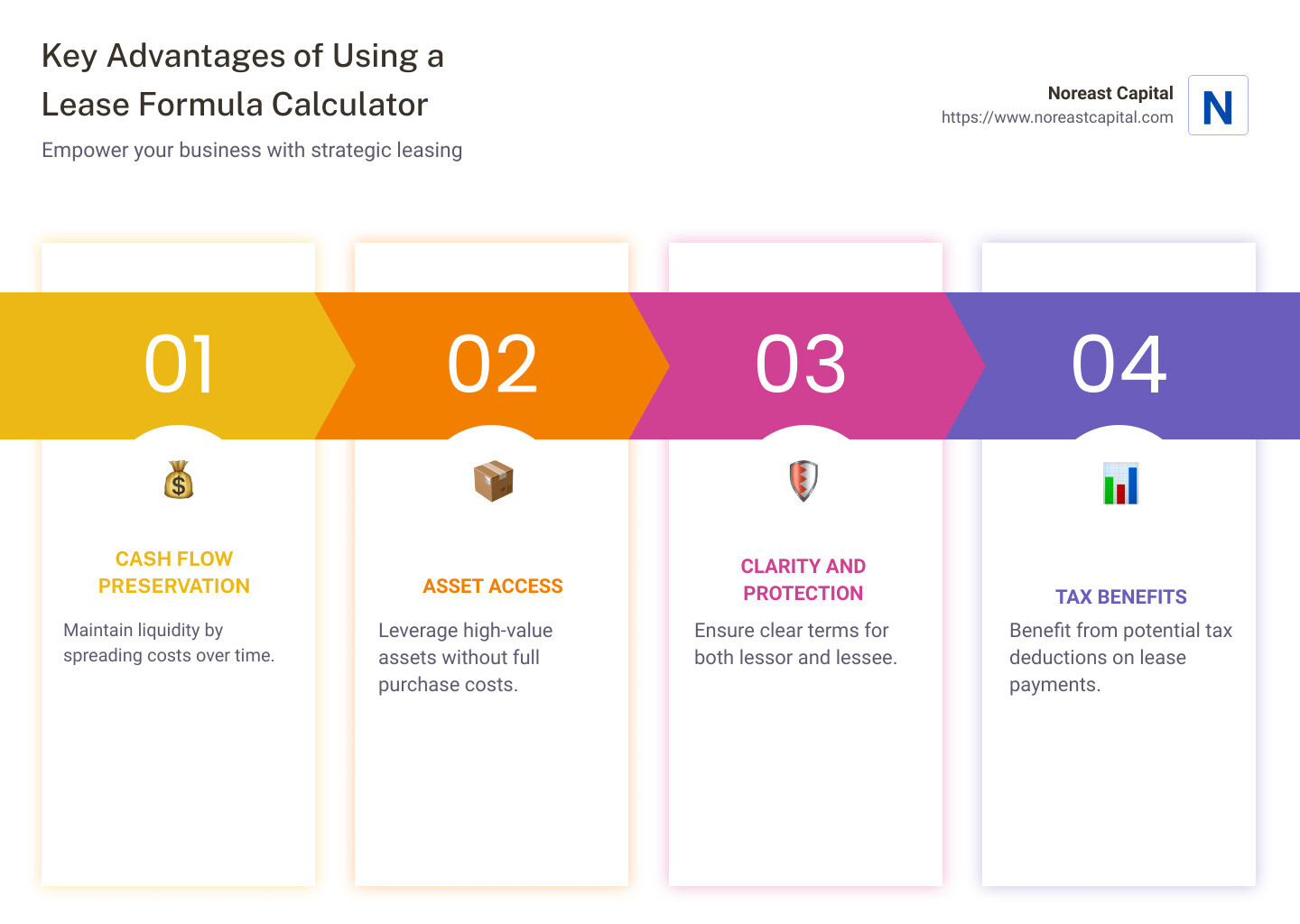
- Leasing offers a strategic avenue to use high-value assets without incurring full purchase costs upfront.
- Contractual agreements ensure clarity and protection for both lessor and lessee.
- Financial advantages, such as cash flow preservation and tax benefits, are significant reasons businesses opt for leasing over buying.
The concept of leasing is all about maximizing access while minimizing risk. It allows businesses to leverage necessary assets while maintaining cash flow for other critical areas of operation. With leasing, the business owner and the equipment do not have to meet head-on with steep costs or rapidly depreciating values. Instead, they enter into a partnership via a lease contract, which clearly outlines terms, payments, and end-of-lease options.
I’m Vincent Cerniglia, an expert in the field of lease formula calculators, with longstanding experience in helping businesses like yours steer the complex world of equipment financing. My work with Noreast Capital has empowered countless enterprises to make informed leasing decisions, and I am here to guide you through this financial journey with clarity and confidence.
Handy lease formula calculator terms:
– capital equipment finance calculator
– finance lease calculator
– lease amortization schedule calculator
Understanding Lease Calculations
When it comes to leasing, understanding the lease formula is crucial. This formula is the backbone of determining your monthly payments and the asset’s residual value at the end of the lease term.
The Lease Formula
The lease formula is a simple way to calculate what you’ll pay each month. It primarily considers the capitalized cost (the price of the asset you’re leasing) and the residual value (what the asset will be worth at the end of the lease). Here’s a basic breakdown:
- Capitalized Cost: Think of this as the starting line. It’s the agreed value of the asset at the beginning of the lease.
- Residual Value: This is the finish line. It’s the estimated worth of the asset when the lease ends. This value is crucial because it affects the monthly payment amount.
Monthly Payments
Your monthly lease payments are like the stepping stones between the starting line and the finish line. They cover two main aspects:
Depreciation Fee: This part of your payment compensates for the asset’s loss in value over the lease term. It’s calculated as the difference between the capitalized cost and the residual value, divided by the number of months in the lease.
Interest Charge: Known in leasing as the money factor, this is the cost of borrowing the asset. It’s a small percentage of the sum of the capitalized cost and residual value.
Here’s a quick example: If you lease a car with a capitalized cost of $30,000 and a residual value of $16,000 over 36 months, your monthly depreciation fee would be around $388. Add the interest charge, and you have your total monthly payment.
Residual Value
The residual value is more than just a future guess. It’s a key player in your lease. A higher residual value means lower monthly payments. This is because you’re paying for less depreciation.
Residual values are often pre-set by the lessor. It’s wise to research and compare these values to ensure they align with industry standards. Overestimating can lead to higher payments, while underestimating might affect your decision to buy the asset at lease-end.
Understanding these components helps you use a lease formula calculator effectively. It ensures you’re not just signing a contract but making a strategic financial decision.

In the next section, we will dig deeper into using the lease formula calculator to explain the components like capitalized cost and depreciation fee, helping you make confident leasing decisions.
Lease Formula Calculator: A Comprehensive Guide
When leasing an asset, the lease formula calculator is your best friend. It helps you understand the financial aspects of your lease, breaking down complex calculations into simple terms. Let’s explore the key components of this calculator: capitalized cost and depreciation fee.
Capitalized Cost
The capitalized cost is the starting point of your lease. It’s essentially the negotiated price of the asset you’re leasing, much like the selling price if you were buying it. This cost includes the asset’s price minus any down payments or trade-ins.
- Think of it as the sticker price on a car, but after you’ve haggled it down.
Having a lower capitalized cost means you’ll pay less in the long run. This is why negotiating a good deal upfront is crucial.
Depreciation Fee
The depreciation fee is a vital part of your monthly payments. It covers the asset’s loss in value over the lease term. To calculate it, subtract the residual value from the capitalized cost and divide by the number of months in the lease.
For example, if you lease a piece of equipment with a capitalized cost of $50,000 and a residual value of $20,000 over 48 months, your monthly depreciation fee is about $625.
- This fee ensures you’re only paying for the asset’s use during the lease, not its entire value.
Using the Lease Formula Calculator
A lease formula calculator makes these calculations straightforward. By inputting values like the capitalized cost, residual value, lease term, and interest rate, you can quickly determine your monthly payments. This tool helps you plan your finances and avoid surprises.
To use the calculator effectively:
- Enter the Capitalized Cost: Start with the negotiated price of the asset.
- Input the Residual Value: Estimate what the asset will be worth at lease-end.
- Specify the Lease Term: Indicate how many months you’ll be leasing the asset.
- Include the Interest Rate: This is often expressed as a money factor.
By understanding these elements, you can leverage the lease formula calculator to make informed leasing decisions. This ensures you’re not just signing on the dotted line but strategically managing your financial commitments.
In the next section, we’ll explore other crucial components of a lease, such as the money factor, mileage, and wear and tear, to further empower your leasing knowledge.
Key Components of a Lease
When navigating leasing, understanding the key components can save you money and stress. Let’s break down three critical elements: money factor, mileage, and wear and tear.
Money Factor
The money factor is a crucial part of your lease payments. It’s similar to an interest rate on a loan. The lower the money factor, the less you’ll pay in interest over the lease term.
How is it calculated? Multiply the money factor by 2,400 to convert it to an annual percentage rate (APR). For example, a money factor of 0.002 translates to an APR of 4.8%.
Why does it matter? A lower money factor means lower monthly payments. It’s often based on your credit score, so maintaining a good score can save you money.
Mileage
Mileage limits are standard in vehicle leases. Most leases include a mileage cap, typically between 10,000 to 15,000 miles per year. Exceeding this limit can lead to penalties, usually ranging from 5 to 20 cents per mile over the limit.
Tip: If you drive a lot, consider a high mileage lease. It might have higher monthly payments, but could save you from hefty penalties.
Average American Mileage: That the average American drives about 18,000 miles a year. Plan accordingly to avoid unexpected costs.
Wear and Tear
Wear and tear refer to the condition of the leased asset when you return it. Leases expect “normal” wear and tear, but “excessive” wear and tear can result in charges.
Normal vs. Excessive: Normal wear might include minor scratches or small dings. Excessive wear could be large dents or major interior damage.
Avoiding Charges: Take care of the asset as if it were your own. Regular maintenance and minor repairs before returning the asset can help avoid penalties.
Understanding these components can help you make better leasing decisions and manage your lease effectively. In the next section, we’ll answer some frequently asked questions about lease calculations, including how to calculate monthly payments and APR.
Frequently Asked Questions about Lease Calculations
What is the formula for calculating a lease?
Calculating a monthly lease payment might seem daunting, but it’s simpler than you think. Here’s a basic breakdown:
Capitalized Cost (Cap Cost): This is the negotiated price of the vehicle. It’s the starting point for your lease calculations.
Residual Value: This is what the car is expected to be worth at the end of the lease. It’s usually set by the lender and is non-negotiable.
Depreciation Fee: This is the difference between the cap cost and the residual value, divided by the number of months in the lease. This fee covers the loss in value over the lease term.
Interest (or Rent) Charge: This is calculated by multiplying the sum of the cap cost and the residual value by the money factor.
Monthly Payment Formula:
[
\text{Monthly Payment} = \text{Depreciation Fee} + \text{Interest Charge}
]
Don’t forget upfront costs like down payments, taxes, and fees. These can affect your total lease cost.
How to calculate APR on a lease?
The Annual Percentage Rate (APR) is a familiar term for anyone who’s taken out a loan, but in leasing, it’s called the money factor. Converting the money factor to an APR can give you a clearer picture of your interest costs.
Conversion Formula: Multiply the money factor by 2,400 to get the APR. For example, if your money factor is 0.0015, the APR is 3.6%.
Why Bother with APR? Understanding the APR helps you see the true cost of leasing. It allows you to compare leasing with other financing options like loans.
What is the lease value rule?
The lease value rule is particularly relevant for business leases and personal use of company vehicles. It determines the taxable benefit of using a leased vehicle for personal reasons.
Annual Lease Valuation: This is the method used to calculate the value of the personal use of a company car. It considers the fair market value of the vehicle and the percentage of personal use.
Why It Matters: Knowing the annual lease valuation helps in understanding potential tax implications. It ensures you’re compliant with tax regulations while using a company vehicle for personal errands.
Understanding these calculations can help you steer the leasing process with confidence. In the next section, we’ll explore further details on leasing, including common misconceptions and tips for negotiating better terms.
Conclusion
At Noreast Capital, we believe that understanding lease calculations is key to making informed financial decisions. Our goal is to provide businesses with the tools they need to thrive without the burden of ownership. Leasing equipment can be a strategic move for companies looking to save money and maintain cash flow, and our lease formula calculator is designed to make this process easy and transparent.
Equipment Leasing with Noreast Capital offers several financial solutions that cater to diverse business needs. By leasing, companies can access the latest technology and equipment without the upfront costs, allowing them to allocate resources more effectively. This flexibility is especially beneficial for businesses that need to adapt quickly to changing market demands.
Our services are not just about leasing; we offer a comprehensive approach to equipment financing. Whether you’re looking to lease office furniture, electronic gadgets, or heavy machinery, we ensure a seamless experience from start to finish. With locations in Annapolis, Baltimore, and Washington, D.C., we’re well-positioned to support businesses across the region.
Explore how Noreast Capital can help your business grow with our equipment leasing calculator and find the benefits of leasing with confidence.