

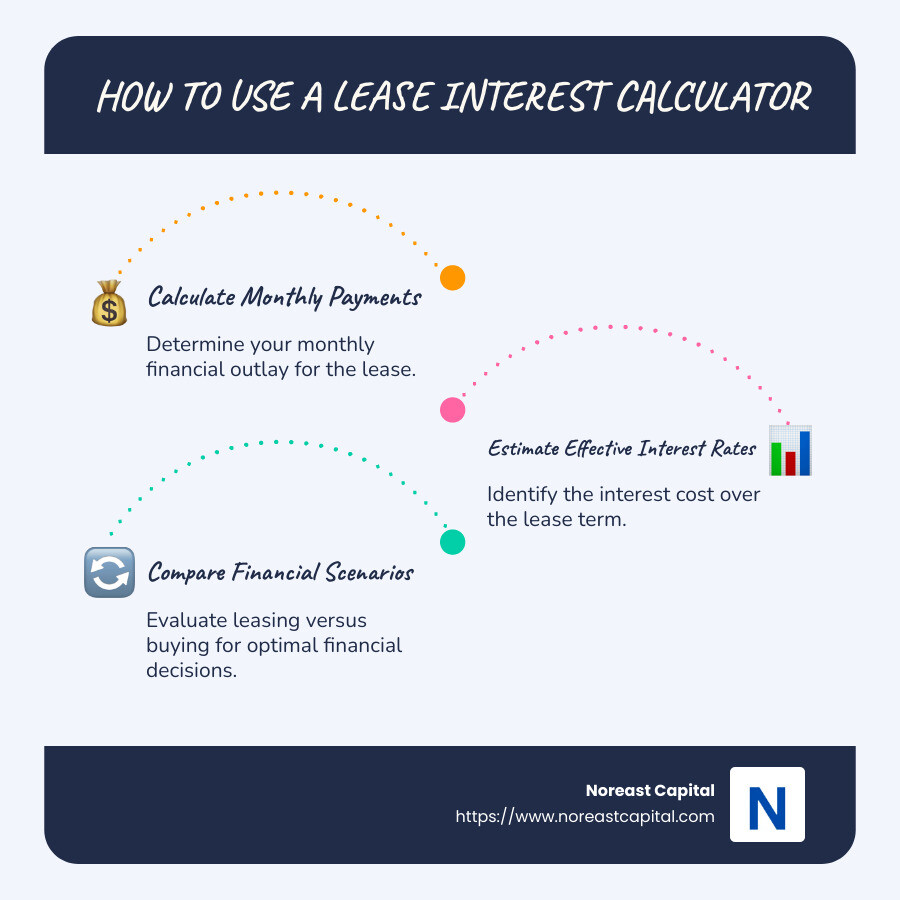
A lease interest calculator can be an essential tool for any business owner aiming to make informed decisions about leasing without getting bogged down by complex financial jargon. Whether you’re considering leasing new equipment or a vehicle, calculating the lease interest helps in evaluating the total cost and understanding the financial commitment involved. Here’s a quick breakdown of what a lease interest calculator can do for you:
- Calculate Monthly Payments: Determine what your monthly financial outlay will be.
- Estimate Effective Interest Rates: Understand how much interest you’ll pay over the term of the lease.
- Compare Financial Scenarios: Weigh leasing against buying to see which option suits your financial strategy better.
Leasing has become a popular alternative to buying due to its lower upfront costs and potential tax benefits. However, understanding the full financial picture is crucial, which is where lease interest calculations become invaluable.
As Vincent Cerniglia from Noreast Capital, I’ve witnessed the transformative power of leasing in preserving cash flow while accessing essential equipment. My experience in equipment financing makes me an advocate for using lease interest calculators to ensure businesses get the best possible deal.
Know your lease interest calculator terms:
– finance lease calculator
– lease amortization schedule calculator
– lease formula calculator
Understanding Lease Interest
When you’re diving into leasing, understanding lease interest is crucial. The term “lease interest” might sound complex, but it boils down to a few key concepts: the money factor, the interest rate, and the lease interest rate.
What is the Money Factor?
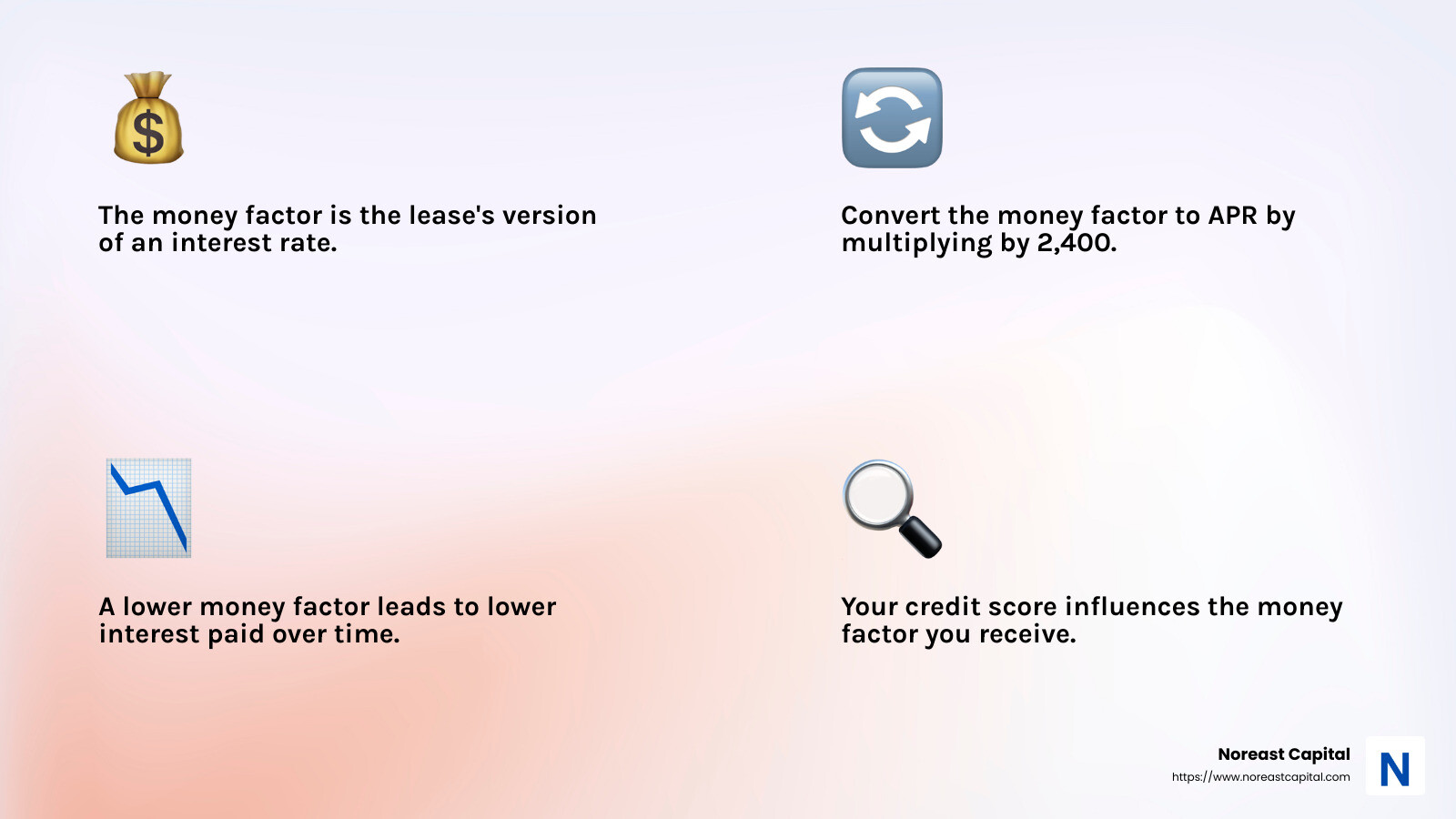
The money factor is a term you’ll often encounter in leasing. It’s essentially the financing charge you’ll pay on a lease. Think of it as the lease’s version of an interest rate. Unlike the interest rates you’re familiar with, the money factor is usually a small decimal number, like 0.002.
To convert this to a more recognizable annual percentage rate (APR), you multiply by 2,400. For example, a money factor of 0.002 translates to an APR of 4.8%. This conversion helps you compare leasing costs to traditional loan interest rates.
Interest Rate vs. Lease Interest Rate
While the terms might seem interchangeable, there’s a subtle distinction between an interest rate and a lease interest rate. The interest rate is the cost of borrowing money, expressed as a percentage. In leasing, the interest rate is embedded in the lease payments, and it is often represented by the money factor.
The lease interest rate, on the other hand, is a broader term that encompasses all costs associated with leasing, including the money factor and any additional fees. This rate gives you a complete picture of what you’re paying to lease an asset.
Why Lease Interest Matters
Understanding the lease interest rate is vital because it affects your total lease cost. A lower money factor means less interest paid over time, making it crucial to negotiate this factor when entering a lease agreement. Your credit score plays a significant role here; a higher score usually means a lower money factor, saving you money in the long run.
Being informed about lease interest rates can save you a substantial amount of money. It empowers you to negotiate better terms and make smarter financial decisions.
By grasping these concepts, you can take control of your leasing agreements and ensure they align with your financial goals.
How to Use a Lease Interest Calculator
When you’re looking to lease an asset, understanding the financial implications is crucial. A lease interest calculator can help you make sense of the numbers. Let’s break down how you can use it to calculate your monthly payments and effective interest rate.
Using the Lease Calculator
1. Determine Your Monthly Payment
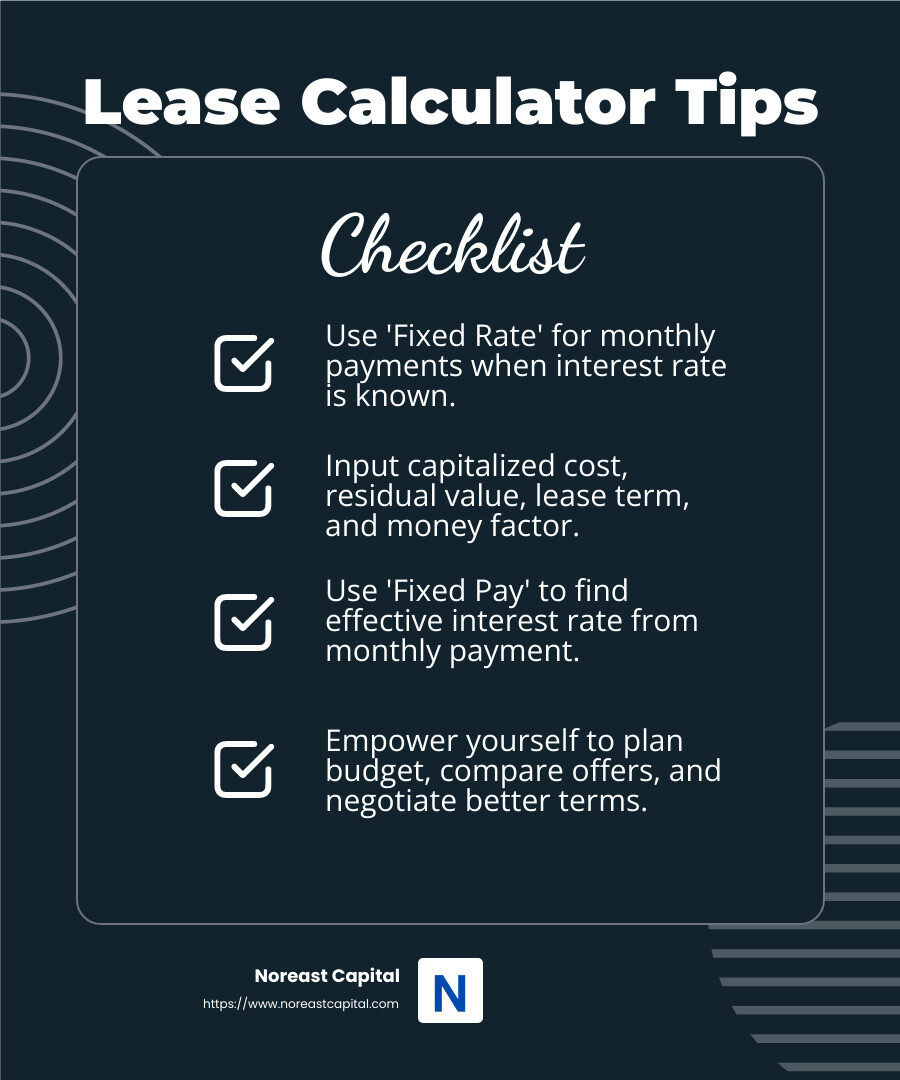
If you already know the interest rate, you can use the “Fixed Rate” tab on the calculator to find out your monthly payment. Here’s what you’ll need:
- Capitalized Cost: The negotiated price of the asset you’re leasing.
- Residual Value: The estimated value of the asset at the end of the lease term.
- Lease Term: The duration of your lease, typically in months.
- Money Factor: The small decimal number that represents the interest on your lease.
With this information, the calculator will compute your monthly payment. This payment primarily covers the asset’s depreciation and the interest charges.
2. Calculate the Effective Interest Rate
If you’re starting with a known monthly payment, use the “Fixed Pay” tab. Here’s what you’ll input:
- Monthly Payment: The amount you pay each month.
- Capitalized Cost and Residual Value: As before, these values are crucial.
- Lease Term: Again, this is the number of months in your lease agreement.
The calculator will then provide the effective interest rate, helping you understand the true cost of financing your lease.
Why Use a Lease Interest Calculator?
A lease interest calculator is a valuable tool because it takes the guesswork out of leasing. By providing clear figures, it allows you to:
- Compare Offers: See how different interest rates and terms affect your payments.
- Plan Your Budget: Know exactly what you’ll pay each month, helping you manage your finances better.
- Negotiate Better Terms: Armed with accurate calculations, you can negotiate a more favorable lease agreement.
Using a lease interest calculator empowers you to make informed decisions and avoid unexpected financial surprises.
By leveraging this tool, you can ensure that your lease aligns with your financial goals and offers the best value for your money.
Calculating Lease Interest: Step-by-Step Guide
Calculating lease interest can seem tricky, but breaking it down step-by-step makes it manageable. Let’s explore the key elements: money factor conversion, residual value, and depreciation.
Step 1: Money Factor Conversion
The money factor is the lease’s version of an interest rate. It’s usually displayed as a small decimal, like 0.00125. To convert this into a more familiar annual percentage rate (APR), multiply it by 2,400.
For example, a money factor of 0.00125 translates to an APR of 3% (0.00125 x 2,400 = 3%).
Why is this important? Knowing the APR lets you compare the lease interest to traditional loan interest rates. A lower money factor means you’re paying less in financing charges.
Step 2: Understanding Residual Value
The residual value is what the asset is worth at the end of the lease. This value is set by the lender and is non-negotiable.
Why does it matter? A higher residual value means you’ll use less of the asset’s value, which can lower your monthly payment. For instance, if a car has a residual value of 60% after three years, you’re only responsible for 40% of its original value.
Step 3: Calculating Depreciation
Depreciation is the amount the asset loses in value over the lease term. This is a big part of your monthly payment.
How to calculate it:
- Start with the Capitalized Cost: This is the negotiated price of the asset.
- Subtract the Residual Value: This gives you the total depreciation over the lease term.
For example, if a car’s capitalized cost is $30,000 and its residual value is $18,000, the depreciation is $12,000 over the lease period.
Pulling It All Together
With these elements—money factor, residual value, and depreciation—you can calculate your lease interest and payments.
Why does this matter? Understanding these components helps you:
- Make Informed Decisions: Know exactly what you’re paying for.
- Plan Financially: Budget effectively by knowing your monthly obligations.
- Negotiate Wisely: Use knowledge to get better lease terms.
By mastering these steps, you can confidently steer the leasing process and ensure your lease is financially sound.
Frequently Asked Questions about Lease Interest
How do you calculate interest on a lease?
To calculate interest on a lease, you need to understand the money factor. This is the lease’s version of an interest rate. It’s usually a small decimal like 0.00125. To find the equivalent annual percentage rate (APR), multiply the money factor by 2,400.
For example, if your money factor is 0.002, your APR would be 4.8% (0.002 x 2,400 = 4.8%).
Why is this important? Knowing the APR helps you compare lease interest to traditional loan interest rates. A lower money factor means you pay less in financing charges.
What is a typical lease interest rate?
Lease interest rates, or leasing rates, can vary widely. They depend on your credit score, the lease term, and market conditions. Typically, these rates range from 2% to 16%.
What affects these rates?
- Credit Score: Higher scores can get you lower rates.
- Lease Term: Longer leases might offer better rates.
- Market Conditions: Economic factors can influence the rates lenders offer.
Tip: Always check the market rates before leasing to ensure you’re getting a fair deal.
What is the 1% rule in car leasing?
The 1% rule is a simple guideline to evaluate if a car lease is a good deal. According to this rule, your monthly payment should be about 1% of the car’s Manufacturer’s Suggested Retail Price (MSRP).
For example:
- If the car’s MSRP is $30,000, aim for a monthly payment of $300 or less.
Why use the 1% rule?
- Quick Assessment: It provides a quick way to gauge the lease’s affordability.
- Budget Planning: Helps ensure the lease fits within your financial plan.
Remember: This is just a guideline. Other factors like down payment and lease terms also affect the overall cost. Always use a lease interest calculator to get a detailed breakdown of your payments.
Conclusion
At Noreast Capital, we understand that navigating equipment leasing can be complex. Our goal is to make it simple and accessible for businesses of all sizes. With our expertise in equipment leasing, we offer financial solutions that allow businesses to use the equipment they need without the burden of ownership. This helps maintain cash flow and save money.
Why choose Noreast Capital? We provide customizable leasing options custom to your unique needs. Whether you’re a restaurant owner looking to upgrade your kitchen or a business needing the latest technology, our solutions ensure that you can operate efficiently and effectively.
Our equipment leasing calculator is a powerful tool designed to help you understand the financial implications of your lease. By using this calculator, you can determine your monthly payments and the effective interest rate, making it easier to plan your finances.
We are committed to supporting your business growth. Our flexible terms and competitive rates mean you can focus on what matters most—running your business. With locations in Annapolis, MD; Baltimore, MD; and Washington, DC, we are well-positioned to serve businesses across the region.
Ready to explore your equipment leasing options? Visit our equipment leasing calculator to get started. Let us help you turn your business goals into reality with the right financial support. Your success is our success, and together, we can achieve great things.