

When it comes to how to lease equipment, small business owners are often looking for a way to acquire the tools they need without draining their cash reserves. Here’s a quick rundown to get you started:
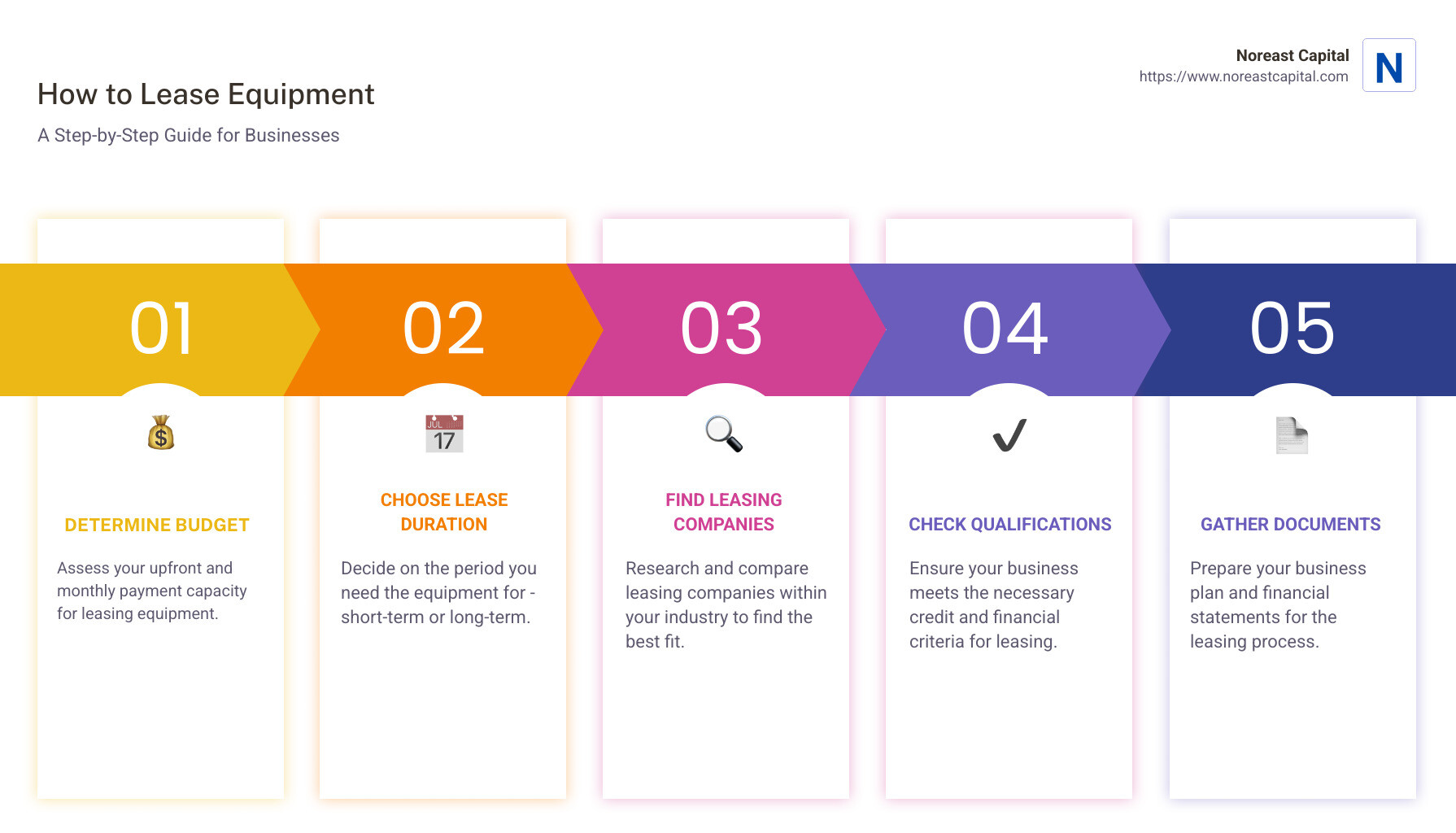
- Determine Budget: Know your upfront and monthly payment capacity.
- Choose Lease Duration: Decide between short-term or long-term use.
- Find Leasing Companies: Research and compare companies in your industry.
- Check Qualifications: Ensure you meet credit and financial criteria.
- Gather Documents: Prepare your business plan and financial statements.
In today’s competitive market, leasing equipment is a strategic move that can boost business growth and manage resources wisely. Equipment leasing offers a flexible solution that aligns with modern financial strategies, allowing companies to stay ahead without the burden of ownership costs.
As Vincent Cerniglia, a leader at Noreast Capital Corporation, I have years of experience helping businesses steer equipment leasing. Our goal is to provide straightforward solutions to keep your business thriving, from choosing the right lease type to managing operational costs.
Find more about how to lease equipment:
– equipment lease agreement
– how does equipment leasing work
– how to get out of an equipment lease
Understanding Equipment Leasing
When it comes to how to lease equipment, understanding the different types of leases is crucial. Not every lease fits every business need, so let’s break down the main types: capital leases and operating leases.
Capital Lease
A capital lease is like a long-term commitment with benefits. Think of it as a rent-to-own deal. You lease the equipment with the intention of owning it at the end of the lease term. This type of lease is perfect if you want to keep the equipment for a long time but don’t have the cash to buy it outright.
Ownership Benefits: With a capital lease, you can treat the leased equipment as an asset on your balance sheet. This means you can claim depreciation and interest expenses on your taxes.
Long-Term Use: Ideal for equipment that you plan to use for many years, like machinery or vehicles. At the end of the lease, you can often purchase the equipment for a nominal fee.
Financial Impact: Capital leases impact your financial statements as if you own the equipment. This can affect your company’s assets and liabilities.
Operating Lease
An operating lease is more like a short-term rental. You use the equipment for a specific period, and at the end, you return it. This type of lease is great for equipment that becomes outdated quickly or for short-term projects.
Flexibility: Operating leases offer lower monthly payments and more flexibility. You can use the latest technology without worrying about obsolescence.
Off-Balance Sheet: Traditionally, operating leases didn’t appear on balance sheets, which helped companies keep a lower debt-to-equity ratio. However, recent accounting standards now require some operating leases to be included on balance sheets.
End-of-Lease Options: At the end of the lease, you can renew, return, or sometimes purchase the equipment at its fair market value. This flexibility is especially beneficial for businesses in industries.
Choosing the Right Lease
Selecting the right lease type depends on your business goals and financial situation. If you want to eventually own the equipment, a capital lease might be the way to go. But if you need flexibility and lower upfront costs, an operating lease could be more suitable.

Understanding these lease types helps you make informed decisions that align with your business’s financial flexibility and operational needs. By choosing wisely, you can preserve cash flow, access the latest technology, and manage your resources effectively.
In the next section, we’ll dig into the benefits of equipment leasing, exploring how it can improve cash flow management, provide access to cutting-edge technology, and offer potential tax advantages.
How to Lease Equipment
When you’re ready to dive into how to lease equipment, grasp the key components involved. Let’s break it down into three simple parts: the lease agreement, the roles of lessor and lessee, and those all-important monthly payments.
Lease Agreement
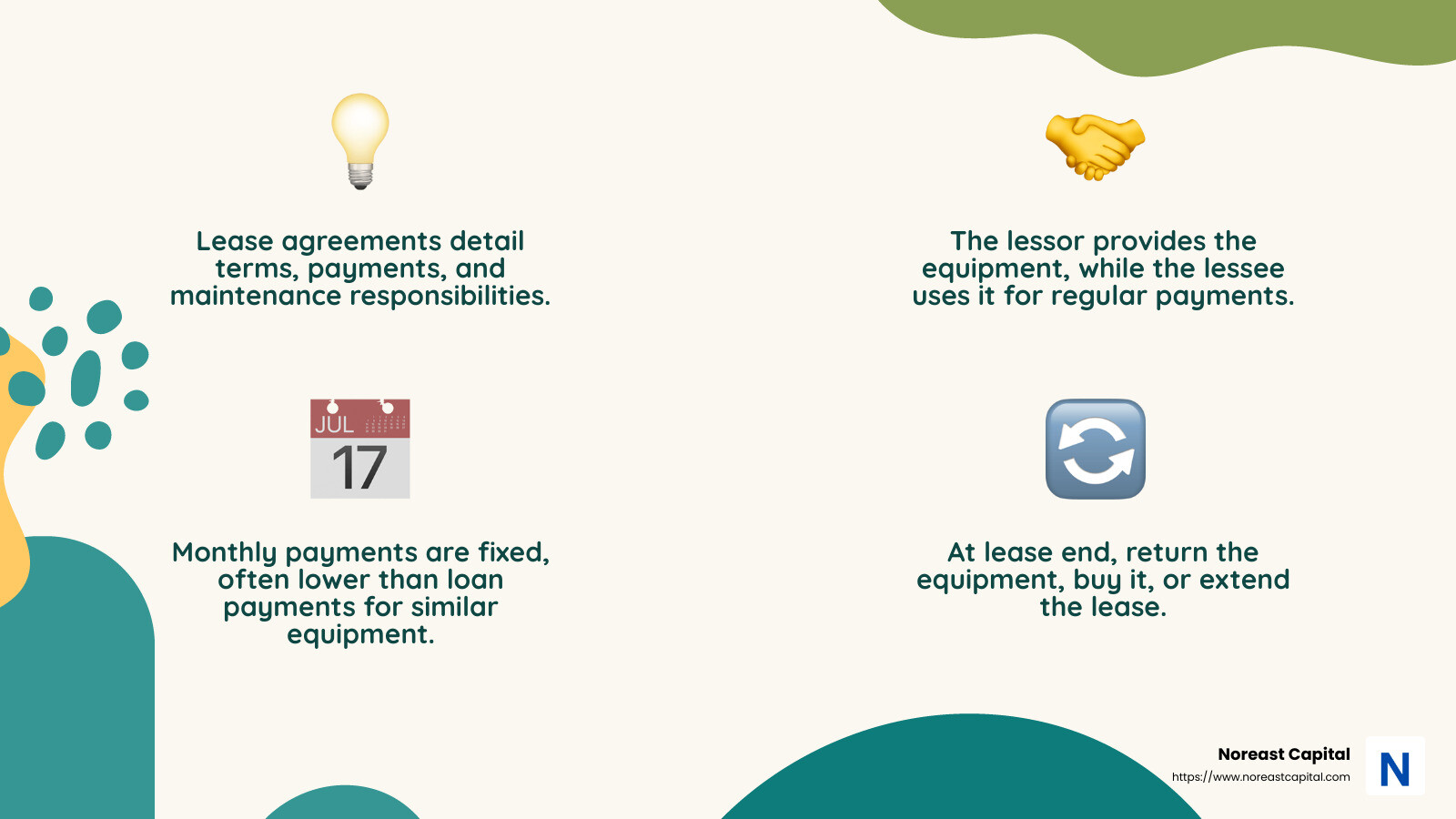
The lease agreement is your roadmap. This contract details everything from the lease term to the monthly payment amount. It spells out maintenance responsibilities, insurance requirements, and end-of-term options.
Think of it as your guide through the leasing journey. Before signing, make sure you understand every detail. If negotiation is possible, focus on elements like lease term and buyout options. However, interest rates and default clauses are usually non-negotiable.
Lessor and Lessee
In this arrangement, the lessor is the equipment owner. They could be a leasing company or a manufacturer. The lessee is you, the business or individual using the equipment.
The lessor provides the asset, while you use it in exchange for regular payments. It’s a win-win: you get the equipment you need without the hefty purchase price, and the lessor gets a steady income stream.
Monthly Payments
Monthly payments are the backbone of your lease. They’re typically fixed, making budgeting easier. These payments are calculated based on the equipment cost, lease term, and your creditworthiness.
Here’s a simple breakdown:
- Initial Costs: Often lower than buying. You might need a small down payment or none at all.
- Regular Payments: Fixed amounts paid monthly, covering the lease’s duration. Usually lower than loan payments for the same equipment.
- End of Lease Options: Return the equipment, buy it at a predetermined price, or extend the lease.
Understanding these elements of how to lease equipment empowers you to make informed decisions. It’s not just about accessing equipment; it’s about financial flexibility and strategic planning.
Next, we’ll explore the benefits of equipment leasing, including how it can boost cash flow and provide access to the latest technology.
Benefits of Equipment Leasing
Leasing equipment offers several advantages that can transform how a business operates. Let’s unpack these benefits, focusing on cash flow management, access to technology, and tax advantages.
Cash Flow Management
Leasing is a smart move for businesses aiming to keep their cash flow healthy. Instead of paying a large sum upfront to buy equipment, leasing spreads the cost over time. This means manageable monthly payments and more cash available for other crucial business needs.
Imagine a startup restaurant in Washington, DC. By leasing its kitchen equipment, the restaurant can allocate funds to marketing and improving customer experience rather than draining its capital on purchases. This strategy keeps the business agile and ready to seize growth opportunities.
Access to Technology
Staying competitive often requires access to the latest tools and technology. Equipment leasing makes this possible without the burden of ownership. At the end of a lease term, businesses can upgrade to newer models, ensuring they always have cutting-edge equipment.
Consider a graphic design company in Baltimore. By leasing high-end computers and software, the company can continuously offer top-notch services to clients. This access to modern technology can be a game-changer in maintaining a competitive edge.
Tax Advantages
Leasing can also offer significant tax benefits. Typically, lease payments are considered a business expense, making them tax-deductible. This provides an immediate tax benefit compared to purchasing, where tax advantages are realized over time through depreciation.
For example, a construction company leasing heavy machinery can deduct lease payments as business expenses, potentially reducing its taxable income. This immediate tax relief can improve the company’s financial health and growth prospects.
In the next section, we’ll dig into the common types of equipment leases available, helping you choose the best fit for your business needs.
Common Types of Equipment Leases
When it comes to how to lease equipment, understanding the different types of leases is crucial. Let’s explore three popular options: the $1 buyout lease, the fair market value lease, and the TRAC lease.
$1 Buyout Lease
The $1 buyout lease is like the “rent-to-own” model. You make monthly payments, and at the end of the lease term, you can purchase the equipment for just $1. This type of lease is ideal if you’re confident that you’ll want to keep the equipment long-term.
- Pros: Ownership at the end, predictable payments.
- Cons: Higher monthly payments compared to other lease types.
This lease is perfect for businesses in Annapolis, MD, that plan to use equipment for many years, like a bakery needing a reliable oven.
Fair Market Value (FMV) Lease
The FMV lease offers flexibility. At the end of the lease term, you have options: buy the equipment at its current market value, renew the lease, or return the equipment. This is great for items that quickly become outdated, like computers.
- Pros: Lower monthly payments, flexibility at the lease end.
- Cons: No ownership unless purchased at market value.
Imagine a tech startup in Baltimore, MD, leasing computers. With an FMV lease, they can easily upgrade to the latest models when the lease ends, keeping their tech cutting-edge.
TRAC Lease
A TRAC (Terminal Rental Adjustment Clause) lease is custom for vehicles, like trucks or vans. You and the lessor agree on the vehicle’s value at the lease’s end. You can then buy the vehicle for that price, renew the lease, or return it.
- Pros: Lower payments, flexibility, custom for vehicles.
- Cons: Residual value risk if the market changes.
A delivery company in Washington, DC, might use a TRAC lease for its fleet, ensuring they have the right vehicles without the commitment of ownership.
In the next section, we’ll discuss how to qualify for equipment leasing, covering important factors like credit score, business plan, and annual revenue.
How to Qualify for Equipment Leasing
Qualifying for equipment leasing is simpler than you might think. Let’s break it down into three key areas: credit score, business plan, and annual revenue.
Credit Score
Your credit score is like your business’s reputation in numbers. A solid score, typically above 600, tells leasing companies you’re reliable. Think of it as a trust signal. If your score is below this mark, don’t worry. You can still qualify by showing other signs of financial stability.
Example: A restaurant owner in Annapolis, MD, with a credit score of 620, might easily secure a lease for new kitchen equipment.
Business Plan
A business plan is your roadmap. It shows leasing companies that you have a clear vision and strategy. Your plan should include your business model, market analysis, and financial projections. This helps lessors see that you’re not just dreaming but planning smartly.
Tip: If you’re in Baltimore, MD, and planning to expand your tech startup, a detailed business plan can be your ticket to leasing the latest computers.
Annual Revenue
Your annual revenue is a snapshot of your business’s health. Leasing companies use this to assess your ability to make regular payments. While there’s no set number, a steady or growing revenue stream strengthens your application.
Case Study: A delivery company in Washington, DC, with increasing annual revenue might easily secure a TRAC lease for a new fleet of vehicles.
In the next section, we’ll tackle some of the most Frequently Asked Questions about Equipment Leasing, including what happens at the end of a lease, how rates are determined, and whether leasing can save you money in the long run.
Frequently Asked Questions about Equipment Leasing
What Happens at the End of an Equipment Lease?
When your equipment lease ends, you have several options. It’s like reaching a fork in the road with multiple paths to choose from:
Renew the Lease: If the equipment still meets your needs, you can renew the lease. This is like renewing a lease on a great apartment. It’s straightforward and sometimes comes with new terms or lower payments.
Purchase the Equipment: Many leases offer a buy-out option. This means you can purchase the equipment at a predetermined price. If you’ve grown attached to the equipment or find it essential to your operations, this could be a smart move.
Return the Equipment: If you’re ready for an upgrade or the equipment no longer fits your needs, simply return it. This option is hassle-free and allows you to stay flexible with your business needs.
How Are Equipment Lease Rates Determined?
Several factors influence the rates you’ll see when leasing equipment:
Credit Score: Much like personal credit, a higher business credit score can lead to better lease terms and lower rates. A score above 600 is typically a good starting point.
Equipment Type: Specialized or high-demand equipment might have different rates compared to standard machinery. Think of it like renting a luxury car versus a compact car.
Lease Duration: Longer leases often have lower monthly payments but might cost more over the term. Shorter leases can be more expensive monthly but offer flexibility.
Can Equipment Leasing Save Money in the Long Run?
Yes, equipment leasing can be a savvy financial move. Here’s how:
Preserve Capital: Leasing reduces the need for large upfront investments, allowing you to use your capital for other business needs.
Tax Deductions: Lease payments can often be deducted as business expenses, potentially lowering your tax bill. This is a great way to keep more money in your pocket.
Avoid Obsolescence: Technology changes fast. Leasing lets you upgrade to the latest equipment without the burden of owning outdated technology. This keeps your business competitive and efficient.
In the next section, we’ll explore the Benefits of Equipment Leasing, including how it can help with cash flow management, provide access to cutting-edge technology, and offer valuable tax advantages. Stay tuned to see how leasing can be a strategic tool for your business!
Conclusion
Choosing to lease equipment with Noreast Capital is more than just a financial decision—it’s a strategic move for your business’s future. By opting for leasing, you gain financial flexibility, allowing you to allocate resources where they matter most. This approach helps you manage cash flow effectively, ensuring you have the capital to invest in growth opportunities.
Strategic Decision-Making: Leasing equipment lets you stay ahead of the curve without the burden of ownership. It’s about making smart, forward-thinking choices that align with your long-term goals. Whether you’re looking to stay competitive with the latest technology or need to manage operational costs, leasing provides a custom solution that supports your business strategy.
Financial Flexibility: Leasing offers a way to preserve capital, which is crucial for any business looking to expand or invest in other areas. With leasing, you can avoid large upfront costs and instead pay manageable monthly fees. This flexibility means you can respond to market changes and seize new opportunities without financial strain.
Partnering with Noreast Capital means you’re not just leasing equipment; you’re gaining a trusted advisor who understands the complexities of your business needs. We’re dedicated to helping you make informed decisions that drive your business forward.
Ready to explore how equipment leasing can empower your business? Visit our Office Equipment Financing page to learn more and get started on your journey to success. Let’s work together to make your strategic vision a reality.