

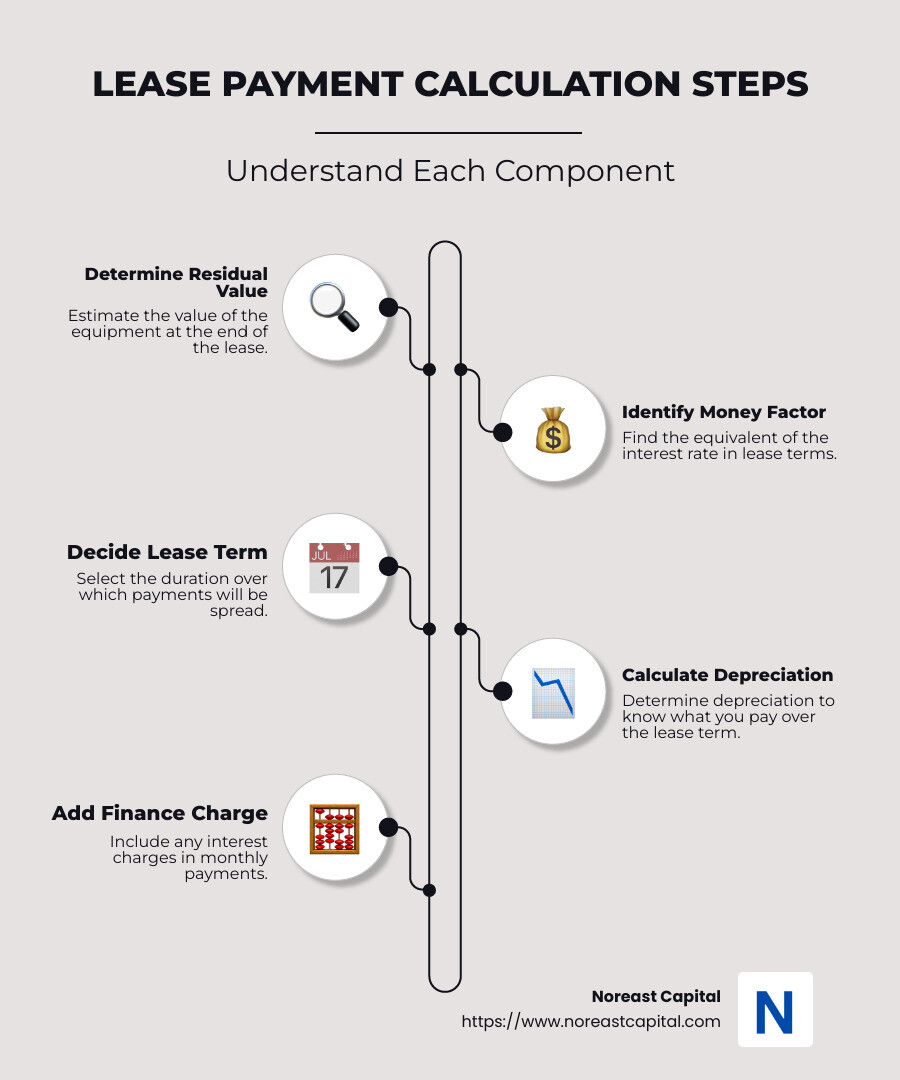
Lease payment calculation is a must-know for any business owner seeking to manage expenses without the heavy burden of owning equipment. This simple process involves understanding a few key factors that determine your monthly lease costs. Here’s a quick breakdown:
1. Residual Value: The estimated value of the equipment at the end of the lease.
2. Money Factor: Analogous to the interest rate in loan terms.
3. Lease Term: The duration over which payments are spread.
Calculating lease payments helps businesses keep cash flow flexible and updated with the latest equipment. Each lease payment component works together to ensure that you are only paying for the depreciation of the equipment over the lease term, along with any interest charges.
As Vincent Cerniglia, I’ve dedicated my career at Noreast Capital Corporation to making equipment leasing more accessible for businesses of all sizes. With years of experience in lease payment calculation and financial strategies, I aim to simplify leasing processes and ensure clients achieve optimal financial health.
Lease payment calculation vocab explained:
– 3 year lease calculator
– used car lease calculator
Understanding Lease Components
When diving into lease payment calculation, understand the components that make up a lease agreement. These elements help you determine what you’ll pay each month and how to negotiate better terms. Let’s break down the key components:
MSRP (Manufacturer’s Suggested Retail Price)
The MSRP is the sticker price of the equipment or vehicle. It’s the price the manufacturer suggests it should sell for. This figure is crucial because it serves as the starting point for negotiations and influences the residual value of the lease. A higher MSRP can lead to a higher residual value, which might lower your monthly payments.
Capitalized Cost
The Capitalized Cost is the actual price you agree to pay for the equipment after negotiations. This can be lower than the MSRP and includes any discounts or rebates. The capitalized cost forms the basis for your lease calculations and is a key factor in determining depreciation.
Residual Value
The Residual Value is what the equipment is expected to be worth at the end of the lease term. It’s usually expressed as a percentage of the MSRP. A higher residual value means the equipment is expected to hold its value better, leading to lower monthly payments. For instance, a vehicle with a 65% residual value will cost less to lease than one with a 55% residual value, even if both have the same MSRP.
Money Factor
The Money Factor is akin to the interest rate on a loan. It determines the finance charges on the lease and is expressed as a small decimal number. To get an idea of the equivalent annual interest rate, you can multiply the money factor by 2,400. For example, a money factor of 0.00125 translates to an interest rate of about 3%.
Lease Term
The Lease Term is the duration of the lease, typically in months (like 36 or 48 months). The length of the lease can impact your monthly payments. Shorter terms might mean higher monthly payments but less overall depreciation, while longer terms might spread out the costs more but could increase interest charges.
Understanding these components is crucial for effective lease payment calculation. Each element plays a significant role in shaping your financial commitment and helps ensure that your lease aligns with your business goals. By grasping these factors, you can negotiate more confidently and make informed decisions that benefit your bottom line.
How to Calculate Lease Payment
Calculating your lease payment might sound tricky, but it boils down to a few simple steps. Let’s break it down into depreciation and finance charge, which are the main components of the lease payment calculation.
Depreciation
Depreciation is the amount the equipment loses in value over the lease term. To calculate this, you subtract the residual value from the capitalized cost. The residual value is what the item is expected to be worth at the end of the lease.
Here’s the formula:
[ \text{Depreciation Fee} = \frac{\text{Capitalized Cost} – \text{Residual Value}}{\text{Lease Term (Months)}} ]
Example: If your capitalized cost is $25,000 and the residual value is $15,000 over a 36-month lease, your depreciation fee would be:
[ \frac{25,000 – 15,000}{36} = \$277.78 \text{ per month} ]
Finance Charge
The finance charge is like the interest you pay on a loan. It’s calculated using the money factor, which is a small decimal number representing the lease’s interest rate.
Here’s how to find it:
[ \text{Finance Charge} = (\text{Capitalized Cost} + \text{Residual Value}) \times \text{Money Factor} ]
Example: Using a money factor of 0.00125, the finance charge would be:
[ (25,000 + 15,000) \times 0.00125 = \$50 \text{ per month} ]
Combining Costs
To find your base monthly lease payment, add the depreciation fee and finance charge:
[ \text{Base Monthly Payment} = \text{Depreciation Fee} + \text{Finance Charge} ]
Example:
[ 277.78 + 50 = \$327.78 ]
Finally, don’t forget to add any local taxes to get your total monthly lease payment. For example, with an 8% sales tax:
[ 327.78 \times 1.08 = \$354.00 ]
By understanding these steps, you can tackle lease payment calculation with confidence. This approach ensures you’re clear on your financial obligations, helping you plan effectively and avoid surprises.
Step-by-Step Lease Payment Calculation
Now that we’ve covered the basics, let’s dive into the step-by-step process of calculating your lease payment. This involves understanding monthly depreciation, monthly rent charge, and monthly tax. Each of these components plays a crucial role in determining your final lease payment.
Monthly Depreciation
Depreciation is the reduction in value of the leased item over time. To find the monthly depreciation, you need to know the capitalized cost (the agreed price of the item) and the residual value (the estimated value at the end of the lease).
Formula:
[ \text{Monthly Depreciation} = \frac{\text{Capitalized Cost} – \text{Residual Value}}{\text{Lease Term (Months)}} ]
Example:
If the capitalized cost is $30,000 and the residual value is $18,000 for a 36-month lease:
[ \frac{30,000 – 18,000}{36} = \$333.33 \text{ per month} ]
Monthly Rent Charge
The monthly rent charge is similar to an interest payment. It’s calculated using the money factor. This factor, when multiplied by 2,400, gives an approximate annual interest rate.
Formula:
[ \text{Monthly Rent Charge} = (\text{Capitalized Cost} + \text{Residual Value}) \times \text{Money Factor} ]
Example:
With a capitalized cost of $30,000, a residual value of $18,000, and a money factor of 0.0015:
[ (30,000 + 18,000) \times 0.0015 = \$72.00 \text{ per month} ]
Monthly Tax
Taxes can vary based on your location, so it’s important to include them in your calculations. Typically, sales tax is applied to the sum of the monthly depreciation and rent charge.
Formula:
[ \text{Monthly Tax} = (\text{Monthly Depreciation} + \text{Monthly Rent Charge}) \times \text{Sales Tax Rate} ]
Example:
If the sales tax rate is 7%:
[ (333.33 + 72.00) \times 0.07 = \$28.38 \text{ per month} ]
Total Monthly Lease Payment
Finally, to find the total monthly lease payment, combine the depreciation, rent charge, and tax:
Formula:
[ \text{Total Monthly Payment} = \text{Monthly Depreciation} + \text{Monthly Rent Charge} + \text{Monthly Tax} ]
Example:
[ 333.33 + 72.00 + 28.38 = \$433.71 ]
By following these steps, you can confidently calculate your lease payments and ensure that your financial planning is accurate and effective. Understanding these components helps you manage your expenses and avoid unexpected costs.
Factors Affecting Lease Payments
When it comes to lease payment calculation, several factors can influence the overall cost. Understanding these elements can help you make informed decisions and potentially save money over the lease term.
Mileage
Mileage limits are a significant factor in lease agreements. Most leases come with an annual mileage cap, typically between 10,000 to 15,000 miles. Exceeding this limit can result in additional charges, often ranging from 5 to 20 cents per mile. For example, if you drive 2,000 miles over the limit at a rate of 15 cents per mile, you’ll face an extra charge of $300 at the end of the lease.
To avoid these fees, consider your driving habits before signing a lease. If you drive more than the average, a high mileage lease might be a better option, though it may come with higher monthly payments.
Wear and Tear
Wear and tear refers to the condition of the vehicle at the end of the lease. Leases expect the car to be returned in reasonable condition. However, any excessive wear and tear can lead to additional charges. Examples include significant dents, scratches, or interior damage.
To minimize these costs, regular maintenance and care are essential. Simple actions like washing the car, addressing minor repairs, and keeping the interior clean can help maintain the vehicle’s condition. Some lessees opt for wear and tear insurance to cover potential costs.
Maintenance
While routine maintenance is crucial for keeping your leased vehicle in good condition, it’s important to understand who is responsible for these costs. Most leases require the lessee to handle regular maintenance, such as oil changes and tire rotations. Failing to adhere to maintenance schedules can lead to penalties or affect the vehicle’s condition assessment at lease end.
Some lease agreements offer maintenance packages that cover these costs, often at an additional monthly fee. Weigh the benefits and costs of these packages against expected maintenance expenses to determine if they’re a worthwhile investment.
By keeping an eye on these factors, you can better manage your lease payments and avoid unexpected costs. Understanding how mileage, wear and tear, and maintenance impact your lease agreement helps you make smarter financial decisions.
Frequently Asked Questions about Lease Payment Calculation
What is the formula to calculate a lease payment?
Calculating a lease payment might seem complex, but breaking it down into steps makes it manageable. Here’s a simple formula to guide you:
- Find the Net Capitalized Cost: This is the negotiated selling price minus any down payment or trade-in value.
- Calculate Depreciation: Subtract the residual value (the car’s worth at the lease end) from the net capitalized cost. Divide this by the number of months in the lease to get the monthly depreciation fee.
- Compute the Finance Charge: Add the net capitalized cost and the residual value, then multiply by the money factor.
- Combine These Costs: Add the depreciation fee and the finance charge for your base monthly lease payment.
- Add Taxes: Apply any local sales tax to get the total monthly lease payment.
This step-by-step approach ensures clarity in your financial obligations.
How do you calculate lease amount?
To determine the total lease cost, multiply your total monthly lease payment by the lease term. Don’t forget to include any upfront costs like the down payment or acquisition fee.
Example Calculation:
- Monthly Payment: $354
- Lease Term: 36 months
- Down Payment: $2,000
- Acquisition Fee: $500
Total Lease Amount = ($354 * 36) + $2,000 + $500 = $15,244
Knowing how to calculate these elements helps you evaluate the full financial impact of a lease.
How much is a lease payment on a $45,000 car?
Let’s estimate a lease payment using typical values for a $45,000 car:
- Residual Value: 55% of $45,000 = $24,750
- Money Factor: 0.00125
- Lease Term: 36 months
Depreciation Fee = ($45,000 – $24,750) / 36 = $561.11 per month
Finance Charge = ($45,000 + $24,750) * 0.00125 = $86.84 per month
Base Monthly Payment = $561.11 + $86.84 = $647.95
With an 8% sales tax, the Total Monthly Payment is $647.95 * 1.08 = $699.79.
Understanding these calculations empowers you to make informed decisions about your lease agreements.
Conclusion
Leasing can be a powerful tool for businesses seeking financial flexibility and operational efficiency. At Noreast Capital, we specialize in providing custom equipment leasing solutions that help businesses thrive without the burden of ownership.
Benefits of Leasing:
Lower Monthly Payments: Leasing often results in lower monthly payments compared to purchasing. This is because payments are based on depreciation rather than the full purchase price.
Preserve Capital: Leasing requires less upfront capital, allowing businesses to allocate funds to other critical areas like marketing or expansion.
Access to Latest Technology: Stay competitive by upgrading to new equipment at the end of your lease term, especially in industries where technology evolves rapidly.
Tax Advantages: Leasing can offer tax benefits, such as deductions through the Section 179 Deduction, which can lower your net cost.
Flexible Terms: Leases can be customized with terms that fit your cash flow needs, offering seasonal payments or lower initial payments.
Choosing the right leasing partner is crucial. At Noreast Capital, we pride ourselves on our personalized service and industry expertise. Our customizable solutions are designed to meet your unique needs, ensuring you get the most out of your lease agreements.
Our streamlined process ensures you acquire the necessary equipment without unnecessary delays, helping you maintain your business momentum. With our strong industry partnerships, we negotiate favorable terms, passing those savings on to you.
By understanding lease payment calculation and partnering with a knowledgeable provider like Noreast Capital, you can improve your business’s efficiency and growth. We’re here to guide you through the complexities of leasing, ensuring you make the most out of your investments.
Contact us today to explore how we can support your equipment financing needs and help you maintain cash flow while staying at the forefront of your industry.