

Open uping Financial Freedom with Lease-to-Own
The lease to own benefits provide businesses with a practical path to equipment ownership without the burden of large upfront costs. When you’re considering this financing option, here’s what you need to know:
Key Lease-to-Own Benefits:
* Lower initial costs – typically just 2-7% option fee vs. 20% for traditional purchases
* Payment flexibility – monthly payments that build toward ownership
* Credit building opportunity through reported on-time payments
* “Test drive” period before committing to purchase
* Protection from depreciation during the lease period
* Maintenance support often included during the lease term
Lease-to-own agreements (also called rent-to-own) allow you to use equipment immediately while making payments that partially count toward eventual ownership. This arrangement creates a stepping stone between renting and buying outright, giving you time to strengthen your finances before completing the purchase.
For businesses with limited capital or those needing to preserve cash flow, lease-to-own provides a practical alternative to traditional financing. You’ll typically pay a small option fee upfront (2-7% of the equipment’s value) and slightly higher monthly payments than a standard lease, with a portion of those payments credited toward your eventual purchase.
I’m Vincent Cerniglia from Noreast Capital, where I’ve helped hundreds of businesses leverage lease to own benefits to acquire essential equipment while maintaining healthy cash flow. My expertise in structuring flexible lease-to-own agreements ensures you get terms that align with your business goals and financial situation.
Why This How-To Guide Matters
In today’s economic climate, the path to acquiring essential equipment can seem increasingly challenging. With rising equipment costs and tightening credit requirements, many businesses find themselves caught in a frustrating cycle – needing equipment to grow but lacking the capital to purchase it outright.
The homeownership gap we see in residential real estate has a parallel in the business world. Small and medium-sized businesses often struggle to compete with larger corporations that can easily afford to purchase equipment outright. This equipment acquisition gap can limit growth potential and prevent businesses from scaling effectively.
Lease-to-own arrangements offer a flexible financing solution that bridges this gap, providing a structured pathway to ownership while preserving cash flow. Whether you’re a landscaping company needing new mowers, a medical practice requiring diagnostic equipment, or a manufacturing operation looking to upgrade machinery, understanding the lease to own benefits can transform how you approach equipment acquisition.
How Lease-to-Own Works Step-by-Step
Let’s walk through exactly how lease-to-own arrangements work in the real world. I love explaining this process because it truly offers a middle path between renting and buying that many businesses don’t realize exists.
Think of lease-to-own as the “try before you buy” approach to equipment financing. You get immediate access to the equipment you need while building ownership over time – like planting seeds that grow into assets for your business.
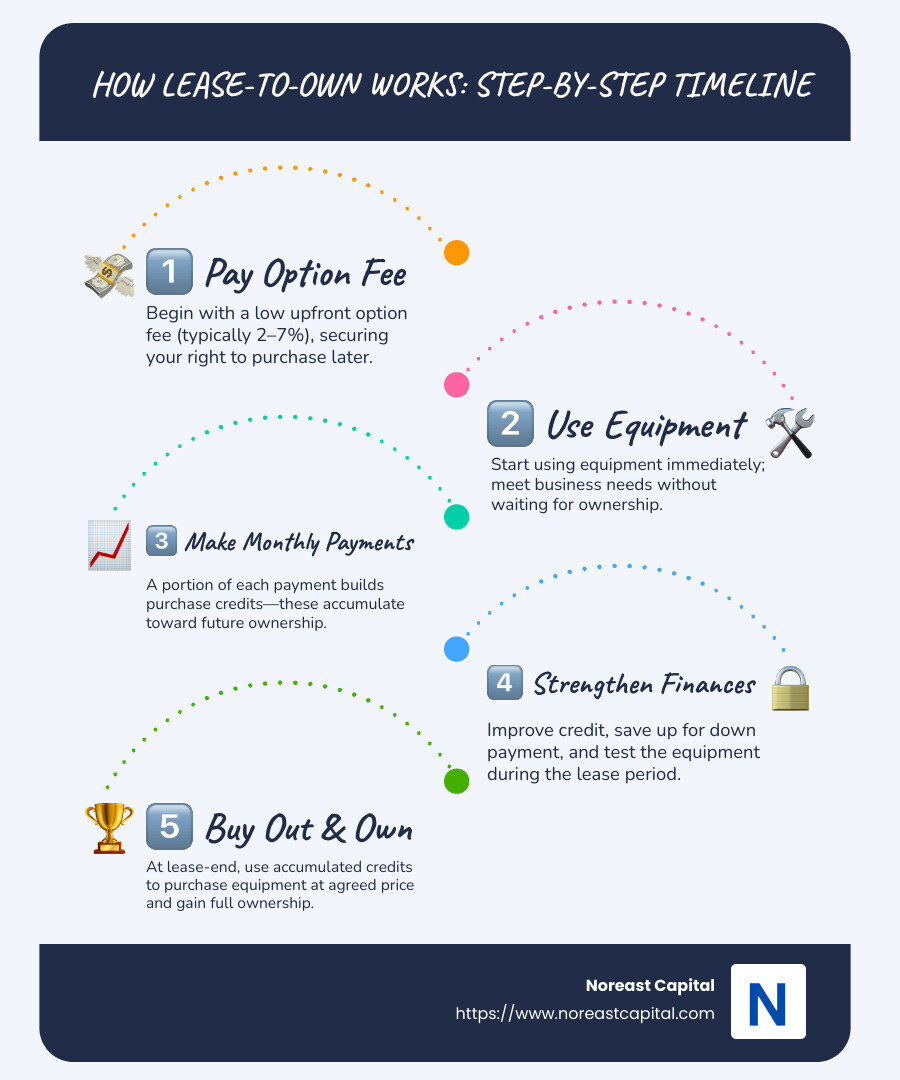
When you enter a lease-to-own agreement with Noreast Capital, the journey begins with selecting the perfect equipment for your needs. Unlike traditional financing that might require extensive credit checks, we focus on finding a workable solution that matches your business situation.
Next comes the option fee – this small upfront payment (typically between 2-7% of the equipment’s value) secures your right to purchase the equipment later. It’s substantially less than a traditional down payment, which keeps more money in your business account where it belongs.
Throughout the lease term, your monthly payments work double-duty. Yes, they cover your use of the equipment, but here’s where the lease to own benefits really shine – a portion of each payment (usually 10-15%) accumulates as credit toward your eventual purchase. I like to call this your “ownership account” – it grows month after month.
The purchase price is established at the beginning of your agreement, protecting you from price increases. This locked-in price gives you clarity and predictability for your financial planning. Most agreements run between 12-36 months, though we can customize the contract length to align with your business cycles and cash flow patterns.
One important aspect to understand is the division of responsibilities. During the lease period, you’ll typically handle maintenance duties for minor repairs while larger issues may remain with the financing company depending on your specific agreement. You’ll also need appropriate insurance coverage for the equipment, and we’ll clearly outline any tax implications so there are no surprises.
Let’s compare the two main types of lease-to-own structures:
| Feature | Lease Option | Lease Purchase |
|---|---|---|
| Purchase requirement | Optional at lease end | Obligated to purchase |
| Flexibility | Can walk away without buying | Must complete the purchase |
| Upfront fee | Option fee (2-7%) | Down payment (often higher) |
| Risk level | Lower risk for tenant/lessee | Higher commitment level |
| Best for | Testing equipment suitability | Certain about long-term needs |
| Maintenance | Often tenant’s responsibility | Usually tenant’s responsibility |
I’ve found that businesses appreciate understanding these differences upfront. The lease option provides more flexibility if you’re testing new equipment or uncertain about long-term needs, while the lease purchase offers structure when you’re confident about your equipment requirements.
The beauty of lease-to-own is its clarity and simplicity. You’ll know exactly what you’re paying, what you’re building toward, and when you’ll reach full ownership. It transforms what could be a complex financial transaction into a straightforward path to equipment ownership that supports your business growth every step of the way.
1. Decide on Contract Type
When you’re ready to explore lease to own benefits, your first big decision is choosing the right contract type. Think of this as setting the foundation for your entire equipment acquisition journey – it’s that important!
There are two main paths you can take, each with its own advantages depending on your business situation and comfort level with commitment.
Lease Option Agreement gives you breathing room and flexibility. With this arrangement, you have the right to purchase the equipment when your lease ends, but you’re not obligated to do so. If the equipment turns out to be less perfect for your business than you expected, or if your business needs shift dramatically, you can simply hand back the keys (so to speak) and walk away. Many of our clients at Noreast Capital prefer this approach when they’re testing waters with new equipment or when they’re in industries where technology changes rapidly.
As Gregg Wasilko, an experienced real estate agent who has worked with similar arrangements notes, “I’ve done rent-to-own deals on behalf of buyers as well as sellers over the years. The flexibility of these arrangements can be particularly valuable in uncertain markets.”
On the other hand, a Lease Purchase Agreement represents a stronger commitment. With this contract, you’re legally bound to purchase the equipment when the lease period ends. While this might sound intimidating, it often comes with better terms – think lower monthly payments or a more attractive final purchase price. The financing company offers these better terms because they have certainty about the eventual sale.
The walk-away clause is where these two options really differ. It’s your escape hatch in a lease option, protecting you from being locked into buying equipment that no longer serves your business well. Without this clause (as in a lease purchase), you’re all in – committed to completing the purchase regardless of what happens.
At Noreast Capital, we’ve guided hundreds of businesses through this decision process. We find that most small to medium businesses benefit from the flexibility of lease options, especially when trying new equipment types or expanding into new service areas. However, lease purchases can be smart choices when you’re absolutely certain about your long-term equipment needs and want to secure the most favorable financial terms possible.
Your business goals, growth trajectory, and comfort with commitment should guide this important first decision. We’re always here to help you weigh the pros and cons for your specific situation.
2. Negotiate Key Numbers
Let’s talk money – the part that often makes people nervous, but actually gives you the most power in a lease-to-own arrangement. When structuring your agreement, three key numbers will shape your entire experience.
First, there’s the option fee – your ticket to the ownership opportunity. This upfront payment typically runs between 2-7% of the equipment’s value, which is refreshingly lower than the hefty 20% down payment you’d need for a traditional purchase. While it’s usually non-refundable, this fee should be credited toward your final purchase price when you decide to buy. Think of it as reserving your seat on the ownership train while keeping your cash reserves healthy.
Next comes the rent premium – the secret sauce of equity building in lease-to-own arrangements. Your monthly payments will run about 10-15% higher than a standard lease, but here’s the beautiful part: that extra portion isn’t just disappearing. It’s actually accumulating as credit toward your future purchase.
For example, if you’d normally pay $1,000 monthly to simply rent the equipment, your lease-to-own payment might be $1,150. That extra $150 is essentially forced savings – money that’s working for you by reducing the final purchase amount. It’s like having a savings account built right into your equipment payments!
Perhaps the most valuable number to nail down is the locked-in purchase price. In today’s unpredictable market, knowing exactly what you’ll pay in the future provides incredible peace of mind. When equipment values are climbing (as they often are these days), locking in today’s price can save you thousands down the road.
As financial expert Victoria Araj puts it: “Setting a purchase price upfront gives borrowers greater certainty when planning their financial future.”
At Noreast Capital, we’ve helped countless business owners structure these numbers to maximize the lease to own benefits while keeping monthly payments manageable. The right balance varies widely depending on your cash flow situation, growth plans, and the specific equipment you’re acquiring.
These numbers aren’t set in stone until you sign. Don’t be afraid to negotiate each component to create an arrangement that truly works for your business’s unique situation. The best agreements feel comfortable today while building toward a stronger financial position tomorrow.
3. Clarify Responsibilities
When you’re diving into a lease-to-own agreement, understanding who’s responsible for what is absolutely crucial. Unlike traditional equipment rentals where the owner handles most maintenance issues, lease-to-own arrangements create a middle ground where responsibilities are shared – after all, you’re on the path to ownership!
Think of it as a transition period where you’re gradually taking on the duties of an owner while still having some of the protections of a renter. Here’s how these responsibilities typically break down:
As the tenant or lessee, you’ll generally handle the day-to-day upkeep of the equipment. This includes regular maintenance like oil changes for vehicles, blade sharpening for cutting equipment, or software updates for technology. These minor repairs keep everything running smoothly and protect your investment in the long run.
Meanwhile, the landlord or lessor (that’s us at Noreast Capital) usually remains responsible for those budget-busting major repairs. If a transmission fails or a critical component breaks down, we typically cover these substantial expenses – though exactly what qualifies as “major” should be clearly defined in your agreement.
“I always tell my clients to negotiate a specific dollar threshold for repairs,” says Amanda Rodriguez, who specializes in lease-to-own arrangements. “Something like ‘tenant handles repairs under $500, lessor covers anything above’ gives everyone clarity and prevents disagreements down the road.”
The insurance situation also requires attention. During your lease period, you’ll need to carry comprehensive coverage on the equipment with the lessor named as an additional insured party. This protects both your interests and ours. Once you exercise your purchase option and become the full owner, you’ll simply transition to standard owner’s insurance.
One of the key lease to own benefits is this gradual shift in responsibility. You can ease into equipment ownership without immediately taking on all the financial risks. Many of our clients at Noreast Capital appreciate having this transition period where they can learn the maintenance needs of their equipment while still having some backup for major issues.
Remember to get everything in writing! Your agreement should clearly spell out who handles what types of repairs, any dollar thresholds that determine responsibility, required maintenance schedules, and exactly how insurance coverage should be structured. Taking the time to clarify these points upfront can save you significant headaches (and potentially thousands of dollars) down the road.
4. Use the Lease Period Wisely
The lease period isn’t just a waiting game—it’s prime time to strengthen your financial foundation while you’re already using the equipment you need. Think of these months or years as your financial training camp before the big game of ownership.
Most lease-to-own arrangements run between 1-3 years, giving you a generous runway to improve your position before taking full ownership. This breathing room is one of the most valuable lease to own benefits for growing businesses that need equipment now but aren’t quite ready for the full financial commitment.
During this time, focus on repairing your credit profile. If your business credit score isn’t where you’d like it to be, consistent on-time payments on your lease can help rebuild it. Make sure to ask your lessor if they report these payments to commercial credit bureaus—if they don’t automatically, request that they do. At Noreast Capital, we understand the importance of credit building and can work with you to ensure your responsible payment history gets recognized.
“The lease period gives businesses a chance to demonstrate their reliability while simultaneously improving their credit profile,” notes Vincent Cerniglia, our financing specialist. “It’s like getting a practice run at ownership with training wheels.”
Beyond the rent credits you’re already accumulating through your monthly payments, consider establishing a separate savings fund specifically for your eventual purchase. Even small, consistent deposits can add up to a significant additional down payment when it’s time to exercise your purchase option. This extra capital can help secure more favorable financing terms or potentially reduce your need for additional financing altogether.
As you approach the final months of your lease term, start shopping around for financing options if you’ll need a loan to complete the purchase. Getting pre-approved several months before your lease ends gives you leverage in negotiations and prevents last-minute scrambling. It also gives you clarity on exactly what you can afford and what your monthly payments will look like post-purchase.
Some forward-thinking businesses even use this period to train staff on equipment maintenance or to optimize their operational processes around the equipment—knowing they’ll be keeping it long-term makes these investments worthwhile.
The lease period isn’t just about waiting until you can own the equipment—it’s about actively preparing for successful ownership while enjoying the benefits of using the equipment today. With some strategic planning, you’ll be in a much stronger position when it’s finally time to exercise your purchase option.
Lease to Own Benefits at a Glance
When you’re weighing your equipment financing options, it helps to see the full picture of what lease-to-own can offer. Think of it as getting the best of both worlds – the flexibility of leasing with the long-term advantages of ownership. Let’s break down these benefits from different perspectives.
Key Lease to Own Benefits for Buyers
One of the most powerful lease to own benefits is the ability to build equity while you’re using the equipment. Unlike traditional leases where your payments simply vanish into thin air, lease-to-own arrangements put a portion of each payment toward eventual ownership. You’re not just spending money – you’re actually investing in your business’s future.
Your credit profile gets a nice boost too. Those consistent, on-time payments create a positive payment history, which financial experts tell us accounts for about 35% of your credit score calculation. For growing businesses, this credit improvement can open doors to better financing options down the road.
I love the practical “test-drive” aspect of these agreements. You get to use the equipment extensively before making your final purchase decision. Sarah, one of our landscaping clients, told me: “Having six months to really put those commercial mowers through their paces before committing to buy them saved us from a $30,000 mistake. We finded we needed a completely different model for our specific terrain.”
The structure also creates a helpful forced savings mechanism. That slight premium you pay each month accumulates as purchase credit, essentially creating a structured savings plan that many business owners find helps with budgeting and financial discipline.
In today’s market where equipment costs seem to rise constantly, locking in your purchase price from day one provides valuable protection against inflation. This price certainty lets you plan with confidence, knowing exactly what your total acquisition cost will be.
A construction company owner recently shared: “When we started out, we couldn’t afford to purchase all our equipment outright. The lease-to-own program from Noreast Capital allowed us to get top-quality excavators immediately while building toward ownership. Three years later, we owned all our equipment outright, and our business had grown substantially.”
More info about Lease to Own Financing No Credit Check
Lease to Own Benefits for Sellers & Landlords
From the other side of the transaction, equipment financing companies and dealers find plenty to love about these arrangements too.
The revenue boost is significant – lease-to-own agreements typically generate 10-15% higher monthly payments than standard leases. This increased cash flow makes a meaningful difference to a financing company’s bottom line.
That upfront option fee provides immediate income, typically between 2-7% of the equipment value. Even if the purchase option isn’t exercised later, this non-refundable fee remains with the lessor.
I’ve noticed something interesting in my years at Noreast Capital – lessees with purchase intentions almost always take better care of the equipment. They treat it like they already own it, which means less wear and tear and fewer maintenance headaches for everyone involved.
The longer commitment periods help too. With lease terms typically ranging from 1-5 years, these arrangements dramatically reduce the frequent turnover costs associated with shorter-term rentals. No more constant cleaning, reconditioning, and remarketing equipment every few months.
For sellers who prefer certainty, lease purchase agreements (rather than lease options) provide a guaranteed sale from day one. This predictability can be extremely valuable for business planning.
The numbers back this up: industry data shows equipment on lease-to-own agreements stays on the market for an average of just 23 days, with less than a 1% default rate. That’s remarkably efficient compared to other financing models.
When done right, lease-to-own creates that rare win-win situation where both parties walk away better off – buyers get their equipment with financial flexibility, and sellers enjoy premium pricing with reduced hassles.
More info about Lease to Own Lawn Equipment
Smart Money Moves: Financial & Legal Considerations
Let’s talk money – because understanding the financial side of lease-to-own makes all the difference in maximizing those lease to own benefits. I’ve helped hundreds of businesses steer these waters, and the right approach can save you thousands.
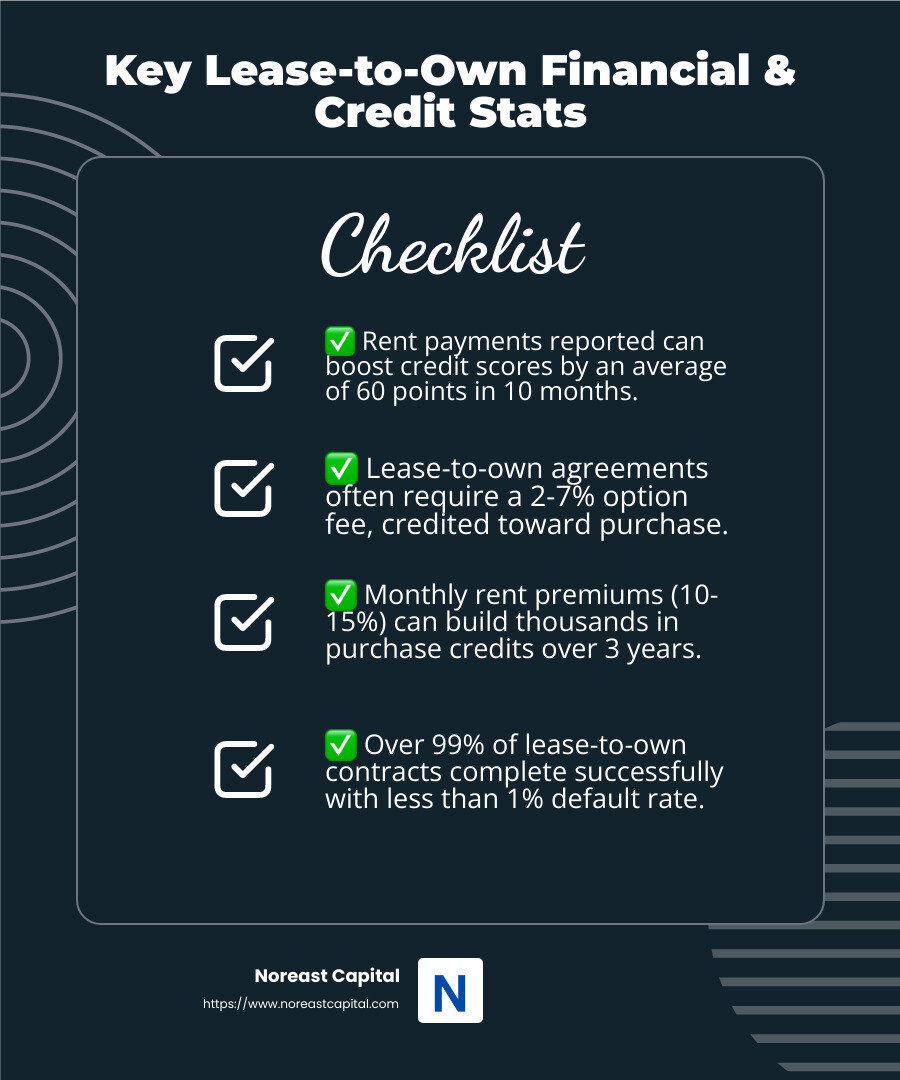
When you’re setting up your agreement, the option fee typically ranges from 2-7% of the equipment’s value. This is significantly lower than traditional down payments, which often hit 20% or more. At Noreast Capital, we structure these fees to minimize your upfront costs while securing your purchase rights. The best part? This fee should be credited toward your purchase price when you decide to buy.
Planning ahead for financing is crucial. If you’ll need a loan to complete the purchase later, use your lease period strategically. FHA loans might allow down payments as low as 3.5%, while conventional loans typically ask for 10-20%. Those rent credits you’ve been accumulating? They can help satisfy these requirements.
“Understanding exactly how your rent premium converts to purchase credit is like finding money you didn’t know you had,” as one of our clients put it. Here’s a real-world example: if your monthly payment is $1,200 with a 15% premium ($180), you’ll build up $6,480 in purchase credits over a 3-year lease. That’s serious equity!
Your credit score can get a nice boost too. Recent research from the Consumer Financial Protection Bureau shows that when rent payments are reported to credit bureaus, consumers saw an average 60-point increase in their credit scores within just 10 months. That improved credit profile can mean better financing terms when you’re ready to buy.
Don’t forget to chat with your accountant about tax implications. While lease payments are typically tax-deductible business expenses, this changes once you exercise your purchase option. Every business has unique tax considerations, and getting this right matters.
Consider including an appraisal clause that adjusts the purchase price based on the equipment’s market value when your lease ends. This protects both you and the lessor from major market swings – especially important in volatile equipment categories.
Latest research on rent reporting and credit
More info about 9 Benefits of Financing Business Equipment
Crunch the Numbers Early
Before signing anything, take time to run the numbers. Most lenders look for debt-to-income ratios below 43% when approving financing. Calculate how your lease payments affect this ratio now, and how it might change when you convert to a purchase loan later.
Don’t forget about closing costs – they typically range from 2-5% of the equipment value and should be factored into your budget from day one. I always recommend clients set aside a little each month toward these expenses.
Escrow arrangements can provide peace of mind. Consider establishing an escrow account for your rent credits to ensure these funds are properly managed and applied to your purchase. This third-party protection keeps everything transparent.
Ask for a detailed rent credit schedule showing exactly how your equity builds over time. At Noreast Capital, we provide comprehensive financial projections that show exactly how your payments translate to ownership, eliminating surprises and helping you budget effectively.
Protect the Deal Legally
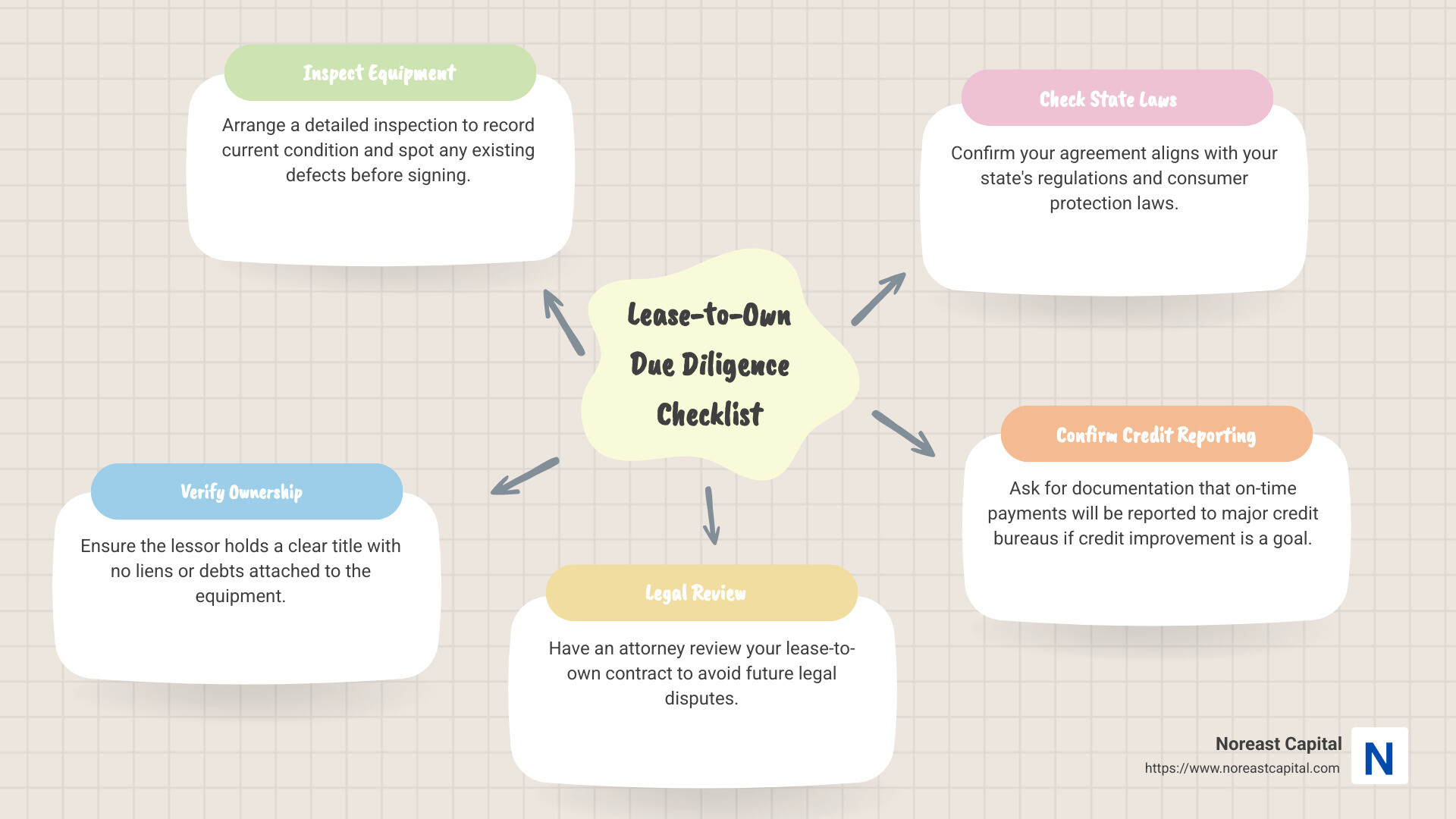
The right legal protections create a smooth path to ownership for both parties. Start with a thorough equipment inspection before signing to document its condition and identify any pre-existing issues. This baseline protects you from disputes later about “who damaged what.”
Always verify that the lessor has clear title to the equipment and that there are no liens or encumbrances that could complicate your eventual purchase. This simple step prevents major headaches down the road.
“The modest cost of legal review can prevent costly disputes later,” as I often tell our clients. Have a business attorney review your lease-to-own agreement before signing. They’ll spot potential issues you might miss.
Be aware that lease-to-own regulations vary by state. In Maryland, Washington DC, and throughout our service areas, Noreast Capital ensures all agreements comply with local regulations. These legal nuances matter – what works in Virginia might not fly in Maryland.
A well-structured legal agreement protects both parties and clearly outlines the path to ownership, making the transition as predictable as possible. When done right, the legal framework supports rather than complicates your journey to equipment ownership.
Avoiding Pitfalls: How to Protect Yourself
Let’s be honest – while the lease to own benefits can be game-changing for your business, these arrangements aren’t without risks. Think of this section as your safety net, helping you spot potential problems before they trip you up.
I’ve seen businesses rush into agreements without doing their homework, only to face headaches down the road. That’s why understanding these common pitfalls is so important for protecting your investment.
Watch out for deals that seem suspiciously good. Legitimate lease-to-own arrangements from reputable companies like Noreast Capital will always have clear, transparent terms. If someone’s promising you equipment with virtually no requirements or suspiciously low payments, your scam radar should be beeping loudly!
What happens if equipment values take a nosedive during your lease? Without proper protections, you might be stuck with a purchase price that’s higher than what the equipment is actually worth. That’s why I always recommend including market adjustment clauses in your agreement – they’re like an insurance policy against significant market shifts.
Understanding payment terms is absolutely crucial. Some agreements offer grace periods for late payments, while others might immediately put your purchase option at risk. I recently worked with a manufacturing company that didn’t realize their agreement had a “three strikes” policy – after three late payments, they lost all accumulated credits. We helped them negotiate better terms with clearer consequences.
The repossession clauses deserve special attention too. Know exactly what triggers repossession and how quickly it could happen after missed payments. This isn’t the fine print you want to skim over!
If building credit is one of your primary goals, verify that your lessor actually reports to major credit bureaus. Ask which bureaus they report to and how they handle reporting errors. This isn’t something to take on faith – get it in writing.
One business owner shared this eye-opening experience with me: “We signed with a company that promised to report our payments to build our business credit. Six months in, we finded they weren’t reporting at all. We switched to Noreast Capital, who provided documentation of their reporting practices upfront.”
Tenant Safeguards
If you’re the business acquiring equipment through a lease-to-own arrangement, protect yourself with these proven strategies.
Consider requesting that your rent credits be held in a third-party escrow account rather than simply tracked by the lessor. This extra layer of security ensures your accumulated equity is protected even if the leasing company faces financial difficulties. It’s like keeping your money in a bank instead of under a mattress!
Negotiate repair responsibility caps from the beginning. Without them, you could find yourself paying for expensive repairs on equipment you don’t yet own. I typically recommend setting both dollar limits (like $500 per repair) and specifying types of repairs you’ll handle versus those that remain the lessor’s responsibility.
Set up credit monitoring to verify your on-time payments are actually showing up on your credit report. This small step ensures you’re actually receiving one of the key lease to own benefits – credit building. Many of my clients are surprised to find how quickly their business credit profiles improve when payments are properly reported.
At Noreast Capital, we build these safeguards into our agreements from the start. We believe protected clients are happy clients, and happy clients complete their lease-to-own journeys successfully.
Landlord Safeguards
For those on the equipment-providing side, protecting your investment is equally important.
Establish clear financial qualification criteria for applicants to reduce default risk. This might include minimum time in business, revenue requirements, or credit score thresholds. These aren’t arbitrary hoops to make people jump through – they’re predictors of success that benefit both parties.
Structure option fees as non-refundable to compensate for taking equipment off the market. This upfront commitment demonstrates the lessee’s seriousness and provides some financial protection if they don’t exercise their purchase option.
Define maintenance responsibilities with crystal clarity. I’ve seen countless disputes arise from vague language about who handles what repairs. Spell out exactly what falls to the lessee and what remains your responsibility – your future self will thank you when a major repair issue inevitably arises!
These mutual protections create balance in your agreement, increasing the likelihood that both parties will walk away satisfied. After all, the best lease-to-own arrangements aren’t about winners and losers – they’re about creating a pathway to equipment ownership that works for everyone involved.
Frequently Asked Questions about Lease to Own Benefits
Does a lease-to-own agreement improve my credit score automatically?
The truth is, those monthly payments you make won’t magically appear on your credit report without some intentional action. For your lease-to-own payments to help build your credit score, the company you’re working with needs to actively report your payment history to the major credit bureaus (Experian, Equifax, and TransUnion).
Here at Noreast Capital, we understand that credit building is a major motivation for many of our clients, which is why we offer payment reporting as an option for businesses looking to strengthen their credit profiles.
The impact can be significant too. Recent research from the Consumer Financial Protection Bureau shows that about 79% of consumers see their credit scores improve when their rent payments are reported. The biggest winners? People with limited credit history or those recovering from past credit challenges.
Before signing any lease-to-own agreement with credit building in mind, be sure to ask these specific questions:
– Will they report to all three major credit bureaus, or just one?
– Do they report both on-time payments and late payments?
– Is there an extra fee for this reporting service?
– What happens if there’s a reporting error? How do they handle corrections?
Consistent on-time payments reported to the bureaus can be a powerful tool for strengthening your business credit profile over time.
What happens to my option fee if I don’t buy?
In most cases, that option fee you paid upfront is non-refundable if you decide not to purchase the equipment when your lease ends. Think of it as compensation to the equipment owner for keeping that item reserved exclusively for you and off the market for other potential buyers.
That said, the specific terms can vary quite a bit between different agreements and companies. Some contracts might include provisions for partial refunds under certain circumstances, while others might allow you to transfer your option rights to another business if you no longer need the equipment.
At Noreast Capital, we believe transparency is essential when it comes to financial arrangements. That’s why we clearly outline all option fee terms in our agreements upfront, with no hidden surprises waiting for you down the road. We’ll make sure you understand exactly what happens to your option fee in all possible scenarios before you sign anything.
Can I negotiate which repairs I’m responsible for?
Absolutely! Repair responsibilities are definitely negotiable in most lease-to-own agreements. While the standard arrangement typically makes you (the lessee) responsible for routine maintenance and minor repairs, with the lessor handling major repairs or system failures, these terms can be customized to fit your specific situation.
When negotiating your agreement, consider discussing these key points:
Setting specific dollar thresholds can bring clarity to everyone (for example, you handle repairs under $500, while the equipment owner covers anything more expensive). You might also want to specify certain systems or components that should remain the owner’s responsibility throughout the lease period.
Many businesses find it helpful to establish a repair fund as part of their agreement. This approach sets aside a small portion of each payment specifically for future repairs, ensuring money is available when unexpected maintenance issues arise.
One of our clients, a printing company, negotiated terms where they handled all routine maintenance and minor repairs, but any issues with the central printing mechanism remained our responsibility. This arrangement gave them peace of mind knowing they wouldn’t face a catastrophic repair bill if the core technology failed.
The lease to own benefits of customizing your repair responsibilities include better budget predictability and avoiding disputes down the road about who pays for what. Just make sure whatever you agree to is clearly documented in writing before signing.
Conclusion
Let’s face it – buying equipment outright isn’t always realistic when you’re growing a business. That’s where lease-to-own shines, offering a path to ownership that works with your cash flow, not against it.
Throughout this guide, we’ve explored how lease-to-own creates a middle ground between renting and buying. This approach isn’t just about delaying a purchase – it’s about structuring a journey to ownership that makes financial sense every step of the way.
The lease to own benefits we’ve discussed make a compelling case for why so many businesses are choosing this option:
You’ll start with just a small upfront investment – typically 2-7% compared to the hefty 20% down payment required for most traditional purchases. Each monthly payment builds equity through rent credits, essentially creating a forced savings plan that moves you steadily toward ownership. Meanwhile, you get to use the equipment daily, confirming it truly meets your needs before committing fully.
Perhaps most importantly, the lease period gives your business breathing room to strengthen financially. Whether you’re building credit, saving additional funds, or growing revenue with your new equipment, time is on your side. And with today’s unpredictable markets, having a locked-in purchase price provides valuable protection against inflation and price increases.
Here at Noreast Capital, we’ve seen how these arrangements transform equipment acquisition for businesses throughout Washington DC, Baltimore, and Annapolis. Our clients appreciate our transparent approach – we make sure you understand exactly how each payment brings you closer to ownership, with no hidden surprises along the way.
Whether you need landscaping equipment for your growing lawn care business, specialized medical devices for your practice, or manufacturing machinery to increase production, lease-to-own creates a structure where everyone wins. You get immediate access to essential equipment while preserving cash flow, and equipment providers secure reliable, motivated lessees.
Ready to explore how lease-to-own might work for your specific situation? More info about lease-to-own financing without credit checks — find how Noreast Capital can help you put these lease-to-own benefits to work today.
By viewing equipment acquisition as a journey rather than a single transaction, you gain something invaluable – flexibility. You maintain the cash flow needed to steer challenges, seize opportunities, and ultimately grow your business. And that might be the greatest benefit of all – changing what could be a financial strain into a strategic advantage that helps your business thrive.