

Mastering Office Equipment Leasing & Financing: An Overview
When it comes to setting up or expanding an office, Office Equipment Leasing & Financing offers a compelling alternative to purchasing outright. This financing strategy allows businesses to use equipment and technology essential for operations without the hefty upfront costs.
In a nutshell, here’s what you need to know about Office Equipment Leasing & Financing:
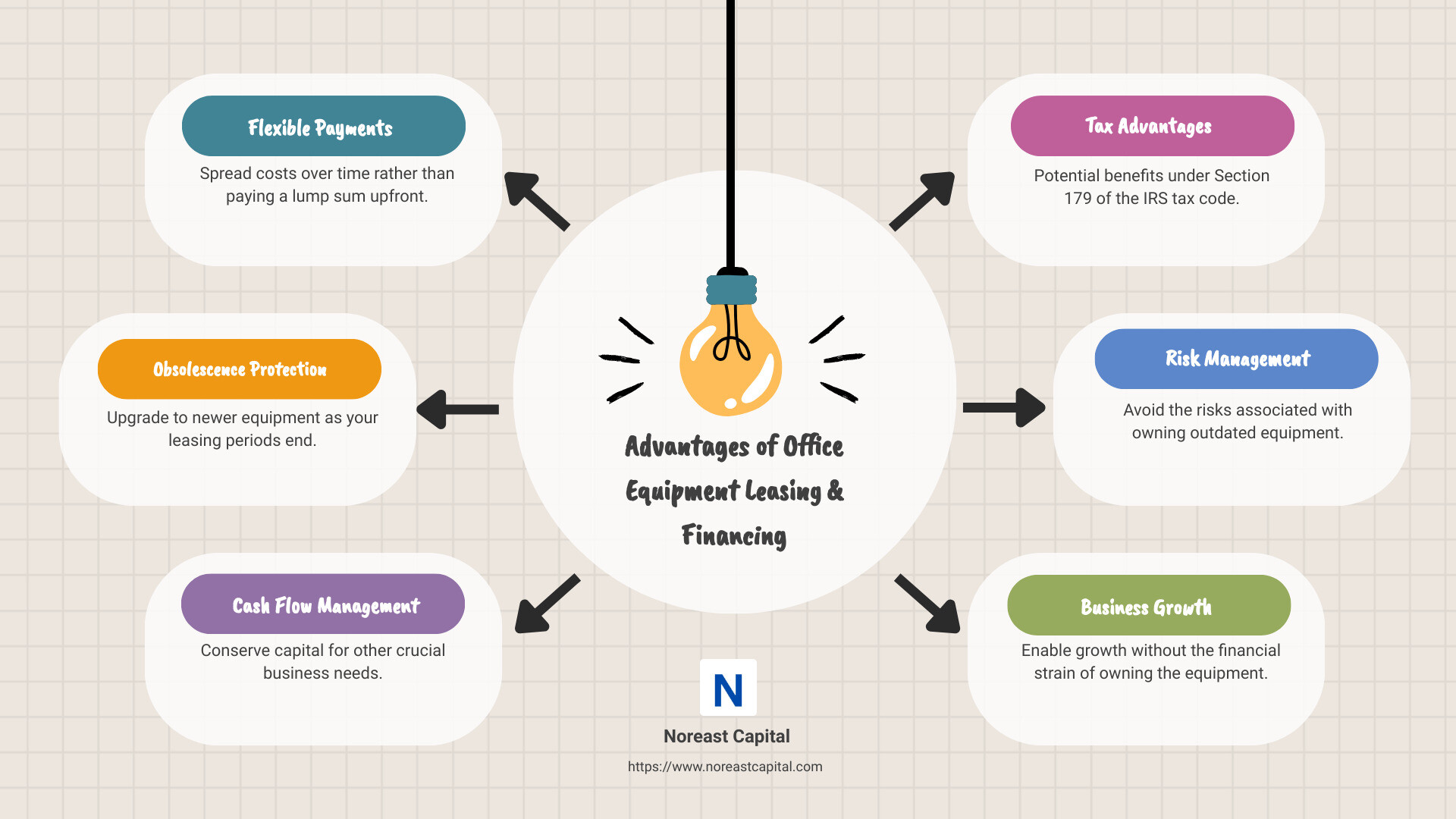
- Flexible Payments: Spread costs over time rather than paying a lump sum upfront.
- Obsolescence Protection: Upgrade to newer equipment as your leasing periods end.
- Cash Flow Management: Conserve capital for other crucial business needs.
- Tax Advantages: Potential benefits under Section 179 of the IRS tax code.
Leasing and financing can be particularly beneficial for small to medium-sized businesses. It turns large capital expenditures into manageable payments, enabling growth without the financial strain of owning the equipment.
Hi there, I’m Vincent Cerniglia from Noreast Capital. For years, I’ve helped businesses find financing solutions custom to their unique needs, including Office Equipment Leasing & Financing. Let me guide you through making the best choice for your office essentials.
Next, we’ll dive deeper into what Office Equipment Leasing & Financing entails, its benefits, and how you can choose the best option for your business.
Important Office Equipment Leasing & Financing terms:
– how to lease equipment for business
– leasing vs financing
– how does equipment leasing work
What is Office Equipment Leasing & Financing?
Office Equipment Leasing & Financing is a financial strategy that allows businesses to use essential office equipment without paying the full cost upfront. This approach can be crucial for managing cash flow, staying current with technology, and minimizing financial risk.
Leasing vs. Financing
Leasing means you pay to use the equipment for a specified period, but you don’t own it at the end of the lease term. The leasing company retains ownership. This can be ideal for equipment that needs frequent updates, like computers or telecommunications systems.
Financing, on the other hand, involves taking out a loan to purchase the equipment. You own the equipment once the loan is paid off. This option is better for long-term assets that don’t need frequent replacement, like office furniture.
Benefits
- Cash Flow Management: Leasing and financing spread costs over time, freeing up capital for other essential business needs.
- Obsolescence Protection: Leasing allows for easy upgrades to the latest technology, ensuring your business stays competitive.
- Tax Benefits: Both options can offer tax advantages. For example, under Section 179 of the IRS tax code, businesses can deduct the full purchase price of qualifying equipment financed during the tax year.
- Flexibility: Leasing agreements can be custom to your business needs, with options to add or upgrade equipment as needed.
- Risk Management: Leasing transfers the risk of equipment obsolescence and maintenance to the lessor, reducing your financial risk.
Drawbacks
- Total Cost: Leasing can sometimes be more expensive over the long term compared to buying outright.
- Ownership: With leasing, you don’t own the equipment, which can be a drawback if you prefer to have full control over your assets.
- Commitments: Both leasing and financing require you to make regular payments, which can be a strain if your business experiences cash flow issues.
In summary, Office Equipment Leasing & Financing provides a flexible and cost-effective way to equip your business. By understanding the differences, benefits, and drawbacks, you can make an informed decision that aligns with your business goals.
Next, we’ll explore the different types of office equipment you can lease or finance.
Types of Office Equipment You Can Lease or Finance
When it comes to Office Equipment Leasing & Financing, almost any type of equipment can be covered. Here are some common categories:
Machinery
Office machinery includes everything from high-end photocopiers and printers to binding machines and shredders. Leasing these items can be especially useful because they often need updates to stay efficient and secure.
Vehicles
If your business requires transportation, you can lease or finance commercial vehicles. This includes delivery vans, company cars, and even specialized vehicles like trucks or buses. Leasing vehicles can help manage cash flow and avoid large upfront costs.
Computers
Computers and related technology are some of the most common items leased. This includes desktops, laptops, servers, and even specialized software. Leasing allows you to stay updated with the latest technology without the burden of frequent large purchases.
Furniture
Office furniture can be a significant expense, especially when setting up a new office or expanding an existing one. You can lease desks, chairs, conference tables, and even ergonomic furniture designed to improve employee comfort and productivity.
Telecommunications
Telecommunications equipment, such as phone systems, video conferencing tools, and networking hardware, can also be leased. This is particularly beneficial for businesses that need to stay current with the latest communication technologies.
Medical Equipment
For medical offices, leasing can cover expensive items like CT scanners, X-ray machines, and dental equipment. This allows medical practices to offer the latest in patient care without the heavy financial burden of purchasing these high-cost items outright.
By leasing or financing these types of equipment, businesses can manage cash flow better, stay updated with the latest technology, and reduce financial risk.
Next, we’ll dig into the benefits of Office Equipment Leasing & Financing.
Benefits of Office Equipment Leasing & Financing
Cash Flow Management
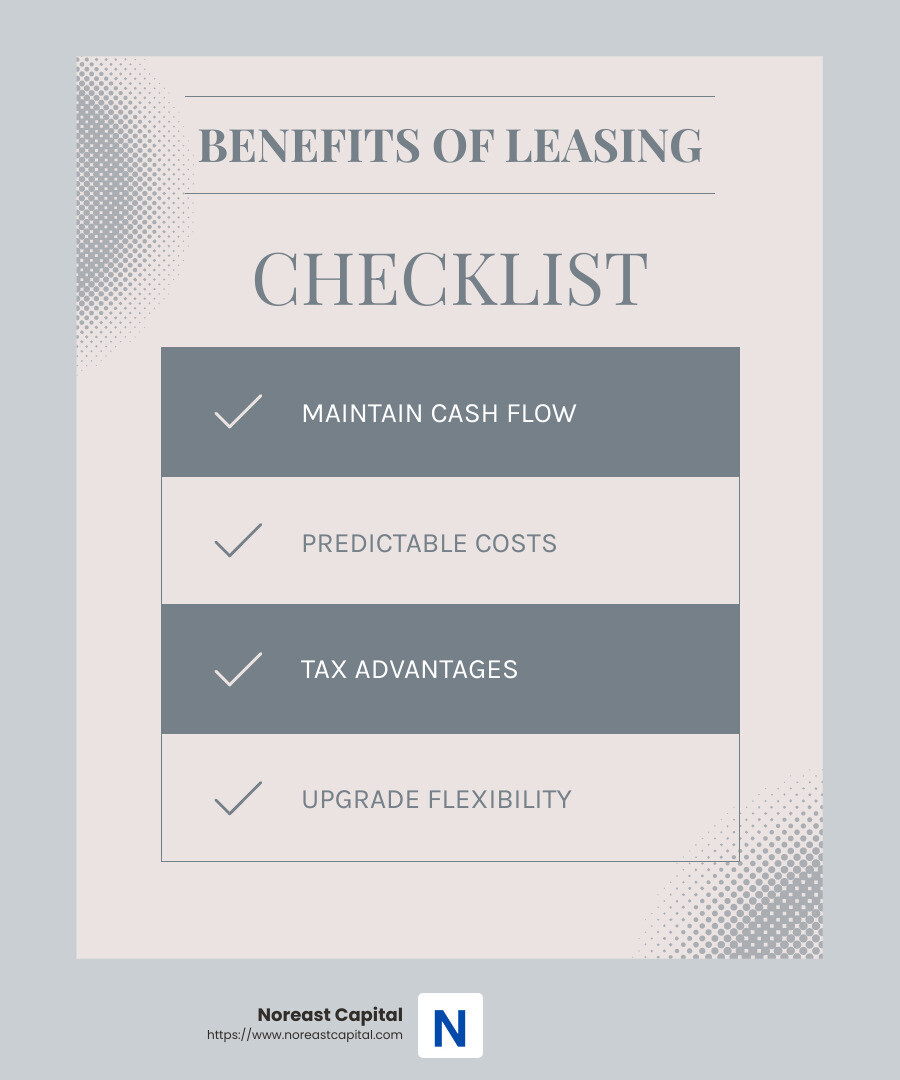
One of the biggest advantages of Office Equipment Leasing & Financing is improved cash flow management. Leasing allows you to spread the cost of expensive equipment over time, rather than making a large upfront payment. This frees up capital for other critical business needs like marketing, payroll, or inventory.
For example, if you lease a high-end photocopier, you can allocate funds to other pressing needs instead of tying up a large sum in a single purchase.
Cost Predictability
Leasing provides predictable monthly payments, making budgeting easier. You know exactly how much you need to pay each month, which helps avoid unexpected expenses. This is particularly useful for small businesses that need to manage their finances closely.
Tax Benefits
Leasing can offer significant tax advantages. Monthly lease payments are often considered a business expense and can be deducted from your taxable income.
According to Noreast Capital, this can lead to substantial tax savings for your business. Always consult with a tax advisor to understand how leasing can benefit your specific situation.
Upgrade Flexibility
Leasing provides flexibility to upgrade your equipment as technology evolves. This is crucial for staying competitive in today’s business environment. When your lease term ends, you can easily upgrade to the latest equipment without the hassle of selling outdated items.
For instance, leasing computers and related technology ensures you always have the latest tools to keep your business running efficiently.
Risk Management
Leasing transfers the risks associated with owning equipment to the lessor. This includes risks like equipment obsolescence, maintenance, and disposal. At the end of the lease term, you can return the equipment without worrying about its resale value or disposal.
By leasing, you also avoid the risk of owning equipment that may become obsolete quickly, such as technological devices or specialized machinery.

These benefits make Office Equipment Leasing & Financing a smart choice for businesses looking to manage their finances effectively while staying up-to-date with the latest technology.
How to Choose Between Leasing and Financing
When deciding between leasing and financing office equipment, consider several key factors: cash flow needs, equipment lifecycle, tax implications, and ownership preferences.
Cash Flow Needs
Leasing is ideal if you want to conserve cash flow. It allows you to spread out payments over time, which can be easier on your budget. Instead of a large upfront cost, you make smaller, consistent payments. This can free up capital for other business needs.
Financing, on the other hand, requires a sizable down payment, typically around 20% of the loan. While this might strain your cash flow initially, you own the equipment outright once the loan is paid off.
Equipment Lifecycle
Consider how long you plan to use the equipment. Leasing is excellent for items that may become obsolete quickly, like computers or specialized machinery. At the end of the lease, you can easily upgrade to the latest technology without the hassle of selling outdated equipment.
Financing is more suitable for equipment with a long useful life. If you expect to use the equipment for many years, owning it can be more cost-effective in the long run. You can also sell the equipment later if it still holds value.
Tax Implications
Both leasing and financing offer tax benefits, but they differ in how they are applied.
Leasing payments are often considered a business expense, making them fully deductible. This can reduce your taxable income significantly. Always consult with a tax advisor to understand the specific benefits for your situation.
Financing allows you to depreciate the equipment over time. This can also provide tax savings, but the benefits are spread out over several years. Additionally, the interest on the loan is usually tax-deductible.
Ownership Preferences
Your preference for ownership is a crucial factor.
Leasing means you do not own the equipment. The lessor retains ownership, and you return the equipment at the end of the lease term. This is a good option if you prefer flexibility and do not want the responsibilities of ownership, like maintenance and disposal.
Financing means you own the equipment once the loan is paid off. This can be advantageous if you prefer to have control over the asset and its future use. Ownership also allows you to sell the equipment later if it still has value.
In summary, the decision between leasing and financing depends on your specific business needs and financial situation. Evaluate your cash flow, the expected lifecycle of the equipment, tax benefits, and whether you prefer to own the equipment. Each option has its pros and cons, so choose the one that aligns best with your strategic goals.
Next, we will explore the steps to lease or finance office equipment, guiding you through the application process, credit score requirements, and necessary documentation.
Steps to Lease or Finance Office Equipment
Now that you’ve decided between leasing and financing, let’s dive into the steps to get the office equipment you need. This section will guide you through the application process, credit score requirements, documentation needed, and approval process.
Application Process
The first step in leasing or financing office equipment is the application. This can differ based on the lender:
Traditional Lenders: If you’re applying through a bank or credit union, you’ll typically need to meet with a loan officer. They might require a detailed business plan and other financial documents.
Online Lenders: The process is more streamlined. You’ll usually complete an application form on their website and may have to participate in a phone call. Online applications are often quicker but may have higher interest rates.
Equipment Dealers: Some dealers offer in-house financing or work with third-party financing companies. They can help you complete the application on-site, making it a convenient option if you’re already purchasing equipment from them.
Credit Score Requirements
Your credit score plays a crucial role in determining your eligibility for leasing or financing:
Good Credit (650 and above): If your credit score is 650 or higher, you are more likely to receive favorable terms and lower interest rates. This applies to both leasing and financing options.
Fair to Poor Credit (below 650): Some lenders accept lower credit scores, but you might face higher interest rates and more stringent terms. In such cases, providing a personal guarantee or having a co-signer with a better credit score can help.
Documentation Needed
The documentation required varies by lender but generally includes:
Business Plan: Especially needed for traditional lenders, a business plan outlines your business model, market analysis, and financial projections. It demonstrates your ability to repay the loan or lease.
Financial Statements: These include profit and loss statements, balance sheets, and cash flow statements. They provide a snapshot of your business’s financial health.
Tax Returns: Lenders often require your business’s tax returns for the past two to three years to assess your financial stability.
Personal Financial Information: For small businesses or startups, lenders might also ask for your personal financial information, such as personal tax returns and credit reports.
Approval Process
Once you’ve submitted your application and documentation, the approval process begins:
Initial Review: Lenders will conduct an initial review, which may include a soft credit pull. This step assesses your basic eligibility without affecting your credit score.
Detailed Evaluation: A more thorough evaluation follows, involving a hard credit pull, which can impact your credit score. Lenders will scrutinize your financial documents, business plan, and credit history.
Decision and Terms: If approved, the lender will present you with the loan or lease terms, including interest rates, repayment schedule, and any additional fees.
Acceptance and Funding: After you agree to the terms, the lender will finalize the paperwork. For financing, funds are typically disbursed to your account. For leasing, the equipment is purchased by the lessor and provided to you.
Navigating the steps to lease or finance office equipment can seem daunting, but understanding each phase helps streamline the process. Next, we’ll explore the top office equipment leasing and financing options available through Noreast Capital.
Top Office Equipment Leasing & Financing Options
When it comes to Office Equipment Leasing & Financing, Noreast Capital stands out for its competitive and flexible solutions. Here, we’ll dive into the leasing and financing options they offer, supported by customer testimonials and case studies.
Noreast Capital’s Leasing and Financing Solutions
Noreast Capital provides a range of leasing and financing options custom to meet the needs of businesses of all sizes. Whether you need new furniture, computers, phone systems, or copiers, Noreast Capital has you covered.
Key Features:
- Flexible Terms: Noreast Capital offers a variety of lease terms and structures to suit your business needs.
- Quick Approval: The approval process is streamlined to get you the equipment you need fast.
- No Money Down: Many of their programs allow for financing with no money down, conserving your capital.
- Upgrade Flexibility: You can easily upgrade your equipment as your business grows.
- Superior Customer Service: Their dedicated team provides personalized support throughout the leasing process.
Customer Testimonials
John D., Small Business Owner:
“Noreast Capital made it easy for us to lease new office furniture with no upfront costs. The flexible terms allowed us to upgrade as our business grew without any hassle.”
Sarah L., Office Manager:
“We needed new computers and phone systems, but we couldn’t afford to pay for everything upfront. Noreast Capital’s financing options gave us the flexibility we needed to keep our cash flow stable.”
Case Studies
Case Study 1: Tech Startup Expansion
Background: A tech startup needed to expand its operations quickly but lacked the capital to purchase new office equipment outright.
Solution: Noreast Capital provided a leasing solution that covered all their needs, including desks, chairs, computers, and telecommunications systems. The startup was able to conserve its capital for other critical expenses.
Outcome: The startup successfully expanded its operations, increasing its workforce by 50% within six months. The flexibility of the leasing terms allowed them to upgrade their equipment as they grew.
Case Study 2: Medical Office Upgrade
Background: A medical office required new diagnostic equipment but faced budget constraints.
Solution: Noreast Capital offered a financing plan with no money down and low monthly payments, making it feasible for the medical office to acquire advanced diagnostic tools.
Outcome: The medical office improved its diagnostic capabilities, leading to better patient outcomes and increased patient satisfaction. The financing plan allowed them to invest in technology without straining their budget.
Learn More
Explore more about Noreast Capital’s Office Equipment Leasing & Financing options on their official website and get in touch with their sales representatives to find the best solution for your business needs.
Next, we’ll answer some frequently asked questions about office equipment leasing and financing to help you make informed decisions.
Frequently Asked Questions about Office Equipment Leasing & Financing
What is the difference between equipment leasing and financing?
Equipment leasing and equipment financing are two ways businesses can obtain the equipment they need without paying the full cost upfront, but they work differently.
Leasing: When you lease equipment, you pay to use it for a specific period, usually with monthly payments. At the end of the lease term, you may have the option to purchase the equipment, return it, or renew the lease. Leasing is ideal if you need to update your equipment frequently or want to avoid the risks of obsolescence.
Financing: Equipment financing is more like a loan. You borrow the money to buy the equipment and repay it over time, usually with interest. Once the loan is paid off, you own the equipment outright. Financing is better suited if you plan to use the equipment for a long time and want to build equity.
In summary, leasing is often the better choice for businesses looking to conserve capital and maintain flexibility, while financing is ideal for those who prefer ownership.
What credit score do you need to lease equipment?
Your credit score plays a significant role in your ability to lease equipment. Generally, a credit score of 640 or higher is a good starting point. However, some lenders may have more flexible requirements. For instance:
- 640 and above: Typically qualifies for better terms and lower interest rates.
- Below 640: You may still qualify, but expect higher interest rates and possibly more stringent terms.
Each lender has its own criteria, so it’s beneficial to shop around. Some may also consider additional factors like your business’s cash flow and industry experience.
What type of equipment can be leased?
Almost any type of office equipment can be leased. Here are some common categories:
- Computers and IT equipment: Laptops, desktops, servers, and networking devices.
- Office furniture: Desks, chairs, filing cabinets, and workstations.
- Telecommunications: Phone systems, video conferencing equipment, and intercoms.
- Medical equipment: Diagnostic tools, heart monitors, dental and optical equipment.
- Printing and publishing: Printers, copiers, binders, and cutting machines.
Leasing allows businesses to stay updated with the latest technology and equipment without large upfront costs. It’s a practical solution for managing cash flow and ensuring operational efficiency.
For more detailed information on the types of equipment you can lease, check out Noreast Capital’s offerings.
Next, we’ll guide you through the steps you need to take to lease or finance office equipment, ensuring a smooth and efficient process.
Conclusion
In summary, Office Equipment Leasing & Financing offers businesses a flexible and cost-effective way to acquire the tools they need. Whether you choose to lease or finance, each option has its unique benefits and drawbacks. Leasing allows for lower upfront costs and regular upgrades, while financing provides the path to ownership and long-term use.
At Noreast Capital, we specialize in providing custom leasing and financing solutions. Our goal is to help businesses conserve capital, manage cash flow, and stay up-to-date with the latest equipment. With our competitive rates and superior customer service, we make the process simple and hassle-free.
Final Thoughts
Deciding between leasing and financing office equipment can be complex, but understanding your business needs and financial situation can make the choice clearer. Whether you need new computers, office furniture, or specialized medical equipment, Noreast Capital is here to support you every step of the way.
For more information on how we can help you with your office equipment needs, visit our website or contact one of our specialists today.
Next, we’ll guide you through the steps you need to take to lease or finance office equipment, ensuring a smooth and efficient process.