

Open uping the Power of a Restaurant Equipment Leasing Calculator
Looking to understand your restaurant equipment leasing calculator results? Here’s a quick answer:
- Input the estimated cost of equipment
- Choose a lease term
- Hit ‘Calculate’
- Get your monthly payment estimate
When it comes to upgrading or expanding your restaurant, getting the right equipment is crucial—but it can be expensive. That’s where a restaurant equipment leasing calculator comes in handy. This tool helps you estimate monthly payments, which can significantly ease the financial burden and improve your cash flow.
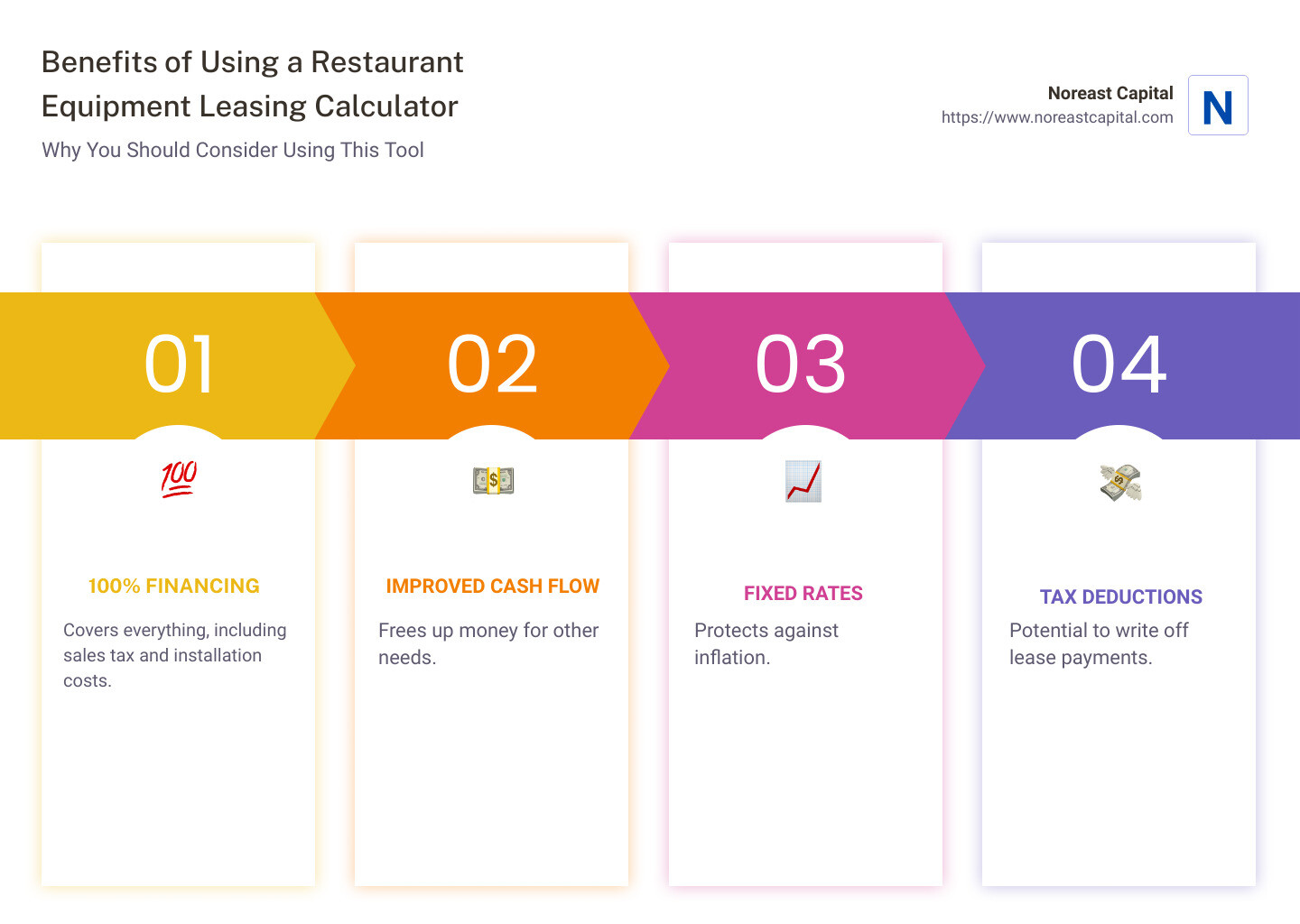
Using a restaurant equipment leasing calculator offers several benefits:
- 100% Financing: Covers everything, including sales tax and installation costs.
- Improved Cash Flow: Frees up money for other needs.
- Fixed Rates: Protects against inflation.
- Tax Deductions: Potential to write off lease payments.
I’m Vincent Cerniglia, and I’m here to make the complexities of restaurant equipment leasing easy to understand. With my extensive experience, I’ve helped countless restaurant owners steer the maze of financing options.
What is a Restaurant Equipment Leasing Calculator?
A restaurant equipment leasing calculator is a specialized tool designed to help restaurant owners estimate the monthly payments for leasing equipment. This tool is essential for anyone looking to upgrade or expand their restaurant without the hefty upfront costs.
Definition
Simply put, a restaurant equipment leasing calculator allows you to input various financial details about the equipment you want to lease and then calculates your estimated monthly payments. This helps you plan your finances more effectively.
Purpose
The main purpose of this calculator is to provide an easy-to-understand estimate of what your monthly financial obligations will be. This helps you:
- Budget more accurately
- Understand the financial impact
- Make informed decisions about leasing vs. buying
Functionality
Using a restaurant equipment leasing calculator is straightforward. Here’s a step-by-step guide:
- Input the estimated cost of the equipment you are looking to lease.
- Enter the down payment amount (if any).
- Select the lease term (e.g., 24 months, 36 months).
- Input the interest rate associated with the lease.
- Choose the type of lease (e.g., FMV, 10% buyout, $1 buyout).
Once you have entered these details, click the ‘Calculate’ button to generate your monthly payment estimate.
Key Features
- User-Friendly Interface: Easy to steer, even for those not well-versed in finance.
- Comprehensive Input Fields: Allows you to input various financial details for a more accurate estimate.
- Detailed Output: Provides monthly payment estimates, total cost of lease, and total cost of buyout.
- Flexibility: Can be used for different types of leases and various terms.
Example Scenario
Imagine you want to lease a commercial oven that costs $50,000. You decide on a 48-month lease term with an 8% interest rate. Here’s how the different types of leases would break down:
| Lease Type | Monthly Payment | Total Cost of Lease | Total Cost of Buyout |
|---|---|---|---|
| FMV Lease | $747.41 | $35,875.81 | $62,542.47 |
| 10% Buyout Lease | $1,131.91 | $54,331.91 | $59,331.91 |
| $1 Buyout Lease | $1,220.63 | $58,590.16 | $58,591.16 |
As you can see, the FMV lease offers the lowest monthly payment but the highest buyout cost. Conversely, the $1 buyout lease has the highest monthly payment but the lowest buyout cost.
Using a restaurant equipment leasing calculator helps you see these differences clearly, so you can choose the lease type that best fits your financial situation and long-term goals.
How to Use a Restaurant Equipment Leasing Calculator
Using a restaurant equipment leasing calculator can make budgeting for new equipment straightforward and stress-free. Here’s a step-by-step guide to help you steer the process.
Input Fields Explained
Equipment Cost: Enter the total estimated cost of the restaurant equipment you plan to lease. This is the purchase price before any down payment or financing.
Down Payment: If you plan to make an initial down payment, input that amount here. A down payment can reduce your monthly payments.
Lease Term: Select the duration of the lease. Common terms range from 24 to 60 months. Longer terms usually result in lower monthly payments but higher total costs.
Interest Rate: Input the interest rate associated with your lease. This rate affects your monthly payments and overall cost.
Lease Type: Choose the type of lease that fits your needs. The options typically include:
- Fair Market Value (FMV) Lease
- 10% Buyout Lease
- $1 Buyout Lease
Output Fields Explained
Monthly Payments: This is the estimated amount you’ll pay each month. The calculator will generate this based on the input fields above. For example, with a $50,000 equipment cost and a 48-month term, monthly payments will vary depending on the lease type:
- FMV Lease: $747.41
- 10% Buyout Lease: $1,131.91
- $1 Buyout Lease: $1,220.63
Residual Value: This is the estimated value of the equipment at the end of the lease term. It varies by lease type:
- FMV Lease: $26,666.67
- 10% Buyout Lease: $5,000.00
- $1 Buyout Lease: $1
Total Cost of Lease: This field shows the total amount paid over the lease term, excluding the buyout cost. For example:
- FMV Lease: $35,875.81
- 10% Buyout Lease: $54,331.91
- $1 Buyout Lease: $58,590.16
Total Cost of Buyout: This is the total expense incurred if you decide to purchase the equipment at the end of the lease. It includes all monthly payments plus the residual value:
- FMV Lease: $62,542.47
- 10% Buyout Lease: $59,331.91
- $1 Buyout Lease: $58,591.16
Example Scenario
Let’s walk through an example to illustrate how to use the calculator.
Imagine you want to lease a commercial oven priced at $50,000. You choose a 48-month lease term with an 8% interest rate. Here’s how the different lease types would break down:
| Lease Type | Monthly Payment | Total Cost of Lease | Total Cost of Buyout |
|---|---|---|---|
| FMV Lease | $747.41 | $35,875.81 | $62,542.47 |
| 10% Buyout Lease | $1,131.91 | $54,331.91 | $59,331.91 |
| $1 Buyout Lease | $1,220.63 | $58,590.16 | $58,591.16 |
As seen, the FMV lease offers the lowest monthly payment but the highest total cost of buyout. Conversely, the $1 buyout lease has the highest monthly payment but the lowest total cost of buyout.
Using a restaurant equipment leasing calculator helps you see these differences clearly, so you can choose the lease type that best fits your financial situation and long-term goals.
Next, we’ll explore the various types of equipment leases in more detail.
Types of Equipment Leases
When considering leasing equipment for your restaurant, understand the different types of leases available. Each lease type has its own set of benefits and drawbacks. Here, we’ll break down the most common types: Fair Market Value (FMV) Lease, 10% Buyout Lease, $1 Buyout Lease, TRAC Lease, and PUT Lease.
Fair Market Value (FMV) Lease
Definition: An FMV lease allows you to lease equipment with the option to buy it at its fair market value at the end of the lease term.
Benefits:
- Lower Monthly Payments: FMV leases typically offer the lowest monthly payments compared to other lease types.
- Flexibility: At the end of the lease, you can choose to buy the equipment, return it, or upgrade to new equipment.
- Tax Advantages: Lease payments may be tax-deductible as operating expenses.
Drawbacks:
- Higher Buyout Cost: If you decide to purchase the equipment at the end of the lease, the cost can be high.
- Uncertainty: The fair market value is determined at the end of the lease, which can be unpredictable.
10% Buyout Lease
Definition: A 10% buyout lease allows you to purchase the equipment at the end of the lease term for 10% of its original value.
Benefits:
- Moderate Monthly Payments: Payments are generally higher than FMV leases but lower than $1 buyout leases.
- Fixed Buyout Price: You know upfront how much it will cost to buy the equipment at the end of the lease.
- Flexibility: Similar to FMV leases, you can choose to buy, return, or continue leasing the equipment.
Drawbacks:
- Higher Total Cost: The total cost of the lease can be higher compared to FMV leases.
- Commitment: If your needs change, you may still be committed to the lease terms.
$1 Buyout Lease
Definition: A $1 buyout lease allows you to purchase the equipment at the end of the lease term for just $1.
Benefits:
- Ownership: This lease is ideal if you are certain you want to own the equipment at the end of the term.
- Predictable Costs: You know exactly what you will pay over the lease term, including the buyout cost.
- Tax Benefits: You may be able to deduct depreciation and interest expenses.
Drawbacks:
- Higher Monthly Payments: Monthly payments are typically the highest among the lease types.
- Less Flexibility: This lease is more like a loan, with less flexibility to return or upgrade the equipment.
TRAC Lease
Definition: A Terminal Rental Adjustment Clause (TRAC) lease is primarily used for leasing vehicles. It allows for adjusting the rental or lease payments based on the actual value of the vehicle at the end of the lease term.
Benefits:
- Lower Monthly Payments: Payments can be lower because they are based on the residual value of the vehicle.
- Flexibility: You can adjust the lease terms based on the vehicle’s actual market value at the end of the lease.
Drawbacks:
- Residual Risk: If the vehicle’s value is lower than expected, you may owe more at the end of the lease.
- Complexity: These leases can be more complex to understand and manage.
PUT Lease
Definition: A 10% Purchase Upon Termination (PUT) lease allows you to lease equipment with the obligation to purchase it at the end of the lease term for 10% of its original cost.
Benefits:
- Lower Monthly Payments: Payments are generally lower than a $1 buyout lease.
- Predictable Buyout Cost: You know the buyout cost upfront, which can help with financial planning.
Drawbacks:
- Commitment to Purchase: You are obligated to buy the equipment at the end of the lease term, which can be a drawback if your needs change.
- Higher Total Cost: The total cost of the lease can be higher compared to other lease types.
Understanding the different lease types can help you make an informed decision that aligns with your restaurant’s financial goals. Next, we’ll dig into the benefits of using a restaurant equipment leasing calculator to aid in your decision-making process.
Benefits of Using a Restaurant Equipment Leasing Calculator
Using a restaurant equipment leasing calculator offers several advantages that can significantly impact your financial planning, cost analysis, and decision-making process. Let’s explore these benefits.
Financial Planning
A leasing calculator helps you plan your finances by providing an estimate of your monthly payments. This predictability allows you to budget more effectively and allocate resources to other areas of your business.
Example: If you input the cost of a new oven at $10,000 and select a lease term of 48 months with an interest rate of 8%, the calculator will give you a clear picture of what your monthly payments will be. Knowing this helps you plan your cash flow and avoid financial surprises.
Cost Analysis
Understanding the total cost of leasing equipment is crucial. The calculator breaks down the expenses, including monthly payments and the residual value at the end of the lease term.
Case Study: A restaurant owner used our calculator to compare different lease options for a $50,000 piece of equipment. The results showed that a Fair Market Value (FMV) lease had the lowest monthly payments but the highest buyout cost, while a $1 buyout lease had higher monthly payments but the lowest total cost of buyout. This detailed cost analysis enabled the owner to choose the most cost-effective option.
ROI Calculation
Return on Investment (ROI) is a key metric for any business decision. The leasing calculator allows you to input your estimated monthly revenue due to the new equipment, helping you see the potential ROI.
Quote: “Using the calculator, I realized that the new equipment could increase my monthly revenue by $5,000. The ROI calculation showed that the investment would pay off in less than a year!” – Jane, Restaurant Owner
Decision-Making
Armed with detailed financial information, you can make more informed decisions. The calculator helps you weigh the pros and cons of different lease types, taking into account your equipment needs and financial situation.
Fact: According to the National Restaurant Association, food and labor costs consume about 66% of every dollar in sales. Knowing your exact lease payments helps you manage these high operating expenses more effectively.
Using a restaurant equipment leasing calculator simplifies complex financial decisions, making it easier to plan, analyze costs, calculate ROI, and ultimately choose the best leasing option for your business.
Next, we’ll answer some frequently asked questions about restaurant equipment leasing calculators.
Frequently Asked Questions about Restaurant Equipment Leasing Calculators
How are equipment leases calculated?
Equipment leases are calculated based on several key factors:
Equipment Price: This is the total cost of the equipment you want to lease. For example, if you’re leasing a $50,000 oven, this amount will be the starting point for all calculations.
Down Payment: Some leases require an initial down payment. For instance, a $10,000 down payment on a $50,000 piece of equipment reduces the principal amount to $40,000.
Lease Term: This is the length of the lease, typically ranging from 12 to 60 months. A longer lease term usually means lower monthly payments but higher total interest costs.
Interest Rate: The annual interest rate affects the monthly payments and total cost. For example, an 8% interest rate will be applied to the principal amount over the lease term.
Lease Type: Different types of leases (FMV, $1 Buyout, 10% Buyout) have different impacts on monthly payments and residual values.
To calculate the monthly lease payment, you can use the formula for an annuity payment:
[ \text{Monthly Payment} = \frac{P \times r \times (1 + r)^n}{(1 + r)^n – 1} ]
Where:
- ( P ) is the principal amount (equipment price minus down payment)
- ( r ) is the monthly interest rate (annual rate divided by 12)
- ( n ) is the number of payments (lease term in months)
What is the lease factor of equipment?
The lease rate factor is a simplified way to estimate your monthly lease payment. It’s a decimal number that, when multiplied by the equipment cost, gives you the monthly payment.
For example, if the lease rate factor is 0.03 and the equipment costs $50,000:
[ \text{Monthly Payment} = \text{Lease Factor} \times \text{Equipment Cost} ]
[ \text{Monthly Payment} = 0.03 \times 50,000 = \$1,500 ]
This factor considers the interest rate, lease term, and type of lease. It provides a quick way to estimate payments without complex calculations.
How to make money leasing equipment?
Leasing equipment can be profitable for leasing companies through several avenues:
Charges and Fees: Leasing companies often charge fees such as processing fees, late payment fees, and early termination fees. These add to the overall profitability.
Interim Rent: This is the rent charged for the period between the equipment delivery and the lease start date. It ensures that the leasing company earns revenue even before the lease officially begins.
Lease Extensions: At the end of the lease term, lessees may choose to extend the lease, providing additional income for the lessor.
Residual Value: If the lessee returns the equipment at the end of the lease, the lessor can sell or re-lease it, earning more money from the same asset.
By understanding these elements, you can better steer the complexities of equipment leasing and make informed decisions that benefit your restaurant’s financial health.
Next, we’ll dig deeper into choosing the right financing option for your restaurant equipment needs.
Conclusion
In summary, a restaurant equipment leasing calculator is an invaluable tool for any restaurant owner looking to make informed financial decisions. By inputting key variables such as equipment cost, down payment, lease term, and interest rate, you can quickly determine your monthly payments, total lease cost, and potential buyout costs. This helps you plan your budget more effectively, ensuring your restaurant remains financially healthy.
Using a leasing calculator allows you to:
- Improve Cash Flow: By spreading out the cost of expensive equipment, you can manage your cash flow better and allocate funds to other essential areas of your business.
- Evaluate ROI: The calculator helps you understand the return on investment, ensuring that the equipment will contribute positively to your bottom line.
- Compare Lease Types: Whether it’s a Fair Market Value (FMV) lease, a 10% buyout lease, or a $1 buyout lease, the calculator provides a clear picture of the costs and benefits associated with each option.
At Noreast Capital, we are committed to helping you steer the complexities of restaurant equipment financing. Our goal is to provide you with the financial tools and resources necessary to thrive in the competitive restaurant industry. Our customizable financing options ensure you can acquire high-quality equipment without compromising your cash flow or financial stability.
Investing in the right equipment is crucial for your restaurant’s success. It allows you to deliver exceptional dining experiences and positions your business for growth and profitability. With Noreast Capital, you have a dedicated partner ready to support you every step of the way, from application to approval and beyond.
In conclusion, the journey to securing the best restaurant equipment financing might seem daunting, but with Noreast Capital, it doesn’t have to be. Our team is here to guide you through the process, ensuring you find the financing solution that best fits your restaurant’s needs and goals. Let us help you turn your culinary dreams into reality with the right financial support. Your success is our success, and together, we can achieve great things.
Thank you for considering Noreast Capital as your trusted partner in restaurant equipment financing. We look forward to serving you and contributing to your restaurant’s success story.