

A used car lease calculator can be your go-to tool for making smart financial decisions when leasing a pre-owned vehicle. Here’s how it works in a nutshell:
- Estimate monthly payments: Input details like the car’s negotiated price, residual value, money factor, and term length.
- Understand cost-saving benefits: Compare leasing costs to owning, considering factors like lower monthly payments and reduced maintenance.
- Evaluate financial advantages: Determine if leasing fits your budget by looking at initial outlays and long-term financial impact.
Leasing a used car can offer substantial benefits—lower monthly payments, tax advantages, and the flexibility of a newer vehicle without the steep price tag. It allows businesses to preserve capital and avoid the hefty depreciation often seen with outright purchases. Whether you’re navigating financial problems or aiming for cost-efficient solutions, understanding these leasing benefits can help you make the right choice.
I’m Vincent Cerniglia, and as a leader in equipment financing at Noreast Capital, I’ve honed my expertise in used car lease calculator solutions, providing cost-effective lease options to various businesses. This experience positions me to guide you through the intricacies of used car leasing, beginning with this insightful exploration. Let’s explore the fundamentals of used car leasing, where every financial decision matters.
Understanding Used Car Leasing
When it comes to leasing a used car, understanding the key components can make all the difference in making a smart financial decision. Let’s break down the essential elements of used car leasing: lease terms, residual value, depreciation, and mileage limits.
Lease Terms
Lease terms define the length of your lease agreement, typically ranging from 24 to 48 months. The term you choose will affect your monthly payments and the overall cost of the lease. Shorter lease terms often mean higher monthly payments, but they allow you to switch to a different vehicle sooner. Longer terms offer lower payments but might not always be the best option due to increased wear and tear over time.
Residual Value
Residual value is the estimated worth of the car at the end of the lease. It’s a crucial factor because it influences your monthly payment. A higher residual value usually means lower monthly payments. For example, if a car’s MSRP is $30,000 and the residual value is set at 60%, the car is expected to be worth $18,000 at the end of the lease. Understanding this value helps you decide if purchasing the vehicle at lease-end is a good deal.
Depreciation
Depreciation is the reduction in the car’s value over time. During a lease, you pay for the depreciation that occurs while you have the vehicle. Cars with lower depreciation rates are more cost-effective to lease because they retain their value better. This translates to lower monthly payments compared to cars that depreciate quickly.
Mileage Limits
Mileage limits are set by the lease agreement and typically range from 10,000 to 15,000 miles per year. Exceeding these limits can lead to hefty penalties, often between 5 to 20 cents per mile over the limit. If you drive a lot, consider a high mileage lease, which allows for more miles but may come with higher monthly payments. That the average American drives around 18,000 miles a year, so choose your mileage cap wisely.
By understanding these key factors, you can make informed decisions about your used car lease. Use a used car lease calculator to estimate your monthly payments and see how different terms and conditions affect your lease. This tool can help you steer the complexities of leasing and ensure you get the best deal possible.

How to Use a Used Car Lease Calculator
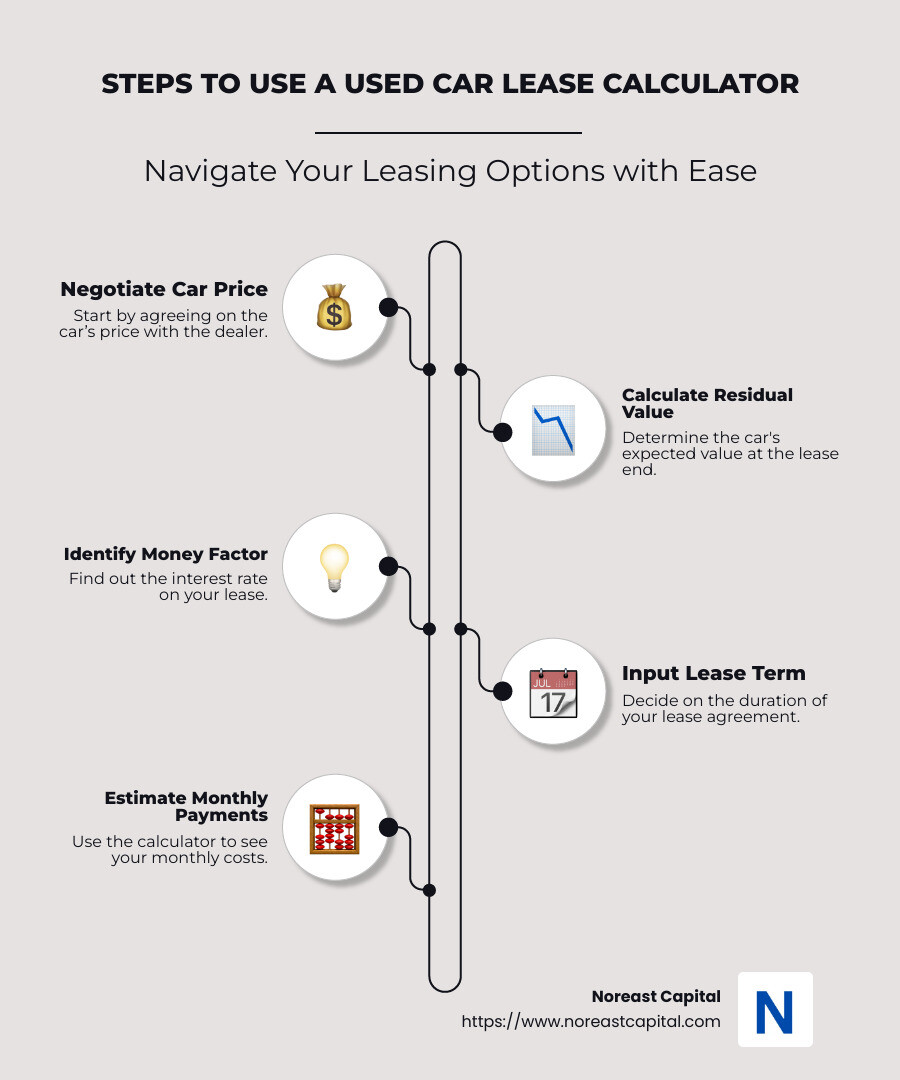
A used car lease calculator is your best friend when it comes to figuring out your potential lease costs. It helps you break down complex numbers into simple, easy-to-understand monthly payments. Here’s how to use it effectively:
Capitalized Cost
Capitalized cost is like the starting point of your lease. Think of it as the price you pay to use the car. It’s based on the car’s negotiated price plus any fees and taxes, minus any down payment or trade-in value. The lower the capitalized cost, the less you’ll pay each month.
Money Factor
The money factor is the lease equivalent of an interest rate. It determines the finance charge on your lease. To convert the money factor to a more familiar interest rate, multiply it by 2400. For instance, a money factor of 0.002083 is roughly a 5% annual interest rate. The lower the money factor, the lower your monthly payments will be.
Monthly Payments
Once you have your capitalized cost and money factor, the calculator estimates your monthly payments. It considers the car’s depreciation and finance charges over the lease term. Depreciation is the difference between the car’s capitalized cost and its residual value. You’ll pay for this depreciation, plus interest, spread over the lease term.
Here’s a simple breakdown:
- Enter the Vehicle Details: Input the car’s MSRP, final negotiated price, and any incentives or rebates.
- Set the Lease Terms: Choose the lease length and expected annual mileage.
- Include Additional Costs: Add any down payment or trade-in value to adjust the capitalized cost.
- Calculate: The calculator will show you the estimated monthly payment, helping you see how different factors affect your lease.
Using a used car lease calculator can save you from surprises and ensure you’re making a financially sound decision. It’s a straightforward way to see how changes in terms or costs impact your payments, giving you the power to negotiate a better deal.
Key Factors Affecting Your Lease
When leasing a used car, several key factors will influence your overall lease cost and experience. Understanding these elements can help you make informed decisions and potentially save money.
Residual Value
Residual value is a crucial number in car leasing. It’s the estimated worth of the car at the end of the lease term. The higher the residual value, the lower your monthly payments will be. This is because you’re paying for the car’s depreciation, which is the difference between the car’s initial value and its residual value. Typically, a car with a residual value of 65% or higher is considered a good deal.
Mileage
Leases come with mileage limits, usually between 10,000 to 15,000 miles per year. If you exceed these limits, you could face penalties, often ranging from 5 to 20 cents per mile. It’s essential to estimate your yearly mileage accurately. If you drive more than average, consider a high-mileage lease to avoid extra charges.
Wear and Tear
Wear and tear refer to the condition of the car when you return it at the end of the lease. Normal wear and tear are expected, but anything deemed excessive could result in additional fees. To avoid these costs, maintain your car well and address any minor damages promptly. Some lessees opt for wear and tear insurance to cover unexpected expenses.
Maintenance
While leasing can mean lower monthly payments, you still need to maintain the vehicle. Regular maintenance is crucial to avoid excessive wear and tear charges. Most leases require you to follow the manufacturer’s recommended service schedule. Keeping up with oil changes, tire rotations, and other routine services can save you money in the long run.
By understanding these key factors—residual value, mileage limits, wear and tear, and maintenance—you can better steer the leasing process. This knowledge will help you use a used car lease calculator effectively, allowing you to see how these elements impact your lease and helping you make smarter financial decisions.
Frequently Asked Questions about Used Car Leasing
What is the 1% rule in car leasing?
The 1% rule is a simple guideline to assess whether a lease deal is favorable. It suggests that your monthly lease payment should be about 1% or less of the car’s MSRP (Manufacturer’s Suggested Retail Price). For instance, if a car’s MSRP is $30,000, a good lease deal would have a monthly payment of $300 or less. This rule provides a quick way to compare lease offers, but remember, it’s just a starting point. Other factors like residual value and money factor also play a significant role in determining the overall cost.
How do you calculate the value of a lease?
Calculating the value of a lease involves understanding several components. First, the lease value is influenced by the car’s depreciation, which is the difference between the car’s initial value and its residual value at the end of the lease term.
To get a comprehensive view, consider the present value factor, which helps determine the total lease cost in today’s dollars, accounting for interest and time. Additionally, lease liability refers to the total amount you owe over the lease term, including monthly payments and any fees. By using a used car lease calculator, you can input these variables to estimate your total lease cost accurately.
Is it better to lease a car for 36 or 48 months?
Choosing between a 36-month or 48-month lease depends on several factors. A 36-month lease often offers a higher residual value, meaning lower monthly payments since the car depreciates less over a shorter period. It also aligns well with most warranty periods, potentially saving on out-of-pocket expenses for maintenance or repairs.
On the other hand, a 48-month lease might offer lower monthly payments but could result in higher costs over time due to increased wear and tear and potential repairs after the warranty expires. Consider your driving habits, maintenance preferences, and financial goals when deciding on the lease term that best suits your needs.
Conclusion
Leasing a car, especially a used one, can be a smart financial move when approached with the right knowledge and tools. At Noreast Capital, we are committed to helping you steer the complexities of equipment leasing with ease and confidence. Our goal is to provide businesses with flexible financial solutions that allow them to use essential equipment without the burden of ownership.
By leveraging our expertise in the equipment leasing industry, we offer customizable options that maintain your cash flow while ensuring you have access to the tools necessary for growth. Whether you’re looking to lease a vehicle or other commercial equipment, our solutions are designed to meet your unique needs.
Using a used car lease calculator can simplify your leasing decision, providing clarity on costs and helping you make informed choices. By understanding key factors such as residual value, depreciation, and the money factor, you can optimize your lease terms and secure a deal that aligns with your financial objectives.
Explore our range of leasing options and find how Noreast Capital can support your business’s success. Visit our equipment lease page to learn more about our offerings and how we can partner with you to achieve your goals. Let’s drive smart together, ensuring your business thrives with the right financial backing.