The Real Cost Difference: Leasing vs. Financing a Car
Which is cheaper leasing or financing a car is a bit like asking whether it’s better to rent or buy a home – the answer depends on your unique situation and what you value most. Here’s the straightforward breakdown:
| Factor | Leasing | Financing |
|---|---|---|
| Monthly payments | Lower (avg. $586) | Higher (avg. $734) |
| Upfront costs | Minimal | 10-20% down payment typical |
| Long-term cost | Higher if you lease repeatedly | Lower if you keep car after loan payoff |
| Best for | Short-term needs, newer models every few years, lower monthly payments | Long-term ownership, high mileage drivers, building equity |
When you’re staring at price tags of new vehicles averaging over $48,000 in 2025, the way you pay for that car matters tremendously to your financial health. I’ve seen clients save thousands by choosing the right option for their specific driving habits and financial goals.
Think of leasing as paying for the privilege of driving a car during its best years. You’re essentially covering the depreciation during your time with the vehicle – similar to an extended rental relationship. You’ll enjoy lower monthly payments, but you won’t build any equity in the vehicle.
With financing, you’re taking a different approach. Those higher monthly payments are building toward something tangible – complete ownership of the vehicle. Once the loan is paid off, you’ve got an asset you can keep driving payment-free or sell when you’re ready for something new.
The numbers tell an interesting story: According to Experian’s latest 2025 data, the average lease payment sits at $606 monthly, while financing payments average $738. That $132 monthly difference looks attractive in the short term, but consider the longer view: two consecutive three-year leases typically cost thousands more than buying one car and keeping it for six years.
I’m Vincent Cerniglia from Noreast Capital, and I’ve guided hundreds of businesses through this exact decision. What I’ve learned is that determining which is cheaper leasing or financing a car requires honest analysis of how you’ll actually use the vehicle, not just how you think you might.

The real cost difference often comes down to your timeline. If you’re someone who enjoys driving a new car every few years and doesn’t mind never owning outright, leasing’s lower monthly payments might work beautifully for you. But if you’re the type to drive a car “until the wheels fall off,” financing will almost certainly save you money in the long run.
For deeper dives into specific comparisons, check out our guides on lease a car vs loan and leasing vs renting a car to understand the nuances that might apply to your situation.
Leasing vs. Financing 101: How Each Option Works
Let’s break down how these two options really work before we get into the money side of things. It all comes down to a simple question: do you want to own your car?
When you finance a car, you’re borrowing money to become the owner. Each monthly payment builds your equity—your personal stake in the vehicle. Pay off the loan, and the car is 100% yours. No more payments! You can keep driving it for years, sell it when you want, or trade it in—and whatever value is left belongs to you.
When you lease a car, you’re basically paying for the privilege of driving the vehicle for a set time—usually 2-4 years. Your payments cover the vehicle’s depreciation during that period, plus interest (what insiders call the “money factor”) and some fees. When the lease ends, you hand back the keys and walk away, or you can buy it for the predetermined residual value if you’ve fallen in love with it.
“Leasing is like a long-term rental where you pay to drive a car for a specific time,” as financial experts often explain. “Buying gives you ownership and control, but typically costs more upfront.”
Understanding depreciation is crucial here. Cars lose value fastest in their early years—AAA research shows a new car loses about $4,680 in value each year during the first five years. With a lease, you’re only paying for the depreciation during your lease term, which is why those monthly payments tend to be lower than financing.

The Nuts-and-Bolts of a Lease
Let’s peek under the hood of a lease agreement to see what drives your costs:
Your capitalized cost is the negotiated selling price of the vehicle. Just like when buying, a lower price means lower monthly payments—so yes, you should absolutely negotiate this!
The residual value is what the car is expected to be worth when your lease ends, shown as a percentage of the original MSRP. Higher residual value means lower monthly payments because you’re financing less depreciation. Luxury brands like Lexus and BMW often have strong residual values.
The money factor is basically interest in disguise. To convert it to a more familiar APR, just multiply by 2,400. A money factor of 0.00125 equals a 3% APR.
Watch out for the mileage cap, typically 10,000-15,000 miles per year. Going over costs you $0.10-$0.25 per extra mile at lease-end, which can add up fast if you’re a road warrior.
Be prepared for an acquisition fee of $395-$995 upfront, and a disposition fee of $300-$500 when you return the vehicle. These are standard administrative charges that cover paperwork and preparing the car for its next driver.
As veteran car advisor Ray Shefska suggests, “Always check the manufacturer’s website for current lease offers in your area before visiting a dealership.” These manufacturer incentives can slash your leasing costs significantly.
The Mechanics of an Auto Loan
Auto loans are more straightforward:
The principal is simply the amount you’re borrowing—the purchase price minus your down payment.
Your interest rate (APR) is the yearly cost of borrowing, shown as a percentage. Your credit score heavily influences this number.
The loan term is how long you’ll be making payments, usually 36-84 months. Longer terms mean smaller monthly payments but more interest paid overall. A six-year loan might feel easier on your monthly budget, but you’ll pay more in the long run.
Amortization describes how your payments get split between principal and interest over time. Early in the loan, most of your payment goes toward interest; later, more goes toward principal. This is why you build equity slowly at first, then faster as the loan matures.
With financing, you’re building equity with each payment. Though the car loses value over time, your loan balance decreases faster, eventually creating positive equity—the difference between what the car is worth and what you still owe.
Which is cheaper leasing or financing a car depends on your specific situation, but understanding these fundamentals helps you make the right choice for your needs.
For an even deeper dive into these options, check out our comprehensive guide on leasing vs. financing.
Which Is Cheaper Leasing or Financing a Car? Cost Breakdown
Now let’s break down the actual costs of leasing versus financing to determine which is cheaper: leasing or financing a car.

Monthly Payments: which is cheaper leasing or financing a car
When it comes to your monthly budget, leasing typically wins the battle. According to Experian’s latest data from Q1 2025, the average monthly lease payment sits at $586, while the average loan payment climbs to $734. That’s nearly $150 difference hitting your bank account every month!
Why such a gap? Think of it this way: when you lease, you’re only paying for the portion of the car you’re “using up” during your lease term. With a $40,000 car that will be worth $20,000 after three years, you’re essentially paying for that $20,000 of depreciation (plus interest), spread over 36 months.
When financing the same car, your payments need to cover the entire $40,000 purchase price (plus interest). It’s like paying for the whole pizza when you only plan to eat half!
The money factor (lease-speak for interest) plays a big role too. Here’s a quick insider tip: to convert a money factor to an APR, multiply it by 2,400. So a money factor of 0.00125 equals a 3% APR. The lower this number, the sweeter your monthly lease payment.
Upfront & End-of-Term Costs: which is cheaper leasing or financing a car
The sticker shock often happens before you even drive off the lot. With financing, you’re typically looking at a down payment of 10-20% of the vehicle’s price. On a $40,000 car, that’s $4,000-$8,000 upfront!
Leasing, meanwhile, is much gentler on your immediate cash flow. You’ll typically need the first month’s payment, maybe a security deposit (though this is often waived with good credit), an acquisition fee ($395-$995), and the usual documentation and registration fees. In most states, you’ll only pay sales tax on the monthly payments, not the entire vehicle value.
But leasing has its farewell costs too. When you return the keys, be prepared for a disposition fee ($300-$500) and potential charges for exceeding your mileage limit (typically $0.10-$0.50 per extra mile) or any wear and tear beyond what’s considered “normal.” Those coffee stains and door dings can add up!
With financing, once you make that final payment, the car is yours—no disposition fees, no mileage penalties, just the pride of ownership and freedom from car payments (until the repair bills start coming in, but that’s another story!).
Total Long-Term Outlay
Here’s where things get interesting—and where many lease-lovers get a reality check. Let’s compare a six-year scenario with a $40,000 vehicle in 2025:
If you choose two consecutive 3-year leases, you’re looking at:
- Monthly payments totaling about $39,600 ($550 × 72 months)
- Two acquisition fees adding up to $1,790
- Two disposition fees totaling $790
- A grand total of $42,180
- And at the end? You hand back the keys with nothing to show for it
If you opt for a 5-year loan followed by ownership, you’ll pay:
- Monthly payments totaling $45,000 ($750 × 60 months)
- A down payment of $4,000
- Total outlay of $49,000
- But here’s the kicker: you’ll own a vehicle worth approximately $16,000 (assuming 60% depreciation over 6 years)
- Making your net cost just $33,000
That’s nearly a $9,000 difference in your favor with financing!
The math reveals an important truth: leasing typically costs more in the long run because you’re constantly paying for a vehicle during its steepest depreciation period. It’s like repeatedly buying the first slice of pizza—the most expensive bite—then giving the rest away.
Of course, numbers don’t tell the whole story. If you value driving a new car every few years with the latest safety features and technology, that premium might be worth it to you. Lower monthly payments might also be crucial if your cash flow is tight or if you’re using the vehicle for business purposes where you can deduct lease payments.
For a deeper dive into how these calculations work, check out our detailed guide on how lease vs. finance car is calculated.
Beyond the Price Tag: Hidden Factors That Shift the Balance
When comparing leasing and financing, the monthly payment isn’t the whole story. There’s a world of “fine print” factors that can dramatically impact which option truly saves you money in the long run.
Mileage Limitations
If you’ve got a long commute or love road trips, this one’s a big deal. Most leases cap you at 10,000-15,000 miles per year, and going over can get expensive fast.
I recently worked with a sales rep who drives about 20,000 miles annually for work. Over a three-year lease, he’d rack up 24,000 excess miles. At the typical $0.25 per mile penalty, that’s a shocking $6,000 in fees when turning in the keys! For high-mileage drivers, financing almost always wins the “which is cheaper leasing or financing a car” debate.
When you finance, your car is yours—drive it across the country ten times if you want. No penalties, no sweat.
Wear-and-Tear Considerations
Kids, pets, and active lifestyles can be rough on vehicles. With a lease, every scratch, stain, and ding potentially costs you at turn-in time.
One of my clients, a mom of three young children, learned this lesson the hard way. Her leased SUV suffered the typical kid-related casualties—juice spills, crayon marks, and a few door dings from neighboring cars in parking lots. When she returned the vehicle, she faced nearly $1,200 in wear-and-tear charges.
When you finance, those same marks might affect resale value someday, but the choice of when (or whether) to fix them is entirely yours.
Maintenance Responsibilities
Lease agreements come with strings attached—you must follow the manufacturer’s maintenance schedule, often at dealer service centers where rates tend to be higher.
The silver lining? Most leased vehicles remain under warranty for the entire term, so major repairs are typically covered. You’ll mainly handle routine maintenance like oil changes and tire rotations.
With financing, you’re responsible for all maintenance and repairs after the warranty expires. That timing often coincides with when components start to wear out, potentially adding thousands to your ownership costs in years 4-6. This maintenance reality can significantly impact which is cheaper leasing or financing a car in the long term.
Insurance Requirements
Your lease contract likely demands premium insurance coverage:
- Higher liability limits (typically 100/300/50)
- Lower deductibles ($500 or less)
- Mandatory gap insurance
These beefed-up requirements can add $300-$500 to your annual insurance bill compared to the minimum coverage you might choose with a financed vehicle. When calculating which is cheaper leasing or financing a car, many people overlook this consistent monthly cost difference.
Early Termination Penalties
Life happens—jobs change, families grow, finances shift. If you need to end a lease early, brace yourself for potentially severe penalties, often equivalent to making all remaining payments plus fees.
Financing offers more flexibility here. If circumstances change, you can sell or trade in the vehicle, pay off the loan balance, and move on—sometimes even with a bit of equity depending on your car’s value and how much you’ve paid down.
Electric Vehicle Incentives
If you’re considering an EV, leasing offers a unique advantage. Under current laws, the leasing company can claim the federal tax credit (up to $7,500) and pass those savings to you through lower monthly payments.
This explains why our research shows that nearly half (46%) of all new electric vehicles are leased rather than purchased. When you finance an EV, you can only claim the tax credit if you meet certain income requirements and if the vehicle was assembled in North America—restrictions that don’t apply to leases.
Leasing an EV also helps you avoid the rapid obsolescence in battery and charging technology that’s still evolving year by year. By the end of a three-year lease, you can upgrade to a newer model with improved range and features.
For a deeper dive into all these factors and how they might affect your specific situation, check out our comprehensive leasing vs financing guide. We’ve also gathered independent analysis on EV lease incentives from Consumer Reports to help you make the most informed decision.
Pros and Cons at a Glance
When you’re trying to figure out which is cheaper leasing or financing a car, a side-by-side comparison can really help clear things up. Let’s break down what each option brings to the table:
Leasing Advantages:
Your wallet might thank you immediately when leasing. With payments typically 20-30% lower than financing, you’ll free up monthly cash flow. Plus, you can often drive away with minimal money down—a welcome relief if you’re watching your savings.
“I love getting a new car every three years with all the latest tech,” shares Maria, one of our clients who’s leased her last three vehicles. “The warranty coverage gives me peace of mind, and I never worry about major repair bills.”
For business owners, there’s another perk: potential tax benefits when you use the vehicle for business purposes. And when you’re done? No stress about selling or trade-in values—just hand over the keys and walk away (assuming you’ve stayed within your mileage limits and kept the car in good shape).
Financing Advantages:
The ownership factor can’t be overlooked. When you finance, every payment builds equity—something you can leverage when it’s time for your next vehicle. This long-term approach often saves money over time, especially once you’ve paid off the loan and enjoy payment-free driving.
Freedom is the word that comes up most often with our financing customers. Freedom to drive unlimited miles without penalty. Freedom to customize your ride with aftermarket accessories. Freedom to sell or trade whenever you want without early termination fees.

Your insurance costs might be lower too, since financing gives you more flexibility in choosing coverage levels. And when your loan term ends, there are no disposition fees or wear-and-tear charges to worry about—the car is simply yours.
Giovanni Velez, a Marketing Director we interviewed, puts it perfectly: “When choosing between buying or leasing, your vehicle timeline is important. Essentially, how long do you want to drive your next car? If it’s three years, then leasing is the way to go.”
But if you’re like Tom, another Noreast Capital client who keeps his vehicles for 8-10 years, financing makes more financial sense. “Over the long term,” our financial advisor often reminds clients, “the cheapest way to drive is to buy a car and keep it until it’s uneconomical to repair.”
The right choice ultimately depends on your personal priorities. Do you value lower monthly payments and the latest features? Leasing might be your answer. Prefer building equity and unlimited mileage? Financing could be the better route. Your driving habits, financial situation, and how you weigh the various advantages will guide your decision.
For a deeper dive into how these options compare, check out our comprehensive guide on leasing vs financing.
Your Personal Break-Even Calculator
Wondering which is cheaper leasing or financing a car for your unique situation? Let’s walk through a simple process to find your break-even point—the moment when one option becomes more financially advantageous than the other.
Step 1: Gather the Key Numbers
I’ve helped hundreds of clients run these numbers, and it always starts with collecting the same basic information. For a lease, you’ll need the capitalized cost (your negotiated price), residual value, money factor, term length, monthly payment, and upfront costs. Don’t forget to estimate maintenance and potential end-of-lease charges!
For financing, gather your purchase price, down payment, interest rate, loan term, monthly payment, and maintenance estimates. The most commonly overlooked figure? Your vehicle’s estimated future value—this represents the equity you’ll build.
“Most people focus only on the monthly payment,” I often tell clients, “but that’s like judging a book by only reading the first chapter.”
Step 2: Calculate Total Lease Costs
Add up your monthly payments across the entire term, plus your upfront costs, expected maintenance, and any likely end-of-lease charges. The formula looks like this:
Total Lease Cost = (Monthly Payment × Term Length) + Due at Signing + Estimated Maintenance + Estimated End-of-Lease Charges
Be honest with yourself about your driving habits—if you typically drive more than the allowance, factor in those excess mileage fees (they add up quickly at $0.15-$0.25 per mile!).
Step 3: Calculate Total Financing Costs
For financing, your calculation needs to include your down payment, all monthly payments, maintenance costs, and—this is crucial—subtract the vehicle’s estimated resale value:
Total Financing Cost = Down Payment + (Monthly Payment × Term Length) + Estimated Maintenance - Estimated Resale Value
That last part is what many calculators miss. If you’re financing a $40,000 car that will be worth $16,000 after six years, that $16,000 is effectively money back in your pocket (or equity toward your next purchase).
Step 4: Compare Total Costs
Now for the moment of truth—compare your total costs over the same time period. I always recommend using a 6-year horizon since that’s typically how long most people keep their cars.
Warm, fuzzy feeling of making your final car payment? That needs to factor into your decision too. With financing, those payment-free months after your loan is paid off dramatically reduce your average monthly cost over time.
Step 5: Consider the Net Advantage to Leasing
For the financially savvy, there’s a concept called “Net Advantage to Leasing” (NAL) that compares the present value of all cash flows:
NAL = Present Value of Buying Costs - Present Value of Leasing Costs
If this number is positive, leasing has a financial edge. If negative, buying wins financially.
For a more detailed guide on calculating lease payments, our resource on how to calculate lease payment for car walks you through the process step by step.
Example Calculation
Let me show you how this works with a real-world scenario—a $40,000 SUV:
Leasing (3-year term):
- $550 monthly payment
- $2,000 due at signing
- About $1,000 in maintenance (mostly just oil changes and tire rotations)
- $500 in estimated end-of-lease charges
- Total lease cost: $23,300 ($550 × 36 + $2,000 + $1,000 + $500)
Financing (6-year comparison):
- $650 monthly payment for 72 months
- $4,000 down payment
- $3,000 in maintenance (including some bigger repairs in later years)
- $16,000 estimated resale value after 6 years
- Total financing cost: $37,800 ($650 × 72 + $4,000 + $3,000 – $16,000)
Looking at just 3 years? With financing, you’d pay $650 × 36 + $4,000 + $1,500 in costs, but your car would be worth about $24,000. Your effective 3-year cost would be only $5,900 versus $23,300 for leasing.
Wait—does that mean financing is always better? Not necessarily! If you’re the type who enjoys a new car every few years, the convenience of leasing might outweigh the long-term savings of buying. And for businesses, leasing often offers tax advantages that can tip the scales.
The beauty of this calculator approach is that it gives you clarity about the true costs, letting you make a decision based on both the numbers and your personal preferences. After all, some things—like that new-car smell every three years—simply can’t be assigned a dollar value.
Frequently Asked Questions About Leasing vs. Financing Costs
Does my credit score change which is cheaper leasing or financing a car?
Your credit score doesn’t just affect whether you qualify for a lease or loan – it can completely flip the script on which is cheaper leasing or financing a car.
Think of your credit score as your financial report card. With leasing, that score determines your money factor (the lease’s interest rate), whether you’ll need to put down a security deposit, and if you can snag those tempting promotional lease deals you see advertised.
For financing, your score impacts your APR, how likely you are to get approved, and how much the dealer might require as a down payment.
According to Experian’s 2025 data, credit tiers typically look something like this:
- Excellent: 800-850 (open ups the best rates)
- Good: 740-799 (still very competitive)
- Average: 670-739 (expect to pay a bit more)
- Below average: 580-669 (significantly higher rates)
- Poor: 300-579 (limited options, if any)
Here’s where it gets interesting: with excellent credit, you might qualify for a money factor equivalent to just 2-3% APR on a lease. Move down to average credit, and that could jump to 5-7%. This seemingly small difference adds up to $30-$50 more on your monthly lease payment.
The gap can be even wider with financing. The difference between excellent and average credit could mean a 3-5 percentage point APR jump, adding $50-$80 to your monthly payment on a $30,000 vehicle.
I’ve noticed that many people with less-than-stellar credit scores actually have better luck qualifying for financing than leasing. Leasing companies tend to be pickier about who they approve because they’re essentially betting on your ability to make payments without damaging their asset.
What happens at the end of a lease versus loan payoff?
The moment of truth comes when your lease or loan term ends, and this is where the financial paths really diverge.
When your lease ends, you stand at a crossroads with several options:
Return the vehicle, pay any disposition fee (typically $300-500), settle up for any excess mileage or unusual wear, and simply walk away. It’s clean and simple, but you have nothing to show for all those payments.
You can buy the vehicle at its predetermined residual value (set when you signed the lease). Sometimes this is a great deal if the car is worth more than expected, but often it’s priced at market value.
Many people simply trade in for another lease. The dealer handles the return, and you drive off in something new with that new-car smell.
If you’re not quite ready to decide, some leasing companies allow short-term extensions to buy you time.
When you pay off a loan, the story is completely different:
You now fully own an asset! You can keep driving with no monthly payments, which is when the real savings kick in. Every payment-free month is money in your pocket.
If you sell the vehicle, any money you get is yours to keep. That’s the equity you’ve built up over years of payments.
Trading in for something new? That equity can significantly reduce the cost of your next vehicle.
As one of my clients told me recently, “Paying off my truck was like getting a raise. I drove it payment-free for three more years and saved enough for a substantial down payment on my next vehicle.”
The financial advantage of ownership is tangible – you end up with something of value. With leasing, you’re essentially renting long-term with nothing to show for it when you’re done.
Are leased EVs really cheaper after incentives?
When it comes to electric vehicles, the leasing versus financing math gets a fascinating twist thanks to federal tax incentives.
Which is cheaper leasing or financing a car becomes much clearer with EVs because of a special loophole: leasing companies can claim the full $7,500 federal tax credit for eligible EVs and pass those savings to you through lower monthly payments. The best part? This benefit applies regardless of where the EV was made or how much money you earn.
Contrast this with buying an EV, where the rules are much stricter. You can only claim the tax credit if:
- Your EV was assembled in North America
- You don’t make too much money ($300,000 for joint filers)
- The vehicle price falls under certain limits
This is why, according to our 2025 data, more than 46% of all new electric vehicles are leased rather than purchased. The numbers simply make more sense for many drivers.

Beyond the tax incentives, leasing an EV protects you from two major risks:
First, battery technology is evolving at lightning speed. Today’s cutting-edge EV might seem outdated in just a few years as ranges improve and charging gets faster. Leasing lets you upgrade to newer technology when your term ends.
Second, EV depreciation is still unpredictable as the market matures. Leasing shifts that depreciation risk to the leasing company.
I was chatting with a Tesla owner last month who summed it up perfectly: “I leased my Model 3 because I wanted the tax credit savings without jumping through hoops, and I knew battery tech would improve dramatically in three years. When my lease ends, I can move up to something with better range without worrying about selling my outdated model.”
For businesses looking at adding EVs to their fleet, the leasing advantage can be even more pronounced, with additional tax benefits beyond just the EV credit. At Noreast Capital, we’ve helped numerous businesses leverage these incentives to modernize their fleets while maintaining healthy cash flow.
Conclusion
After diving deep into the numbers and factors that determine which is cheaper leasing or financing a car, I’ve found that the answer truly depends on your unique situation and goals. It’s not just about the raw numbers—it’s about what makes sense for your lifestyle and financial picture.
Leasing tends to be the budget-friendly option in the short term, giving you:
- Lower monthly payments that keep more cash in your pocket each month
- Minimal upfront costs so you can drive away without depleting your savings
- Reduced maintenance worries since you’re covered by warranty for most of the lease
- Potential tax advantages if you use your vehicle for business
- Simplicity at the end when you can just hand in the keys and walk away
On the flip side, financing usually wins the long-term cost battle by offering:
- Building equity with every payment you make
- Freedom to drive as many miles as you want without penalty
- No stress about wear and tear beyond normal resale considerations
- Payment-free driving once you’ve paid off your loan
- Complete ownership giving you the freedom to sell or modify your vehicle
I loved what Trent Denman, an Auto Broker we interviewed, shared: “If the payment is considerably less on a lease purchase, it might be better to lease. Usually, insurance and registration are about the same regardless of purchase method.” Simple, practical advice that cuts through the noise.
Here at Noreast Capital, we’re not pushing you toward either option. Our single goal is helping you pick the financing path that keeps more money in your pocket while getting you the vehicle you need. Whether you’re cruising around Annapolis, commuting in Baltimore, or navigating DC traffic, we want your car financing to work for you, not against you.
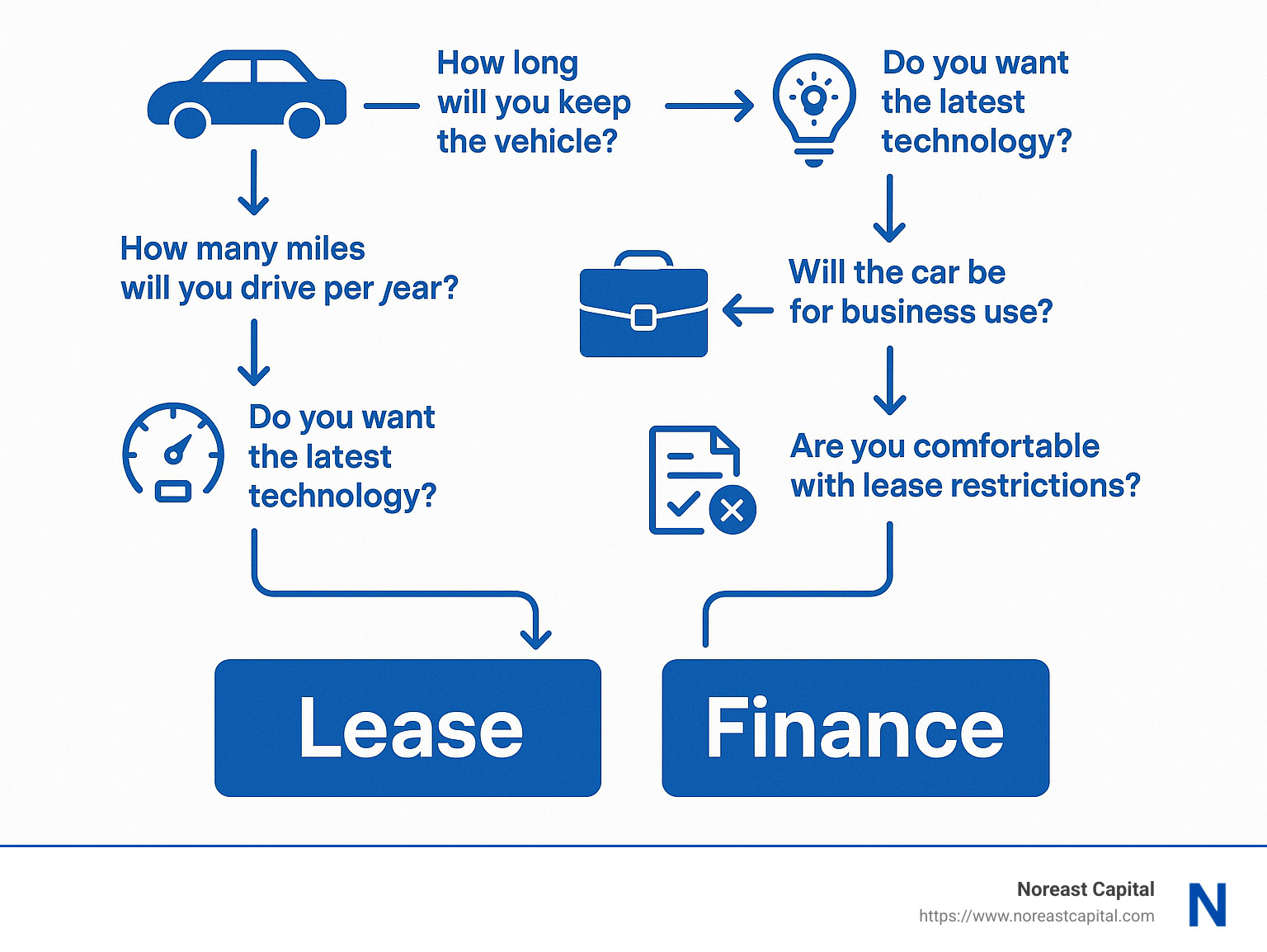
Before you make your decision, take a moment to ask yourself:
- How many years do you realistically plan to keep this vehicle?
- Do you typically put a lot of miles on your car each year?
- How important is it to you to have the newest tech and safety features?
- Will you be using this vehicle for business purposes?
- Where does your credit score stand right now?
- Can you live comfortably with the restrictions that come with leasing?
The cheapest option on paper isn’t always the best choice for your life. Value, convenience, and peace of mind matter too. By weighing all these factors thoughtfully, you’ll find the sweet spot between affordability and what truly works for your lifestyle.
For a deeper dive into the differences between these two options, check out our detailed guide on the difference between lease and loan car.