

Equipment leasing benefits can make a significant difference for businesses seeking efficient, flexible, and strategic ways to acquire necessary equipment. Here’s a quick look at some key benefits:
- Cost-effective: Spread out payments to avoid large upfront costs.
- Flexibility: Adapt to industry changes with ease.
- Strategic Value: Free up capital for other business opportunities.
When technology swiftly evolves and market demands shift, equipment leasing provides a cost-effective solution that offers flexibility and strategic value. By choosing to lease rather than buy, businesses can conserve cash flow, stay updated with the latest technology, and gain the freedom to pivot strategies without the constraints of equipment ownership.
As an advocate for smart financial solutions, I am Vincent Cerniglia, and have dedicated my career at Noreast Capital to helping businesses realize the strategic advantages of equipment leasing benefits. With extensive experience across various industries, my focus is on ensuring that every business can leverage leasing to improve operational efficiency and adaptability.
Equipment Leasing Benefits
Tax Advantages
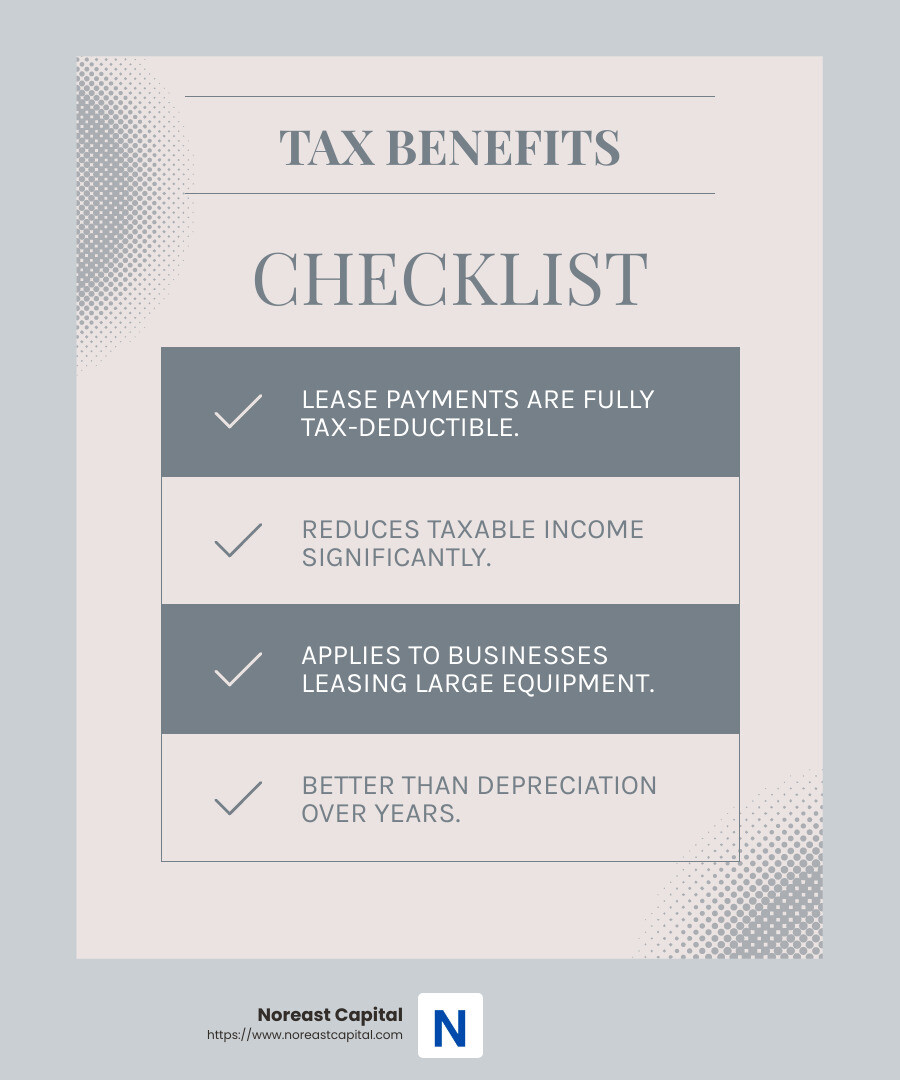
One of the standout benefits of equipment leasing is the tax advantages it offers. According to the IRS, lease payments are usually considered a business expense, making them fully tax-deductible. This can result in significant savings, especially for businesses that lease large amounts of equipment. Unlike purchasing, where you claim depreciation over several years, leasing allows you to deduct the entire lease payment each year. This can greatly reduce your taxable income.
Conserve Cash Flow
Leasing helps businesses conserve cash flow by avoiding large upfront costs. Instead of paying for equipment all at once, you can spread the cost over monthly lease payments. This leaves more cash available for other critical business needs, such as hiring staff, marketing, or expanding operations.
For example, consider a new restaurant in Annapolis, MD, that needs to equip its kitchen. By leasing, it can allocate funds to improve the customer dining experience rather than depleting its cash reserves on equipment.
Upgrade Flexibility
With technology advancing rapidly, businesses must stay current to remain competitive. Equipment leasing offers upgrade flexibility, allowing you to switch to newer, more advanced equipment as it becomes available. When the lease term ends, you can simply return the old equipment and lease the latest model. This reduces the risk of owning outdated or obsolete technology.
In industries like healthcare and manufacturing, where technology plays a crucial role, being able to upgrade equipment without financial strain is a significant advantage. It ensures businesses can maintain efficiency and quality with minimal disruption.
In summary, equipment leasing benefits provide businesses with tax advantages, conserve cash flow, and offer the flexibility to upgrade equipment easily. These benefits make leasing an attractive option for businesses looking to optimize their operations and financial health.
Flexibility and Access to Latest Technology
In today’s world, technological advancements are constant. New gadgets and tools emerge every year, and staying up-to-date can be challenging. This is where equipment leasing shines. It offers businesses the flexibility to adapt quickly to new technologies without the burden of ownership.
Reduced Obsolescence
One of the key benefits of leasing is the ability to avoid obsolescence. When you own equipment, you’re stuck with it until you can afford to replace it. But with leasing, you can return outdated equipment at the end of the lease term and upgrade to the latest model. This is especially important in industries like healthcare and IT, where technology changes rapidly.
Consider Deaconess Healthcare System, which upgraded its Stryker system 7 to the latest system 8 through leasing. This move kept them at the forefront of medical technology without a hefty upfront cost.
Upgrade Options
Leasing also provides upgrade options that are custom to your business needs. At the end of a lease, you can choose to renew, purchase, or upgrade your equipment. This means you can always have access to the latest technology, ensuring your business remains competitive and efficient.
For example, a tech company in Washington, DC, can lease the latest inspection cameras or mechanical tooling from Noreast Capital. When newer models become available, they can upgrade seamlessly, keeping their operations cutting-edge.
In conclusion, equipment leasing offers businesses the ability to stay current with technological advancements, reduce the risk of obsolescence, and enjoy flexible upgrade options. These equipment leasing benefits are invaluable for businesses aiming to maintain a competitive edge.
Financial Advantages of Equipment Leasing
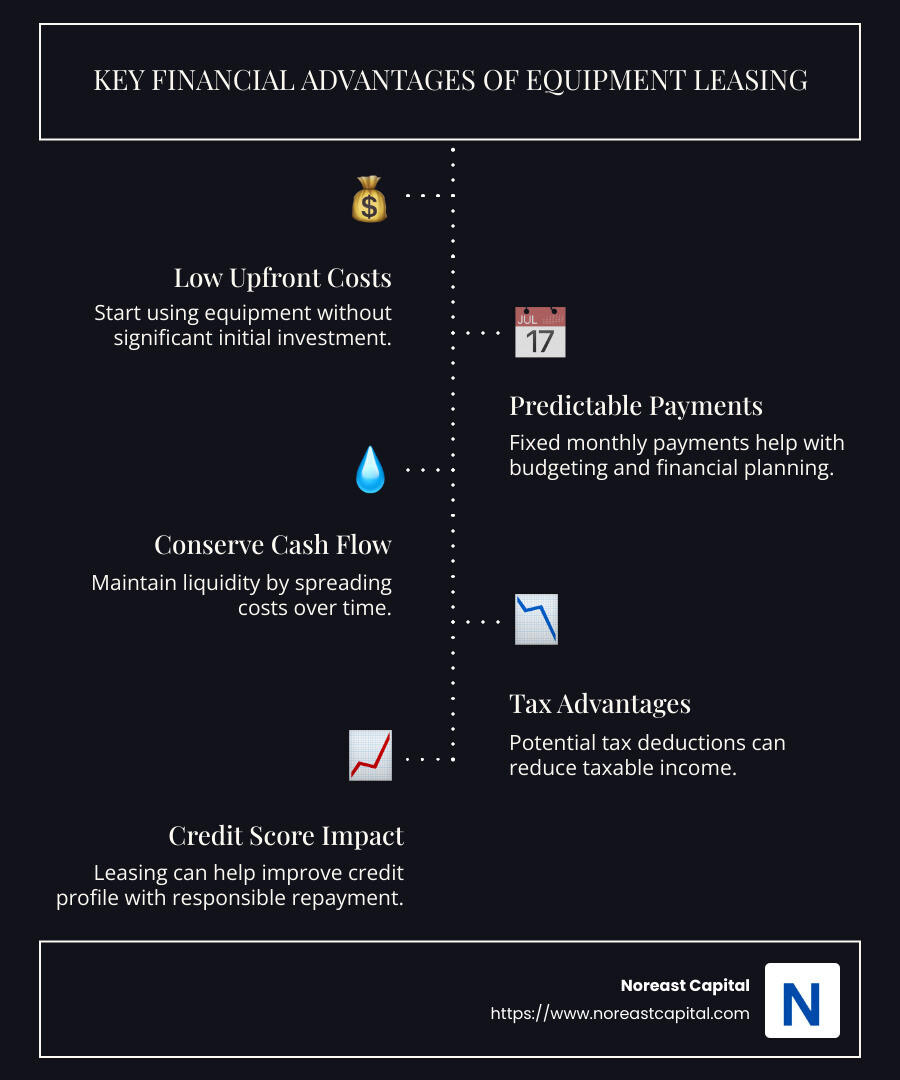
When it comes to acquiring equipment, leasing offers significant financial advantages over buying. Let’s explore how leasing can be a smart business move.
Low Upfront Costs
One of the biggest draws of equipment leasing is the low upfront costs. Unlike purchasing, which often requires a hefty down payment, leasing allows businesses to acquire the equipment they need without a large initial investment. This means you can keep your cash reserves intact for other critical business needs, like hiring staff or expanding your operations.
For instance, a small startup in Annapolis, MD, could lease essential office equipment without depleting its cash flow. This flexibility helps the business grow without financial strain.
Predictable Payments
Leasing provides predictable monthly payments, making budgeting a breeze. Unlike loans with fluctuating interest rates, lease payments are fixed. This consistency helps businesses manage their finances more effectively and avoid unexpected expenses.
Consider a restaurant in Baltimore, MD, that leases kitchen equipment. With fixed monthly payments, the restaurant can plan its budget with certainty, ensuring smooth operations and financial stability.
Credit Score Impact
Leasing can also positively impact your credit score. Unlike loans, which are viewed as debt, lease payments are generally considered operational expenses. This means they’re less likely to negatively affect your credit rating. In fact, timely lease payments can even improve your credit score over time.
A business in Washington, DC, that consistently meets its lease obligations could see its credit score rise, making it easier to secure financing for future growth.
In summary, equipment leasing offers financial advantages that include low upfront costs, predictable payments, and a positive impact on your credit score. These benefits make leasing an attractive option for businesses looking to optimize their financial health and maintain flexibility.
Types of Equipment Leases
When considering equipment leasing, it’s crucial to understand the different types of leases available. Each type offers unique equipment leasing benefits custom to various business needs.
Capital Leases
A capital lease, also known as a finance lease, is ideal for businesses that want to eventually own the equipment. With this option, you make regular payments over a set period, and at the end of the lease, you have the option to purchase the equipment, often for a nominal fee.
Ownership Benefits: Capital leases allow businesses to treat the equipment as an asset on their balance sheet. This means you can claim depreciation and interest expenses, which can be a significant tax advantage.
Long-Term Use: If you plan to use the equipment for a long time, a capital lease can be cost-effective. By the end of the lease term, you’ve essentially paid for the equipment, making it yours to keep.
Operating Leases
Operating leases, also known as service leases, are more like rentals. They are perfect for businesses that need flexibility and access to the latest technology without the burden of ownership.
Lower Payments: These leases typically have lower monthly payments compared to capital leases, making them easier on your cash flow.
Flexibility: At the end of an operating lease, you can return the equipment, upgrade to newer models, or extend the lease. This is beneficial for industries with rapidly advancing technology, as it reduces the risk of obsolescence.
Lease Terms
Understanding the terms of your lease is essential to maximizing the equipment leasing benefits. Lease terms can vary significantly, so it’s important to choose one that aligns with your business goals.
Duration: Equipment leases can range from 12 to 60 months, with 36 months being the most common. Shorter terms offer more flexibility, while longer terms can provide stability and lower payments.
Payment Structures: Leases can have various payment structures, such as step payments, where payments start low and increase over time, or seasonal payments that align with your business’s cash flow cycles.
End-of-Lease Options: Depending on the lease type, you may have options like purchasing the equipment at fair market value, renewing the lease, or returning the equipment.
By understanding the types of equipment leases and their terms, businesses can make informed decisions that align with their financial strategy and operational needs. This knowledge ensures that you can leverage the best equipment leasing benefits for your specific situation, leading into the next section on frequently asked questions about equipment leasing.
Frequently Asked Questions about Equipment Leasing
What are the tax advantages of leasing equipment?
Leasing equipment can offer significant tax advantages. One major benefit is that lease payments are generally 100% tax deductible. This means you can deduct the full amount of your lease payments from your taxable income, which can lead to substantial savings.
Additionally, while purchasing equipment might allow you to take advantage of the Section 179 deduction, there are limitations. For instance, in 2020, businesses could write off up to $1,040,000, but only if they purchased less than $2,590,000 worth of equipment. Leasing does not have these restrictions, making it an attractive option for businesses of all sizes.
What is an advantage to leasing equipment rather than buying it?
One of the primary advantages of leasing is the ability to conserve cash flow. When you lease equipment, you avoid the large upfront costs associated with purchasing. This allows you to allocate your capital to other critical areas of your business, such as hiring employees or expanding operations.
Leasing also offers upgrade flexibility. As technology evolves, having the latest equipment can be crucial for maintaining a competitive edge. Leasing allows you to upgrade to newer models at the end of your lease term, ensuring your business always has access to the latest technology without the hassle of selling outdated equipment.
What is the major advantage of leasing?
The major advantage of leasing lies in the combination of ownership options and financial freedom. Leasing provides businesses with the option to purchase equipment at the end of the lease term, often at a reduced price. This flexibility means you can decide whether to keep the equipment based on your future needs and financial situation.
Furthermore, leasing impacts your credit score minimally compared to large loans. Traditional equipment purchases often require significant financing, which can increase your company’s debt load and affect your credit score. Leasing, on the other hand, involves an initial credit check with minimal impact, allowing you to maintain better financial health.
Leasing provides a strategic balance between having the equipment you need and maintaining the financial flexibility to adapt as your business grows. This leads us into more detailed discussions about the financial advantages of equipment leasing.
Conclusion
In today’s business environment, strategic flexibility is key to staying competitive. Equipment leasing benefits your business by providing the tools you need without the heavy financial burden of ownership. At Noreast Capital, we understand the importance of maintaining cash flow while ensuring access to the latest technology.
Why choose Noreast Capital?
We’re more than just a leasing company. We offer a partnership that helps your business thrive. Our custom leasing solutions mean you can keep your equipment up-to-date without being tied down by outdated technology. With locations in Annapolis, Baltimore, and Washington, DC, we’re here to support your business needs wherever you are.
Leasing with us allows you to:
- Conserve cash flow: Avoid large upfront costs and allocate your funds to other critical areas.
- Upgrade flexibility: Stay ahead with the latest technology, ensuring your business remains competitive.
- Tax advantages: Enjoy potential tax deductions that can lead to significant savings.
By choosing equipment leasing, you gain the financial freedom to invest in growth opportunities without compromising on the quality of your tools. Whether you’re a new business or an established company looking to expand, leasing provides the strategic flexibility you need to achieve your goals.
For more insights on how leasing can benefit your business, explore our detailed guide on the difference between a lease and a loan. Let Noreast Capital be your partner in building a more agile and financially sound future.