
A contractor lands a larger job and needs another excavator, skid steer, or compact loader fast. The work is there. The margin may be there too. What gets in the way is the acquisition decision.
Do you buy and build equity, or lease and preserve cash?
For contractors, franchise operators, healthcare practices, and other small to medium-sized businesses, lease vs purchase isn't an accounting exercise. It shapes working capital, debt capacity, upgrade timing, and how quickly you can say yes to the next opportunity. For equipment vendors and dealers, the same decision shows up from the other side of the desk. If your customer can't absorb the upfront spend, the sale can stall even when the need is obvious.
Most articles treat this as a buyer decision only. In practice, the strongest financing outcomes happen when the end-user's cash flow needs and the vendor's sales process are considered together.
The Core Dilemma When Acquiring Commercial Equipment
A growing contractor doesn't hesitate because the machine isn't needed. The hesitation comes from what the machine does to the balance of the business.
A cash purchase can tighten liquidity right when payroll, fuel, mobilization, and materials are also rising. A financed purchase may require a meaningful down payment and leaves the business carrying ownership risk. A lease can lower the initial burden, if the structure matches how the equipment will be used and how the company gets paid.
Why this decision is usually bigger than the monthly payment
The wrong comparison is "which option has the lower stated payment?" The better comparison is "which structure fits the business model?"
A site contractor with uneven receivables has a different need than a multi-location operator with predictable monthly revenue. That's why customized payment structures matter. In one finance industry discussion, customized schedules such as seasonal, step, or deferred payments were highlighted as a frequently overlooked part of lease vs purchase analysis, with the article noting potential significant liquidity improvement during off-seasons, that many SMBs in volatile sectors prefer flexible leases, and that lease implicit rates dropped below bank loans for equipment under $500K in a recent period according to the cited discussion of ELFA reporting. That same discussion also noted vendor-embedded programs being associated with 25% sales closure improvement for distributors (financialprofessionals.org article on deciding whether to lease or buy capital assets).
That matters in construction and other seasonal trades because timing beats theory. If payments start before the equipment is producing revenue, a good asset can still create a bad cash event.
Practical rule: If revenue is lumpy, the financing structure matters almost as much as the asset itself.
The vendor side of the same problem
Dealers see this every day. A buyer likes the machine, agrees on spec, and then pauses when the conversation turns to down payment, tax impact, or whether the equipment will still fit the business three years from now.
That pause is why vendors should understand lease vs purchase enough to guide the first conversation. Not to give tax advice or replace underwriting. Just to frame the trade-offs correctly.
Even in other equipment categories, the buying-versus-leasing logic is similar. A smaller-ticket example such as coffee machine leasing vs buying is useful because it shows the same underlying issue. Businesses aren't choosing a machine. They're choosing how much cash to commit upfront, how often they expect to upgrade, and whether ownership is the primary goal.
Understanding Your Equipment Acquisition Options
The phrase "lease" gets used broadly. In commercial equipment finance, the structure matters because it tells you who is solving for ownership, who is solving for use, and who needs flexibility at the end.
Here is the practical side-by-side view.
| Acquisition method | Best fit | Main strength | Main trade-off |
|---|---|---|---|
| Purchase | Long-use assets, stable demand, strong resale confidence | Full ownership and control | More capital tied up, owner carries residual and maintenance burden |
| True or FMV lease | Equipment with faster obsolescence or uncertain long-term need | Lower payment and end-of-term flexibility | You may not keep the asset unless you buy it later |
| $1 buyout lease | Businesses that expect to keep the equipment long term | Lease-style cash flow with ownership intent | Usually higher payment than FMV because you're effectively buying |
| Operating lease | Businesses focused on use, shorter lifecycle, or accounting flexibility | Use of equipment without taking on long ownership horizon | End-of-term planning matters more |
Purchase means more than just writing a check
A purchase can be cash or financed, but the business outcome is the same. You're building ownership.
That makes sense when the asset is durable, not likely to become obsolete quickly, and useful beyond the initial financing term. Contractors lean this way with core fleet assets they know they'll run hard for years.
Ownership also gives complete control over modifications, use intensity, and resale timing. If you're certain the equipment will stay productive deep into its life, purchase becomes easier to justify.
True or FMV lease works when use matters more than title
A true lease, called an FMV lease, is the right fit when the priority is lower monthly cost and end-of-term choice. The lessee pays for use of the equipment, not necessarily for eventual ownership.
This can be a fit for software, office automation, medical technology, restaurant equipment, or any asset category where the business might want to refresh before the equipment reaches the end of its mechanical life.
The trucking market gives a useful commercial analogy. In the U.S. trucking industry, 49% of Class 8 vehicles are leased and 51% owned, while 76% of leasing activity is full-service leasing, according to the cited summary of the 2023 National Private Truck Council benchmark report. That same summary also notes that 30% of fleets use a combination approach, and describes leasing advantages such as shorter trade cycles, outsourced maintenance, and avoiding equity lockup. In the example included there, buying leaves $11,512 in equity after 39 months on a $42,000 asset, while leasing lowers the payment to $426 per month versus $780 for purchase financing (PacLease discussion of ownership vs leasing and "iceberg" costs).
That same logic applies to contractors and industrial firms. If uptime, flexibility, and predictable use matter more than eventual resale, FMV leasing can be the cleaner tool.
The $1 buyout lease is for buyers who already know they want the asset
A $1 buyout lease is close to ownership in effect. The business intends to keep the equipment, and the end-of-term purchase option reflects that.
This structure fits heavy machinery, modular buildings, production equipment, and other assets with a long useful life. It can help a company preserve cash compared with an outright purchase while still keeping ownership as the likely end result.
Operating lease sits between flexibility and practicality
An operating lease makes sense when the business wants to use the equipment for a set period, maintain flexibility, and avoid overcommitting to assets that may age out of the operation quickly.
Think of equipment categories where business needs change faster than the hardware wears out. That's a different problem from choosing between buy new or used cubicles. In both cases, though, the buyer is still balancing expected use period, capital preservation, and the cost of change later.
A good lease structure doesn't force ownership on a business that only needs reliable use.
Analyzing the Financial and Tax Implications
A contractor looking at a $75,000 skid steer and a vendor trying to close that sale care about the same question for different reasons. The buyer wants usable monthly cost, tax clarity, and an exit that will not create a problem later. The vendor wants a financing option that keeps the deal moving without forcing a discount.
That is why lease versus purchase analysis needs to be built around four points. Cash required at the start. Total cost during the period you expect to use the equipment. Tax treatment. What happens to the asset at the end.
Lease vs purchase key financial differences
| Financial Aspect | Leasing | Purchasing |
|---|---|---|
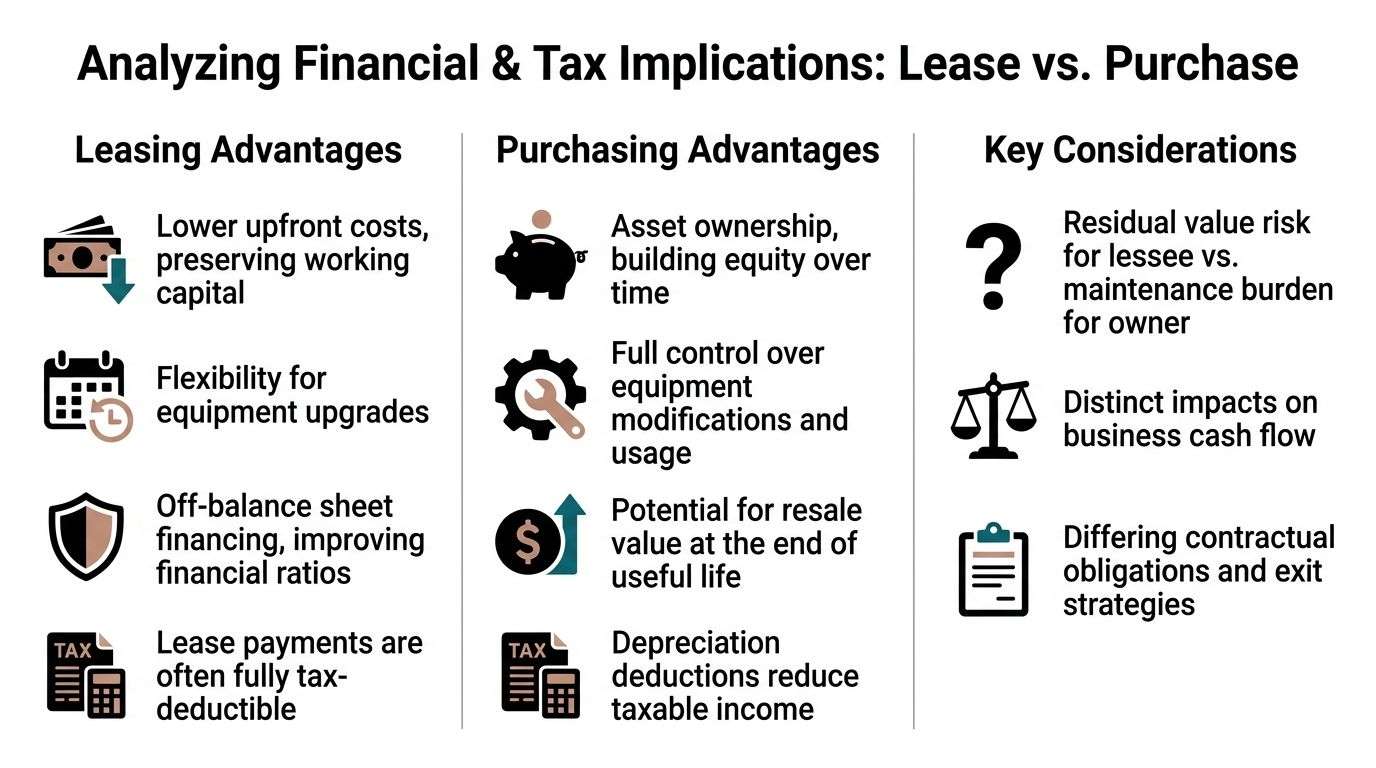
| Upfront cash | Usually lower upfront burden | Usually requires more initial cash or down payment |
| Monthly obligation | Often lower because payments track depreciation and use | Often higher because you're paying toward full ownership |
| Working capital | Preserves cash for payroll, growth, inventory, and operations | Ties up more capital in the asset |
| Tax treatment | Lease payments may be deductible, depending on structure and tax situation | Depreciation and other purchase-related treatment may apply |
| Residual risk | Usually reduced in FMV and operating structures | Owner carries resale and disposition risk |
| Long-hold economics | Often better for shorter use cycles | Often better when the asset stays productive for many years |
| Upgrade flexibility | Easier to return, renew, or replace | Harder to swap without selling or trading equipment |
Cash flow decides more deals than rate does
Monthly payment matters, but it is not the full answer.
A purchase usually asks for more cash up front, whether that is a down payment, sales tax, delivery, installation, or soft costs that get paid outside the financing. A lease often reduces that first cash requirement and spreads more of the expense over the useful period of the equipment. For an SMB adding one machine, that difference can protect operating cash. For a vendor, it can keep a buyer from postponing the order or downsizing the package.
The practical question is simple. What else needs that cash in the next 6 to 12 months? Payroll, inventory, mobilization costs, hiring, and service coverage usually matter more to a growing company than owning a title sooner.
Protecting cash only helps if the structure still fits the hold period and usage pattern.
Total cost depends on hold period, maintenance, and residual exposure
Two transactions can have similar monthly payments and very different total economics.
With a purchase or a $1 buyout lease, the business is paying toward long-term ownership. That often works well when the equipment will stay productive well past the finance term. The company keeps the asset, controls disposition, and may continue using it after the note is gone. The trade-off is that the buyer also carries resale risk, aging-related repairs, and the chance that the equipment is worth less than expected when replacement time comes.
With an FMV lease or operating lease, part of the economics comes from limiting residual exposure. That can be a better fit for equipment with faster technology change, uncertain usage, or a shorter replacement cycle. Vendors benefit here too. A structured upgrade path gives sales teams a reason to reopen the conversation before the current unit becomes a pain point for the customer.
The break-even point is rarely philosophical. It usually comes down to how long the asset will stay in service and how confident the business is about its value and condition at disposition.
Tax treatment can change the answer at the margin
Tax treatment should support the business case, not rescue a weak one.
Lease payments may be deductible in some structures. Purchased equipment may qualify for depreciation benefits, and financed purchases can still create tax advantages depending on the transaction and the company's taxable income. The details vary by entity type, profitability, and how the agreement is documented. A useful starting point is this overview of equipment financing tax benefits, then a CPA can apply those rules to the actual deal.
Vendors should pay attention to this point as well. Buyers often stall because they are unsure whether leasing or purchasing creates the better after-tax result. A sales process that includes a clear financing summary, without giving tax advice, removes friction and shortens the decision cycle.
Mistakes that distort the comparison
A few errors show up repeatedly in real transactions:
- Comparing payment to payment only: A lower monthly number can still produce a worse outcome over the expected use period.
- Ignoring non-financed costs: Freight, installation, maintenance, software, and taxes can change the economics quickly.
- Using the wrong hold period: Modeling seven years of ownership for equipment that will likely be replaced in three leads to bad decisions.
- Assuming residual value is stable: Some assets hold value well. Others fall fast once hours, condition, or technology shift.
- Separating financing from the sales process: Vendors lose deals when financing enters late and the buyer has already anchored on cash price alone.
A practical way to frame it
Run the comparison using your expected hold period first, then test a shorter and longer case.
If the equipment is core to the business, likely to stay in service for many years, and still productive after the finance term, purchase or a $1 buyout lease often holds up better. If cash preservation, upgrade timing, or residual risk matter more, FMV or operating lease structures usually deserve closer review. Buyers get a structure that fits how they will use the equipment. Vendors get a better chance of closing the sale at full margin instead of negotiating against budget pressure alone.
Lease vs Purchase Scenarios by Asset Class
The fastest way to make this decision practical is to put it into real operating situations. Different asset classes call for different answers because the risk isn't the same.
A contractor acquiring an excavator
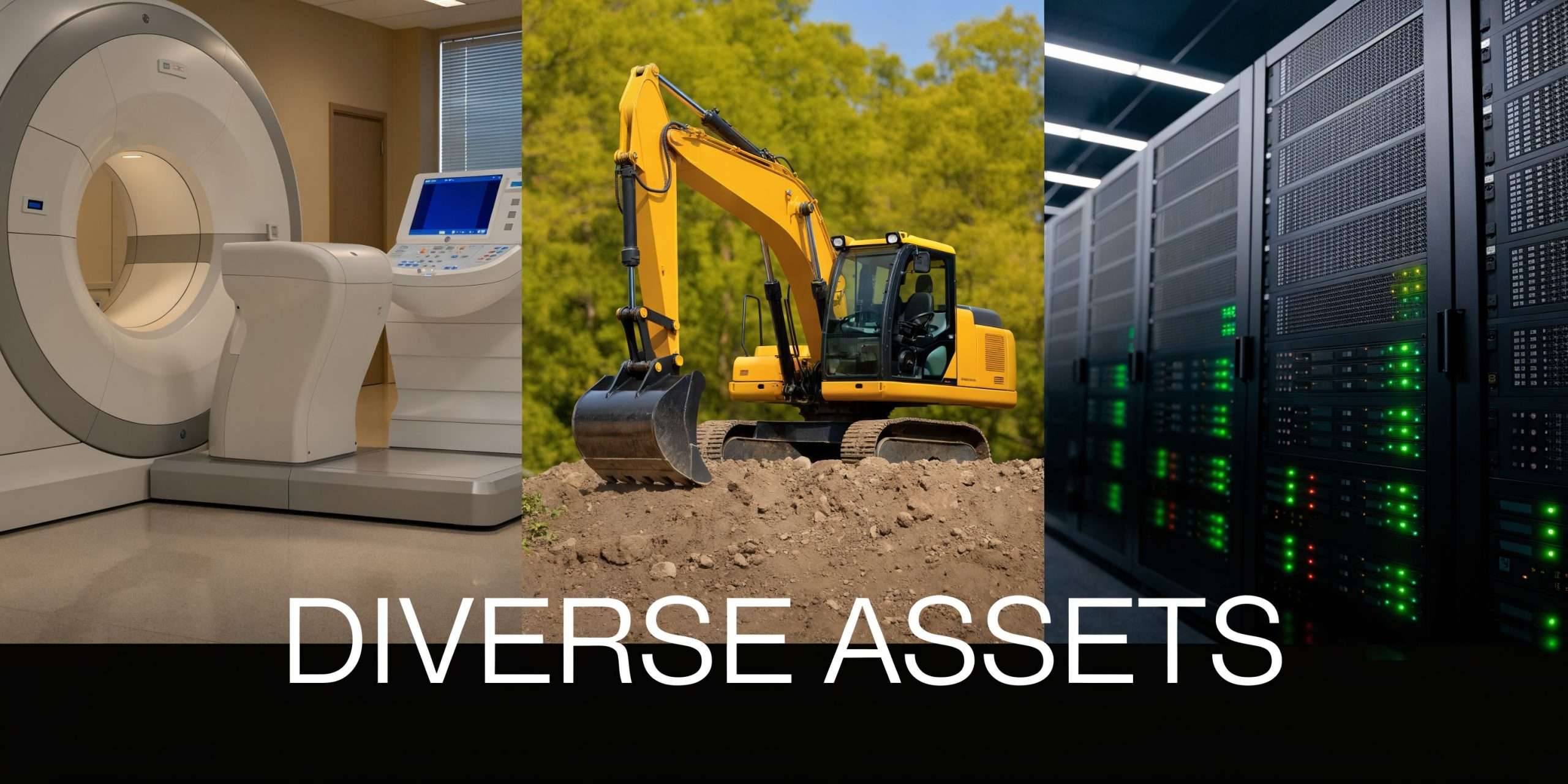
A contractor adding an excavator isn't chasing novelty. The goal is production capacity.
If the machine is a core fleet asset and the company expects to keep it for a long operating life, ownership becomes more attractive. The business can absorb wear, maintain it on its own terms, and keep using it after the original financing period ends.
The long-hold economics from large asset analysis are useful in this context. In a Lease vs. Purchase Analysis Model for a $70 million production facility, purchase produced an NPV cost of $27.1M under base assumptions, falling to $10.8M with strong resale assumptions. Leasing in that model resulted in an NPV of $70.3M, which was a 2.6X premium to base purchase and 6.5X to optimized purchase. The same analysis noted that misjudging resale by 10% can swing NPV by $5M to $7M, and tied lease preference to cases where obsolescence exceeds 20% annually or cash flow constraints exceed 15% of EBITDA (Vorys analysis of the lease versus purchase model).
The numbers are from a facility, not an excavator, but the principle holds. For long-lived, customizable, stable-use assets, ownership gets stronger over time.
A contractor in this position lands in one of two camps:
- Buy outright or finance the purchase when the machine will stay in the fleet and resale confidence is high.
- Use a $1 buyout lease when preserving liquidity matters but ownership still makes strategic sense.
If the equipment is likely to become part of the permanent fleet, don't choose a flexible structure just because the payment looks easier.
A restaurant franchise outfitting a new location
Kitchen equipment creates a different problem. The franchise owner may want ownership eventually, but the opening phase is cash-intensive.
Lease structures work well when the business needs to preserve working capital for tenant improvements, staffing, marketing, and launch costs. A true lease or operating lease can be useful when the operator wants to bundle equipment with installation or related soft costs and avoid overcommitting cash before revenue stabilizes.
The practical question is not whether a fryer or walk-in cooler can last a long time. It can. The better question is whether the business should tie up cash in those assets during expansion.
This is one reason many businesses lease assets across categories rather than buy them. If you want a wider view of what companies commonly finance instead of own from day one, 10 assets that businesses lease rather than buy is a useful reference point.
For a growing franchise group, what tends to work is a structure that lowers opening-stage cash strain and keeps future unit growth possible. What doesn't work is using available cash on equipment and then scrambling to cover operational ramp-up.
A dental practice upgrading digital imaging
A dental or healthcare practice is less concerned with raw mechanical durability and more concerned with technology relevance. The equipment may still work years from now, but the business value can drop sooner if patient expectations, software integration, or imaging standards move on.
That makes an FMV lease or operating lease more compelling. The practice can use current equipment, preserve capital, and keep end-of-term options open if a better platform appears before the hardware fully wears out.
This is the classic use-over-ownership case. The asset isn't just a machine. It's part of the patient experience, the diagnostic workflow, and the office's competitive position.
The pattern across all three
The right answer changes by asset class because three variables change:
- Expected hold period
- Obsolescence risk
- Cash sensitivity during the acquisition period
Construction equipment leans toward ownership when it's core to the fleet. Restaurant build-outs lean toward cash preservation. Medical technology leans toward flexibility.
That's why broad statements about lease vs purchase usually fail in practice. The better approach is asset-specific and business-specific.
How Equipment Vendors Can Use Financing to Grow Sales
Vendors treat financing as a support function. The stronger approach is to treat it as part of the sales strategy.
When a customer asks for terms, they aren't just asking how to pay. They're asking whether the vendor can help them fit the equipment into their business reality.

Lowering the cash barrier changes the conversation
Leasing has broad acceptance because it reduces upfront commitment and supports faster replacement cycles. In the U.S. automotive market, leasing accounts for 24% of new vehicle transactions as of 2025, with average monthly lease payments of $659 compared with $682 for auto loans. In the cited example for a $42,000 net-priced vehicle over 39 months, total cash outlay was $16,622 for leasing versus $18,910 for purchasing, and monthly payments were $426 versus $780, a difference of $354 per month (NGPF summary of 2025 U.S. auto leasing share and payment comparison).
Again, that's a vehicle example. But the sales lesson carries over. Buyers respond when the acquisition path matches their cash flow reality.
For an equipment dealer, that means financing can help move the conversation from sticker price to monthly affordability, total use case, and upgrade planning.
Embedded financing helps vendors keep control of the deal
A vendor who can discuss lease options early keeps the account from drifting to outside lenders late in the process. That matters because once the buyer leaves to "check financing," the sale gets slower and less predictable.
Useful vendor programs generally do four things well:
- Present options at quote stage: The customer sees purchase and lease paths before budget resistance hardens.
- Support different deal profiles: One buyer wants ownership. Another wants low payment and upgrade flexibility.
- Accommodate soft costs: Installation, delivery, and related items can sometimes be structured into the financing package.
- Create repeat touchpoints: End-of-term renewals, upgrades, and replacements give the vendor another reason to stay in the account.
One option in this category is a direct-lender model such as vendor financing programs for equipment dealers, where the financing source works directly with vendors and end users rather than through additional middle layers. That setup can matter when the deal needs customized schedules, faster communication, or support around end-of-term planning.
What vendors should avoid
A few habits weaken financing as a sales tool:
- Waiting until the customer objects to price
- Offering one generic payment path to every buyer
- Ignoring seasonal cash flow realities
- Treating financing as paperwork instead of part of the proposal
Buyers don't reject useful equipment. They reject acquisition structures that don't fit the business.
Your Decision Framework and End-of-Term Strategy
Most lease vs purchase decisions get easier when you stop asking which option is "better" and start asking which option fits the asset and the business.
Five questions that narrow the choice fast
Start here:
How long will you realistically keep the equipment?
If the answer is deep into the asset's useful life, purchase or a $1 buyout lease deserves priority.Will this equipment become outdated before it wears out?
If yes, FMV or operating lease structures make more sense than ownership.What does the business need cash for over the next year?
Equipment doesn't exist in a vacuum. If growth, staffing, expansion, or project mobilization are competing for cash, preserving liquidity may be more valuable than building equity.How confident are you in future resale value?
Strong resale supports ownership. Uncertain resale pushes risk back into the decision.Do you want flexibility at the end, or certainty today?
Some businesses want a clear path to own. Others want the option to return or upgrade without forcing a disposition process later.
A simple framework by outcome
If your answers point to one of these outcomes, the likely direction becomes clearer:
- Own and hold: Purchase or $1 buyout lease
- Use and upgrade: FMV lease
- Use for a defined term with flexibility: Operating lease
- Preserve cash while opening or expanding: Lease structures with deferred, step, or seasonal payments
End-of-term choices matter from day one
A mistake is choosing a lease without planning for the finish. The end-of-term path should be part of the initial discussion, not an afterthought.
The main end-of-term options are straightforward:
- Purchase the equipment: Best when the asset still fits the operation and the business now wants ownership.
- Renew the lease: Useful when the equipment still performs well and replacement isn't urgent.
- Upgrade into new equipment: Strong fit for technology-sensitive categories or businesses standardizing newer equipment across locations.
- Return the equipment: Appropriate when the equipment is no longer needed or the business wants to avoid resale effort.
Each option works when it matches usage. Problems show up when businesses choose an ownership-heavy structure for a short-cycle asset, or a short-cycle lease for equipment they always intended to keep.
End-of-term strategy isn't cleanup. It's part of the original acquisition decision.
Common Questions About Equipment Leasing and Purchasing
What is a sale-leaseback and when does it make sense
A sale-leaseback lets a business convert owned equipment into working capital while continuing to use the asset. The company sells the equipment to a financing source and leases it back under agreed terms.
This can make sense when the business owns valuable equipment but needs liquidity for expansion, payroll support, inventory, or project execution. It's also worth considering when cash is trapped in equipment that the company still depends on operationally.
It doesn't make sense just because cash is available. The structure has to solve a business need.
Can software be leased
Yes. In commercial finance, software can be leased along with related implementation or technology packages, depending on the transaction structure.
This is especially useful when software is critical to operations but likely to change before the business would want to own a long-lived system outright. Leasing can align software costs with the period of use and reduce the strain of paying for a large technology deployment upfront.
The same logic applies to bundled systems where software is part of a broader operational rollout.
Is leasing always cheaper than buying
No. Leasing is better for shorter use periods, cash preservation, and obsolescence protection. Buying is better when the asset will stay productive for a long time and resale or continued use supports ownership economics.
The phrase "cheaper" also causes problems because businesses mean different things by it. Lower monthly payment is one kind of cheaper. Lower long-term total cost is another.
Those aren't always the same answer.
What's the difference between a direct lender and a broker
A direct lender funds transactions itself. A broker places the deal with one or more outside financing sources.
That difference can affect speed, communication, flexibility, and how payment structures are handled. In more complex deals, especially those involving seasonal schedules, soft costs, or vendor programs, businesses and dealers prefer to know who is making the credit and documentation decisions.
Should a contractor ever mix leasing and purchasing
Yes. Many businesses shouldn't force every asset into one model.
A mixed strategy works better. Core fleet assets that stay useful for years may be purchased or financed toward ownership. Equipment with shorter use horizons, uncertain deployment, or higher upgrade pressure may be leased.
That lets the business own what it should own and stay flexible where flexibility offers tangible value.
If you're weighing lease vs purchase for commercial equipment, or you're a vendor looking to offer financing to end users, Noreast Capital Corporation provides direct equipment financing and leasing programs across a wide range of asset categories, including options such as FMV leases, operating leases, $1 buyout structures, sale-leasebacks, and customized payment schedules tied to business cash flow.