

Why Capital Equipment Financing Fuels Business Growth
Capital equipment financing is a specialized funding solution that allows businesses to acquire essential machinery, vehicles, and technology without paying the full cost upfront. Instead of depleting cash reserves, you can spread payments over time while using the equipment to generate revenue immediately.
What is Capital Equipment Financing?
– A type of asset-based lending where the equipment serves as collateral
– Typical approval rates: 60-70% (compared to 15-30% for unsecured loans)
– Financing amounts: $5,000 to $5 million
– Terms: 1-10 years depending on equipment type
– Typical interest rates: 4-20% based on credit profile
– Funding speed: As fast as 24 hours for amounts under $250,000
Every business eventually reaches a point where growth demands new equipment—but the question becomes how to afford it without compromising cash flow. Whether you need construction machinery, medical devices, IT infrastructure, or commercial vehicles, the large upfront costs can strain your working capital and limit opportunities.
That’s where capital equipment financing creates a strategic advantage. By preserving your cash reserves while still acquiring the assets needed to expand operations, you gain both the equipment and the financial flexibility to pursue other growth initiatives.
I’m Vincent Cerniglia from Noreast Capital, where I’ve helped countless businesses steer capital equipment financing decisions to maximize growth while optimizing their cash flow. With over a decade of experience structuring equipment financing solutions across multiple industries, I understand how the right financing approach can transform a capital expense into a powerful growth catalyst.
Understanding Capital Equipment Financing 101

When it comes to growing your business, that shiny new piece of equipment often feels just out of reach. That’s where capital equipment financing comes in – a funding approach that’s truly different from other options because the equipment itself serves as collateral. This creates a win-win situation for everyone involved: you get the equipment you need, and lenders feel more comfortable approving your request.
How Capital Equipment Financing Works
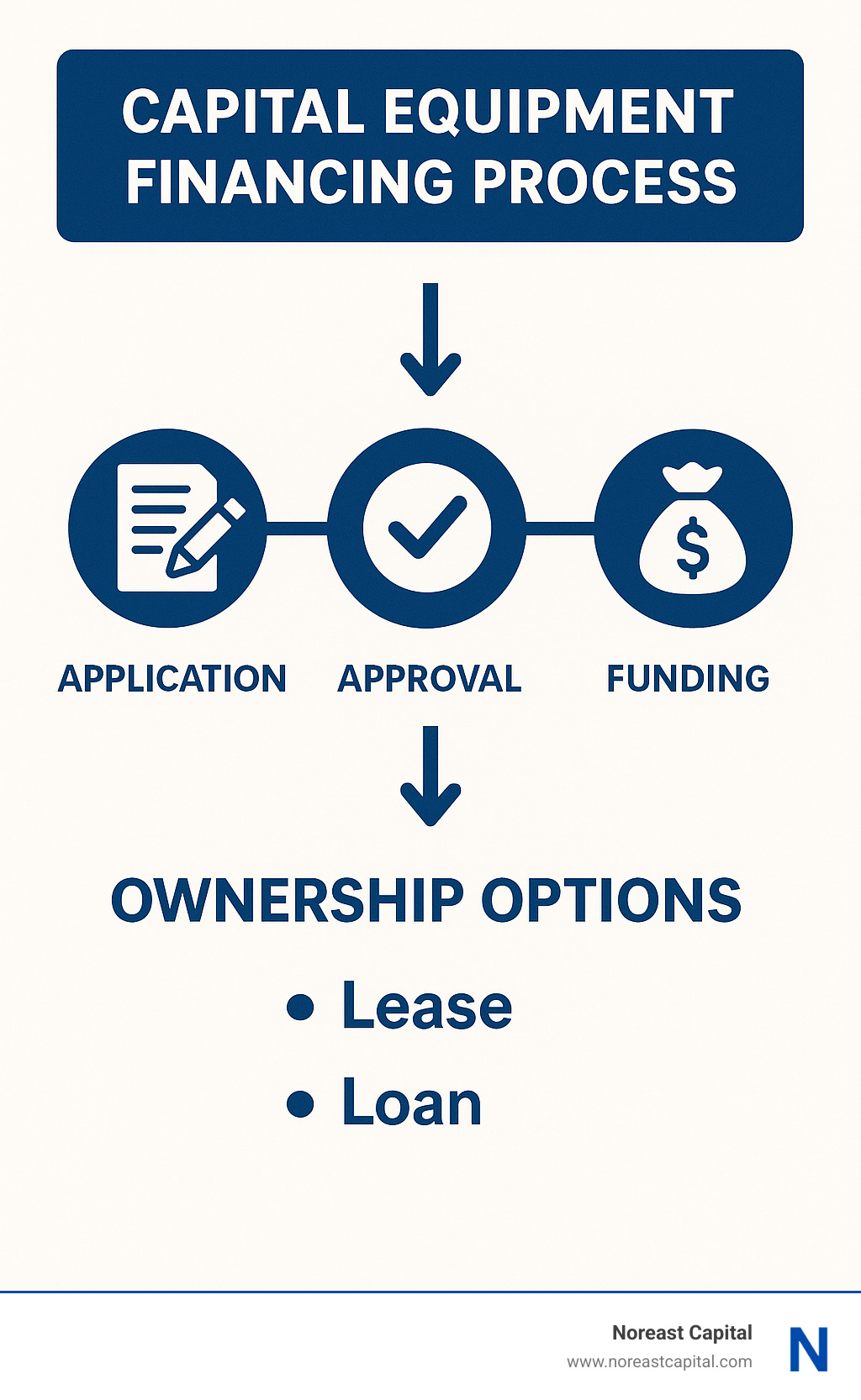
Think of capital equipment financing as a straightforward journey that begins with a need and ends with your business growing. First, you’ll identify exactly what equipment would help your business thrive – whether that’s a new excavator, medical imaging system, or commercial kitchen setup – and get a formal quote from your vendor.
Next, you’ll submit an application that outlines your basic business information. The good news? For equipment under $250,000, many lenders offer “application-only” programs that won’t bury you in paperwork. Your lender then evaluates your credit profile, business history, and the equipment itself. Because that equipment serves as collateral, approval rates typically hover between 60-70% – significantly higher than unsecured loans.
Once approved, you’ll sign an agreement that clearly spells out your payment terms and end-of-term options. The lender pays your vendor directly, and before you know it, your new equipment arrives ready to start generating revenue.
The entire process moves surprisingly quickly – same-day approvals are common for smaller amounts, with funding completed in just 2-3 business days. Even larger equipment packages typically go from application to funding in about a week.
Types of Equipment You Can Finance
One thing I love about capital equipment financing is how versatile it is. If it helps your business grow and has a useful life of at least two years, chances are you can finance it.
Construction companies can finance everything from massive excavators to specialized tools. Healthcare providers often finance cutting-edge diagnostic equipment and imaging machines. Restaurants finance commercial kitchens that would otherwise require enormous upfront investments. Even your office infrastructure – from furniture to phone systems – can be financed.
Manufacturing businesses rely on financing for production lines and industrial robots, while transportation companies finance their fleets of trucks and specialized vehicles. And in today’s digital world, technology systems like servers, networks, and even software can be financed.
The beauty is that even custom-built or highly specialized equipment often qualifies, though terms may vary based on the equipment’s expected lifespan and potential resale value.
Benefits of Capital Equipment Financing
When I talk with business owners about capital equipment financing, they’re often surprised by just how many advantages it offers beyond simply “getting the equipment.”
Perhaps the biggest benefit is preserved working capital. Instead of emptying your bank account for that equipment purchase, you keep your cash reserves intact for other critical needs like marketing, hiring, or inventory. This creates financial flexibility that can be a game-changer for growing businesses.
You’ll also enjoy immediate revenue generation – the equipment starts making you money right away, even as you pay for it over time. This positive cash flow effect is why so many businesses choose financing over saving up for purchases.
The fixed payment structure makes budgeting simpler and more reliable. You’ll know exactly what you’re paying each month, eliminating financial surprises.
There are also potential tax advantages to consider. Equipment financing often provides benefits through Section 179 deductions, depreciation, or interest expense write-offs (though you’ll want to consult your tax advisor about your specific situation).
As you successfully make payments, you’re building business credit, strengthening your profile for future funding needs. And the scalable growth path means you can continue adding equipment as your business expands without repeatedly depleting your cash reserves.
Finally, depending on how you structure your agreement, you’ll have flexible end-of-term options – you can own the equipment outright, upgrade to newer technology, or simply return it when the term ends.
For businesses looking to grow without compromising their financial foundation, capital equipment financing creates a powerful competitive advantage – enabling faster growth while maintaining the operational flexibility that’s so crucial in today’s business environment.
Equipment Loans vs. Equipment Leases: Side-by-Side Breakdown

When you’re exploring capital equipment financing options, you’ll quickly find two main paths: equipment loans and equipment leases. Think of them as different routes to the same destination—getting the equipment your business needs without a massive upfront cash outlay.
Let’s break down how these options compare:
| Feature | Equipment Loan | Equipment Lease |
|---|---|---|
| Ownership | You own the equipment from day one | Lessor owns equipment until end of term |
| Down Payment | Typically 5-20% | Often $0 or first/last payment |
| Monthly Payment | Generally higher | Generally lower |
| Term Length | 1-7 years typical | 2-5 years typical |
| End of Term | You own equipment outright | Purchase, renew lease, or return |
| Tax Treatment | Depreciation + interest deduction | May deduct entire payment as expense |
| Balance Sheet Impact | Asset + liability | Operating lease may be off-balance sheet |
| Best For | Long-term equipment needs | Regularly upgraded equipment |
Key Differences & Structures
Equipment loans work much like your home mortgage—you’re borrowing money to purchase something outright, making regular payments until it’s fully yours. With each payment, you’re building equity in the equipment.
If traditional loans feel a bit too rigid for your needs, don’t worry. We’ve got options! Standard equipment loans offer predictable fixed monthly payments. Need lower payments now with a bigger payment later? A balloon payment loan might be perfect. And for growing businesses, step-up loans start with smaller payments that increase as your revenue grows.
Equipment leases, on the other hand, are more like renting with benefits. You’re paying for the use of the equipment rather than buying it outright. The beauty of leasing comes in its flexibility.
A Fair Market Value (FMV) lease gives you the lowest monthly payments with options to buy, renew, or return when the lease ends. Need certainty about ownership? A $1 buyout lease has higher payments but guarantees ownership for just a dollar when the term ends. For vehicle-heavy businesses, TRAC leases offer predetermined residual values, while Split TRAC leases share the residual value risk between you and the lessor.
Pros and Cons of Each Option
When it comes to equipment loans, the biggest advantage is building ownership with every payment you make. You’re free to use or modify the equipment however you need—no asking permission. Come tax time, you’ll appreciate the potential benefits from depreciation and interest deductions. And there’s something satisfying about knowing exactly where you stand without end-of-term negotiations.
Of course, loans do come with higher monthly payments and full responsibility for maintenance and repairs. There’s also the risk that your equipment becomes outdated while you’re still paying it off, and most loans require some form of down payment.
Equipment leases shine with their lower monthly payments, which can be a game-changer for cash flow. Many leases include maintenance packages (goodbye, surprise repair bills!), and upgrading to newer equipment at term end is typically seamless. For businesses watching their balance sheets, operating leases often offer tax advantages, and you’ll rarely need a down payment.
The trade-offs? You’re not building equity during the lease term, you might face usage restrictions, and you could face charges for excessive wear and tear. Over the total lifecycle, leasing may cost more than buying outright—though the flexibility often justifies the premium.
What Happens at Term End?
This is where loans and leases truly diverge in their paths.
With an equipment loan, the ending is simple—you own the equipment outright. You can keep using it cost-free, sell it when you’re ready, or trade it in toward newer equipment. Your asset, your choices.
Equipment leases offer more flexibility at term end. If you’ve grown attached to the equipment, you can purchase it—at fair market value with an FMV lease, at a predetermined amount with a TRAC lease, or for just a dollar with a $1 buyout lease. Not ready to commit? Renew the lease for additional terms, often at reduced payments. Ready to move on? Simply return the equipment. Looking to upgrade? Trade in for newer equipment on a fresh lease.
The right choice between loans and leases really comes down to your unique business needs. At Noreast Capital, we help businesses throughout the Baltimore, Washington DC, and Annapolis areas evaluate these options to find the perfect fit for their equipment needs, cash flow priorities, and accounting preferences.
More info about Equipment Financing vs Leasing
Capital Equipment Financing Qualification & Application Guide
Securing capital equipment financing requires meeting certain qualification criteria and navigating the application process effectively. Understanding what lenders look for and how to present your business in the best light can significantly improve your chances of approval and help you secure favorable terms.
Capital Equipment Financing Qualification Requirements
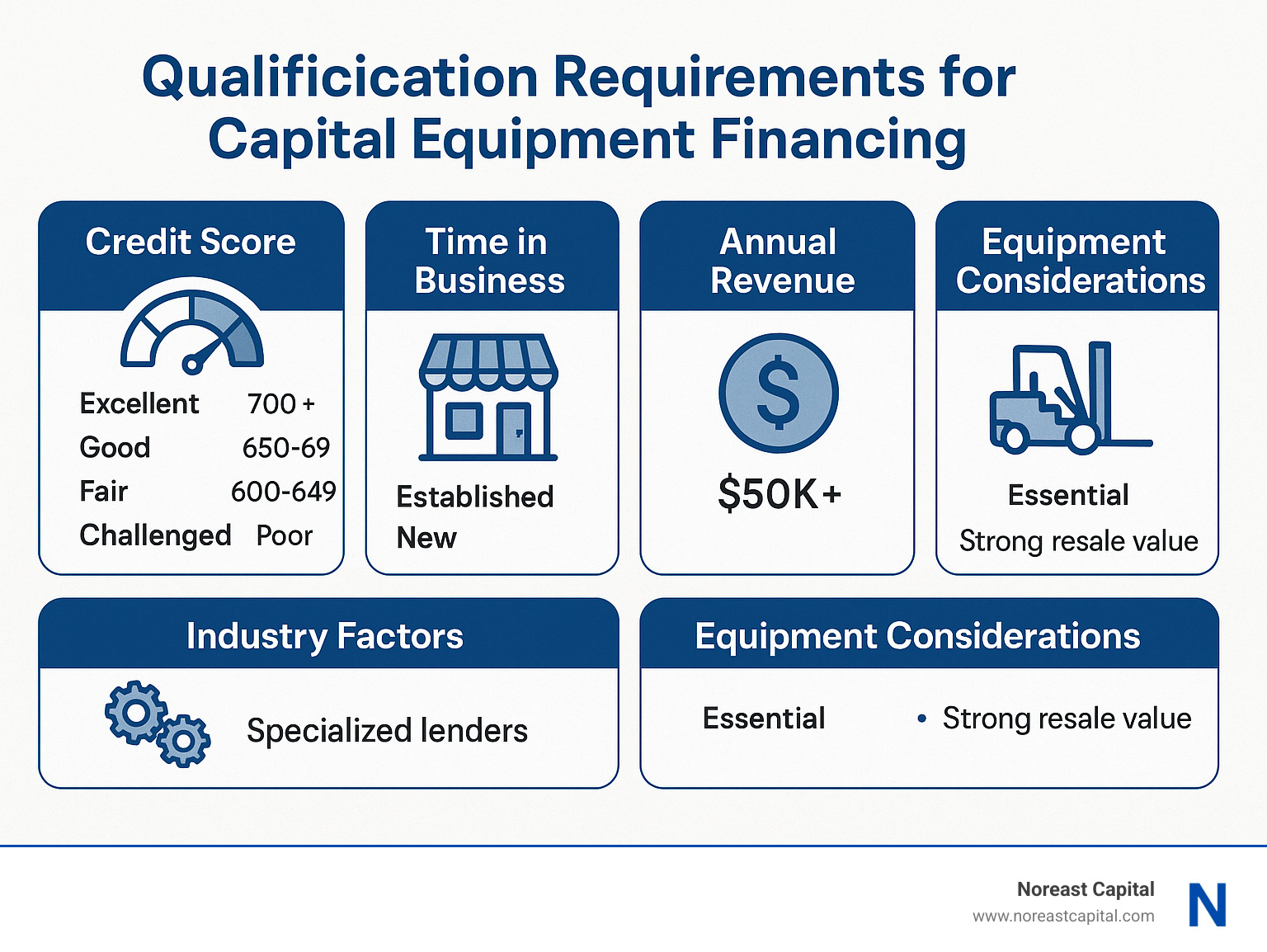
Lenders evaluate several key factors when considering equipment financing applications:
1. Credit Score Requirements
– Excellent (700+): Best rates (4-8%), highest approval odds, minimal documentation
– Good (650-699): Competitive rates (8-12%), strong approval odds, standard documentation
– Fair (600-649): Higher rates (12-16%), moderate approval odds, additional documentation may be required
– Challenged (550-599): Higher rates (16-20%), lower approval odds, higher down payments, additional documentation required
– Poor (below 550): May require substantial down payment (25-30%) or cosigner
2. Time in Business
– Established (2+ years): Preferred by most lenders, best terms available
– Early-stage (1-2 years): Many financing options, though rates may be higher
– Startups (under 1 year): Limited options, higher rates, larger down payments
3. Annual Revenue
– Most lenders look for minimum annual revenue of $50,000+
– Higher financing amounts typically require proportionally higher revenue
4. Industry Factors
– Some industries (construction, transportation, medical) have specialized lenders
– High-risk industries may face stricter requirements
5. Equipment Considerations
– Essential, revenue-generating equipment is easier to finance
– Equipment with strong resale value improves terms
– New equipment typically qualifies for better rates than used
Capital Equipment Financing Application Checklist
For the smoothest application process, prepare these documents in advance:
Basic Application (Required for All):
– Completed application form
– Business and personal contact information
– Federal Tax ID (EIN)
– Business entity type and formation date
For Amounts Under $250,000 (Application-Only):
– Equipment quote/invoice from vendor
– Bank account information for funding
For Amounts Over $250,000 (Additional Documentation):
– Last 2-3 months of business bank statements
– Most recent business tax returns (1-2 years)
– Financial statements (P&L and balance sheet)
– Business debt schedule
– Equipment specifications and vendor information
Tips for Application Success:
1. Address any known credit issues upfront with a brief explanation
2. Include a simple business overview highlighting growth and stability
3. Explain specifically how the equipment will generate revenue
4. Provide detailed equipment specifications and vendor information
5. Be prepared to show cash reserves for down payment if required
Interest Rates, Terms & Funding Speed
Understanding the financial aspects of capital equipment financing helps you budget appropriately and evaluate offers:
Interest Rates & Factor Rates:
– Traditional Interest Rates: 4-20% based on credit profile, equipment type, and term length
– Factor Rates: Sometimes used for shorter-term financing, expressed as a multiplier (e.g., 1.15 means you’ll repay 115% of the financed amount)
Typical Term Lengths:
– Technology/Software: 2-3 years
– Medical Equipment: 3-5 years
– Vehicles/Transportation: 3-7 years
– Heavy Machinery: 5-7 years
– Long-lived Assets: Up to 10 years
Down Payment Requirements:
– Strong credit: 0-10% down
– Average credit: 10-15% down
– Challenged credit: 15-30% down
Funding Timeline:
– Application review: Same-day to 48 hours
– Approval decision: 24-72 hours
– Documentation: 1-2 days
– Funding to vendor: 1-3 days after signed documents
– Total timeline: As fast as 24 hours for simple transactions, 5-7 days for complex deals
At Noreast Capital, we’ve streamlined our application process to minimize paperwork and maximize speed, with many clients receiving same-day decisions and funding within 48 hours of application submission.
Tax Implications & 2024 Law Changes You Must Know

Let’s talk about something that might not be the most exciting topic but could save your business thousands of dollars: the tax benefits of capital equipment financing. With recent changes to tax laws and more on the horizon, understanding these implications isn’t just helpful—it’s essential for your bottom line.
Section 179 & Bonus Depreciation Strategies
Here’s the good news: Section 179 allows your business to deduct the full purchase price of qualifying equipment in the year you start using it, rather than slowly depreciating it over many years. Think of it as an immediate tax break that significantly reduces your effective equipment cost.
For 2024, you can deduct up to $1,160,000 under Section 179. This deduction begins to phase out when your equipment purchases exceed $2,890,000, so timing your acquisitions matters. Both new and used equipment qualify, as long as you’re using it for business at least 50% of the time.
Meanwhile, bonus depreciation is on a gradual decline. In 2023, it was at 80%, but for 2024, it’s dropped to 60%. This percentage will continue to decrease annually: 40% in 2025, 20% in 2026, and completely gone by 2027 unless Congress extends it.
When deciding between Section 179 and bonus depreciation, Section 179 is something you choose to take, while bonus depreciation happens automatically (unless you opt out). Also, Section 179 can’t exceed your business income, while bonus depreciation can actually create a loss—which might be beneficial depending on your tax situation.
As I tell my clients at Noreast Capital, “If you’re planning major equipment purchases in the next few years, sooner is definitely better than later from a tax perspective.”
Lease Accounting Under ASC 842
The accounting world got a shake-up with ASC 842, changing how leases appear on financial statements. If you’re concerned about how financing impacts your balance sheet, this is important to understand.
Under these rules, most leases now show up on your balance sheet as right-of-use (ROU) assets with corresponding lease liabilities. The old advantage of keeping operating leases off your balance sheet has largely disappeared.
The rules now distinguish between finance leases (similar to what we used to call capital leases) and operating leases, with different ways of recognizing expenses. Finance leases split costs between interest and amortization, while operating leases typically spread costs evenly over the term.
This change means the accounting differences between leases and loans have narrowed. Your financial ratios might look different now, which could affect debt covenants with lenders. It’s worth reviewing your financing strategy with this in mind.
TCJA Sunset & IRA Clean-Energy Incentives
Two major pieces of legislation are creating both urgency and opportunity in the equipment financing world.
The Tax Cuts and Jobs Act (TCJA) has several business provisions scheduled to expire after 2025. This includes potential changes to business interest deduction limitations and possibly even tax rates. This uncertainty makes strategic planning more important than ever.
On the brighter side, the Inflation Reduction Act (IRA) created exciting incentives for clean-energy equipment. If you’re considering electric vehicles, charging infrastructure, or renewable energy equipment, you might qualify for improved tax credits. There are even manufacturing credits available if you produce clean energy components.
What makes this particularly interesting is that some of these credits can now be transferred, creating flexible financing opportunities that weren’t available before. For businesses in the Baltimore, Washington DC, and Annapolis areas, these incentives can make upgrading to more efficient equipment significantly more affordable.
The intersection of these tax provisions with your equipment needs requires careful planning. At Noreast Capital, we regularly partner with our clients’ tax professionals to ensure they’re maximizing available benefits while maintaining compliance. The right strategy can turn a necessary expense into a powerful tax advantage.
For scientific research on Section 179 deductions and official guidance, the IRS Publication 946 provides comprehensive information straight from the source.
Optimizing Working Capital & Avoiding Costly Mistakes

Let’s talk about something that keeps many business owners up at night – cash flow. The beauty of capital equipment financing isn’t just getting that shiny new machine in your warehouse; it’s about what it does for your overall financial health. Think of it as both getting the equipment you need AND keeping your financial flexibility intact.
How Financing Boosts Cash Flow
When you finance equipment instead of emptying your bank account to buy it outright, magic happens with your working capital.
First, you preserve your hard-earned liquidity for day-to-day operations. That means you’ve still got cash on hand for inventory, making payroll, launching that marketing campaign you’ve been planning, or handling those surprise expenses that always seem to pop up at the worst possible time.
You can also structure your financing to match when your business actually makes money. This is a game-changer for many of our clients. If you run a landscaping business with busy summers and quiet winters, why not set up seasonal payments that are higher in July and lower in January? Or if you’re just starting to use new equipment, step-up payments begin lower and increase as the equipment helps you generate more revenue.
I recently worked with a bakery owner who was hesitant to upgrade her industrial mixers because of the upfront cost. We arranged financing with a 60-day deferred payment plan, which gave her time to install the equipment, train her staff, and start producing more product before the first payment came due. Her cash flow remained positive throughout the transition.
Already own equipment outright? Consider a sale-leaseback arrangement to open up that capital. You sell your existing equipment to a financing company like Noreast Capital, then lease it back with regular payments. Meanwhile, you get a lump sum of cash that you can put to work growing your business immediately.
The real power move is reinvesting your preserved capital in high-ROI activities. While your financed equipment steadily pays for itself through increased production, the cash you didn’t spend upfront can be working hard elsewhere – perhaps funding a marketing push that brings in new customers, developing a new product line, or hiring that sales superstar you’ve had your eye on.
Common Mistakes to Avoid
After helping hundreds of businesses with their equipment financing, I’ve seen some patterns emerge. Here are the pitfalls I most often help clients steer around:
Focusing solely on monthly payment is probably the most common mistake. That attractively low payment might look good on paper, but what about the total cost over time? I always encourage clients to look at the complete picture – interest rates, term length, and any end-of-term obligations. Sometimes a slightly higher monthly payment actually saves thousands in the long run.
Mismatching equipment life and financing term can create serious headaches. Financing computer equipment for five years when it’s likely to be obsolete in three? You’ll be making payments on outdated technology. Conversely, choosing too short a term for heavy machinery can strain your cash flow unnecessarily. The sweet spot is aligning your financing term with how long the equipment will actively generate revenue.
Hidden fees can turn a good deal sour quickly. Documentation fees, origination charges, UCC filing fees, early payoff penalties – these can add up fast if you’re not careful. I always provide a complete breakdown of every cost involved so there are no surprises.
Many businesses forget about adequate equipment insurance, which is typically required by financing agreements. If you don’t maintain proper coverage, the lender might force-place expensive insurance on your behalf – at a much higher cost than you’d pay on your own.
And finally, ignoring end-of-term obligations can lead to unexpected costs. Whether it’s notification deadlines for lease renewal, return requirements, or balloon payments, knowing what happens when your term ends is crucial for proper planning.
Choosing the Right Financing Partner
The partner you choose for your capital equipment financing can make all the difference in your experience and outcomes. Here’s what to look for:
Industry expertise matters tremendously. A partner who understands your specific equipment and industry can structure a deal that truly works for your business model. When you’re explaining why you need that specialized CNC machine or medical imaging equipment, you want someone who gets it.
Transparency should be non-negotiable. All terms, costs, and obligations should be clearly explained upfront. At Noreast Capital, we believe in complete clarity – you should know exactly what you’re getting into and what it will cost.
Flexibility in structuring terms that match your business cycle can transform a good financing arrangement into a great one. Your financing should work with your business, not against it.
Service speed becomes critical when you’re trying to capitalize on time-sensitive opportunities. Sometimes waiting weeks for approval means missing out on the perfect piece of equipment or a vendor discount.
Above all, look for a relationship focus rather than a transactional approach. The best financing partners are interested in your long-term success because they want to finance your next piece of equipment too.
At Noreast Capital, we’ve built our reputation on being that kind of partner for businesses throughout Maryland and the Washington DC area. We take the time to understand your complete financial picture and growth objectives, which allows us to structure solutions that truly support where you want to go – not just where you are today.
More info about How to Finance Heavy Equipment
Frequently Asked Questions about Capital Equipment Financing
Let’s face it – when you’re considering capital equipment financing, questions pop up. I’ve heard them all, from startups wondering if they qualify to established businesses concerned about funding speed. Here are straightforward answers to the questions we hear most often at Noreast Capital:
Can Startups Get Capital Equipment Financing?
Yes! While startups face a steeper climb, equipment financing is absolutely possible for new businesses.
The reality is that without established business credit, lenders look more closely at your personal credit score – typically wanting to see 650+ for reasonable terms. You’ll likely need to put more skin in the game with down payments between 15-30% for businesses under a year old.
I’ve worked with many startups who found success by bringing a cosigner on board. Having an established business or individual backing your application can dramatically improve your terms and approval odds.
What equipment you’re financing matters too. Essential equipment that clearly generates revenue and holds resale value (like medical devices or construction equipment) is much easier to finance than specialized or custom machinery.
Don’t be surprised if lenders ask for your business plan and revenue projections. They’re simply trying to understand how this equipment fits into your growth strategy and how you’ll generate the cash flow to make payments.
How Fast Can I Be Approved & Funded?
Need equipment yesterday? I understand that timing often matters as much as the financing itself.
For smaller deals (typically under $250,000), we often provide same-day approval decisions with minimal paperwork through our application-only process. Once you sign the documents, funding typically happens within 24-48 hours – meaning your vendor gets paid and you get your equipment quickly.
Larger transactions over $250,000 naturally require more scrutiny. These typically take 2-5 business days for approval and another 5-7 business days to fund after approval. The extra time comes from the additional documentation and deeper underwriting these larger deals require.
Your responsiveness makes a huge difference in timing. When clients promptly provide requested documents and quickly return signed agreements, we can often shave days off the process. I’ve seen deals fund in under 24 hours when everything aligns perfectly!
Can I Finance Used or Refurbished Equipment?
Absolutely! Used equipment financing can be a smart strategy to maximize your budget. However, there are some important considerations to keep in mind.
Most lenders set age limits, typically capping equipment age at 10-15 years depending on the type. Construction equipment often has more flexibility than technology, for instance. The equipment needs to be in good working condition with reasonable useful life remaining – lenders won’t finance equipment on its last legs.
For older or specialized used equipment, lenders might require an independent appraisal to confirm value. Financing terms for used equipment are typically shorter than for new, and interest rates might be slightly higher to offset the increased risk.
One tip I share with clients: having service records and maintenance history documentation significantly improves your approval odds and might even help secure better terms.
What Fees Should I Expect with Equipment Financing?
Nobody likes surprises when it comes to fees. While specific fee structures vary between lenders, here’s what you might encounter:
Most lenders charge an origination fee (typically 0-3% of the financed amount) and a documentation fee ($75-$500 depending on complexity). There’s also usually a UCC filing fee ($25-$100) that covers the lender registering their security interest in the equipment.
For larger or specialized equipment, you might encounter site inspection fees. Some agreements include early payoff fees (1-5% of remaining balance) if you pay before a specified time, and various administrative fees for lease conclusion.
My best advice? Ask for complete fee disclosure upfront. At Noreast Capital, we believe in transparency and often waive certain fees for qualified borrowers or larger transactions. Always consider the total cost of financing, not just the interest rate, when comparing options.
How Does Equipment Financing Affect My Business Credit?
Capital equipment financing can actually help build your business credit profile when managed properly. Timely payments create positive payment history that strengthens your business credit scores.
That not all equipment financing companies report to all business credit bureaus, so if building credit is a primary goal, ask about their reporting practices.
Multiple financing applications can trigger credit inquiries, though equipment financing inquiries within a short period (14-30 days) typically count as one for scoring purposes. The financing structure you choose also affects how the debt appears on your financial statements, which can impact future borrowing capacity.
I’ve seen many businesses use their positive equipment financing history as a stepping stone to larger financing amounts and better terms for future equipment needs. It’s one of the hidden benefits of choosing the right financing partner from the start.
Conclusion
Capital equipment financing isn’t just another way to acquire business assets—it’s a powerful growth strategy that can transform your company’s trajectory. When you spread equipment costs over time while putting those assets to work immediately, you create a perfect formula for sustainable expansion without sacrificing cash flow.
Throughout this guide, we’ve explored how the right financing approach can become your competitive advantage. Let’s recap what we’ve learned:
The strategic value of equipment financing extends far beyond simple convenience. By preserving your working capital while gaining immediate access to revenue-generating equipment, you position your business to pursue multiple growth initiatives simultaneously. This financial flexibility can be the difference between steady growth and explosive expansion.
Your choice between loans and leases has significant implications for ownership, tax treatment, and balance sheet impact. Neither option is universally superior—the right structure depends on your specific business goals, cash flow patterns, and equipment lifecycle needs.
Financing options exist for businesses at every stage, from startups to established enterprises. While your credit profile, time in business, and revenue will influence terms and rates, a knowledgeable financing partner can help steer these factors to secure appropriate funding.
The tax landscape continues to evolve, with Section 179 deductions, changing bonus depreciation schedules, and clean energy incentives creating both opportunities and timing considerations. Staying informed about these changes ensures you maximize available benefits while maintaining compliance.
Perhaps most importantly, properly structured equipment financing aligns your payment obligations with your revenue generation, creating a positive cash flow impact from day one. This synchronized approach to financing transforms what could be a financial burden into a growth catalyst.
At Noreast Capital, we’ve spent years helping businesses throughout Maryland and the Washington DC area leverage capital equipment financing to achieve their growth objectives. We understand that each business has unique needs and challenges—which is why we take a personalized approach rather than offering cookie-cutter solutions.
Whether you’re expanding your construction fleet in Baltimore, upgrading medical equipment in Annapolis, or investing in new technology infrastructure in Washington DC, we’re here to help you structure financing that supports your strategic goals.
Ready to explore how capital equipment financing can fuel your business growth while optimizing cash flow? Contact our team today for a friendly, no-pressure consultation and a customized equipment financing quote custom to your specific needs.