

Why Laundromat Equipment Financing Opens Doors for Smart Business Owners
Laundromat equipment financing offers business owners a path to launch or upgrade their operations without draining their cash reserves. Instead of paying $200,000-$500,000 upfront for commercial washers and dryers, you can spread costs over 3-7 years while preserving working capital for rent, utilities, and unexpected expenses.
Quick Answer: Your Main Laundromat Equipment Financing Options
- Equipment Loans – Finance 80-100% of equipment cost, own at the end
- Equipment Leasing – Lower monthly payments, upgrade flexibility, tax benefits
- SBA 7(a) Loans – Government-backed, 10% down, up to 10-year terms
- Vendor Financing – Promotional rates from manufacturers like Speed Queen, Huebsch
- Alternative Lenders – Fast approval for startups, higher rates but flexible terms
The laundromat industry serves a crucial need – with approximately 30,000 self-serve laundromats operating across the United States, these businesses provide essential services while generating steady cash flow. However, the biggest barrier for new owners remains the substantial upfront investment in commercial-grade equipment.
Modern high-efficiency washers and dryers can cost $3,000-$15,000 per unit. A typical 2,000-square-foot laundromat needs 20-30 machines, pushing total equipment costs well into six figures. This is where smart financing becomes essential – it transforms an impossible cash requirement into manageable monthly payments.
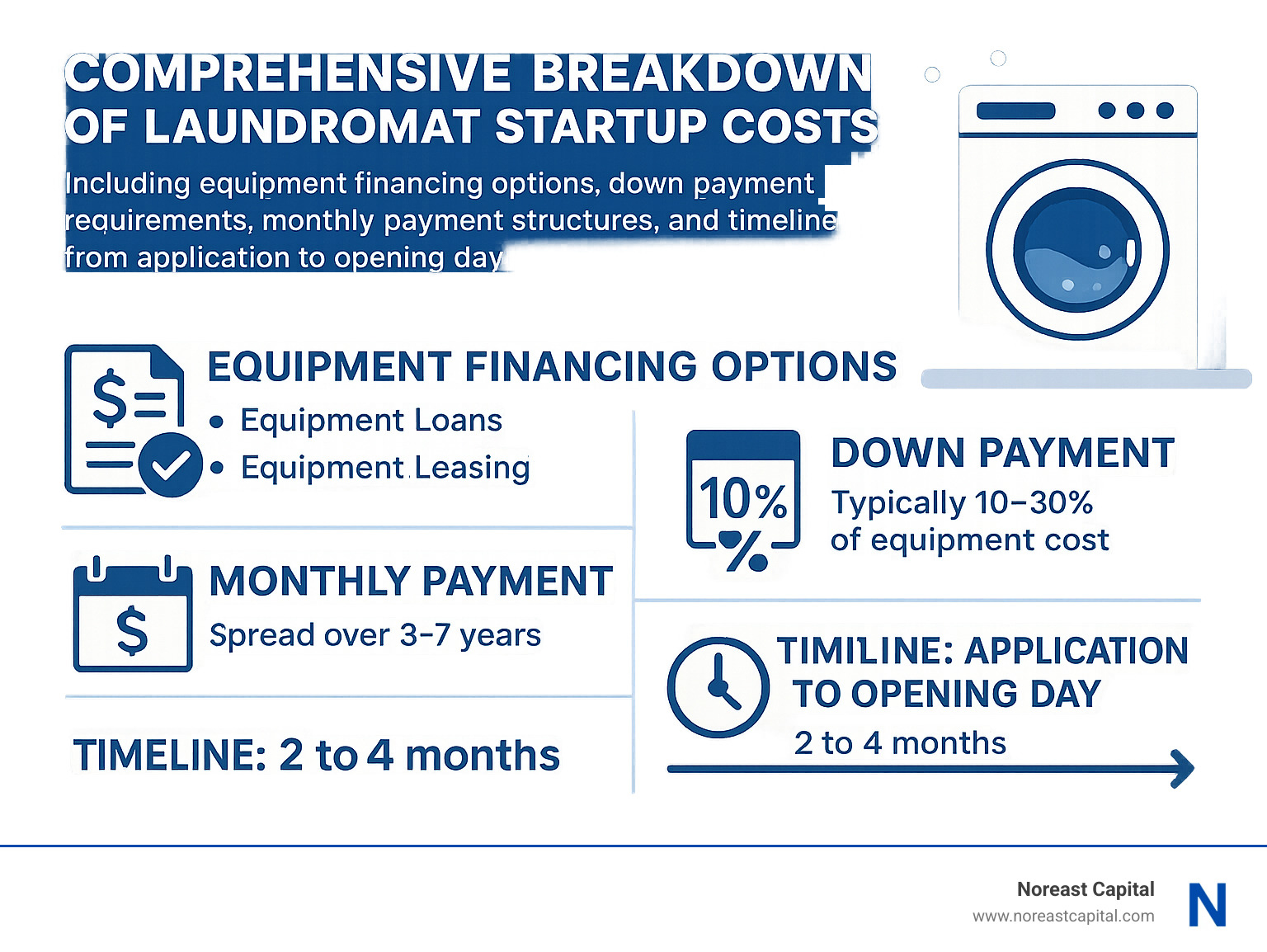
Must-know laundromat equipment financing terms:
– asset based equipment financing
– capital equipment financing
– equipment financing online
What Is Laundromat Equipment Financing & Why It Matters
Laundromat equipment financing lets you own a profitable business without emptying your bank account. Instead of writing a massive check for commercial washers and dryers, you spread the cost over several years while keeping cash available for other expenses.
Term loans let you own equipment immediately while making monthly payments. Equipment leases offer lower payments with upgrade flexibility. SBA 7(a) programs provide government-backed funding with attractive terms, while vendor financing programs often include promotional rates.
What sets laundromat financing apart? The equipment serves as collateral, making lenders more comfortable offering competitive rates. Plus, laundromats generate predictable cash flow – people always need clean clothes.
Definition and Mechanics of Laundromat Equipment Financing
Laundromat equipment financing works on a simple principle: the equipment you’re buying secures the loan. When you finance $150,000 in commercial washers and dryers, those machines become collateral until you’ve paid off the debt.
You’ll encounter both fixed and variable rates. Fixed rates lock in your payment amount for the entire loan term – usually 6-12% depending on your credit score. Variable rates typically start lower but can adjust over time.
Ownership transfer happens immediately with equipment loans. The moment you sign the paperwork, those machines belong to you. This means you can take advantage of tax benefits like depreciation and Section 179 deductions right from day one.
Laundromat Equipment Financing vs Self-Funding: Cash-Flow Impact
Smart business owners choose financing over paying cash for capital preservation. When you finance equipment, you keep cash in the bank for unexpected expenses.
Picture this: You’ve saved $300,000 to open your laundromat. If you spend it all on equipment, you’re left with zero working capital. Instead, finance 80% of equipment costs and put down just $60,000. Now you have $240,000 in working capital.
More info about Easy Equipment Financing explains how preserving working capital creates more opportunities than depleting your cash reserves.
Leasing vs Owning: Quick Primer
An operating lease works like a long-term rental – you make monthly payments without owning the equipment. At lease end, you return equipment, upgrade, or buy at fair market value.
A capital lease is basically a loan in disguise. You make payments over the lease term, and ownership transfers to you at the end for a small fee.
Residual value plays a huge role in lease pricing. This is what the leasing company expects the equipment to be worth at lease end. Higher residual values mean lower monthly payments.
| Factor | Equipment Lease | Equipment Purchase |
|---|---|---|
| Monthly Payment | Lower | Higher |
| Down Payment | Often $0 | 10-30% typical |
| Tax Benefits | Lease payments deductible | Depreciation + Section 179 |
| End of Term | Return/upgrade/buy | Own outright |
| Total Cost | Higher over time | Lower total cost |
Equipment Financing vs Leasing: Which is Best for Your Business? helps you choose the right structure for your situation.
Comparing Your Financing Options
When financing your laundromat equipment, you’ll find diverse options from fast online lenders to traditional banks. The key is matching your specific situation to the right financing source.
Loans & SBA Programs
SBA 7(a) loans are versatile and government-backed. These loans can stretch up to 25 years for real estate and 10 years for equipment. The government guarantees 75-85% of the loan amount, which translates into rates typically 2-3% lower than conventional financing. For full program details, visit the official SBA 7(a) Loan Program page.
Most lenders want credit scores of at least 640, and you’ll need about 10% down. The application takes 30-60 days, but the terms dramatically improve your cash flow.
SBA 504 programs provide up to 90% financing through a three-way split: a bank covers 50%, the SBA provides 40%, and you contribute 10% equity.
Equipment Leasing & Sale-Leaseback
With an operating lease, monthly payments stay off your balance sheet, and you can deduct every penny as a business expense. Finance leases work like loans with lower monthly payments but equipment shows on your balance sheet.
The fair-market value buyout option keeps choices open. When your lease ends, you can return equipment, upgrade, or buy at current market value.
More info about Equipment Lease Agreement helps you understand which lease structure makes sense for your situation.
Vendor & Manufacturer Promotions
Manufacturers regularly offer financing deals that beat traditional lenders. You might see promotional programs offering rates as low as 4.75% for the first year, 90-day payment deferrals, no security deposits and no prepayment penalties.

Marketplace & Alternative Funding
Online lending marketplaces connect you with 75+ lenders at once. Revenue-based financing focuses on your business cash flow rather than credit scores. Business lines of credit work like credit cards for your business—you only pay interest on what you use.
The trade-off with alternative lending is speed versus cost. You can get approved within 24-48 hours, but typically pay 2-5% more than traditional financing.
Qualifying & Applying for Laundromat Equipment Financing
Getting approved for laundromat equipment financing varies by lender type. Online lenders might approve you with credit scores as low as 500. Traditional banks usually want 680 or higher. SBA lenders typically look for scores around 640.
Your Debt Service Coverage Ratio (DSCR) measures whether your business generates enough cash flow to handle loan payments. Most lenders want to see a DSCR of 1.25 or higher.
Minimum Requirements for Laundromat Equipment Financing
For most laundromat equipment financing programs, you’ll need a minimum credit score of 600. Lenders typically want 3-12 months of bank statements to understand your cash flow patterns.
Business plans become crucial for startups. Show lenders you understand your market, competition, and have realistic revenue projections.
Documentation includes personal and business tax returns from 2-3 years, recent financial statements, business license, equipment quotes, and lease agreements.
The Step-By-Step Application Timeline
For equipment purchases under $100,000, many lenders use one-page applications. Credit decisions typically happen within 24-48 hours. Once approved, funding usually occurs within 48-72 hours.
How Does Equipment Leasing Work? walks you through the entire process from application to equipment delivery.
Hidden Costs, Fees & Penalties to Watch
Administrative fees typically run about 0.5% of your financed amount with a $500 minimum. Origination fees vary by lender – some charge 1-3%, others don’t charge them at all.
Good news: prepayment penalties have mostly disappeared from equipment financing programs. Most lenders let you pay off loans early without penalty.

Maximizing ROI & Avoiding Common Mistakes
Getting the most from your laundromat equipment financing goes beyond securing funds. Smart tax planning and cash flow management dramatically improve your return on investment.
Section 179 deductions let you immediately expense up to $1,160,000 (2023 limit) in qualified equipment purchases. This means you can slash your current-year tax bill while building your business.
These deductions apply to the full purchase price of financed equipment, not just your down payment. Finance $200,000 in equipment with $20,000 down, and you can still claim the entire $200,000 Section 179 deduction.
Well-located laundromats consistently generate 15-25% annual returns on invested capital. Modern high-efficiency equipment pays for itself through reduced operating costs – today’s machines use 30-50% less water and energy than older models.
Tax Advantages & Accounting Tips
Section 179 expensing provides immediate tax relief. Buy $100,000 in equipment and potentially deduct the full amount from taxable income. If you’re in a 25% tax bracket, that’s $25,000 in tax savings.
Bonus depreciation kicks in when equipment purchases exceed Section 179 limits. Lease payments offer different advantages – they’re fully deductible as business expenses.
Top Benefits of Equipment Leasing for Small Businesses dives deeper into optimizing your tax strategy.
Cash-Flow Strategies & Payment Structures
Step-down leases start with higher payments that decrease over time. Seasonal payment structures work for locations like college towns. 90-day payment deferrals provide crucial breathing room during startup.

Pitfalls to Avoid When Financing Laundry Equipment
Over-leveraging tops the list of costly mistakes. While 100% financing sounds attractive, maintaining equity cushion protects against unexpected changes.
Top 5 Financing Mistakes to Avoid:
- Financing 100% without cash reserves – Keep working capital for unexpected expenses
- Choosing the lowest payment without considering total cost – Longer terms mean more interest
- Ignoring insurance requirements – Inadequate coverage can void financing agreements
- Not reading end-of-term lease conditions – Surprise charges can be substantial
- Failing to compare multiple offers – Rate differences compound over time
Frequently Asked Questions about Laundromat Equipment Financing
What credit score do I need to qualify?
Online lenders work with credit scores as low as 500, though you’ll pay higher rates. If your score sits around 600, you’ll access business lines of credit and equipment leasing programs.
SBA loans typically require 640+ credit scores with government backing and competitive rates. Traditional banks usually want 680 or higher for the lowest rates.
Your personal credit score matters even for business financing since most lenders require personal guarantees. A 50-point credit score improvement might save you 2-3% in interest rates.
How much down payment or equity is typical?
Equipment leases often require zero down payment. Equipment loans typically ask for 10-20% down, though this can drop to zero for well-qualified borrowers. SBA loans generally stick to their 10% equity contribution requirement.
Vendor financing programs frequently offer promotional terms with no down payment required. Larger down payments usually open up better rates and terms, but don’t drain your cash reserves completely.
Can a startup laundromat get approved?
Absolutely. Vendor financing programs often welcome startups, especially when you combine equipment purchases with solid business plans. Alternative lenders specialize in startup financing, though you’ll typically pay higher rates.
SBA loans can work beautifully for startups with strong personal credit and industry experience. Success factors include strong personal credit (640+ preferred), relevant experience, and comprehensive business plans with realistic projections.
Conclusion
Starting a laundromat doesn’t mean emptying your bank account. Laundromat equipment financing opens doors that might otherwise stay locked while you save hundreds of thousands in cash.
Your customers need clean clothes every week, whether you paid cash for machines or financed them. The revenue stays the same, but financing lets you keep working capital for unexpected repairs or slow months.
Well-located laundromats often generate equipment ROI exceeding 20% annually. When you can borrow at 6-10% and earn 20%+ returns, financing becomes smart leverage rather than necessity.
Fast approvals mean you won’t lose that perfect location while waiting months for decisions. Many clients get credit decisions within 24 hours and equipment delivered within a week of approval.
Flexible terms adapt to your situation. Maybe you’re a startup needing 90-day payment deferrals or an experienced operator wanting energy-efficient machines that’ll cut utility costs by 40%.
The laundromat industry has weathered every economic storm because people always need clean clothes. That stability makes laundromat equipment financing one of the safer bets in small business lending.
Modern high-efficiency machines attract customers with faster cycles while slashing operating costs through reduced water and energy consumption. Those savings often cover significant portions of financing payments.
More info about Business Equipment Leasing shows how our financing solutions align with your business timeline and growth plans.

Ready to spin your financing worries into success? Contact our equipment financing specialists today. We’ll structure a solution that fits your laundromat investment like a perfectly balanced load.